
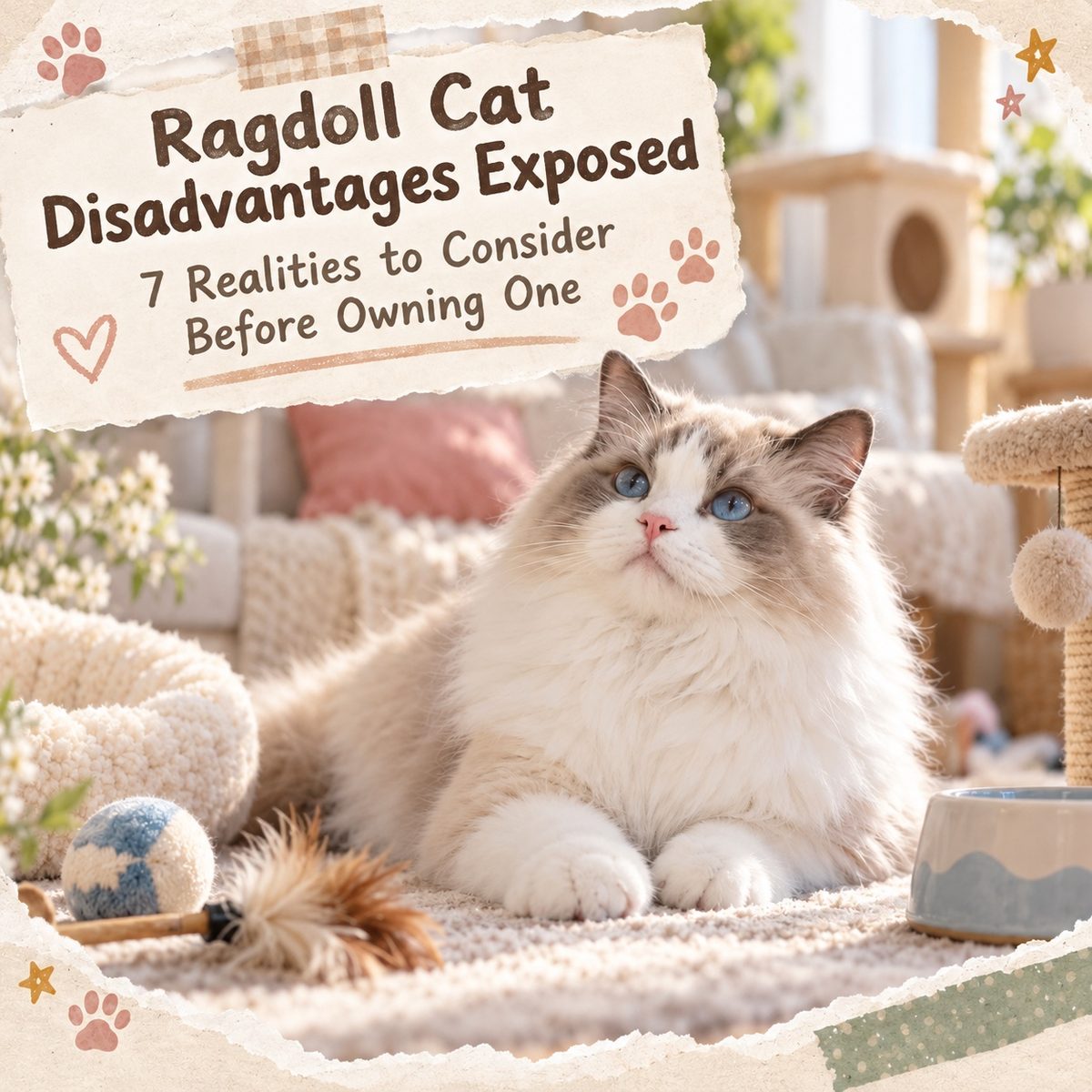
Quick answer: The real downsides of a Ragdoll come down to eight: the long coat needs work, heavy shedding, a big appetite and big bills, clinginess that can tip into separation anxiety, no sense of danger, HCM/PKD genetic risk, a long growth period, and heat sensitivity. Each has a fix, but only if you know about it and are willing to do it — this article is here to show you the full bill before you take a cat home.
Want the full picture on Ragdolls? Start with the Ragdoll breed profile and the complete Ragdoll guide.
What kind of cat is a Ragdoll? The key points in 30 seconds
The Ragdoll originated in California and is a semi-long-haired large cat, famous for going limp like a rag doll when picked up. The table below covers the specs Hong Kong owners look up most; later sections break down prices, owner matching and common misconceptions.
| Item | Ragdoll |
|---|---|
| Origin | California, USA (1960s) |
| Average lifespan | 12–15 years (up to 17 indoors) |
| Weight | Male 5–8 kg / female 4–6 kg |
| Coat | Silky semi-long hair, little undercoat, mats less than a Persian |
| Eyes | Blue (fixed breed trait) |
| Temperament | Gentle, tolerant, extremely people-oriented; nicknamed the "puppy cat" |
| Maturity | Fully grown only at 3–4 years |
| Heat sensitivity | High (thick coat plus low activity) |
| Hong Kong price | About HK$15,000–30,000 |
| Basic monthly cost | About HK$1,100–1,900 |
Three things you must know:
- Easy to keep does not mean cheap to keep — the temperament is the easiest of the lot, but daily brushing is non-negotiable.
- No sense of danger = you build the safety — they don't avoid hazards, so window screens and door locks throughout the flat are essentials.
- An especially long growth period — fully grown only at 3–4 years, so rearing costs stretch out.
In one line: the Ragdoll trades its sweet temperament for your daily brushing time and a slightly higher food bill. If you can accept that, it is the safest long-haired choice for a beginner.
Ragdoll prices and monthly costs (2026 Hong Kong rates)
The price is only the entry fee. The table below shows real 2026 Hong Kong ranges; ask about every line before you put down a deposit.
| Item | Range | Notes |
|---|---|---|
| Registered cattery | HK$15,000–30,000 | Pedigree certificate, parents' HCM/PKD screening records |
| Licensed pet shop | HK$10,000–20,000 | Quality varies widely; check the vaccination card yourself |
| Adoption | HK$0–2,000 | Usually already neutered and vaccinated |
| Vaccines (first year, 3 shots) | HK$900–1,500 | Annual booster after that |
| Neutering | HK$1,800–3,500 | Cheaper for males, more for females |
| Monthly food | HK$450–800 | A large cat, eats more than the average house cat |
| Monthly cat litter | HK$180–320 | Big body, higher usage |
| Monthly grooming/brushing supplies | HK$100–300 | Comb, de-matting comb, professional grooming |
| Monthly deworming (spread out) | HK$90–160 | Dosed by weight |
| Medical reserve (recommended) | HK$300–600 | Heart ultrasound, kidney screening |
| Monthly total | About HK$1,100–1,900 | Excludes major medical costs |
Budget for 1.3–1.5 times a short-haired cat. Not every clinic can do a heart ultrasound and you may need a specialist referral at about HK$1,800–3,000 per scan, so plan ahead.
Three practical savings:
- Brush for 5–10 minutes yourself every day and save HK$100–300 a month on professional grooming.
- Do vaccines and deworming at the same veterinarian; packages are usually about 10% cheaper.
- Buy cat litter in large packs to save HK$40–70 a month long term.
Who is a Ragdoll suited to?
| Owner type | Suitability | Why |
|---|---|---|
| First-time cat families | Very suitable | Tolerant, friendly with children and other pets |
| Someone home at set times | Suitable | High need for company; stable when someone responds |
| Willing to brush daily | Suitable | Brushing is non-negotiable; do it and there's no difficulty |
| Out early, back late, almost never home | Not recommended | Prone to separation anxiety, may stop eating or urinate inappropriately |
| Wants an independent, aloof cat | Not recommended | The Ragdoll is the opposite — it wants to stick to you |
Reverse self-test (three questions):
- Can you spare 5–10 minutes a day for brushing, all year round without fail?
- When you travel, can you find a reliable cat sitter or boarding place?
- Are you willing to budget 1.3–1.5 times a short-haired cat each month, plus a medical reserve?
If you answer "no" to two of the three, the eight costs of a Ragdoll will weigh especially heavy on you.
Ragdoll vs other long-haired breeds
| Breed | Weight (male) | Coat | Basic monthly cost | Beginner-friendly |
|---|---|---|---|---|
| Ragdoll | 5–8 kg | Silky semi-long | HK$1,100–1,900 | Yes (brushing required) |
| Maine Coon | 6–10 kg | Double semi-long | HK$1,300–2,300 | Needs time + budget |
| Persian | 3–6 kg | Long, thick undercoat | HK$1,200–2,000 | Not recommended (severe matting) |
| Norwegian Forest Cat | 5–8 kg | Double long | HK$1,200–2,000 | Yes |
| British Shorthair | 4–6 kg | Short | HK$700–1,300 | Yes |
In one line: for the easiest to live with, pick a Ragdoll; for the lowest maintenance, go straight to a British Shorthair. Among long-haired breeds, the monthly cost gap is mainly grooming and brushing supplies.
Four common Ragdoll misconceptions
| Misconception | Reality |
|---|---|
| Ragdolls feel no pain and can be held any way | Going limp is a relaxation response, not proof of no pain; poor handling still causes resistance and injury |
| Long hair means a grooming salon every day | 5–10 minutes of brushing yourself each day is enough; professional grooming can be once every month or two |
| Ragdolls are always quiet and never meow | They don't meow much, but will meow frequently when hungry or lonely |
| Purebred means no HCM | Carrying the gene is not the same as developing disease, but parental screening records cut the risk sharply — don't judge by price |
Of these four, the most practical is "parents' screening records": buying a cheap cat with no screening is the real high-risk behaviour.
Ragdoll health check schedule: what to test and when
The three things to watch most in a Ragdoll are the heart (HCM), kidneys (PKD) and teeth. Not every clinic can do a heart ultrasound for this breed and a specialist referral may be needed, so allow slack in both time and budget:
| Age | Recommended | Approximate cost |
|---|---|---|
| 8–12 weeks | First vaccine + deworming + microchip | HK$800–1,500 |
| 4 months | Second and third vaccines | HK$600–1,000 |
| 6 months | Pre-neutering blood test + neutering | HK$2,500–4,500 |
| 1 year | Annual check-up + vaccine booster | HK$600–1,000 |
| 2–6 years | Annual check-up + heart auscultation + urine test | HK$700–1,400 |
| 7 years and over | Annual heart ultrasound + kidney check | HK$2,000–4,000 per visit |
Three daily observations (free but every day):
- Breathing rate: over 30 breaths a minute at rest may signal a heart problem or chest fluid.
- Water intake and urine output: a sudden big increase — rule out kidney problems first.
- Teeth and breath: Ragdolls are prone to tartar; bad breath usually means periodontal disease already.
- Weight: weigh monthly; a drop of more than 5% in a month means a vet visit.
Budget reminders:
- A heart ultrasound is about HK$1,800–3,000 per scan, and some cases need a specialist referral, so allow 2–4 weeks.
- Dental scaling is about HK$1,500–3,000, with a blood test before anaesthesia; from age 7, check tartar annually.
Genetic screening for a Ragdoll is not a one-off: HCM changes only show up with age, so an annual ultrasound in adulthood is the baseline, not an option.
Why read a downsides article before getting a Ragdoll
Most people searching "Ragdoll downsides" or "Ragdoll regret" have already seen a hundred cute posts. That is the right order: fall for the looks first, then assess the cost rationally. Ragdolls sit near the top of the cat popularity charts year after year, and both the Cat Fanciers' Association (CFA) and The International Cat Association (TICA) describe their temperament in highly consistent terms — gentle, relaxed, people-oriented. But under the "dream breed" label, the eight real costs are rarely laid out in full.
The eight downsides, one by one — and how to handle each
1. Long coat matting — skip brushing and it really does clump. The Ragdoll's coat is silky with little undercoat, so it mats less than a Persian, but the armpits, belly and tail feathers are the disaster zones. Fix: 5–10 minutes with a comb every day, double it in humid seasons.
2. Heavy shedding. In moulting season, clothes, the sofa and the dining table all being covered is normal. Fix: a fixed brushing slot to trap loose hair in the comb, plus a vacuum and air purifier, and make sure the diet has quality protein.
3. A bigger appetite and bigger bills than average. Ragdolls are a large breed, and adults generally weigh a good deal more than the average house cat, so food, cat litter and flea treatment (dosed by weight) all go up. Fix: budget 1.3–1.5 times a short-haired cat; see the table below for the numbers.
4. Over-clinginess and separation anxiety. Nicknamed the "puppy cat", a Ragdoll follows you into the kitchen and waits at the door for you; left alone for long, it may over-groom or urinate inappropriately. Fix: two 15-minute interaction slots a day, puzzle feeders before you go out; see a veterinarian if it is severe.
5. No sense of danger = high risk. Over-trusting of people and surroundings, with no instinct to avoid hazards. Fix: window screens throughout, make door locks a habit, and never let them roam loose.
6. Genetic screening must be taken seriously. The Ragdoll is a known HCM-prone breed, and PKD is also found in some lines. Fix: choose a cattery with ultrasound screening records for its breeding cats, and arrange annual heart checks in adulthood as your vet advises. Medical decisions rest with a registered veterinarian; this article does not diagnose.
7. A long growth period. Fully grown only at 3–4 years, with coat colour, weight and build all changing slowly, so the novelty phase of rearing costs stretches out. Fix: stage-appropriate kitten food and regular weight records to manage expectations.
8. Heat sensitivity. Thick coat plus low activity makes a Hong Kong summer a challenge. Fix: air-conditioning on a timer, water bowls in several spots, avoid direct sun at midday.
Downside × fix × cost direction: all in one table
| Downside | Fix | Cost/time direction |
|---|---|---|
| Long coat matting | Daily combing, regular professional grooming | About HK$100–300 a month on tools or grooming |
| Heavy shedding | Brush beforehand, keep a vacuum handy | One-off equipment spend |
| Big appetite | Measured feeding to prevent overweight | Food bill about 30–50% higher per month |
| Separation anxiety | Fixed company slots + puzzle toys | 30 minutes of time a day |
| No sense of danger | Window screens, door control, zero roaming | Window screens a one-off few hundred to a thousand dollars |
| HCM/PKD risk | Parental screening + annual heart check | A few hundred to over a thousand dollars a year in check reserves |
| Long growth period | Stage-based feeding and weight records | Monthly costs run longer through the rearing period |
| Heat sensitivity | Air-conditioning on a timer, cooling mat | Summer electricity share goes up |
The honest answer to "are Ragdolls easy to keep?"
In temperament, the Ragdoll is one of the most easy-going breeds around: tolerant, not as sensitive or nervous as some breeds, and with a generally good record of living with children and other pets, which is why it is always called a good cat for beginners. But "easy to keep" and "cheap to keep" are two different things — they trade their sweet temperament for your daily brushing time, a higher food bill, and a schedule tied to the cat (travel means finding a reliable cat sitter or boarding place). If you can accept all three, the Ragdoll's return on investment is among the highest of any breed.
Who should not get a Ragdoll
- People who realistically won't brush every day (three weeks without it and matting starts).
- Office workers out early and back late with almost no time at home.
- Budgets that only stretch to "cute photos" with no medical reserve.
- People who want an independent, aloof cat that entertains itself — the Ragdoll is the exact opposite.
By contrast, if you have time for company, can accept a few hundred dollars more a month, and are willing to do your homework on genetic screening, all eight downsides have a solution.
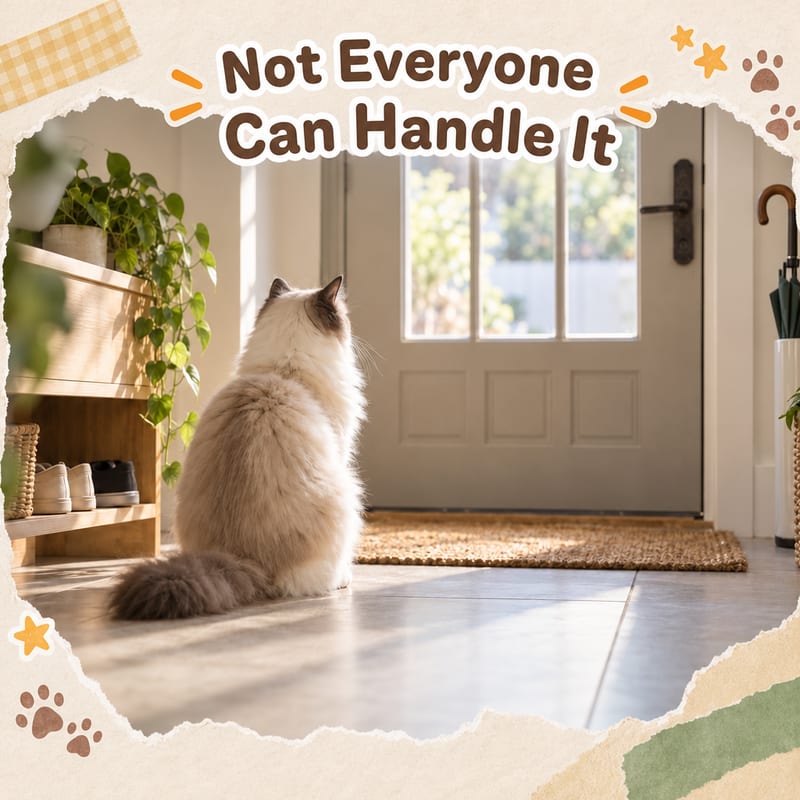
Five real scenarios: what the downsides look like day to day
To be fair, let's put the eight downsides into concrete scenes:
- Before leaving in the morning: you put on dark clothes and spend an extra three minutes picking off hair — shedding isn't a legend, it's a daily routine.
- Opening the door when you get home: a ten-kilo cat is waiting at the door, then follows you into the kitchen and into the bathroom — clinginess in its most literal form.
- A sudden three-day business trip: an ordinary short-haired cat may be fine with food and water left out; a Ragdoll needs a sitter arranged, and that's not an exaggeration — an anxious cat really will stop eating.
- Brushing day becomes bonding day: most enjoy being brushed, but resist when the armpits mat, so beginners need to learn to "work from the base of the knot out to the tip".
- The annual check-up: not every vet clinic can do a heart ultrasound and a specialist referral may be needed, so plan the time and cost before "something happens".
None of these scenarios are meant to scare you, but they all make the same point: the Ragdoll's downsides don't mean "you can't keep one", they mean "know in advance". Owners with full information naturally have a lower regret rate.
Key takeaways
- ✅ Eight downsides: matting, shedding, high costs, clinginess, no sense of danger, genetic risk, slow growth, heat sensitivity — all have a fix.
- ✅ The temperament is widely agreed to be easy-going, but "easy to keep" is not "cheap to keep"; daily brushing is non-negotiable.
- ✅ HCM/PKD parental screening + annual heart checks are the top priority before and after buying a cat.
- ✅ No sense of danger = window screens throughout + zero roaming; don't skimp on safety.
- ✅ Budget 1.3–1.5 times a short-haired cat, plus a monthly medical reserve.
- ✅ Regret mostly comes from lack of information; decide after reading this and you won't.
Related reading
- Ragdoll lifespan and how to extend it
- Ragdoll personality and intelligence explained
- Complete guide to Ragdoll prices and adoption
- Brushing, de-shedding and puzzle toys all in one place: see the long-haired cat comb range and puzzle feeders at PetChill pet supplies.
For the genetic conditions and medical arrangements mentioned in this article, consult a registered veterinarian for actual decisions; if behaviour problems persist, seek professional veterinary or cat behaviour support.
Further reading
- 8 real costs every Hong Kong cat owner should read →
- 8 truths to know before getting one in Hong Kong →
- Eight downsides and fixes every Hong Kong owner should read →
- Comparing 12 cat breeds by personality and price →
- Common diseases, preventive care and vet information →
- Cat ringworm →
- Cat vomit colour chart →
- Guide to cat ear mites →
- Complete guide to cat skin diseases →
 Fuji One full guide →





