
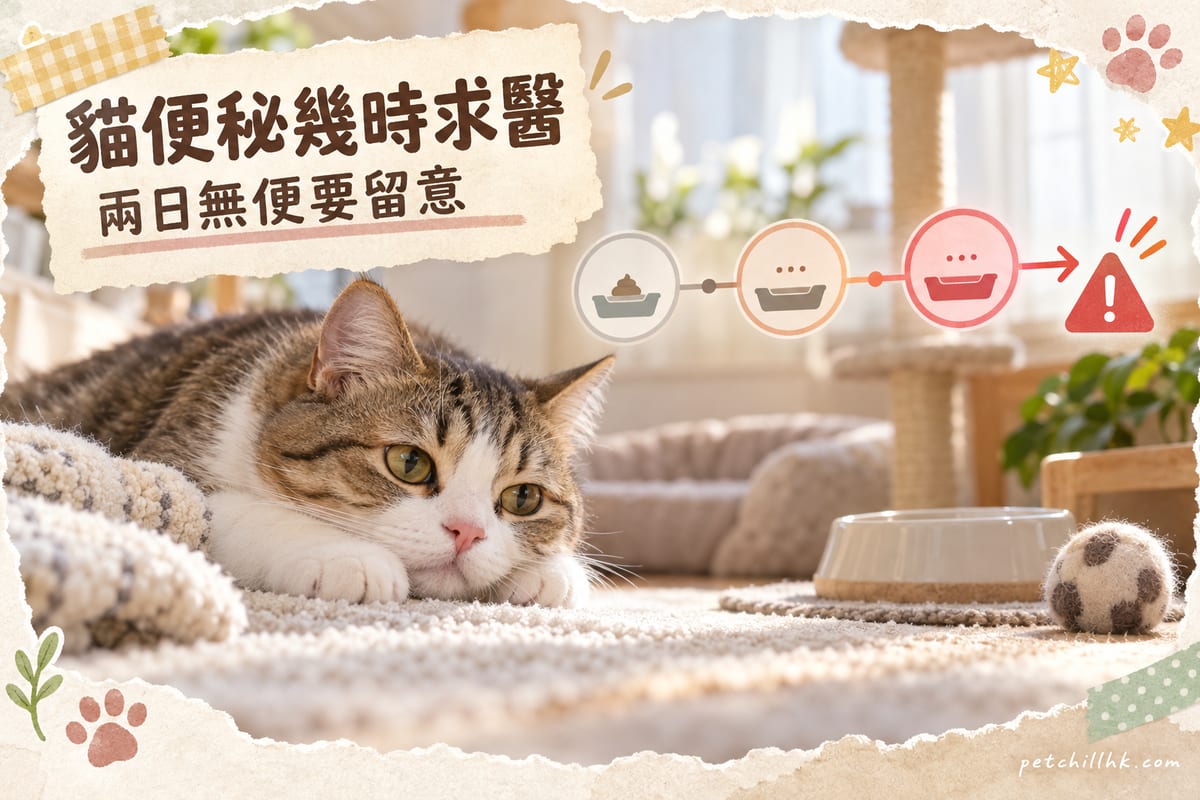
The key number for cat constipation is 48 hours: more than 48 hours without a bowel movement means seeing a vet within 24 hours; more than 72 hours, or straining to the point of crying, vomiting, or complete refusal to eat, is an emergency. But first and foremost, distinguish between 'can't poop' and 'can't pee'—not being able to pee is an immediately life-threatening emergency.
Quick assessment: which level of constipation is it?
| Situation | 🟢 Observe at home | 🟡 See a vet within 24 hours | 🔴 Immediate emergency |
|---|---|---|---|
| Time without a bowel movement | No stool within 24 hours, but normal energy and appetite | More than 48 hours without stool | More than 72 hours without stool, or no stool at all + bloating |
| Litter box behaviour | Slightly more frequent visits, still able to pass stool | Repeated visits, squatting for a long time, only passing small hard pellets | Squatting for a long time without passing stool, crying, jumping out and licking the bottom |
| Stool appearance | Slightly hard but formed | Small, dry and hard (like sheep droppings), with mucus | Cannot pass stool at all, or only a small amount of faecal fluid drips out (easily mistaken for diarrhoea) |
| Energy and appetite | Normal | Slightly reduced appetite, quieter than usual | Refusing food, lethargy, vomiting, obvious abdominal bloating and pain |
| Urination | Normal | Normal | No urine at all / frequent squatting but only drops of urine = urethral obstruction, immediate emergency |
What's the difference between cat constipation and 'difficulty defecating'?
Veterinary medicine distinguishes three levels, which many cat owners confuse:
- Constipation: difficulty defecating, reduced frequency, stool stays in the colon and rectum too long and becomes dry and hard. At this stage, it can mostly be improved through diet, hydration and medication.
- Obstipation: constipation so severe that stool is impacted in the colon/rectum, and the cat cannot pass it even with all its effort, requiring veterinary intervention (enema, manual removal).
- Megacolon: after repeated constipation and obstruction, the colon becomes enlarged and permanently loses its ability to contract, becoming a 'bag with no power to push stool out'. This is a long-term irreversible change, and some cats eventually need surgery.
In other words: constipation is not an isolated problem, but a path that gets harder to treat the longer it's left. International Cat Care points out that constipation itself is extremely uncomfortable, and if left untreated, it can develop into more serious problems—so don't adopt a 'wait for it to pass on its own' mindset.
9 common causes
Constipation is rarely due to a single cause; most cases are a combination of factors:
- Dehydration/insufficient water intake — the colon constantly absorbs water from stool. If a cat drinks little, or has chronic kidney disease (common in senior cats; increased urine output causes mild dehydration), stool becomes dry and hard.
- Insufficient or imbalanced dietary fibre — too little fibre means insufficient stool bulk and slower intestinal motility; but too much fibre combined with insufficient water can actually make stool harder.
- Hairball accumulation — hair swallowed while grooming forms clumps in the intestines, which over time can obstruct defecation.
- Pain causing 'holding it in' — arthritis in senior cats makes squatting to defecate painful; anal gland problems, perianal abscesses and spinal joint pain can also make cats reluctant to defecate.
- Litter box problems — litter that is too coarse or hard (e.g. wood pellets) makes standing uncomfortable, a box that is too small, a noisy location, insufficient cleaning, or too few boxes in multi-cat households can all make cats hold their stool.
- Intestinal disease — intestinal inflammation, tumours, neuromuscular dysfunction (e.g. previous pelvic fracture) affect intestinal motility.
- Medication side effects — some medications (such as certain painkillers, diuretics, antihistamines) can slow intestinal motility.
- Obesity and lack of activity — low activity levels slow intestinal motility as well.
- Thyroid or electrolyte problems — hypothyroidism, high blood calcium and other endocrine problems can also cause constipation.
7 warning signs that mean 'don't wait any longer'
If any of the following occur, it's outside the scope of home observation:
- More than 48 hours with no bowel movement at all, or more than 72 hours (conservative limit)
- Frequent visits to the litter box, squatting and straining for a long time without passing stool, even crying
- Only a small amount of faecal fluid or mucus passed (many owners mistake this for diarrhoea, but it's actually a sign of severe obstruction)
- Obvious abdominal enlargement, resistance or crying out when touched
- Vomiting (especially after eating) + complete refusal to eat
- Lethargy, hiding, unresponsive to calls
- Difficulty urinating or no urine — this is not constipation, it's urethral obstruction, an immediately life-threatening emergency; go to an emergency hospital right away
⚠️ Special reminder: the 'straining in the litter box' posture is almost identical for constipation and difficulty urinating. If you can't tell the difference, treat it as an emergency—because complete urethral obstruction can be fatal within 24–48 hours, while waiting one more day with constipation is usually not fatal; it's better to make a wasted trip.
If you can't tell, you can check the nearest emergency hospital on the list of 24-hour vets in Hong Kong—don't wait.
How will the vet diagnose?
- History and palpation: the vet will gently feel along the abdomen over the colon and detect hard faecal masses.
- Blood tests: to check for dehydration level, kidney function, thyroid, electrolytes (blood calcium) and other possible causes.
- X-ray (imaging): to confirm the amount and location of stool, and rule out foreign bodies, tumours and pelvic problems.
- Ultrasound: to assess the intestinal wall and abdominal organs, helping to find the underlying cause.
Treatment approach (by severity)
| Severity | Common approach | Notes |
|---|---|---|
| Mild constipation | Increase water intake (wet food, water fountain, broth), adjust fibre, increase activity | To be carried out after veterinary assessment |
| Moderate constipation | Vet-prescribed stool softeners (e.g. lactulose) or fibre supplements | Must be prescribed by a vet, dosage calculated by body weight |
| Obstipation | Enema, intravenous or subcutaneous fluids, manual removal of stool if necessary | Requires hospitalisation, a medical procedure |
| Chronic/megacolon | Long-term medication (prokinetics), long-term dietary management | Requires regular follow-up |
| Refractory cases | Surgery (partial colectomy) | Only for severe megacolon cases |
Iron rule: never buy human laxatives, glycerin suppositories or 'laxative teas' for your cat. The dosage and metabolism of human laxatives are completely different for cats and can cause severe electrolyte imbalance, dehydration and even death. International Cat Care also emphasises that cats should not be force-fed—force-feeding can create food aversion and actually make the appetite worse.
Home care and prevention (carry out with vet approval)
- Increase water intake: place several water bowls (away from the litter box and food), use a flowing water fountain, feed wet food or canned food (wet food is about 75–80% water, much higher than dry food).
- Hydration tips: add water to canned food, unsalted chicken broth (no seasoning).
- Fibre adjustment: your vet may recommend a gastrointestinal formula containing psyllium; studies show it helps with chronic constipation, but the amount must follow veterinary instructions.
- Increase exercise: 2–3 play sessions with a wand toy daily to promote intestinal motility.
- Optimise the litter box: big enough (about 1.5 times the cat's body length), fine-grained unscented litter, cleaned daily, and in multi-cat households 'number of cats + 1' boxes.
- Regular grooming: reduce swallowed hair; brush long-haired cats daily.
- Weight management: obesity is a risk factor for constipation; maintain an ideal body condition.
Hong Kong veterinary fee reference (publicly available on clinic websites)
- Hong Kong Leo Animal Medical Centre (LAMCVET): basic consultation $350 | night consultation $600 | emergency consultation $600 (official fee schedule)
- Creature Comforts (East District Animal Hospital / Tseung Kwan O Veterinary Clinic): daytime from $370 | evening (9pm–12am) from $550 | late-night emergency (12am–8am) from $1,100 | home visits from $1,050 (official information)
X-rays, blood tests, enemas and hospitalisation are extra charges, quoted by the clinic according to the actual situation. Prices are subject to the clinic's latest announcement.
Further reading (cat gastrointestinal and related symptoms)
Constipation often occurs together with other symptoms; the following articles help you check them one by one:
- Cat Poop Health Observation Guide — learn to tell health status from stool shape and colour
- What to Do About Cat Dehydration — learn to check skin elasticity at home; dehydration is a common culprit in constipation
- Early Symptoms of Cat Kidney Disease — senior cats drinking and urinating more can cause mild dehydration, leading to constipation
- Complete Guide to Cat Hairballs — hairball accumulation can also obstruct defecation
- Cat Symptom Self-Check Guide — quick reference for 12 common symptoms + red-line triage table

Comparison of three main approaches: fibre, water, hairball gel
Constipation can't be solved with 'one trick'; it must be addressed according to the combination of causes. Here is the positioning of common approaches (amounts and choices must be decided by a vet):
| Approach | Mechanism | Suitable for | Precautions |
|---|---|---|---|
| Increase water | Softens stool, so the colon doesn't need to absorb excess water | Almost all constipated cats (most basic) | Wet food, water fountain, water added to canned food, multiple water sources |
| Dietary fibre (e.g. psyllium) | Increases stool bulk, stimulates intestinal motility | Chronic constipation, slow intestinal motility | When increasing fibre, water intake must be increased at the same time, otherwise stool becomes harder |
| Hairball gel/lubricants | Help hairballs pass through the intestines | Constipation related to hairball accumulation | Cannot be relied on long-term; must be combined with grooming |
| Prescription gastrointestinal food | Adjusts fibre ratio and nutrition | Recurrent chronic constipation | Requires veterinary assessment before switching food |
| Medication (stool softeners/prokinetics) | Directly softens stool or stimulates motility | Moderate to severe constipation | Must be prescribed by a vet; self-use is dangerous |
The most common mistake Hong Kong cat owners make: adding fibre without adding water. Fibre absorbs water; if the cat doesn't drink enough, it can actually make stool harder and more difficult to pass.
Megacolon warning: the longer it's left, the harder it is to treat
When constipation occurs repeatedly, the colon becomes enlarged and gradually loses its ability to contract, becoming megacolon—an irreversible change. Warning signs include: needing medication long-term to pass stool, stools becoming harder and less frequent, a persistently bloated firm abdomen, and weight loss. At this stage, some cats eventually need surgery (partial colectomy). Treating constipation early is the most effective way to avoid reaching this point.
Frequently asked questions
Q: How many days without a bowel movement counts as constipation in cats? A: Cats generally pass stool once a day or every two days. More than 48 hours without any bowel movement means seeing a vet within 24 hours; more than 72 hours, or accompanied by vomiting, refusal to eat or bloating, is an emergency requiring immediate veterinary care.
Q: Can constipation and diarrhoea occur at the same time? A: Yes, and it's a serious warning sign. International Cat Care points out that cats with severe obstipation may pass a small amount of faecal fluid or mucus when straining, which looks like diarrhoea but is actually a sign of impacted stool. Seek veterinary care immediately if this occurs.
Q: Can I give human lactulose to my cat? A: Do not use it on your own. Although lactulose-based stool softeners are commonly used by vets, the dosage must be calculated according to the cat's weight, dehydration level and kidney function; an overdose can cause severe diarrhoea and electrolyte imbalance. Any human medication must first be assessed by a vet.
Q: How can I tell if my cat is constipated or can't pee? A: It's very difficult to tell from posture alone; both involve 'squatting and straining for a long time'. But difficulty urinating/urethral obstruction is an immediately life-threatening emergency (especially in male cats), so if you can't tell, treat it as an emergency. If your cat suddenly visits the litter box frequently, cries, licks the genitals but passes very little urine, go to a 24-hour emergency hospital immediately.
Q: Can wet food really improve constipation? A: It helps. Cats naturally have a low desire to drink, and wet food has a much higher water content than dry food, which can increase overall water intake and make stool softer. However, if constipation has persisted for some time or recurs, the underlying cause must first be investigated by a vet.
Q: Does megacolon always require surgery? A: Not necessarily. Most cases are first managed with medication (prokinetics), diet and hydration. Only when long-term medical treatment fails to control it and severe obstruction recurs will the vet consider partial colectomy. Treating constipation early is the best way to avoid reaching this point.
Q: What PetChill products can help a constipated cat? A: PetChill HK has a range of products to increase water intake and support intestinal care, including flowing water fountains, unsalted fresh meat broth packs, hairball gel, wand toys, low-dust cat litter and sealed food storage containers; self-pickup is available at the Fo Tan, Yuen Long and Fanling stores.
Q: How many days without a bowel movement means my cat needs a vet? A: Start paying attention if there's no bowel movement for more than 48 hours; if it reaches 72 hours, or comes with reduced appetite, vomiting or lethargy, seek veterinary care as soon as possible. Senior cats and cats with a medical history need earlier attention.
Q: What are the symptoms of cat constipation? A: Common signs include: frequent trips to the litter box with no poop, dry hard small stools (like sheep droppings), crying or straining when defecating, reduced appetite, a bloated abdomen and lethargy; in severe cases, vomiting and complete refusal to eat.
Q: What's the difference between cat constipation and 'difficulty defecating'? A: Constipation means a clear reduction in bowel movements with stool accumulating; difficulty defecating means the cat has the urge but can't pass stool or strains a lot. The two can occur together, and the approach differs depending on the cause (diet, dehydration, megacolon, tumours, etc.).
Q: How should senior cat constipation be handled? A: Start with water intake and diet: increase wet food, ensure plenty of drinking water, and use hairball gel or fibre supplements as advised by your vet. Senior cats should also be checked for joint pain (can't get to the litter box) and metabolic diseases; for persistent constipation, tests are recommended rather than relying only on laxative products.
Sources
- International Cat Care — Constipation in cats — definitions, symptoms, causes and care advice for constipation, obstipation and megacolon
- VCA Animal Hospitals — Subcutaneous Fluid Administration in Cats — uses and principles of subcutaneous fluid therapy in cats
Disclaimer
This article is general pet health information and cannot replace veterinary diagnosis or treatment. The causes of constipation can range from diet, dehydration and pain to intestinal tumours; the type and dosage of medication (including stool softeners) must be determined by a registered vet based on the cat's weight, kidney function and dehydration level. If your cat has not passed stool for more than 48 hours, or shows vomiting, refusal to eat or abdominal bloating and pain, seek veterinary care immediately. The fee information in this article is excerpted from the clinics' official websites; prices may change and are subject to the clinics' latest announcements.
Key takeaways
- Key timeline: 24 hours observation → more than 48 hours means seeing a vet within 24 hours → more than 72 hours or accompanied by vomiting/refusal to eat/bloating = emergency
- First distinguish 'can't poop' from 'can't pee': urethral obstruction is an immediately life-threatening emergency; if you can't tell, treat it as an emergency
- Three stages of constipation: constipation → obstipation → megacolon (irreversible)
- Most common causes: insufficient water intake, dehydration, fibre imbalance, hairballs, pain (arthritis in senior cats), litter box problems
- Never give human laxatives or stool softeners on your own
- Prevention focus: wet food + multiple water sources, psyllium fibre (per vet instructions), increased exercise, good quality litter box, regular grooming
 Almo Nature full guide →