
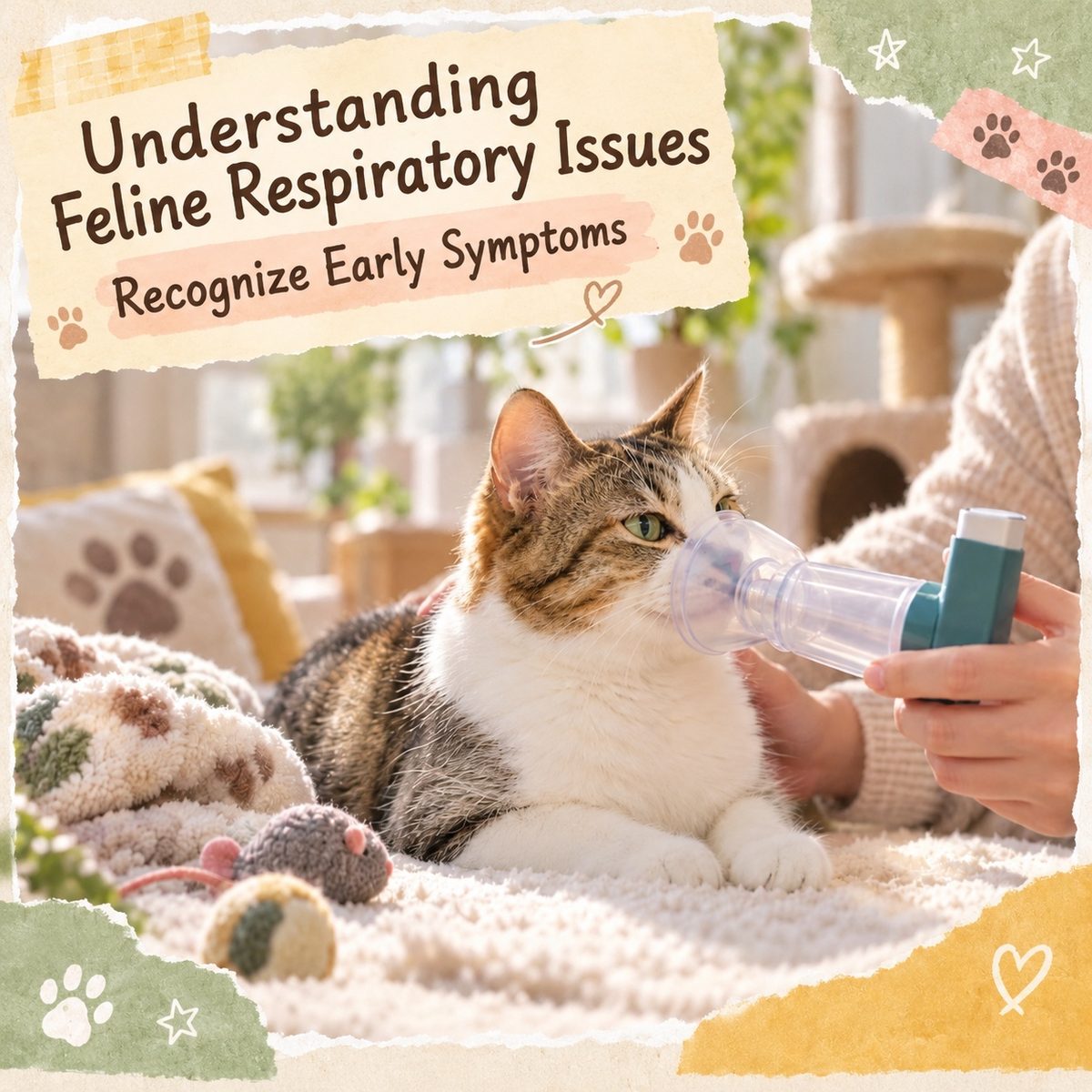
The most typical sign of cat asthma is crouching low, stretching the neck and a dry "hacking" cough, which many owners mistake for trying to bring up a hairball. If your cat is open-mouth breathing, its chest is heaving rapidly, or it even collapses weakly, that is an asthma attack and an emergency — seek veterinary care immediately.
Quick check: which level are the breathing symptoms?
| Situation | 🟢 Observe at home | 🟡 See a veterinarian soon | 🔴 Emergency now |
|---|---|---|---|
| Coughing | Occasional one or two coughs, normal energy and appetite | Persistent cough, coughing every day, retching after coughing | Coughing to the point of breathing difficulty, coughing non-stop |
| Breathing posture | Normal lying down | Breathing faster than usual, obvious abdominal effort | Open-mouth breathing, neck stretched out, restless, unwilling to lie down |
| Breathing sounds | No abnormality | Slight "hissing" or louder snoring sounds | Obvious wheezing, breathing audible from a distance |
| Energy and activity | Normal | Panting after a short play, tiring more easily than usual | Weak, floppy, suddenly collapsing (suspected attack) |
| Mucous membrane colour | Pink | Slightly pale | Gums/tongue blue or white (lack of oxygen) |
| Appetite | Normal | Eating less due to breathlessness | Complete refusal to eat + breathing difficulty |
What is cat asthma?
Feline asthma (Feline Asthma) has similarities to human asthma. Medically it is also called allergic bronchitis, and together with chronic bronchitis it is classified among the cat's "chronic small airway diseases". These names describe the same kind of problem: airway inflammation and narrowing.
The mechanisms include:
- Airway hyperresponsiveness — the airway overreacts to irritants and suddenly contracts
- Airflow obstruction — narrowed airways make it hard for air to move in and out
- Airway remodeling — long-term inflammation changes and thickens the airway wall structure
- Eosinophilic airway inflammation — an allergic immune response involving IgE antibody production
Simply put: the cat's airways are irritated by environmental allergens → the immune system overreacts → the airways swell, secretions increase and muscles contract → the cat has difficulty breathing.
Which cats are prone?
- Age: Most common in adult cats; the International Cat Care indicates most are around 6–9 years old, but cats of any age can be affected.
- Breed: Siamese and related breeds have a noticeably higher incidence, and other sources indicate Himalayan cats are also high-risk, suggesting a possible genetic factor.
- Environment: Cats exposed long-term to allergens or irritants are at higher risk.
- Sex: No obvious sex predisposition.
8 major triggers in Hong Kong homes
Hong Kong's dense, humid living environment has several locally common triggers:
- Incense, joss sticks, mosquito coils — particles from burning incense are strong airway irritants; take extra care with household worship or mosquito coils.
- Second-hand smoke / third-hand smoke — residue on smokers' clothing and sofas is also a continuous irritant source.
- Mould caused by humidity — relative humidity is high in spring and summer in Hong Kong; mould spores on walls, in bathrooms and inside air-conditioners are common allergens.
- Renovation dust and formaldehyde — during moving/renovation, it's best to house the cat temporarily in another room.
- Cat litter dust — bentonite (clay litter) is dusty; consider low-dust or tofu litter.
- Perfume, aromatherapy, diffusers, cleaning sprays — volatile chemicals directly irritate the airways.
- Pollen and seasonal changes — outdoor pollen levels rise with the change of seasons.
- Direct air-conditioning drafts and temperature swings — cold air irritation can make airways contract.
Cat asthma vs hairball: tell them apart at a glance
This is the pair Hong Kong cat owners most often confuse; see the differences below:
| Feature | Cat asthma cough | Hairball |
|---|---|---|
| Posture | Crouching low, body flat to the ground, neck stretched forward | Also crouching, but with more obvious forceful abdominal contractions |
| Sound | "Hacking", wheezing, a dry cough like asthma | Usually retching sounds, then a cylindrical hairball is brought up |
| Result | Usually nothing comes up (dry cough) | Hairball or food is brought up |
| Reaction afterwards | Still panting after coughing, may attack again immediately | Immediately back to normal, walks away and may even want to eat |
| Frequency | Recurrent, can happen daily | 1–2 times a month is a common range |
Tip: Filming with your phone and showing it to the veterinarian is the most effective diagnostic aid. The International Cat Care explicitly recommends video recording, because it's very hard to distinguish "coughing" from "retching" from the owner's description alone.
How will the veterinarian diagnose it?
- History and clinical examination: auscultation of airway sounds, asking about symptom frequency and environmental factors.
- Chest X-ray: typically shows bronchial/interstitial infiltrates ("doughnut" or "train track" patterns).
- Airway sampling (bronchoalveolar lavage): collects airway cells to confirm eosinophilic inflammation.
- Rule out other causes: heart disease, heartworm, lungworm, respiratory infection, foreign bodies, tumours and others can all cause coughing/breathing difficulty and must be ruled out.
- Blood tests: to help assess overall condition (heartworm test, inflammation markers, etc.).
Treatment direction (must be decided by a veterinarian)
| Treatment category | Common options | Role |
|---|---|---|
| Steroids (oral) | Prednisolone, Dexamethasone | Control airway inflammation, commonly used in the acute phase |
| Steroids (inhaled) | Fluticasone, Budesonide | With a cat inhaler/mask, long-term control with fewer side effects |
| Bronchodilators | Albuterol, Terbutaline | Adjunctive only, must not be used as sole treatment |
| Oxygen therapy | Oxygen supply in emergencies | Stabilises the condition in severe breathing difficulty |
| Environmental control | Remove allergens | Must be done in every case; the long-term foundation |
Important medical fact: According to the MSD/Merck Veterinary Manual, bronchodilators should not be used as sole treatment for feline asthma and must be combined with steroids; inhaled steroids need to be given with a cat-specific inhalation mask (aerodynamic chamber).
Iron rule: never give human asthma medication (e.g. inhaled salbutamol inhalers, oral steroids) to a cat on your own. The dose, frequency and choice of medication must be decided by a veterinarian based on the cat's condition.
Red-line timeline: when to go now
- Immediately (🔴): open-mouth breathing, rapid breathing, blue gums, weak collapse, completely unwilling to move → go to a 24-hour emergency hospital immediately, don't wait
- Within 24 hours (🟡): coughing every day, panting after a short play, louder breathing sounds, deteriorating energy
- Within 1 week (🟢): occasional one or two coughs but normal energy and appetite → book a veterinarian for a basic examination and X-ray, don't delay
- Long term: cats already diagnosed with asthma should take medication as instructed by the veterinarian and attend regular follow-ups; if attack frequency increases, bring the follow-up forward
Home environment management (the key to long-term control)
- Ban smoking completely; wash hands and change clothes after smoking before touching the cat
- Switch to fragrance-free/low-volatile cleaning products and avoid spray products
- Keep the home dry (humidity around 50–60%), regularly clean air-conditioning filters and prevent mould in the bathroom
- Switch cat litter to a low-dust type (tofu litter, paper litter); covered litter boxes trap dust, so an open box is recommended for asthmatic cats
- During household worship with incense, isolate the cat in another room and open windows for ventilation
- Use an air purifier (HEPA filter)
- Groom regularly to reduce loose fur, but avoid shaking the brush vigorously in front of the cat
- Maintain an ideal weight; obesity adds to the breathing burden
Hong Kong veterinary fee reference (published on clinic websites)
- LAMCVET: basic consultation $350 | night consultation $600 | emergency consultation $600 (official fee table)
- Creature Comforts (East District Animal Hospital / Tseung Kwan O Veterinary Clinic): daytime from $370 | evening (9pm–12am) from $550 | late-night emergency (12am–8am) from $1,100 | home visits from $1,050 (official information)
Chest X-rays, airway sampling, oxygen therapy and hospitalisation are charged separately and require a quote from the clinic. Prices are subject to the clinic's latest announcement.
Further reading (cat breathing and related symptoms)
- Cat symptom self-check guide — 12 major symptoms quick reference + 🟢🟡🔴 red-line triage table
- Home care for feline upper respiratory infection — managing sneezing, runny nose and nasal congestion
- Complete guide to cat heartworm — heartworm can also cause coughing and breathing difficulty
- What to do about cat dehydration — cats breathing rapidly dehydrate easily
- Cat eye care — upper respiratory problems are often accompanied by eye discharge
Asthma vs hairball vs heart disease: three-way differentiation table
Coughing and breathing difficulty in cats can be caused by three completely different categories of cause, and the management is entirely different:
| Feature | Cat asthma | Hairball | Heart disease (e.g. HCM) |
|---|---|---|---|
| Main presentation | Neck stretched, crouching, dry cough, wheezing | Retching followed by bringing up a hairball | Rapid breathing, open-mouth breathing, reduced activity |
| Anything brought up | Usually nothing (dry cough) | Hairball | Usually nothing; may cough up frothy sputum |
| Timing | Paroxysmal, may worsen at night | Mostly after grooming | Worse after activity, when lying down |
| Auscultation findings | Wheezing, increased breath sounds | Usually normal | Heart murmur, gallop rhythm, arrhythmia |
| Imaging | Bronchial/interstitial infiltrates | Usually normal | Enlarged heart, pulmonary oedema or pleural effusion |
| Response to treatment | Responds to steroids, bronchodilators | No treatment needed | Needs cardiology specialist treatment |
| Danger | Can cause paroxysmal respiratory failure | Generally mild | Can cause sudden heart failure, thromboembolism |
Key point: The veterinarian will distinguish them using cardiac auscultation and chest X-ray (and echocardiography if necessary). If it is treated as asthma but is actually heart disease, the medication direction is completely wrong, so you cannot rely on home judgement — examinations are essential.
How to use a cat inhaler
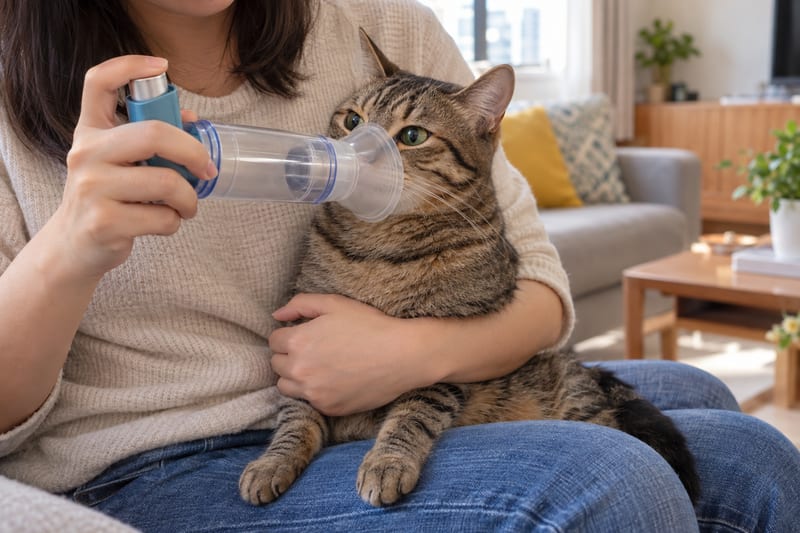
Inhaled steroids (such as fluticasone/budesonide) are a common long-term control option for feline asthma and need to be used with a cat inhalation mask (aerodynamic chamber/spacer); a human mouthpiece inhaler cannot be used directly. Basic steps:
| Step | Action | Note |
|---|---|---|
| 1. Prepare | Assemble the inhaler, mask and spacer chamber, shake the medication well | Use the medication and frequency specified by the veterinarian |
| 2. Restrain | Gently hold the cat with a towel or in a sitting position to keep its head steady | Do not press hard on the mouth and nose |
| 3. Fit the mask | Gently place the mask over the cat's mouth and nose (covering nose and mouth) | The mask should fit snugly but not too tightly |
| 4. Spray | Press the inhaler to release 1 puff of medication | Do not press multiple times in a row |
| 5. Breathe | Let the cat breathe through the mask about 7–10 times (a few seconds to a dozen or so seconds) | Treats can help soothe the cat |
| 6. Clean | Wipe the mask with a damp cloth after each use, and clean the spacer chamber regularly according to the product instructions | Keep the medication pathway clear |
Important: The type of medication, dose and frequency must be decided by the veterinarian, and regular follow-ups are needed to assess control. Cats may resist the mask at first and need gradual training (let them sniff it first, then brief contact with the face, with treats).
Frequently asked questions
Q: Can cat asthma be cured? A: Feline asthma is mostly a long-term chronic condition, and the goal is control, not a helps manage. With medication (mainly steroids) plus strict environmental control, most cats can maintain a good quality of life and a normal lifespan. If left completely untreated, long-term inflammation causes permanent airway remodelling and the condition becomes harder and harder to control.
Q: How do I tell whether my cat is coughing or bringing up a hairball? A: The key is whether anything comes out. An asthma cough is usually dry, nothing is brought up afterwards, and the posture is neck stretched forward with the body flat to the ground; a hairball comes with retching sounds and a hairball is produced, after which the cat immediately returns to normal. Recording a video for the veterinarian is the most accurate method.
Q: Does Hong Kong's humid weather make cat asthma worse? A: Yes. Humid environments encourage mould growth, and mould spores are a common allergen; combined with small living spaces and limited ventilation in Hong Kong, irritant concentrations build up easily. Keeping indoor humidity around 50–60%, regularly cleaning air-conditioning filters and preventing mould are especially important for asthmatic cats.
Q: Can cat asthma suddenly be fatal? A: Yes. A severe asthma attack can cause respiratory failure and is an emergency. If you see your cat open-mouth breathing, with the chest heaving rapidly, blue gums or collapsing weakly, you must go to a 24-hour emergency animal hospital immediately — don't wait.
Q: Can I buy a bronchodilator and use it myself? A: No. Veterinary literature clearly states that bronchodilators should not be used as sole treatment for feline asthma and must be combined with steroids to control airway inflammation. Using a human asthma inhaler on your own — the dose and device are unsuitable for cats and can cause serious heart rhythm problems.
Q: What PetChill products can help with the home environment for an asthmatic cat? A: 【PetChill HK】offers low-dust cat litter, HEPA air purifiers, moisture-control and dehumidifying products, fragrance-free cleaning products and grooming tools, with self-pickup available at the Fo Tan, Yuen Long and Fanling stores, helping you reduce allergens at the source in your home.
Sources
- International Cat Care — Asthma and chronic bronchitis in cats — cat asthma symptoms, age of onset, diagnostic process and when to seek care
- MSD / Merck Veterinary Manual — Feline Bronchial Asthma — mechanisms, common medications (oral/inhaled steroids, bronchodilators) and environmental management recommendations
Disclaimer
This article is general pet health information and cannot replace veterinary diagnosis or treatment. Breathing difficulty in cats can be caused by many reasons including asthma, heart disease, infection, foreign bodies or tumours, and must be confirmed by a veterinarian through examination and imaging. The type, dose and method of use of all medications (including steroids and inhalation therapy) must be prescribed by a registered veterinarian. If your cat shows open-mouth breathing, rapid breathing or blue gums, please go to a 24-hour emergency animal hospital immediately. The fee information in this article is excerpted from the clinics' official websites; prices may change and are subject to the clinics' latest announcements.
Key takeaways
- Cat asthma often presents as crouching low, neck stretched, dry cough like trying to bring up a hairball, and is very easily mistaken for a hairball problem
- 🔴 Emergency warning signs: open-mouth breathing, rapid breathing, blue gums, weak collapse
- High risk: adult cats aged 6–9 years, Siamese and related breeds
- Treatment is mainly steroids (oral or inhaled); bronchodilators are adjunctive only and must not be used alone
- Common Hong Kong triggers: incense and mosquito coils, second-hand smoke, mould, renovation dust, cat litter dust, perfume sprays
- Never give human asthma medication on your own; showing a video to the veterinarian is the most effective diagnostic aid
 Feline Natural full guide →