
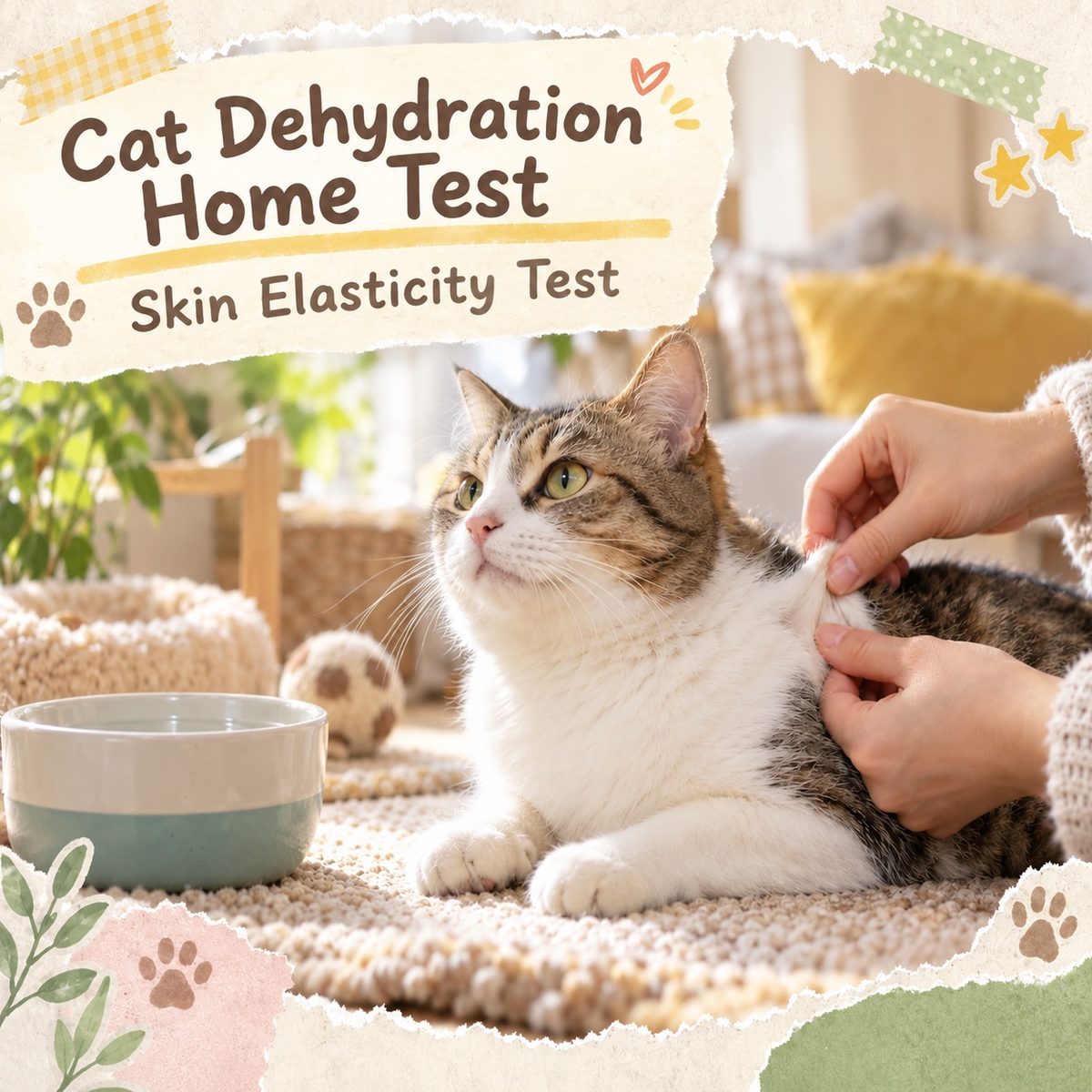
The fastest home dehydration test is the skin turgor test: gently pinch a piece of skin between the shoulder blades and release; normally it springs back immediately. If the skin returns slowly or stays in a "tent" shape, that is a sign of dehydration. If your cat completely stops drinking for more than 24 hours, has dry sticky gums, is lethargic or unsteady on its feet, seek veterinary care immediately.
Quick assessment: which level of dehydration?
| Sign | 🟢 Mild (home hydration) | 🟡 Moderate (see vet ASAP) | 🔴 Severe (emergency now) |
|---|---|---|---|
| Skin turgor test | Springs back immediately | Springs back slowly (about 1–2 seconds) | Skin stays "tented", does not spring back |
| Gums / mouth | Moist, pink | Slightly dry, tacky | Dry and sticky, pale or white |
| Eyes | Bright, not sunken | Slightly sunken | Clearly sunken, dull gaze |
| Demeanour | Normal | Tired, slow to respond | Weak, floppy, hard to rouse |
| Urination | Normal | Significantly reduced urine output | No urine for over 12–24 hours |
| Appetite | Normal | Reduced appetite | Completely refuses food, vomiting or diarrhoea persists |
| Breathing / heart rate | Normal | Slightly fast | Rapid breathing, fast weak pulse |
Why are cats so prone to dehydration?
Three innate factors make cats especially prone to water loss:
- Ancestral habits: Cats' ancestors were desert animals with a naturally low desire to drink, getting most of their water from prey (about 70% water). Domestic cats eating dry food (about 6–10% water) are effectively in a state of "low water intake" long-term.
- Blunted thirst: A cat's thirst mechanism is not sensitive; they often only want to drink after the body has already been short of water for some time, and this is even more pronounced in older cats.
- Small body size, small reserves: Cats are small, so the proportion of water lost is relatively fast. Kittens and older cats are especially vulnerable.
From a veterinary perspective, dehydration is assessed as a percentage of body weight: with mild dehydration (around 5% or less), skin elasticity may still seem normal; as dehydration increases, skin rebound slows noticeably. So the skin test is an early home warning, but cannot replace veterinary assessment.
7 common causes
| Cause category | Specific situation | Notes |
|---|---|---|
| Insufficient water intake | Dry food only, too few or dirty water bowls, bowls placed near the litter tray | Most common, easiest to improve |
| Vomiting / diarrhoea | Acute gastroenteritis, eating something harmful, parasites | Large loss of water and electrolytes in a short time |
| Chronic kidney disease (CKD) | Common in older cats; reduced ability to concentrate urine, greatly increased urine output | Causes persistent mild dehydration |
| Diabetes | High blood sugar causes the body to excrete large amounts of sugar and water, increased drinking and urination | Requires blood tests for diagnosis |
| Hyperthyroidism | Faster metabolism, weight loss, increased drinking and urination | Common in older cats |
| Fever / infection | Rising body temperature increases water loss | Vet needs to treat the underlying cause |
| Hot environment / heatstroke | Hong Kong summer, enclosed spaces, inside cars | An emergency, can be rapidly fatal |

Three-step home assessment
Step 1: Skin turgor test
Gently pinch a piece of skin between the shoulder blades (along the midline of the back), lift it about 1–2 cm and release:
- Springs back immediately = water levels roughly normal
- Returns slowly = mild to moderate dehydration
- Stays tented = severe dehydration, seek veterinary care immediately
Step 2: Gum check
Gently lift your cat's upper lip and touch the gums with a finger or clean cotton swab:
- Moist and slippery = normal
- Dry and tacky = sign of dehydration
- Pale, blue, or stays pale long after pressing = circulation problem, emergency
Step 3: Measure water intake and urine output
Use a graduated water bowl and record daily. Also monitor the number and size of urine clumps in the litter tray:
- Sudden large increase in drinking (increased drinking and urination) = possible kidney disease, diabetes or thyroid problem; needs blood tests
- Sudden decrease in drinking, fewer and smaller urine clumps = may already be dehydrated or unwell; keep a close eye
If possible, weigh your cat at the same time each day on a digital scale. A short-term weight loss of more than 5% is an important warning sign.
Hydration methods: from gentlest to medical grade
| Method | How to do it | Suitable for |
|---|---|---|
| Multiple water sources | Place 3–5 water bowls around the home, away from food and the litter tray | All cats, daily prevention |
| Flowing water fountain | Cats prefer flowing water; can increase intake | Cats with low desire to drink |
| Wet food / canned food | About 75–80% water, far higher than dry food | Most effective daily hydration method |
| Canned food with water / unsalted broth | Add 1–2 tablespoons of clean water or unsalted fresh meat broth | Cats that accept wet food |
| Syringe feeding water | Only small amounts, slowly at the side of the mouth | Requires vet guidance; risk of choking |
| Subcutaneous fluids (SubQ) | Can be done at home after vet training | Mostly for cats with chronic kidney disease |
| Intravenous fluids | Done in hospital | Moderate to severe dehydration, persistent vomiting or diarrhoea |
⚠️ Two mistakes you must avoid:
- Do not force-feed water: forcefully squirting water into a cat's mouth can cause water to enter the trachea and lead to aspiration pneumonia, a serious complication.
- Do not buy needles and fluids to hydrate your cat yourself: the type of fluid for subcutaneous hydration (vets commonly use balanced electrolyte solutions such as Hartmann's / Lactated Ringer's solution), the amount and frequency must be determined by a vet based on your cat's weight and condition.
What is subcutaneous fluid therapy?
For cats that need long-term hydration, such as those with chronic kidney disease, a vet may recommend home subcutaneous fluids: a needle is inserted into the subcutaneous space between the shoulder blades (not into a blood vessel), and the fluid is gradually absorbed by the body. This is very common among owners, but a vet must personally demonstrate and confirm that your technique is correct before you can do it at home; the needles, type of fluid and amount each time are all decided by the vet. Regular follow-up visits are also needed so the vet can assess effectiveness and any complications.
Special attention for Hong Kong summers
Hong Kong summers are hot and humid, and cats are poor at dissipating heat:
- Keep indoor spaces ventilated; avoid leaving cats for long periods in sealed rooms without air-conditioning
- Never leave a cat in a car, even for just a few minutes; the temperature inside can rise rapidly
- Long-haired cats, flat-faced breeds (such as Persians), older cats and cats with heart disease are at higher risk of heatstroke
- Signs of heatstroke: rapid panting, open-mouth breathing, excessive drooling, red gums, high body temperature, unsteady on feet → cool down immediately and take to emergency
- Air-conditioned rooms also need attention: air-conditioning removes moisture from the air, and cats' desire to drink may also decrease
Hong Kong veterinary fee reference (published on clinic websites)
- Hong Kong LAMC Veterinary Centre (LAMCVET): basic consultation $350 | night consultation $600 | emergency consultation $600 (official fee schedule)
- Creature Comforts (East District Animal Hospital / Tseung Kwan O Veterinary Clinic): daytime from $370 | evening (9pm–12am) from $550 | late-night emergency (12am–8am) from $1,100 | home visits from $1,050 (official information)
Blood tests, fluid therapy, hospitalisation, etc. are charged extra and require a quote from the clinic. Prices are subject to the clinic's latest announcement.
Further reading (cat drinking water and related symptoms)
- Cat symptom self-check guide — 12 major symptoms quick reference + red-flag triage table
- Complete guide to early symptoms of kidney disease in cats — increased drinking and urination is a shared warning sign of dehydration and kidney disease
- What to do about cat constipation — dehydration is the most common culprit in constipation
- Guide to observing cat poop health — how to handle water loss from diarrhoea
- Cat vomiting colour triage — watch for dehydration risk with persistent vomiting
Sources
- VCA Animal Hospitals — Subcutaneous Fluid Administration in Cats — indications, uses and principles of subcutaneous fluid therapy in cats
- International Cat Care — How to give subcutaneous fluids to your cat — commonly used fluids (Hartmann's / Lactated Ringer's) and home hydration guidelines
- VETgirl — Evaluating dehydration based on skin turgor in a cat — clinical principles of assessing dehydration using skin turgor
Disclaimer
This article is general pet health information and cannot replace veterinary diagnosis or treatment. The degree, cause and hydration plan for a cat's dehydration (including the type of fluid, amount and frequency) must be determined by a registered veterinarian based on the actual situation. The skin turgor test and gum check are home screening tools only and cannot replace clinical assessment. If your cat completely stops drinking for more than 24 hours, has dry sticky gums, sunken eyes, is lethargic or shows suspected heatstroke, please go immediately to a veterinary clinic or 24-hour emergency animal hospital. The fee information in this article is excerpted from clinic official websites; prices may change and are subject to the clinic's latest announcement.
Key takeaways
- Three-step home check: skin turgor test → gum moisture → record water intake and urine output
- Cats naturally have a low desire to drink and blunted thirst; cats on dry food are in a state of low water intake long-term
- 7 major causes: insufficient drinking, vomiting/diarrhoea, chronic kidney disease, diabetes, hyperthyroidism, fever, heatstroke
- Wet food is the most effective daily hydration method (about 75–80% water; dry food only 6–10%)
- 🔴 Emergencies: completely stops drinking for more than 24 hours, skin does not spring back, gums dry sticky and pale, no urine, suspected heatstroke
- Do not force-feed water (risk of aspiration pneumonia); subcutaneous fluids must first be demonstrated by a vet