
🤖 AI Summary
Cat vomiting is very common, but what comes up matters more than whether they vomit: the colour and form of the vomit are health signal lights. This article uses a six-category colour chart (undigested food / hairball / white foam / yellow fluid / coffee-ground / red) to break down common causes and action levels.
• Green light: occasional hairball, food vomited from eating too fast — observe if the cat is bright
• Red light: red (blood), coffee-ground appearance (internal bleeding), frequent vomiting + low energy — see a vet immediately
• Amber light: repeated yellow fluid, repeated white foam — monitor for 24 hours
Quick answer: Reading cat vomit: undigested food = eating too fast (observe); with hair = hairball (normal range 1-2 times a month); white foam = empty-stomach acid (watch frequency); yellow liquid = bile mixed in (repeated episodes need checking); coffee-ground appearance = suspected gastrointestinal bleeding (see a vet quickly); red/pink = bleeding (see a vet immediately). Any vomiting + low energy / not eating / not drinking = don't bother looking at the colour, go straight to the vet.
Contents
-
First, tell them apart: vomiting, regurgitation, retching
-
Vomit colour chart (6 categories)
-
Each colour explained: causes + action level
-
Red-green lines for vomiting frequency
-
What to prepare for a vet visit: the three observation essentials
-
When to see a vet + emergency red lines
-
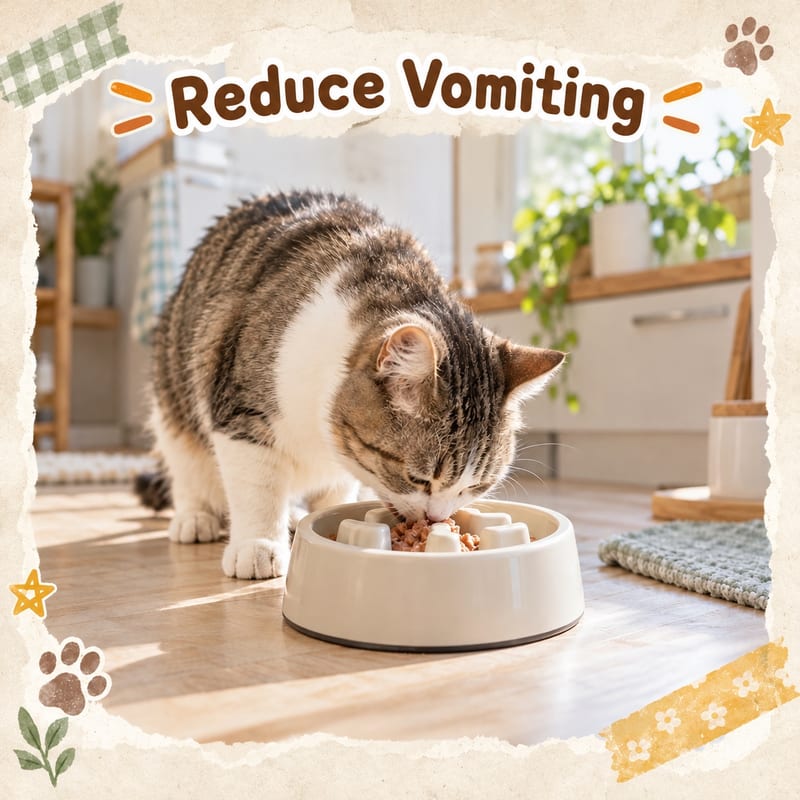
Five everyday ways to reduce vomiting
-
FAQ
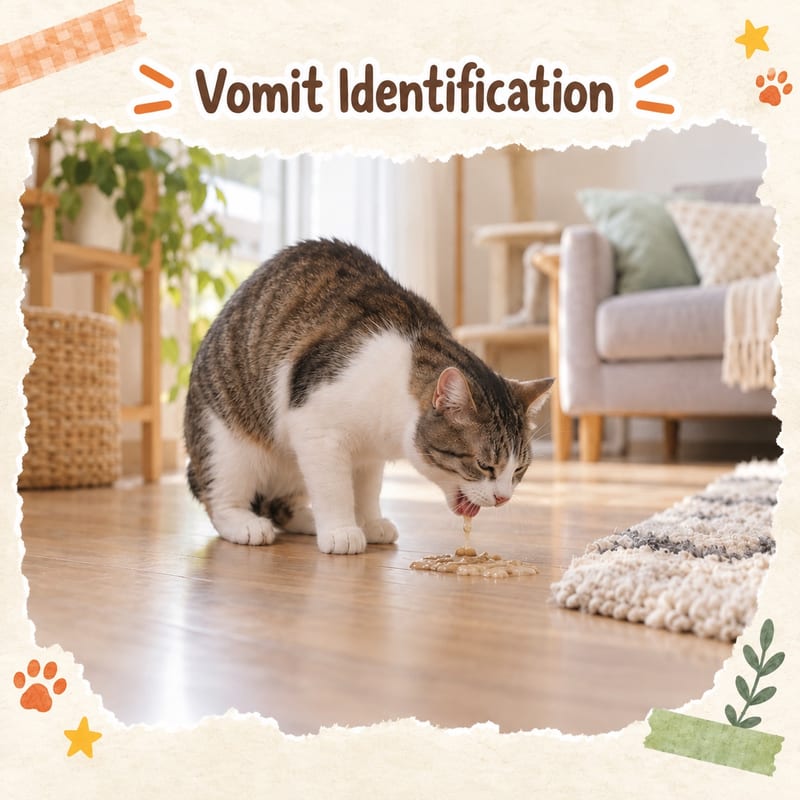
First, tell them apart: vomiting, regurgitation, retching
Before you act, confirm it's 'true vomiting':
- Vomiting — forceful abdominal contractions, vomit comes from the stomach, usually with warning signs (nausea, drooling, a few dry heaves)
- Regurgitation — no abdominal effort, oesophageal contents 'flow out', usually right after eating, bringing up tube-shaped undigested food — often related to eating too fast or oesophageal problems
- Retching — heaving motions but nothing comes up; may be a stuck hairball, or trying to vomit but can't (the latter warrants caution about obstruction)
The three are managed differently: this article focuses on reading the most common true vomiting, but 'repeated retching + nothing coming up' is itself a signal to see a vet.
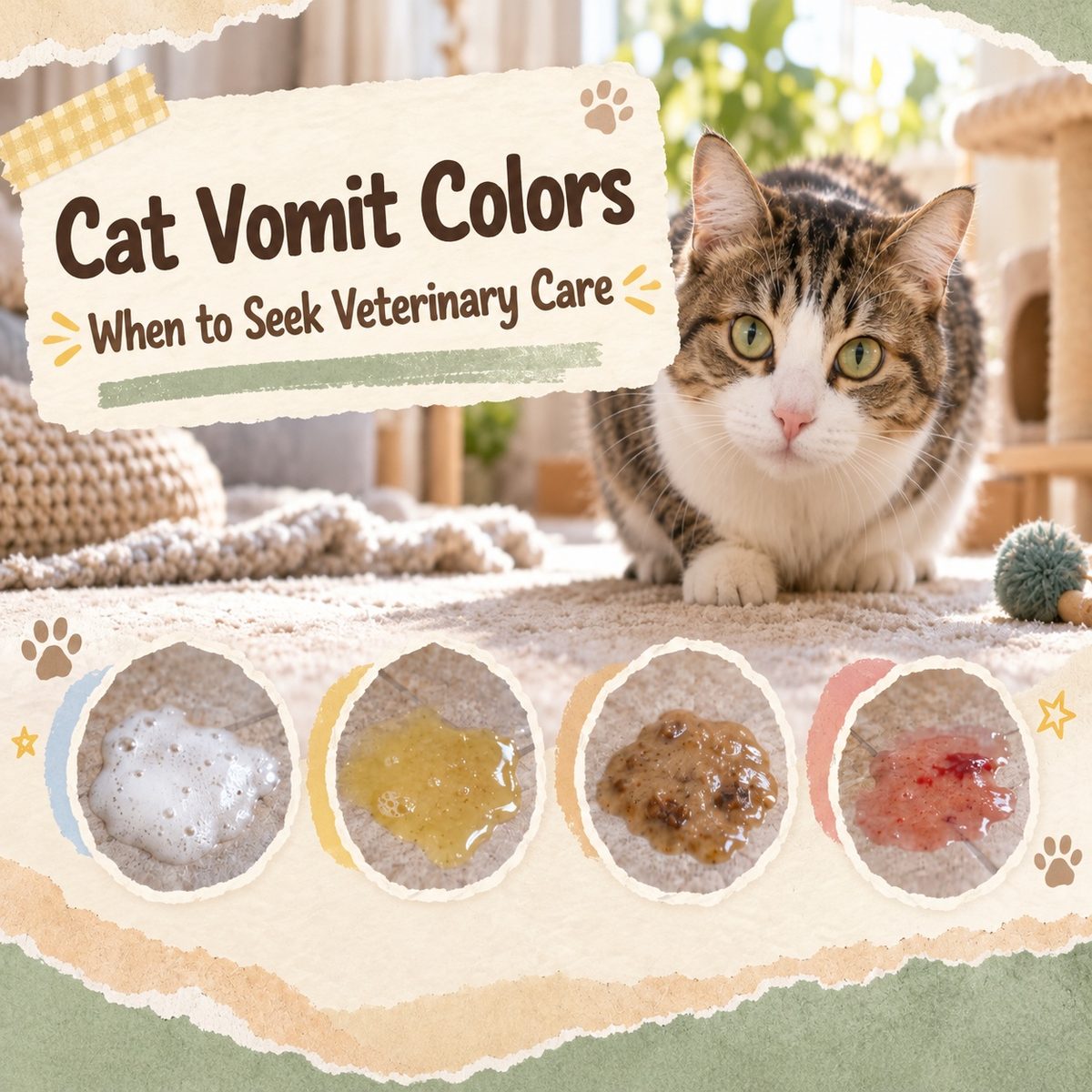
Vomit colour chart (6 categories)
| Colour/form | Most common cause | Urgency level | Action |
|---|---|---|---|
| Undigested food (whole kibble) | Eating too fast, too much, diet change | 🟢 Observe | Slow eating, small frequent meals |
| With hair/hairball | Swallowed hair from grooming | 🟢 Observe | Brushing + hairball management |
| White foam/mucus | Empty-stomach acid, mild GI upset | 🟡 Depends on frequency | Occasional = observe; repeated = vet |
| Yellow/yellow-green liquid | Empty-stomach bile, bile duct irritation | 🟡 Depends on frequency | Repeated = check-up |
| Coffee-ground appearance | Suspected GI bleeding (blood digested by acid) | 🔴 See vet quickly | Same-day visit |
| Red/pink (with blood) | Bleeding: foreign-body scratch, ulcer, poison | 🔴 See vet immediately | Emergency |
One-line rule: white and yellow — count the frequency; coffee and red — go now.
Each colour explained: causes + action level
🟢 Undigested food — whole kibble brought up right after eating, usually from eating too fast/too much or too quick a diet change; the cat usually eats and plays normally afterwards. Improvement: slow-feed bowl, smaller more frequent meals, 7 to 10 day diet transition. But note: if 'vomiting food' keeps recurring long-term, check for food sensitivity or intestinal problems.
🟢 With hair/hairball — cats swallow hair when grooming; an occasional hairball (1 to 2 times a month) is normal. But 'frequent retching without bringing up a hairball' is not normal — there may be excessive hair accumulation or even intestinal hairball disease, needing hairball management or investigation. Pay extra attention to brushing frequency during shedding season.
🟡 White foam — stomach acid irritation on an empty stomach, typically early morning or after too long without food. An occasional episode is nothing to worry about; but repeated white foam, or with low energy, signals gastroenteritis/foreign body/pancreatitis. For long-term early-morning white foam, try adding a small meal before bed.
🟡 Yellow fluid (yellow/yellow-green liquid) — the yellow comes from bile: too long an empty stomach (bile refluxes into the stomach) or continued vomiting after the stomach is emptied. An occasional episode is usually fine; but repeated yellow fluid, especially with weight loss and poor appetite, warrants checking bile duct, liver and pancreas problems — in cats these three organs often become inflamed together (triaditis), so don't delay.
🔴 Coffee-ground appearance — dark brown material like coffee grounds, very likely blood digested by stomach acid: gastric ulcer, foreign-body scratch, upper GI bleeding all look like this. Some owners mistake it for 'vomited food' — the features are a granular appearance, no kibble pieces, sometimes a sour smell. If you see it, see a vet the same day; don't wait.
🔴 Red/pink — fresh blood: may be a foreign body scratching the oesophagus/stomach, tearing from violent vomiting, poisoning (especially rat poison affecting clotting), or tumour bleeding. See a vet immediately — emergency level. Note: if the cat has just eaten red food/treats, first confirm whether it's food colouring — but if unsure, treat it as blood.
Red-green lines for vomiting frequency
Beyond colour, frequency is the second yardstick:
- 🟢 A few times a year, bright and normal afterwards — normal range
- 🟡 Vomiting every month (not just hairballs) — worth a check-up, investigate chronic problems
- 🟡 1 to 2 times a day for two consecutive days — see a vet
- 🔴 More than 3 times in a day — see a vet immediately
- 🔴 Any frequency + low energy/not eating/not drinking/abdominal pain — don't count, go straight to the vet
Special cat reminder: the biggest risk with cat vomiting isn't the vomiting itself but 'not eating' — 24 to 48 hours without food risks fatty liver (see PetChill's fatty liver article). So when judging vomiting, energy and appetite always come first.
What to prepare for a vet visit: the three observation essentials
Before taking your cat to the vet, preparing these three things can speed up diagnosis a lot:
-
Photos/sample — photograph the vomit, ideally with something for scale; a fresh sample can be brought in a zip-lock bag
-
Record the timeline — what time they vomited, how many times, what they ate beforehand (including any possible scavenging/ingestion)
-
Overall condition — appetite (when they last ate normally), water intake, energy, urine and stool, weight changes
The vet will definitely ask these three; prepare them in advance for a faster, more accurate and cheaper consultation.
When to see a vet + emergency red lines
Red-green decision table:
| Situation | Verdict | Action |
|---|---|---|
| Occasional hairball/food vomit, normal energy and appetite | 🟢 Observe | Brushing + slow feeding |
| Occasional early-morning white foam, otherwise normal | 🟢 Observe | Small meal before bed |
| Yellow fluid several times in a month | 🟡 See vet | Check bile duct, liver, pancreas |
| Vomiting two days in a row | 🟡 See vet | Bring the three observation essentials |
| Coffee-ground vomit | 🔴 See vet quickly | Same-day visit |
| Red vomit with blood | 🔴 Emergency | See vet immediately |
| Vomiting + low energy/not eating/not drinking | 🔴 Emergency | See vet immediately |
| Repeated retching with nothing coming up + bloated abdomen | 🔴 Emergency | Check for obstruction, go now |
| Suspected ingestion of thread/toys/poison | 🔴 Emergency | See vet immediately, bring the packaging |
Five everyday ways to reduce vomiting
-
Slow-feeding device — slow-feed bowl/food puzzle toy, helps manage 'eating-too-fast' food vomiting
-
Small frequent meals — automatic feeder splitting 3 to 4 meals, reducing empty-stomach acid and gorging
-
7 to 10 day diet transition — adjust the ratio slowly so the gut has time to adapt
-
Extra brushing in shedding season — brush daily to reduce swallowed hair; use hairball formula/hairball gel
-
Put 'hazards' away — thread, rubber bands, toy parts, lilies (highly toxic to cats) all stored high and secure
This article is for reference only and cannot replace veterinary diagnosis. If you have health concerns, consult a registered veterinarian.
Hong Kong small-flat practicalities: vomit observation + vet route map
In a 300 sq ft Hong Kong flat, the whole family knows when the cat vomits. Here's the three-step 'observe → decide → head out' routine, so you don't panic.
1. Set up observation points
- Vomit scene: photograph immediately, use an Octopus card for scale so the vet can judge amount and texture.
- Timeline: open a 'cat diary' group on WhatsApp, note the time of vomiting, what was eaten, urine and stool colour in real time, and show your phone at the vet.
- Energy and appetite: score 1–5 (1 = lying flat, 5 = parkour), twice a day; if the score drops below 3, start the vet process.
2. Three-minute decision
| Situation | Action | Hong Kong resources |
|---|---|---|
| Occasional hairball/food vomit, energy 4–5 | Observe at home | Brush again next day, adjust slow-feed bowl |
| Vomiting twice in a day, energy 3 | Book daytime clinic | Hong Kong Island: Sai Wan Ho, Causeway Bay; Kowloon: Mong Kok, Prince Edward |
| Coffee-ground/red/repeated white foam, energy ≤2 | Emergency now | HK Island 24h: North Point, Wan Chai; Kowloon 24h: Tsim Sha Tsui, Kowloon City; New Territories 24h: Sha Tin, Tai Wai |
3. Go-bag
- Sample bag: buy small zip-lock bags at Watsons, bag the vomit immediately, keep in the fridge (not freezer).
- Transport: call a van or Uber Pet; if the journey is over 30 minutes, put a towel in the carrier to prevent motion sickness and more vomiting.
- Emergency numbers: pin your nearest 24h vet's number to the top of WhatsApp for one-tap dialling.
If you haven't noted them down, check the 24-hour vet list across Hong Kong first, and note the phone and address by district.
Remember: most Hong Kong clinics accept walk-ins, but bringing the 'three observation essentials' can save on repeat test costs. Most importantly, make sure the cat eats within 24–48 hours — don't let fatty liver get a chance.

Sources
- Merck Veterinary Manual — Vomiting in Cats — classification of cat vomiting, common causes and principles for deciding on veterinary care
- International Cat Care — Cats and poisons — common household toxins causing vomiting and emergency management
Disclaimer
This article is general pet health information and cannot replace veterinary diagnosis or treatment. Vomit colour is only one reference for judging severity; the actual cause must be confirmed by a vet through examination. Any medication (including anti-emetics and stomach medicines) must be prescribed by a registered veterinarian; never give human medicines on your own. If your cat has continuous vomiting, blood in the vomit, severe abdominal pain or refuses food for over 24 hours, go to a 24-hour emergency animal hospital immediately.
Hong Kong vet fee reference (published on clinic websites)
- Hong Kong Leo Animal Medical Centre (LAMCVET, Yau Ma Tei): basic consultation $350 | night consultation $600 | emergency consultation $600 | referral consultation $600 (official fee table)
- Creature Comforts (East District Animal Hospital / Tseung Kwan O Veterinary Clinic): Tseung Kwan O from $420 | East District daytime (8am–9pm) from $370 | evening (9pm–12am) from $550 | late-night emergency (12am–8am) from $1,100 | home visits from $1,050 (official information)
Consultation fees cover only the consultation and basic examination; blood tests, imaging, medication and hospitalisation are charged extra and quoted by the clinic according to the actual situation. Prices are subject to the clinic's latest announcement; this article is for reference only.
Disclaimer
This article is general pet health information and cannot replace veterinary diagnosis or treatment. Every cat's condition, medical history and medication contraindications are different; any assessment of symptoms and treatment plan (including drug type, dosage and course length) must be decided by a registered veterinarian after an in-person examination. If your cat shows any of the red-line symptoms in this article, go to a veterinary clinic or 24-hour emergency animal hospital immediately. The fee information is excerpted from clinic official websites; prices may change at any time and are subject to the clinic's latest announcement.
Further reading
- Full article index
- PetChill pet supplies
- Cat ear mite and earwax colour identification →
- Cat skin disease: 8 types compared →
- Chronic kidney disease (CKD) staging in cats →
- Cat poop observation guide →
- Complete guide to cat hairballs →
- Cat symptom self-check guide (12 symptoms quick reference + 🟢🟡🔴 red-line triage table) — compare severity and timing of vet visits for each symptom at a glance
📌 Key points
- ✅ White foam and yellow fluid: watch the frequency; only repeated episodes warrant a vet visit
- ✅ Coffee-ground or red vomit = emergency, don't wait
- ✅ Food vomit + good energy = try a slow-feed bowl + small frequent meals first
- ❌ Vomiting every month, not just hairballs = don't delay, get a check-up
- ❌ 24–48 hours without food = fatty liver risk, see a vet immediately
 Fuji One full guide →

