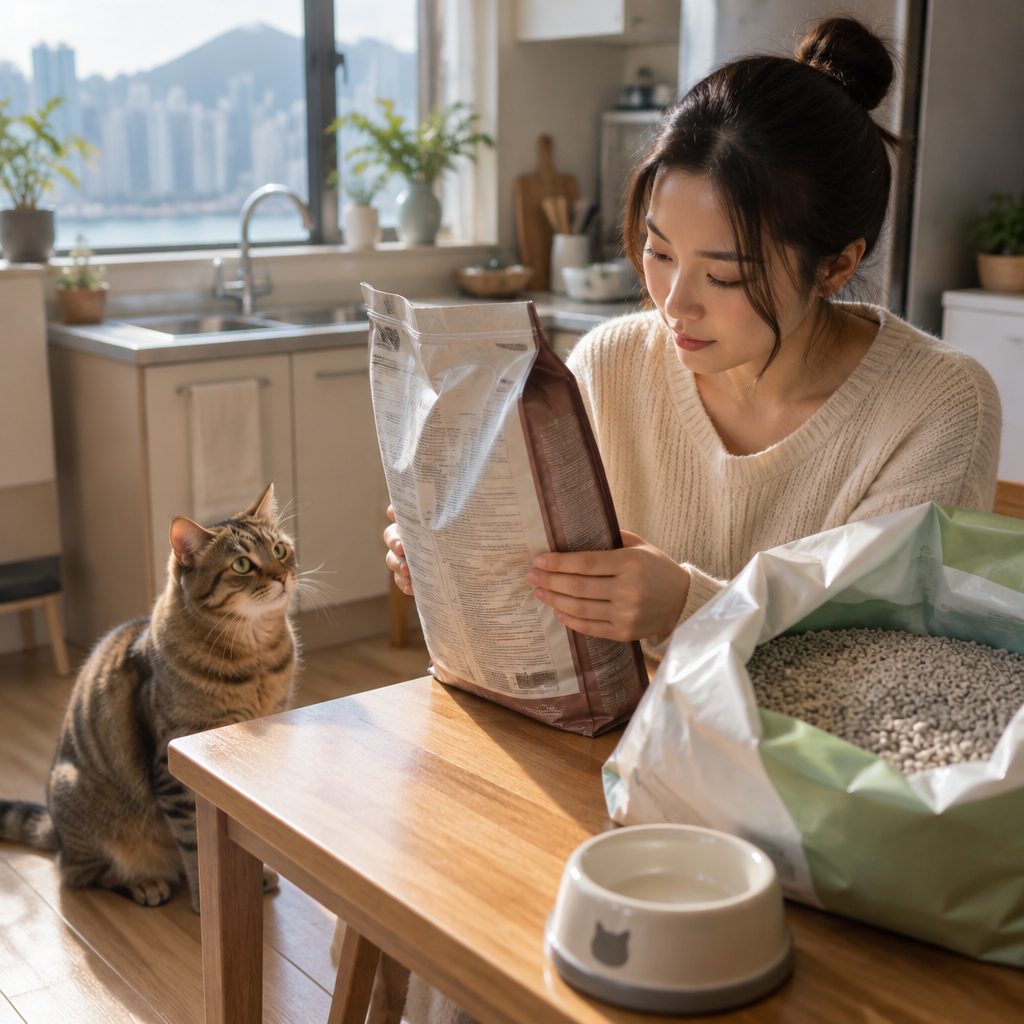
Most of the important information on pet food and supply packaging is in English, and being able to read English labels is the most practical step for Hong Kong pet owners before buying food or supplies. Below is a cheat sheet decoding the most common English terms on dog food, cat litter, pee pads, cat toys and medicine labels.
Quick answers
- Packaging English can be read in four layers: product type (dry/wet), life stage (puppy/adult/senior), ingredient list order, and expected analysis. Of these, the ingredient list and expected analysis most affect actual nutrition.
- Ingredients are listed by weight from most to least; the first ingredient makes up the largest proportion, but not necessarily more than half, so read the second and third ingredients together with it.
- 'Complete and balanced' and the nutritional adequacy statement are the key to judging whether a food is nutritious enough; 'natural', 'premium' and 'holistic' are marketing terms with no unified legal definition in most places.
- Cat litter English mainly covers clay, clumping, tofu, crystal/silica gel and pine; also check dust and scented on the pack.
- Dog pee pads are also called training pad, puppy pad, housebreaking pad and wee-wee pad; specs use absorbency, leak-proof, adhesive backing and similar terms.
- Medicine and dewormer labels mostly use anthelmintic or dewormer, with ingredient names such as praziquantel, pyrantel and selamectin; dosage must always be decided by a veterinarian based on body weight — never calculate it yourself from the packaging.
Key takeaways
- Reading order for English labels: life stage → nutritional adequacy statement → ingredient list → expected analysis → feeding guide.
- Whether the first ingredient is fresh meat or meat meal directly affects the protein source; meat, meat meal and by-product are three different legal definitions.
- Grain-free, holistic and human grade are market terms; they do not mean more complete nutrition, nor that the food suits pets with digestive issues.
- Cat litter and pee pad specs (clumping, dust-free, leak-proof) are mostly product descriptions, not legal claims, so compare them yourself and refer to real user experience.
- Medicine labels must be interpreted by a veterinarian; mg/kg, b.i.d. and t.i.d. on the pack must not be converted on your own.
What are the common English terms on dog and cat food packaging?
The English on the front of the pack is mostly selling points; the back is where the substance is. Imported foods and supplies in Hong Kong come from the US, Europe, Japan, Australia and New Zealand, and labelling formats vary, but the core fields are broadly similar. Below are the most common terms — learn to match them and you won't be led by the big words on the front.
| English term | Meaning | What to look for |
|---|---|---|
| dry food / kibble | Dry food / kibble | Moisture usually about 6%–12%, high calorie density, portion by body weight |
| wet food / canned food / pâté | Wet food / canned food / pâté | High moisture, good for cats that drink little; refrigerate after opening and use quickly |
| semi-moist | Semi-moist | Soft texture; watch sugar and humectant ingredients |
| life stage (puppy/kitten/adult/senior) | Life stage | Nutrient ratios differ for young and senior pets; do not share one food |
| chicken / beef / salmon | Chicken / beef / salmon | First place means the largest amount by weight |
| chicken meal / meat meal | Chicken meal / meat meal | Most water removed; protein concentration usually higher than fresh meat |
| by-product / poultry by-product meal | By-product / poultry by-product meal | Has a legal definition referring to specific organs, not 'waste' |
| crude protein / crude fat | Crude protein / crude fat | Shown as minimum or maximum, not actual digestibility |
| crude fibre / ash / moisture | Crude fibre / ash / moisture | Ash reflects total minerals; moisture affects storage |
| taurine | Taurine | Essential amino acid for cats; cat food must contain enough |
| omega-3 / omega-6 | Omega-3 / omega-6 fatty acids | Usually shown as minimum; linked to skin, coat and joint health |
| calorie content / ME kcal/kg | Calories / metabolisable energy | The most practical number for daily feeding, more accurate than 'cups' |
Remember one principle: adjectives on the front of the pack have no legal force; the numbers and statements on the back do. To compare similar products, the most practical approach is to turn both packs over and check each item against the table above.
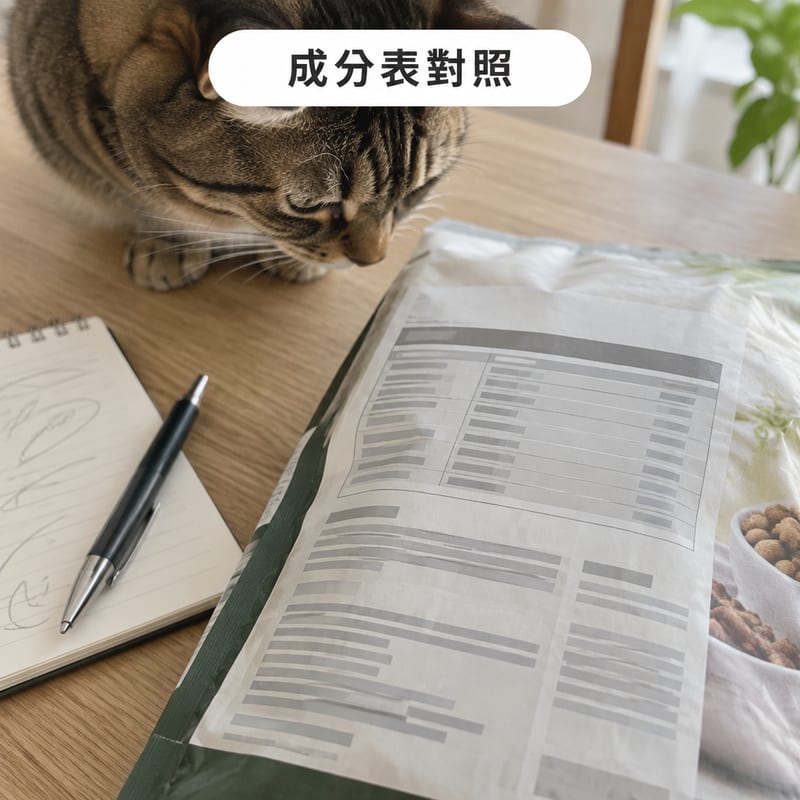
How do you read English cat food labels? Where do you start with the ingredient list?
The ingredient list is ordered by weight from most to least, so the first ingredient is the material with the largest share of the whole pack. But note two things:
First, moisture affects the order. Fresh meat is about 70% water and meat meal less than 10%, so the same batch of materials will rank higher if written as fresh meat and lower if written as meal. To know actual protein concentration, don't just look at whether the first ingredient is 'chicken' or 'chicken meal'.
Second, by-product does not mean poor quality. Under the US labelling system, for example, by-product is a clearly defined legal term referring to clean organs and similar parts, not random scraps; what really matters is how spread out the protein sources are across the whole list, and whether there is too much sugar or too many additives.
After the ingredient list, look at the expected analysis.
| Label field | English wording | Meaning and notes |
|---|---|---|
| Crude protein | crude protein (min) | Minimum value; actual may be higher |
| Crude fat | crude fat (min) | Also a minimum; adjust portions for high-fat formulas by activity level |
| Crude fibre | crude fibre (max) | Maximum value; higher or lower numbers don't necessarily correlate with digestive response |
| Moisture | moisture (max) | Wet food can be over 70%; dry food usually about 10% |
| Ash | ash (max) | Reflects total minerals; some urinary formulas highlight low magnesium |
| Calories | ME kcal/kg | Basis for daily feeding amount, more reliable than 'cups' |
| Taurine | taurine (min) | Essential for cats; usually shown as a minimum |
Then there is the most important field of all: the nutritional adequacy statement. This is usually printed in small print on the back, often worded 'formulated to meet the nutritional levels established by the AAFCO Cat Food Nutrient Profiles', meaning the food is formulated to meet the nutrient levels for a certain life stage; another wording refers to feeding tests, meaning the product has undergone actual feeding trials. Both are acceptable, but if the pack says 'for intermittent or supplemental feeding only', it can only be used as a treat or supplement, not as a main food.
Internationally, WSAVA (World Small Animal Veterinary Association) has long advised pet owners to prioritise the nutritional adequacy statement and life stage when reading labels, rather than just the ingredient list and front-of-pack claims; the US AAFCO also publishes a consumer guide to reading labels (see references at the end). Neither recommends any specific brand; they only explain how to read.
What is cat litter called in English? What's the difference between clay, clumping and tofu?
Cat litter is always called cat litter in English, but the wording on the pack varies greatly by material and clumping method. Hong Kong summers are humid, so when choosing litter, besides material, also look at dust and odour control — these two are usually stated right on the front of the pack.
| English | Chinese | Features and notes |
|---|---|---|
| clumping clay litter | Clumping clay litter | Clumps are easy to clean; watch dust and ingestion risk |
| non-clumping clay | Non-clumping clay | Absorbs but doesn't clump; usually needs full tray changes |
| tofu litter | Tofu litter | Mainly plant fibre; some claim flushable — follow product instructions |
| crystal / silica gel litter | Crystal litter | Absorbs moisture and odour, but some cats dislike the texture; watch ingestion |
| pine / wood pellet litter | Pine / wood pellet litter | Natural wood scent, breaks down to powder when wet; more dust when changing |
| paper pellet litter | Paper litter | Light texture, often used post-surgery or for kittens in transition |
| dust-free / low dust | Low dust | Product description, not a legal standard |
| scented / unscented | Scented / unscented | Cats are sensitive to scent; unscented is usually recommended |
| multi-cat formula | Multi-cat formula | Usually means enhanced odour control or clumping; not necessarily right for every cat |
| clumping strength / hard clumps | Clump hardness | Affects whether clumps break up and stick to the tray when scooping |
A common misconception is that 'dust-free' means absolutely zero dust. In reality these terms have no unified definition, and different batches of the same brand can vary. If anyone in the home — human or cat — has sensitive airways, check real user reviews, and you can also compare types one by one in the cat litter buying and usage guide. Before choosing litter, also think about whether you have one cat or many, as usage and changing frequency differ greatly.
What is a dog pee pad called in English? What other names are there besides pee pad?
Dog pee pads are one of the most-bought consumables among Hong Kong pet owners, yet the English names on the pack can be completely different. Below are common names and spec terms — check before buying so you don't get the wrong size.
- Product names: pee pad, training pad, puppy pad, housebreaking pad, wee-wee pad, absorbent pad, disposable pad, underpad.
- Absorbency: absorbency, absorbent capacity, holds up to X ml/cups, usually written as 'absorbs X ml' or 'day/night use'.
- Leak-proof design: leak-proof backing, waterproof layer, plastic backing, adhesive backing, sticky tabs (stick to the floor to prevent slipping).
- Extra features: charcoal layer, odour control, quick-dry surface, tear-resistant.
- Sizes: small/medium/large/extra large, also given in cm, e.g. 60×60cm, 60×90cm; measure your pen or pad tray before buying.
- Pack count: pack of 50, 100 pcs, count — note whether it means sheets or packs; brands differ.
Note that pee pads are mostly a 'support' product: if a puppy or senior dog has frequent urination, incontinence or a sudden change in urine volume, don't just switch to a thicker pad — take them to a veterinarian. For choosing supplies, see the pet supplies buying guide, which has comparison methods by use.
How do you tell apart the English names of cat toys and everyday supplies?
Many English names for cat toys and everyday supplies are ambiguous, and different brands call the same thing differently. Here is a common Hong Kong comparison:
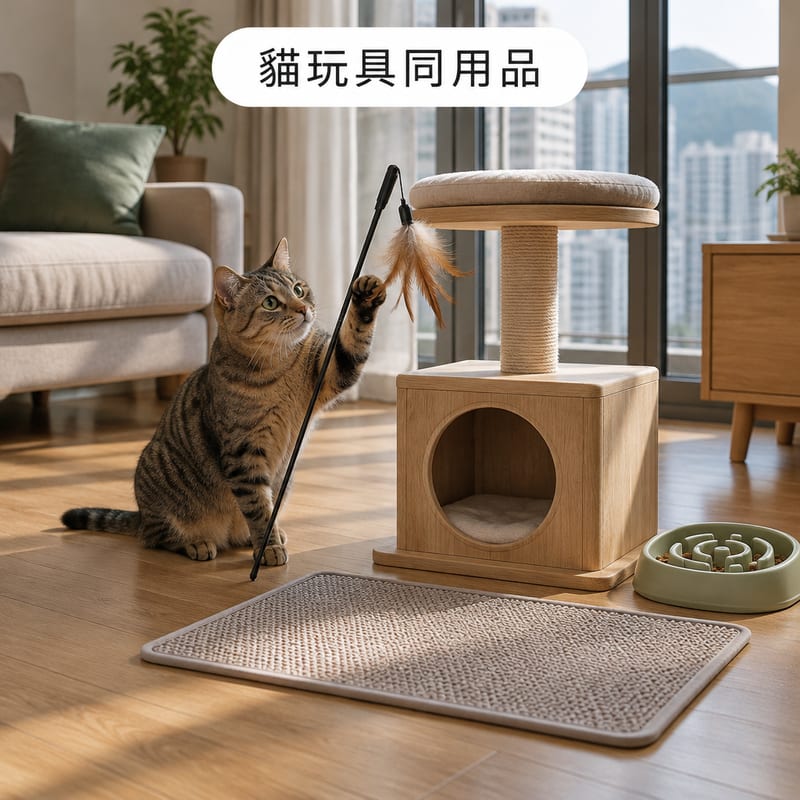
- Wand toys: wand toy, teaser wand, interactive wand, fishing pole toy, often with feather or worm attachments.
- Kicker toys: kicker, kicker toy, belly toy — long shapes for cats to hug and kick.
- Puzzle feeding: puzzle feeder, slow feeder, lick mat, treat dispensing ball — to slow eating.
- Scratching: scratching post, scratching pad, sisal (sisal rope material).
- Resting furniture: cat tree, cat tower, condo, hammock.
- Outdoor gear: harness, carrier, backpack carrier, stroller.
- Cleaning supplies: litter mat, litter scoop, self-cleaning litter box.
When choosing toys, safe, non-toxic and pet-safe on the pack are brand self-declarations with no unified legal standard; what really matters is the material, whether there are small detachable parts and the stitching. For a full guide to choosing toys and everyday supplies, see the cat toys and supplies guide.
What do terms like 'natural', 'premium' and 'holistic' mean?
These terms are marketing language; most places have no unified legal definition, so they cannot be used as an indicator of nutritional level. The WSAVA Global Nutrition Committee specifically notes in its label-reading guidance that the ingredient list and front-of-pack adjectives have limited usefulness for assessing a food's nutritional value, while the nutritional adequacy statement and calorie information are more useful.
To distinguish terms with legal meaning from pure marketing, remember this comparison:
- Meaningful (must meet a definition): complete and balanced, life stage (e.g. adult maintenance), AAFCO nutrient profile statements, nutritional adequacy statement.
- Mostly marketing terms (no unified definition): natural, holistic, premium, super premium, gourmet, human grade, no filler, vet approved.
- Claims to verify carefully: hairball control, urinary tract health, low magnesium, etc. — some are regulated claims in some places and require supporting data; not every brand can substantiate them.
- Easily confused terms: grain-free only means no grains; it does not mean low-carb, because potatoes, peas and similar are also carbohydrate sources.
In other words, 'nice packaging' and 'nutrition that suits your cat or dog' are two different things. To compare two foods, the safest approach is to look at the nutritional adequacy statement, expected analysis and calorie information, then match them to your pet's age, weight and health status.
How do you interpret the English names and abbreviations on medicine and dewormer labels?
Medicine and dewormer labels are the riskiest category, because the numbers on them relate directly to dosage. The following is for vocabulary comparison and understanding only; any dosage, administration and course of treatment must be decided by a veterinarian.
| English | Chinese | Notes |
|---|---|---|
| anthelmintic / dewormer | Dewormer | General term; in Hong Kong usually called deworming medicine |
| praziquantel | Praziquantel | Mainly for tapeworms; prescription ingredient |
| pyrantel | Pyrantel | Mainly for roundworms and hookworms |
| fenbendazole | Fenbendazole | Commonly used for intestinal parasites; course length set by vet |
| selamectin / fipronil | Selamectin / fipronil | Mostly topical spot-on ingredients; follow instructions for use and site |
| spot-on / topical | Spot-on / topical | After use, usually prevent the pet from licking the treated area |
| oral tablet / chewable / suspension | Oral tablet / chewable / suspension | Fasting or after food as directed by the vet |
| mg / kg | Milligrams per kilogram body weight | Dose by weight; do not convert yourself |
| b.i.d. / t.i.d. / s.i.d. | Twice / three times / once daily | Latin abbreviations; do not adjust frequency yourself |
| expiry date / batch no. | Expiry date / batch number | Expired medicine should not be used |
| prescription only / POM | Prescription-only medicine | Requires a vet prescription; do not buy and use on your own |
A few points to note: first, different dewormers target different parasites — tapeworms and roundworms require different ingredients, so 'buy a box of dewormer and give it at home' is high-risk. Second, getting the weight wrong means getting the dose wrong, and kittens, puppies and small dogs are especially sensitive. Third, topical spot-ons and oral medicines should not be casually combined; repeated dosing can cause overdose. Fourth, if you don't understand the English on a medicine label, the most practical step is to photograph it and ask your vet or pharmacy — don't rely on internet remedies. For basic principles of pet medication safety, see the pet medication safety guide.
What five steps can Hong Kong pet owners follow to check English labels?
If you have a fully English pack of food or supplies in hand, check in this order:
- Check life stage and species first: does the pack say for kittens, for adult cats, for all life stages? Cat and dog nutritional needs differ, especially taurine and vitamin A, so they cannot be used interchangeably.
- Check the nutritional adequacy statement: find the complete and balanced sentence, confirm whether it is formulated to meet or proven by feeding tests, and note whether it says 'for intermittent or supplemental feeding only'.
- Check the ingredient list order: read from first to fifth, see whether protein sources are concentrated or spread out, and whether there is too much sugar, flavouring or an ingredient your pet is known to be sensitive to (e.g. certain proteins or gum additives — see carrageenan and gums guide).
- Compare the expected analysis and calories: note the minimum crude protein, minimum crude fat, maximum moisture and ME kcal/kg, to compare brands and calculate daily feeding amounts.
- Check official information: packaging space is limited; full ingredient definitions, ingredient origins and country of manufacture are usually only on the brand's official website; if you can't find them, call official customer service or ask your vet.
One more point: when switching to a new food, don't change all at once — transition gradually by proportion; see the food transition guide. If you are switching because of digestive or skin issues, ask your vet first.
What are the four most common misunderstandings when reading English labels?
- Misunderstanding 1: if the first ingredient is fresh meat, it must be high quality. In fact fresh meat contains water, which makes it easy to rank first; to compare protein concentration, read the meat meal ingredients and expected analysis together.
- Misunderstanding 2: grain-free means hypoallergenic or low-carb. Grain-free only means no grains; it does not mean no other allergens, and potatoes and legumes also provide carbohydrates.
- Misunderstanding 3: human grade means people can eat it, so it must be safe. This is a marketing term; it is not the same as 'complete nutrition', nor does it make the product a main food that meets cat or dog nutritional standards.
- Misunderstanding 4: no Chinese on the pack means parallel import or fake. Not necessarily. Most imported foods are originally printed only in English and the language of the country of origin; to confirm the source, check the distributor label, batch number and official authorisation information.
Which cat foods and supplies have transparent labels that are easy to compare item by item?
Below are examples in stock at PetChill, all with clear English labels, so you can compare each item against the tables above before buying. Prices and stock are subject to the live price on the online store.
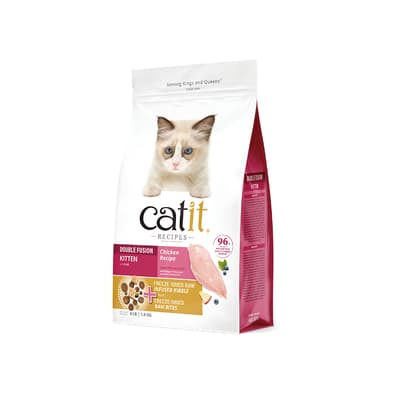
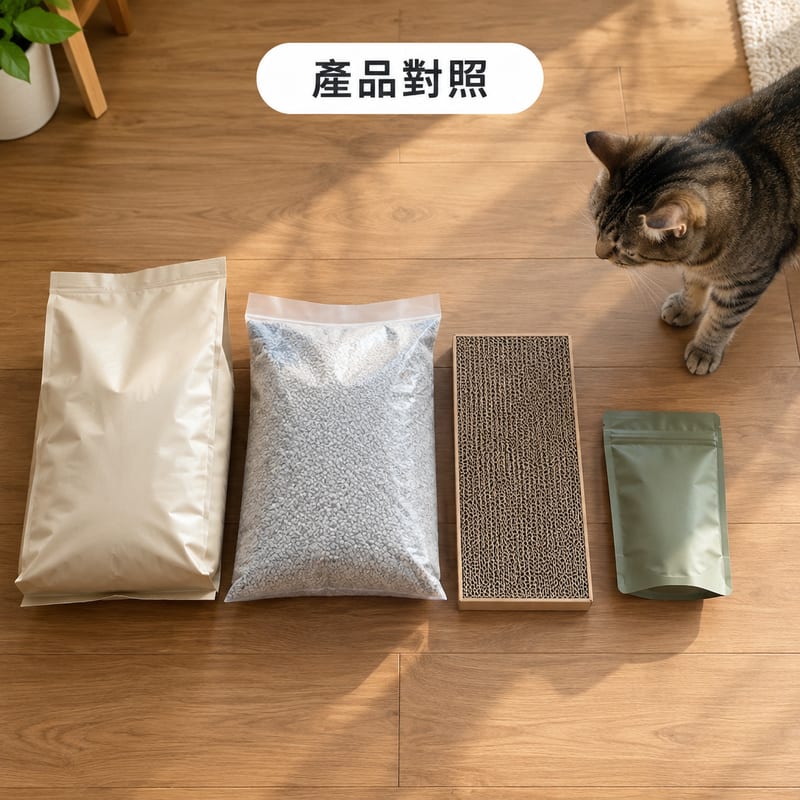
- Catit Recipes Cat Food (Adult Chicken) — HK$270. The pack has a full expected analysis and feeding guide, good for practising label reading.
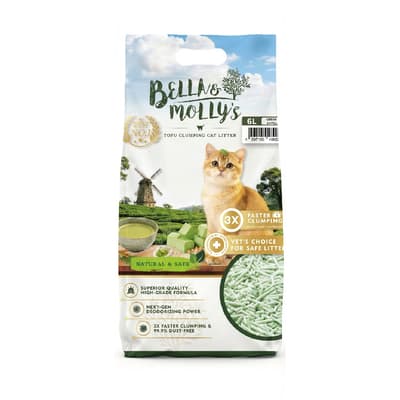
- Bella & Molly's Tofu Cat Litter — HK$24. The pack uses English to state material and clumping method, good for comparing with the cat litter vocabulary table above.
- Cat Scratching Pad — HK$118. A scratching product labelled with the term scratching pad, for comparing with the toy and supplies vocabulary.
- CIAO Chicken Flavour Churu Meat Paste — HK$15. A treat product; the pack generally states for intermittent or supplemental feeding, so it cannot be used as a main food.
PetChill shopping perks: free delivery sitewide, local Hong Kong delivery, no minimum spend; members get a personal 95% off discount code that can be used with other offers at checkout; purchases earn points, with 10 points redeemable for HK$1 off; Alipay, WeChat Pay and PayMe accepted; 7-day returns (goods must be in original condition). If you have questions about labels, WhatsApp customer service (Monday to Saturday 09:30–18:30) before ordering.
Further reading
- Complete guide to English pet food labels and buying
- Dog food nutrition label breakdown
- How to choose cat food? Life stage and ingredient comparison
- Cat litter buying and usage guide
- Carrageenan and gums guide
References
- WSAVA Global Nutrition Guidelines: https://wsava.org/global-guidelines/global-nutrition-guidelines/
- AAFCO Reading Labels: https://www.aafco.org/consumers/understanding-pet-food/reading-labels
- FDA Pet Food Labels - General: https://www.fda.gov/animal-veterinary/animal-health-literacy/pet-food-labels-general
- Hong Kong AFCD (pet import, animal welfare and regulatory information): https://www.afcd.gov.hk/
Veterinary warning: In an emergency, contact a veterinarian immediately; this article is for reference only and cannot replace veterinary diagnosis. Information checked as of 2026-10-14 · Source: PetChill editorial team
 K9 Natural full guide →
 Feline Natural full guide →
 Fuji One full guide →