
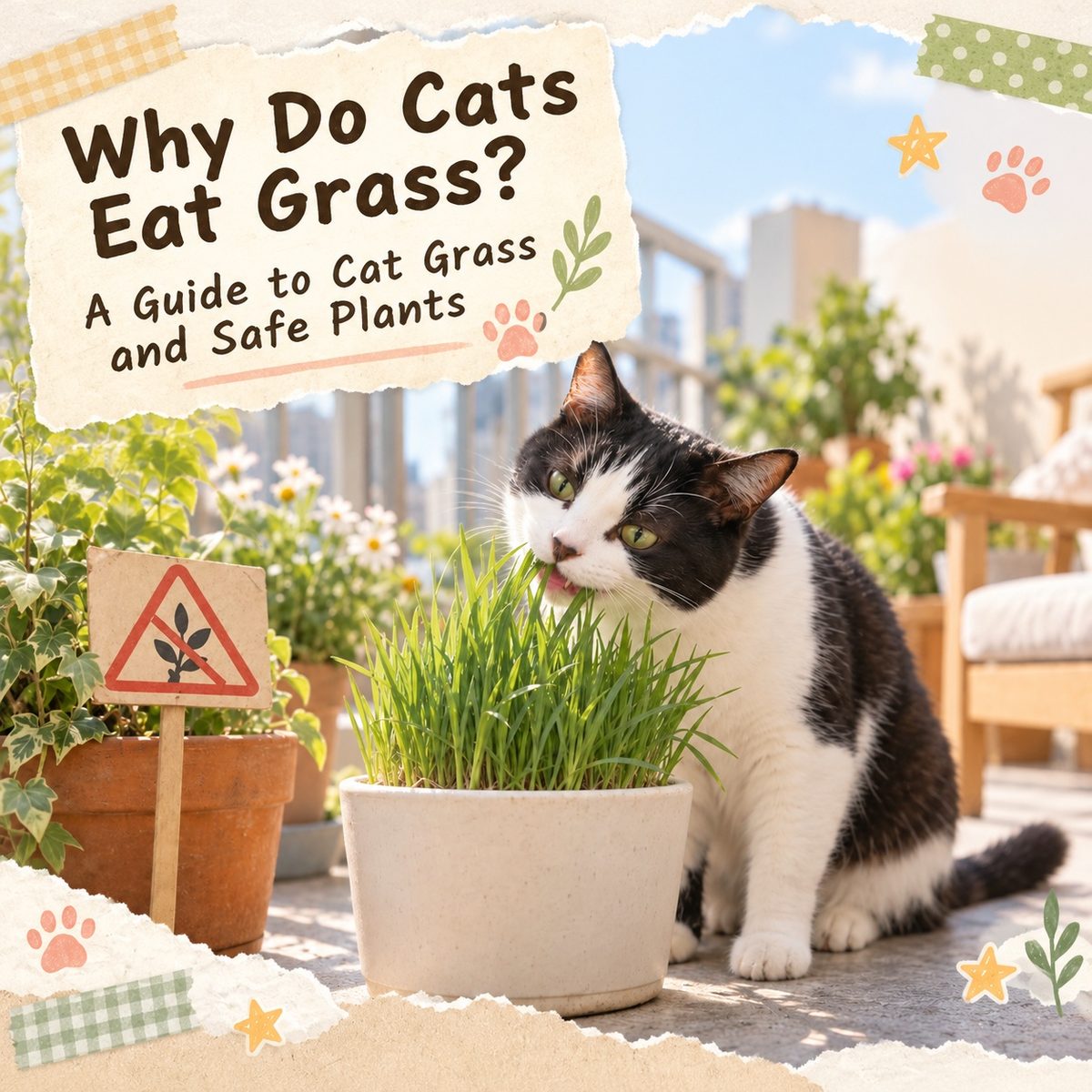
Quick answer: Cats eating grass is a natural feline instinct — a large behavioural study of domestic cats found over 90% have eaten plants, and most of the time it does not mean illness. What really matters is which grass they eat — wheatgrass, oat grass and other cat grasses are safe and even help pass hairballs; but lilies, golden pothos, lily of the valley, sago palm and 3 other common Hong Kong houseplants are deadly to cats, and a lily can cause kidney failure within 72 hours of ingestion. The safest approach: grow a pot of cat grass at home and remove toxic houseplants.
You get home from work and find your cat hiding in a corner, noisily chewing your golden pothos? Many cat owners panic the first time they see their cat eating grass. In fact, cats eating plants is extremely common natural behaviour worldwide — what really deserves attention is not 'should I stop it' but 'which grass is it eating, and could the wrong one cause harm'. Today we break down the science behind cats eating grass, teach you to grow a pot of cat grass at home, and include a blacklist of deadly houseplants.
What is cat grass? 30-second summary
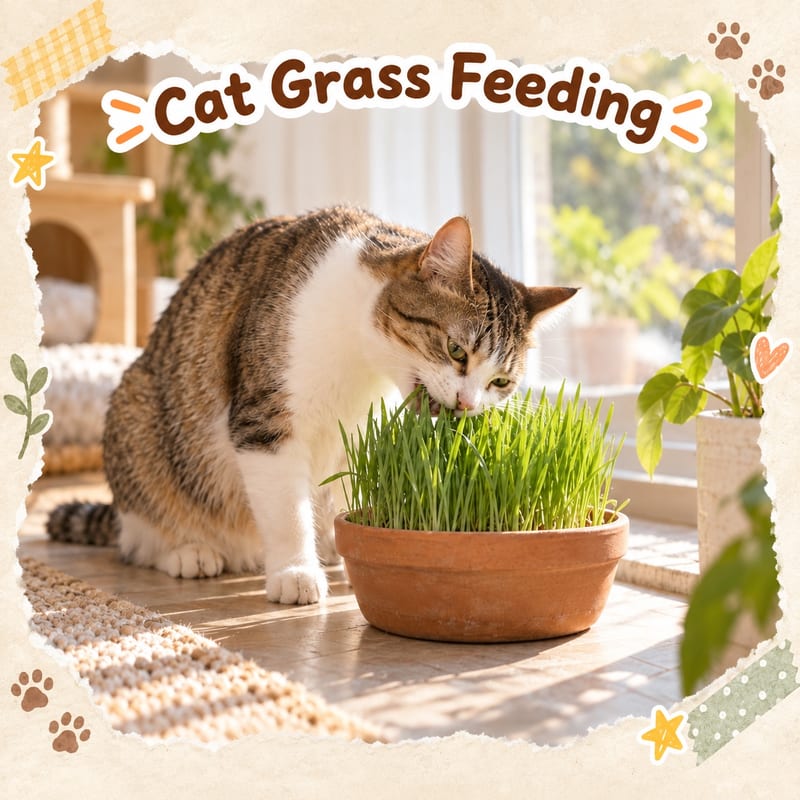
Cat grass generally refers to the seedlings of wheat, oats, barley and other cereals, not a specific herb. It is safe, easy to grow and low-cost — the most common home-grown hairball tool for Hong Kong cat owners. The table below shows the cat grass specs owners ask about most; after reading you will know whether it is worth keeping a pot at home.
| Item | Cat grass |
|---|---|
| Common types | Wheatgrass, oat grass, barley grass (grass-family seedlings) |
| Main components | Crude fibre, folic acid (vitamin B9), chlorophyll, trace minerals |
| Germination to harvest | About 5–7 days, edible at 10 cm |
| Recommended feeding frequency | 1–2 times a week, a small handful each time |
| Smell/texture | Light grassy scent, soft easy-to-bite leaves |
| Cat reaction | Gentle nibbling, then helps pass hairballs or through the gut |
| Safety | High (not a drug, not a stimulant — different from catnip) |
| Hong Kong price | Seeds about HK$20–60/packet, hydroponic tray about HK$30–80 |
| Monthly cost | Home-grown about HK$20–50; ready-grown pot about HK$60–120 |
Three basics you must know:
- Cat grass ≠ catnip — cat grass is eaten for fibre; catnip contains nepetalactone and is a plaything. They cannot replace each other.
- Home-growing is cheapest — a packet of seeds costing a few tens of dollars can grow 3–5 rounds, saving over 70% compared with buying ready-grown pots long-term.
- Do not pick grass outdoors — it may have pesticides, parasite eggs or other animals' urine; Hong Kong's hot, humid summers raise the mould risk even more.
Cat grass price and monthly cost (2026 Hong Kong market)
The cost of growing cat grass is almost negligible, but how you grow and feed it affects actual spending. The table below shows actual Hong Kong price ranges; figures are for reference only.
| Item | Range | Notes |
|---|---|---|
| Wheat/oat seeds | HK$20–60/packet | One packet can grow 3–5 rounds |
| Hydroponic/seedling tray | HK$30–80 | One-off cost, reusable |
| Organic peat soil | HK$25–50 | Each bag grows 2–3 pots |
| Ready-grown cat grass pot | HK$60–120/pot | Convenient but needs frequent repurchase |
| Hairball gel (support) | HK$80–150/tube | Not essential; ask a veterinarian first |
| Veterinary consultation (hairball blockage) | From HK$400/visit | Backup cost if symptoms appear |
| Monthly total (home-grown) | About HK$20–50 | Assuming one pot harvested every 7 days |
A reminder: the most expensive part of growing cat grass is not the materials but the waste of throwing away mouldy pots. Too much water and poor ventilation are the most common causes of failure in Hong Kong summers — keep the hydroponic tray water level below the seeds.
Who is cat grass suitable for?
| Owner situation | Suitability | Reason |
|---|---|---|
| Long-haired cats (Persian, Ragdoll) | Very suitable | High hairball risk; cat grass is the most practical help |
| Households that brush diligently in shedding season | Suitable | Cat grass + daily brushing is the most effective combination |
| New cat owners | Suitable | Low cost, easy to grow; no heartache if it fails |
| Living in a subdivided flat / windowless unit | Needs assessment | Insufficient light makes grass yellow; need grow lights or buy ready-grown |
| Cat shows no interest in cat grass | Need alternatives | Switch to high-fibre complete food and daily brushing |
Reverse self-check (three questions):
- Do you have a ventilated spot with indirect light at home where a pot of grass can grow?
- Are you willing to change the water and harvest once a week?
- Does your cat vomit unusually often after eating grass?
If you cannot answer 'yes' to two of the three, start with high-fibre complete food plus daily brushing instead — no need to force growing.
Cat grass vs other hairball options
| Option | Principle | Monthly cost | Suitable for | Speed of effect |
|---|---|---|---|---|
| Cat grass | Crude fibre stimulates gut movement | HK$20–50 | Most domestic cats | 1–2 weeks |
| Daily brushing | Removes loose dead fur at source | HK$0 | All cats | Immediate |
| High-fibre complete food | Fibre taken with the main diet | HK$0 (already in food) | Cats with normal appetite | 2–4 weeks |
| Hairball gel | Lubricates to help hairballs pass | HK$30–80 | Support for long-haired cats | 1–2 weeks |
| Veterinary prescription | Treats hairball blockage | Consultation from HK$400 | Cats already showing symptoms | Depends on condition |
In short: for the cheapest and most natural, choose home-grown cat grass; for zero cost, brush daily; if your cat is already frequently vomiting yellow fluid, it is not time to add grass — it is time to see a veterinarian.
Four common cat grass misconceptions
| Misconception | Reality |
|---|---|
| Cat grass is a specific plant | Cat grass generally refers to wheat, oat, barley and other cereal seedlings, not a single species |
| Eating cat grass always means illness | Over 90% of domestic cats have eaten plants; most is normal instinctive behaviour |
| Cat grass is the same as catnip | Cat grass is eaten for fibre; catnip is smelled/licked and contains nepetalactone which excites cats |
| The more you feed, the better the hairball control | 1–2 times a week, a small handful each time, is enough; overfeeding also causes vomiting |
Cat grass selection and use process (5 steps)
| Step | What to do | Time/cost |
|---|---|---|
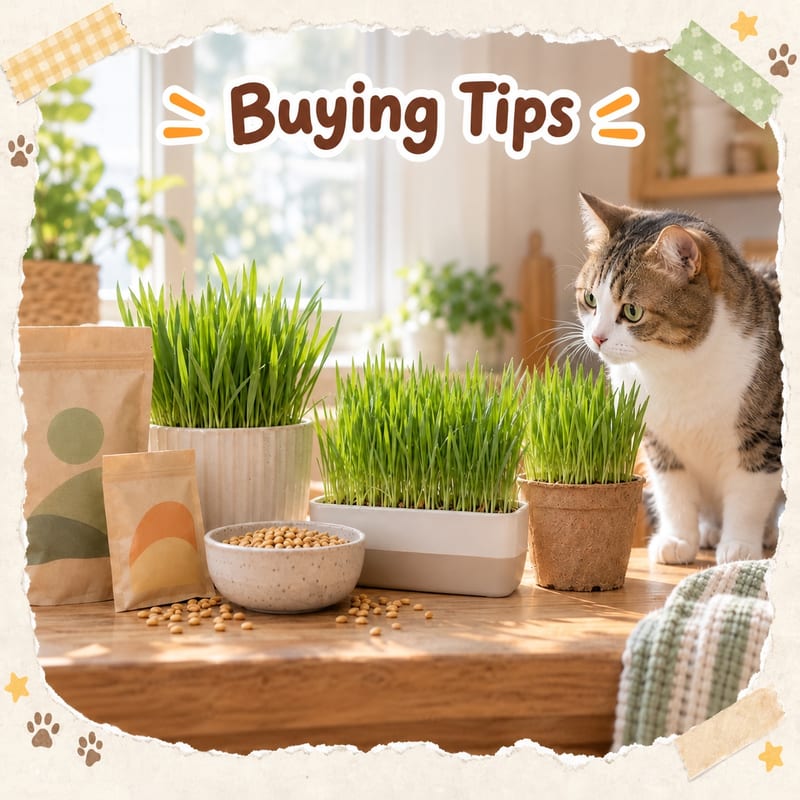
| 1 Choose seeds | Buy wheatgrass or oat grass seeds; avoid unknown loose sources | HK$20–60 |
| 2 Soak seeds | Soak in clean water 8–12 hours to trigger germination | One night |
| 3 Sow | Sprinkle on moist soil or hydroponic cotton, place in indirect light and keep moist | 5 minutes |
| 4 Harvest | When 10 cm tall, cut with roots; change water daily to prevent mould | After 5–7 days |
| 5 Feed | 1–2 times a week, a small handful each time | HK$0 |
Cat grass safety observation timeline
| Cat stage | Recommended approach | Things to watch |
|---|---|---|
| Kittens (under 3 months) | Not recommended | Gut not mature; first move toxic houseplants away |
| Kittens (3–6 months) | Small trial, a small pinch each time | Watch for 24 hours for vomiting or diarrhoea |
| Adults (1–7 years) | 1–2 times a week | Can increase slightly in shedding season |
| Adults (7+ years) | 1–2 times a week | Pair with a check-up every six months |
| History of hairballs | Cat grass + high-fibre complete food + daily brushing | Seek veterinary care if vomiting persists |
To learn why catnip can make your cat 'high', see Catnip science explained + safe use guide.
Three scenarios: how cat grass is actually used and what it costs per month
The same pot of cat grass is used differently by different households; cost differences mainly come from 'growing success rate' and 'cat appetite'.
| Scenario | Usage | Monthly cost | Notes |
|---|---|---|---|
| Single short-haired cat | Once a week | Under HK$20 | Increase to twice in shedding season |
| Single long-haired cat | Twice a week | Under HK$40 | Best with daily brushing |
| Two-cat household | 2–3 times a week, two pots harvested in rotation | Under HK$50 | Separate pots to avoid competition |
| Frequent growing failure | Buy ready-grown pots | HK$120–360 | Depends on repurchase frequency |
| Do not want to grow at all | Daily brushing + high-fibre complete food | HK$0 (already in food) | Acceptable results |
Cat grass safety checklist (check each item before every feeding)
- ✅ Leaves bright green, no yellow spots or mould
- ✅ Water changed before harvest, roots have no odour
- ✅ Growing location confirmed free of pesticides
- ❌ Mouldy, discoloured or sour-smelling — throw away immediately
- ❌ Never feed grass from outdoor patches or unknown sources
Three practical cat grass questions
Q: Is it cheaper to buy ready-grown pots or grow my own? A: A packet of seeds costs about HK$20–60 and can grow 3–5 rounds; ready-grown pots cost HK$60–120 each. Long-term home-growing saves over 70%, provided you have a spot with indirect light and ventilation and are willing to change the water weekly.
Q: Can I feed cat grass every day? A: Not recommended. 1–2 times a week, a small handful each time, is enough; overfeeding also causes vomiting. At most increase slightly in shedding season — do not use it as a meal.
Q: What if my cat completely ignores cat grass? A: Switch to 5 minutes of daily brushing plus a high-fibre complete food containing psyllium husk — this already handles most hairball problems; no need to force it.
Why do cats eat grass? It is not just to vomit hairballs
Older generations say cats eat grass 'to vomit a hairball'. This is partly correct: grass blades can indeed stimulate the cat's stomach and help bring accumulated hairballs up together with grass; the crude fibre in grass can also promote gut movement so dead fur passes in the stool.
But a large behavioural study of domestic cats found over 90% have eaten plants, and most showed no discomfort before eating — mostly gentle nibbling and slow chewing. In other words, eating grass is itself a natural feline instinct, not necessarily a warning sign of illness. Veterinarians suggest several main reasons:
- Folic acid supplement: grass contains folic acid (vitamin B9), which helps cats' blood carry oxygen. When the daily diet is insufficient, cats instinctively seek plants to supplement.
- Helps pass hairballs: especially needed by long-haired cats that groom diligently; crude fibre helps hairballs pass through the gut or be vomited up.
- Ancestral instinct: wild cats ate grass along with the stomach contents of prey; the habit has been passed down for thousands of years.
- Boredom relief and stress reduction: some cats chew when bored or stressed, as self-entertainment like playing with toys.
The table below helps you see at a glance the scientific basis for the four reasons and what owners can actually do:
| Reason for eating grass | Scientific explanation | What owners can do |
|---|---|---|
| Folic acid supplement | Grass contains vitamin B9, supporting blood formation and oxygen transport | A balanced complete food is enough; no extra supplements needed |
| Passing hairballs | Crude fibre stimulates gut movement, helping dead fur pass | Feed cat grass 1–2 times a week in shedding season |
| Ancestral instinct | Wild felines ate grass in prey stomachs | Normal behaviour; no need to correct or stop |
| Boredom/stress relief | Substitute behaviour when bored or stressed by environment | Increase interactive play and environmental enrichment |
Three practical benefits of cat grass
Cat grass usually refers to wheat, oat, barley and other cereal seedlings — safe and easy to grow:
- Promotes hairball passage — fibre helps dead fur pass through the gut, reducing vomiting frequency. If your cat's hairball vomiting suddenly becomes more frequent or it vomits yellow fluid, watch for hairball blockage; see The complete guide to cat hairballs to tell normal from dangerous symptoms.
- Adds fibre and folic acid — supports digestion and blood health, especially useful in shedding season.
- A safe alternative chewing target — with something edible at home, cats will not chew toxic houseplants — two benefits in one.
What is the difference between cat grass, catnip and silvervine?
Many cat owners confuse these three, but their functions are completely different: cat grass is a 'eaten' fibre supplement, while catnip and silvervine are 'smelled/bitten' entertainment products. Buy the wrong one and your cat may show no reaction at all, or even become overexcited.
| Item | Cat grass (wheat/oat seedlings) | Catnip | Silvervine |
|---|---|---|---|
| Main components | Fibre, folic acid, chlorophyll | Nepetalactone | Silvervine lactones, actinidine |
| Cat reaction | Gentle nibbling, then vomits hairballs or passes through gut | Excited rolling, drooling, rubbing for 5–15 minutes | Similar to catnip; some cats react more strongly |
| Main use | Eaten, fibre supplement to help pass hair | Smelled/licked, entertainment and stress relief | Smelled/bitten, entertainment and chewing |
| Cautions | Prevent mould; discard if mouldy | About 30% of cats show no reaction naturally | Not recommended for kittens or cats with a history of seizures |
To learn why catnip can make your cat 'high', see Catnip science explained + safe use guide.
4 steps to grow cat grass at home
- Choose seeds: wheatgrass/oat grass seeds (available at pet shops or hydroponic stores). Cat books say 'every cat-owning household should have a pot of fresh cat grass'.
- Soak seeds: soak in clean water 8–12 hours to trigger germination.
- Sow: sprinkle on moist soil or hydroponic cotton, place in indirect light and keep moist.
- Harvest: after about 5–7 days, when 10 cm tall, give to the cat; change water daily to prevent mould, and if mould appears throw it away and regrow.
Hong Kong's humid weather makes cat grass growing tricky in a few common ways — remember these:
- Mould and odour: usually too much water and poor ventilation. Keep the hydroponic tray water level below the seeds and change water once a day.
- Yellow, thin growth: insufficient light. Place in a bright spot by a window with indirect light; avoid direct sun.
- Soil flying everywhere: add a thin layer of sphagnum moss or coco coir on top to reduce digging.
- Cat eats it all at once: grow two pots in rotation — while one is being eaten, the other is sprouting.
⚠️ Note: 'cat grass' is not the same as 'catnip'. Catnip contains nepetalactone and makes cats excited and roll around — it is a plaything; cat grass is an eaten fibre supplement. Do not mix them up.
How much to feed?
Once or twice a week, a small amount each time, is enough; overfeeding can also cause vomiting. Special reminder: never let cats eat outdoor grass — it may have pesticides, parasite eggs or other animals' urine; Hong Kong's hot, humid summers raise the mould risk even more.
When should you be especially careful? In the following three situations, see a veterinarian directly rather than continuing to feed grass:
- The cat vomits continuously for over 24 hours, or even vomits yellow-green fluid
- Appetite and energy clearly decline; it hides and ignores people
- Constipation for over two days, or straining repeatedly when passing stool
To learn to judge your cat's condition from stool and vomit, see Cat poop observation guide and The complete guide to cat vomiting — both have photo comparisons.
3 hairball helpers besides cat grass
If your cat is not interested in cat grass, or your home is not convenient for growing it, you can use these methods:
- 5 minutes of daily brushing: directly removes loose dead fur — the most effective source control; for long-haired cats, twice a day (morning and evening) is better.
- High-fibre complete food or hairball formula: choose a complete food labelled with fibre (such as psyllium husk) to help hairballs pass through the gut.
- Hairball gel in moderation: as a supplement, not a daily necessity; overdose affects nutrient absorption — ask a veterinarian first.
Also: if your cat eats grass but also steals human food, watch for poisoning risks. Chocolate, onion, garlic, grapes, xylitol and others are toxic to cats; for the full list see The complete guide to cat food toxins.
⚠️ First aid for toxic houseplant ingestion
There are over 700 plants toxic to cats; the following are the most common dangers in Hong Kong homes:
| Plant | Toxic component | Common symptoms after ingestion | Danger level |
|---|---|---|---|
| Lily | Unknown alkaloids (whole plant toxic) | Vomiting, drooling, lethargy; can cause kidney failure within 72 hours | Extremely high (seek veterinary care same day) |
| Golden pothos, ivy | Calcium oxalate crystals | Oral mucosa inflammation, difficulty swallowing, abdominal pain and vomiting | High (mostly reversible) |
| Lily of the valley | Cardiac glycosides | Slow heartbeat, arrhythmia, seizures; can cause sudden death in severe cases | Extremely high |
| Sago palm | Cycasin | Seeds most toxic; can cause liver failure and death | Extremely high |
| Azalea | Grayanotoxin | Persistent vomiting, aspiration pneumonia, neurological signs | High |
| Poinsettia | White sap | Severe mouth pain, vomiting and diarrhoea | Medium (mostly local irritation) |
If you suspect your cat has eaten a toxic plant, never induce vomiting yourself — take a photo of the plant and take the cat to a veterinarian immediately; for lilies, do not wait for symptoms before seeking care. The simplest daily prevention: before buying a houseplant, check whether it is 'cat-safe'; if you have lilies or lily of the valley at home, the safest approach is not to keep them.
Frequently asked questions
Q: Does eating grass mean my cat is sick?
A: Not necessarily. Studies have found most cats show no signs of discomfort before eating grass — it is natural instinct. But if your cat suddenly eats grass frequently along with persistent vomiting, loss of appetite or lethargy, see a veterinarian to rule out gastroenteritis or a hairball blockage.
Q: How often should I give cat grass?
A: Once or twice a week, a small handful each time, is enough. Overeating can also cause vomiting. During shedding season (spring and autumn) you can increase slightly to help shed dead fur.
Q: What is the difference between cat grass and catnip?
A: Cat grass is wheat, oat and other cereal seedlings — eating it adds fibre and folic acid and helps pass hairballs. Catnip is a different plant containing nepetalactone; smelling it makes cats excited and roll around. It is mainly for entertainment, not nutrition.
Q: What should I do if my cat eats a toxic plant?
A: Never induce vomiting yourself. Take a photo of the plant, note the time and amount eaten, and take your cat to a veterinarian immediately. If it was a lily, seek veterinary care the same day even without symptoms, because kidney failure signs may only appear days later.
Q: Can kittens eat cat grass?
A: After about three months old they can try a small amount, but kittens have sensitive stomachs — for the first time give only a small pinch and watch for 24 hours for vomiting or diarrhoea. Kittens are very curious, so move toxic houseplants out of their reach even earlier.
Q: What seeds is cat grass grown from? Can I grow it myself? A: Usually wheat, oat or barley seeds, which sprout within days. Home-growing is most practical: a shallow pot with potting soil, keep moist, place in a bright spot, and it can be cut in about 7–10 days; it may regrow for another round, but watch that the soil does not go mouldy.
Q: My cat vomited after eating grass — is that normal? A: Occasionally vomiting a hairball or grass bits is normal, but frequent vomiting, yellow fluid or reduced appetite is not just 'passing a hairball' — see a veterinarian promptly to rule out gastrointestinal problems.
Q: Is cat grass prone to mould in Hong Kong summers? How can I prevent it? A: Yes, because of high heat and humidity. Control watering frequency, use a pot with drainage holes, and place it in a ventilated spot; if you see white fuzz on the soil or pot edge, throw away the whole pot — do not cut and feed it.
Key takeaways
- ✅ Over 90% of domestic cats have eaten plants; eating grass is mostly natural instinct, not a sign of illness
- ✅ Wheatgrass, oat grass and other cat grasses are safe and easy to grow; harvest in 5–7 days at a cost of a few dollars
- ✅ Feed cat grass 1–2 times a week in shedding season, paired with daily brushing — the most effective hairball combination
- ✅ Cat grass ≠ catnip: one is eaten for fibre, the other is smelled for entertainment
- ✅ Besides cat grass, there are three supporting options: high-fibre complete food, hairball gel and daily brushing
- ❌ Never let cats eat outdoor grass or grass of unknown origin
- ❌ Lilies, golden pothos, lily of the valley, sago palm and 3 other common Hong Kong houseplants are deadly to cats — do not place them within reach
- ❌ Inducing vomiting yourself after toxic plant ingestion only worsens the harm — seek veterinary care immediately
PetChill's Reminder
Cats eating grass is mostly normal behaviour; the smartest approach is to proactively prepare a pot of safe cat grass for them while clearing toxic houseplants from the home. Watch vomiting frequency, give extra care in shedding season, and consult a practising veterinarian if in doubt. To learn more about cat care, keep following PetChill's latest articles!
References: behavioural study of domestic cats eating plants (over 90% of domestic cats have eaten plants), veterinary toxicology lists of common household toxic plants, The Cat Encyclopedia chapters on cat grass and dietary fibre.
Further reading
- Comparison of 12 cat breeds' personalities and prices →
- Common diseases, preventive care, veterinary information →
- Comparison of 12 cat breeds' personalities and prices →
- Common diseases, preventive care, veterinary information →
- Cat kidney disease →
- Cat dental care →
- How to choose a litter box? 2026 Hong Kong litter box guide →
- Pet travel supplies →
 Fuji One full guide →

