
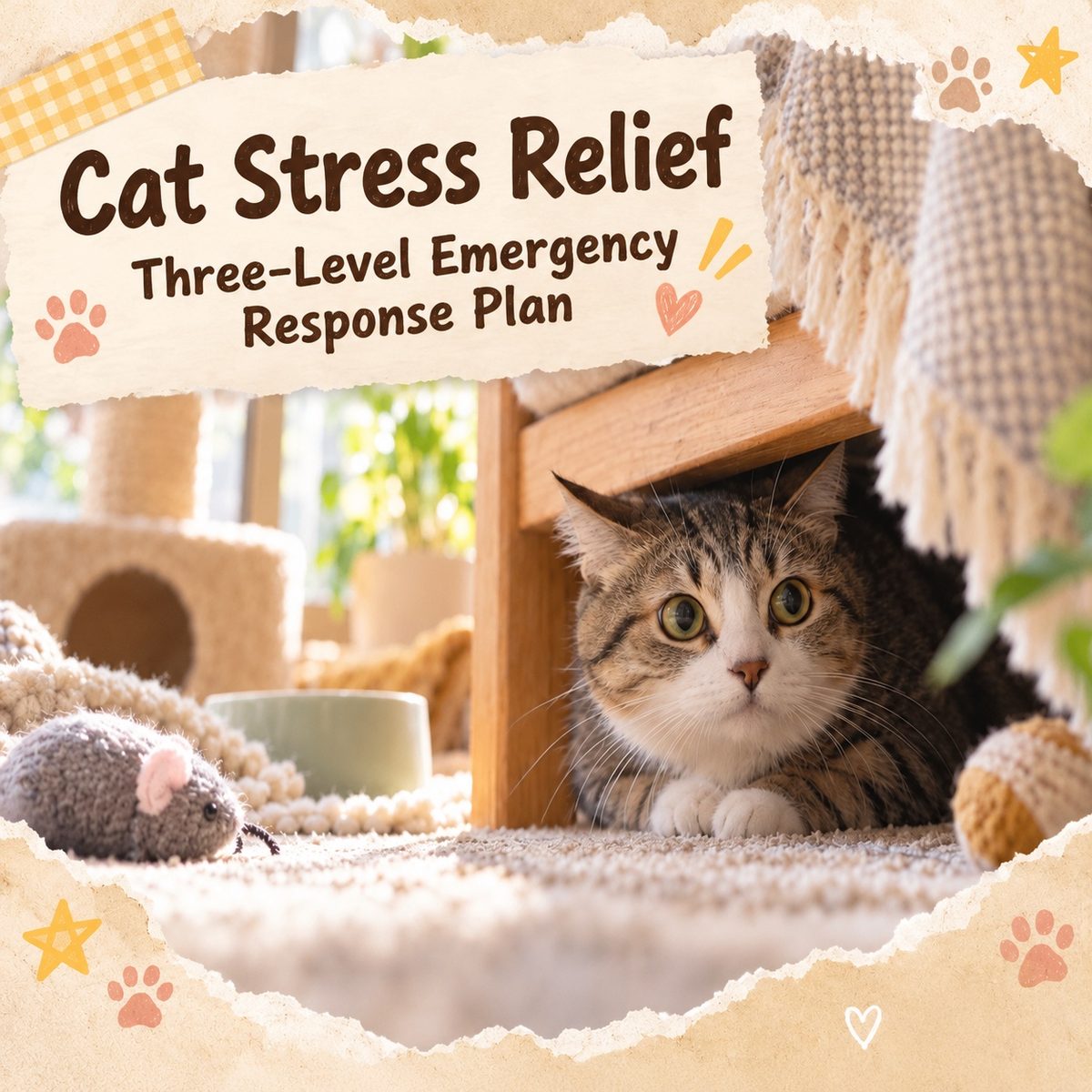
🤖 AI summary
A stress response is a whole-body reaction when a cat faces pressure: mild cases hide and lose appetite; severe cases puff up, hiss, urinate inappropriately and may even develop disease. Cats are good at hiding pain, so many 'sudden personality changes' are actually accumulated stress boiling over.
• Red-green checklist: normal reassurance vs see a vet
• 4-step stress first aid: remove the source → reduce stimulation → restore routine → monitor eating
• 24 hours without food / repeated vomiting or diarrhoea = see a vet immediately
Quick answer: A cat stress response is a whole-body reaction to pressure: mild cases hide and lose appetite, moderate cases over-groom and urinate inappropriately, severe cases hiss, puff up and refuse food; 24 hours without food or no urine in the litter box means see a vet.
Stress responses come in three levels: mild (hiding, alertness) can resolve on its own; moderate (over-grooming, inappropriate urination, reduced appetite) needs active de-stressing; severe (persistent hissing and puffing, 24 hours without food, repeated vomiting or diarrhoea, rapid breathing) needs an immediate vet visit — chronic stress weakens immunity and triggers cystitis, gastroenteritis and other diseases.
Contents
-
Quick reference: stress signs × immediate action
-
What is a stress response?
-
Three-level stress response comparison table
-
Common stressors
-
4-step stress first aid
-
Red-green checklist: when to see a vet (with FAQ)
Quick reference: stress signs × immediate action
| Sign | Level | Immediate action | When to see a vet |
|---|---|---|---|
| Ears back, slightly dilated pupils, alert scanning | Mild | Remove the stimulus, open hiding spots, don't chase to comfort | Usually settles within hours; no vet needed |
| Prolonged hiding, reduced appetite | Moderate | Resume scheduled feeding and litter scooping, don't force cuddles | No improvement after 3 days |
| Over-grooming, licking to bald patches | Moderate | Rule out skin disease first, then add hiding spots and fixed playtime | Book an appointment if it lasts over 3 days |
| Inappropriate urination / spraying | Moderate | Check number of litter boxes (cats + 1) and location, check for stray cats outside the window | If urination is painful, book within 24 hours |
| Sudden fearfulness, hissing, aggression | Moderate | Rule out pain first (biting when touched is a pain signal), then check social conflict | See a vet if accompanied by complete anorexia |
| All-day puffing and hissing, fleeing or attacking on sight | Severe | Take to the furthest room to isolate + white noise, reduce all stimulation | See a vet immediately |
| 24 hours of complete anorexia | Red line | Don't wait, don't force-feed | See a vet immediately (fatty liver risk) |
| 24 hours with no urine in the litter box (especially male cats) | Red line | Don't wait for an appointment, go directly to a 24-hour animal hospital | Urinary blockage can be fatal within 24–48 hours |
| Repeated vomiting or diarrhoea | Red line | Record frequency and timing to prepare for the vet | See a vet immediately (dehydration risk) |
| Rapid breathing, pale or blue gums | Red line | Keep the environment quiet, don't force movement | See a vet immediately |
Quick-reference principle: first decide 'can it settle on its own' vs 'needs human intervention', then decide 'when a vet is needed'. The same cat can be at different levels on different days — look at how long symptoms last, not a single episode.
What is a cat stress response? 30-second summary
A cat stress response is a whole-body physiological reaction to pressure — the brain judges danger, adrenaline and cortisol rise immediately, and the body enters 'fight, flight or freeze'. Brief stress is a normal survival mechanism; the problem is when the stressor persists, chronically high cortisol weakens immunity and disrupts the digestive and urinary systems. Below is a quick overview of the whole article; if you're short on time, read the red-green checklist first.
| Item | Key point |
|---|---|
| Nature | An instinctive physiological reaction, not 'being difficult' or 'bad temperament' |
| Three levels | Mild resolves on its own / moderate needs intervention / severe needs immediate vet care |
| Most dangerous signals | 24 hours without food, male cat with no urine in litter box, rapid breathing |
| Biggest blind spot | Cats hide weakness well; by the time you see obvious abnormality, it has often been brewing for a while |
| Core management | Remove the stressor + restore routine + monitor eating and litter box |
| Hong Kong-specific sources | Upstairs renovation, small flats with no high places, humid heat, neighbourhood noise |
Remember one line: stress itself rarely kills directly, but the chain reaction it triggers (fatty liver, urinary blockage, immune collapse) can. Recognise it one day earlier and save ten times the vet bills.
Stress mechanism at a glance: what's happening inside the body
| Stage | Body changes | External signs | Timescale |
|---|---|---|---|
| Alarm stage | Adrenaline surges, heart rate rises | Dilated pupils, ears back, tense muscles | Seconds to minutes |
| Resistance stage | Cortisol stays high, digestion slows | Reduced appetite, hiding, over-grooming | Hours to days |
| Exhaustion stage | Immunity drops, old illnesses return | Cystitis, gastroenteritis, respiratory infections | After weeks of ongoing stress |
The key is the 'resistance stage': at this stage the cat still 'looks normal', but the body is running on empty. Many owners miss the intervention window here and only discover it at the exhaustion stage — by then it's a vet matter, not a de-stressing toy matter.
Trigger and symptom comparison table
The same stressor can produce different symptoms in different cats. Use this table to work backwards from 'observed symptom' to 'possible trigger':
| Observed symptom | Common trigger | Priority check |
|---|---|---|
| Suddenly hiding under the bed / on top of the wardrobe | Visitors, new pet, loud noise | What changed at home in the past 48 hours |
| Inappropriate urination / spraying | Litter box issues, multi-cat resource competition, stray cats outside the window | Number and location of litter boxes, source of smell |
| Over-grooming to bald patches | Chronic stress, boredom, skin problems | Rule out skin disease first, then check environmental stress |
| Reduced appetite, fussy eating | Too-fast food transition, bowl position disturbed, oral pain | Bowl location and recent food changes |
| Sudden aggression, hissing | Pain signal, forced contact, territorial pressure | Rule out physical pain first, then check social conflict |
| Late-night yowling, pacing | Senior cognitive dysfunction, separation anxiety | Age and time alone |
Working-backwards principle: environmental changes within 48 hours before symptoms appear are the prime suspect. Renovation, new furniture, new cat, changed litter — the answer is in this time window in nine out of ten cases.
Home de-stressing methods and prices (Hong Kong market)
De-stressing doesn't have to cost money, but some tools do save time. Do it in the order 'free first, paid later':
| Method | Approximate price | Suitable for |
|---|---|---|
| Cardboard box hiding spots (one per room) | Free | The basics for every stressed cat |
| Fixed routine (scheduled feeding, scheduled play) | Free | Predictability = security |
| Old clothing with your scent in hiding spots | Free | Moving house, new member joining |
| White noise machine / fan to mask noise | HK$0–300 | Upstairs renovation, thunderstorms, fireworks |
| Pheromone diffuser (refill lasts 30 days) | HK$300–450 (refill HK$200–280) | Switch on 2–3 days before moving or a new cat joining |
| Pheromone spray | HK$150–250 | Carriers, new furniture, car |
| Cat tree / window perch (above 1.5 m) | HK$300–1,500 | Adding vertical space in small flats |
| Puzzle feeder / snuffle mat | HK$50–200 | Boredom-related stress, long time alone |
| Cat pen to separate multi-cat spaces | HK$200–800 | Multi-cat resource conflict |
The correct role of paid tools is 'support': running a pheromone diffuser without removing the stressor is like running the air-conditioning while sauna-ing. Check the trigger first, then choose tools.
When to see a vet: red-flag checklist
If any one of these applies, don't observe, don't ask the internet — act directly:
| Red flag | Risk | Action |
|---|---|---|
| 24 hours of complete anorexia | Fatty liver (fat cats are high-risk after 2–3 days without food) | See a vet immediately |
| 24 hours with no urine in the litter box (especially male cats) | Urinary blockage, can be fatal within 24–48 hours | See a vet immediately |
| Repeated vomiting or diarrhoea | Dehydration, acute gastrointestinal problems | See a vet immediately |
| Rapid breathing, pale or blue gums | Breathing crisis | See a vet immediately |
| Inappropriate urination + crying when urinating | Stress cystitis or stones | Book within 24 hours |
| Over-grooming lasting over 3 days | Chronic stress or skin disease | Book within 3 days |
Cats tolerate not eating far less than dogs. Remember one number: 24 hours is a red line, not a reference value.
Four most common misconceptions about cat stress responses
| Misconception | Reality |
|---|---|
| Hiding means 'ignoring you', so pull the cat out to comfort it | Hiding is a self-regulation mechanism; forcing it out only prolongs recovery — let the cat decide when to come out |
| Stress is a psychological issue and doesn't affect the body | Chronically high cortisol directly weakens immunity and triggers cystitis and gastroenteritis — it is a real physiological issue |
| Catnip can solve stress | It only briefly relaxes about 2/3 of cats; it is an adjunct. The core is always removing the stressor |
| In multi-cat households 'they'll sort it out themselves' | Insufficient resources (litter boxes, bowls, high places) create chronic stress; litter boxes = cats + 1 is a hard rule |
Clear these four misconceptions, and the three-level table and four-step first aid below will be useful.
7-day de-stressing action plan
De-stressing is not 'buy a new toy and you're done' — it's a small project with rhythm. Follow this table day by day; most moderate stress cases show clear improvement within 7 days:
| Day | Key action | Observation indicator |
|---|---|---|
| Day 1 | Identify the trigger (changes in the past 48 hours); open all hiding spots | Will the cat come out to eat? |
| Day 2 | Fix feeding and litter-scooping times; don't force cuddles | Has appetite picked up? |
| Day 3 | Add a high perch; mask noise sources with white noise | Is litter box use normal? |
| Day 4 | Introduce pheromones (if any); route feeding away from conflict spots | Is mood more stable? |
| Day 5 | Add 10 minutes of play (wand toy, not hands) | Does the cat respond to interaction? |
| Day 6 | Review resource layout: litter box, water bowl, scratcher positions | Any queuing / ambushing? |
| Day 7 | Assess: symptoms halved = continue; no improvement = book a vet | Don't drag past this point |
Day 7 is an honest checkpoint: if there's improvement, keep going; if not, stop looking for home remedies online — symptoms lasting a week may mean an underlying medical issue that behaviour intervention can't fix.
Multi-cat household resource allocation table
In multi-cat households, 80% of stress is a resource-design problem, not 'the cats don't get along'. Check your home against this table:
| Resource | Minimum requirement | Common mistake |
|---|---|---|
| Litter box | Cats + 1, spread across different areas | All in the corridor / kitchen |
| Water bowl | Cats + 1, away from food bowls and litter boxes | Only one, next to the litter box |
| Food bowl | One per cat, at least 2 m apart | All in one place, queuing to eat |
| High places | At least one perch above 1.5 m per cat | Only one, becomes a contested spot |
| Hiding spots | Cats + 1 (cardboard box / cat bed) | Only one, weaker cat has no retreat |
| Scratcher | At least one per floor / area | Only one in the living room |
More resources than cats is the iron rule of multi-cat households. 'Just enough' of everything means just enough not enough — because 'just enough' means some cat always has to queue, and queuing itself is a chronic stressor.
What is a stress response?
A stress response is an animal's instinctive physiological reaction to a threat or pressure — the brain judges danger, the body immediately secretes adrenaline and cortisol: heart rate rises, pupils dilate, muscles tense, preparing to 'fight, flee or freeze'.
Brief stress is a survival instinct, perfectly normal. The problem is that cats are highly territorial animals, extremely sensitive to environmental change, and Hong Kong's home environment is full of 'crises in the cat's eyes': renovation drilling, new pets, visitors, moving house, even changing to a different cat litter. When the stressor persists, chronically high cortisol weakens the immune system and disrupts the digestive and urinary systems — cat stress is not 'making a fuss', it's a genuinely life-threatening health issue (e.g. stress cystitis, FMLC feline interstitial cystitis is directly linked to chronic tension).
What's more troublesome: cats are naturally good at hiding weakness — in the wild, weakness gets you hunted, so they pretend everything is fine even when sick or scared. By the time you clearly see abnormality, it has often been brewing for a while.
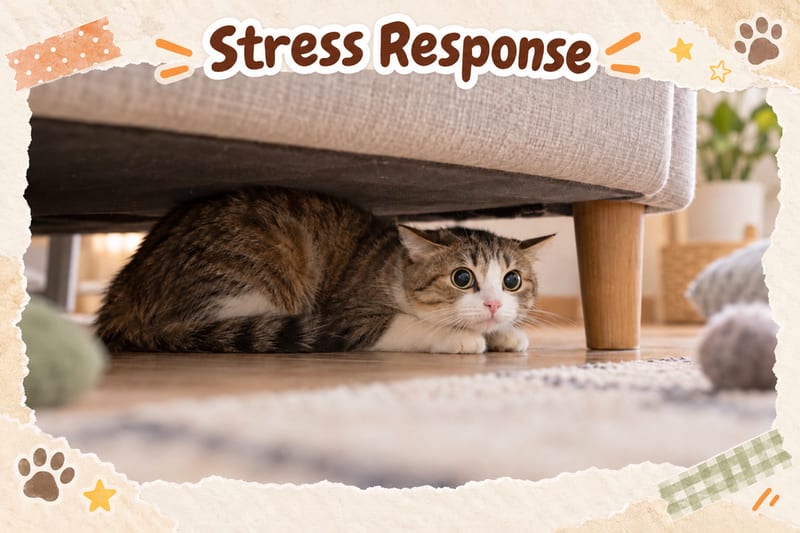
Three-level stress response comparison table
| Level | Behavioural signs | Physiological signs | Management |
|---|---|---|---|
| 🟢 Mild | Ears back, slightly dilated pupils, alert scanning, slight hiding | Brief rapid heartbeat | Remove the stimulus; usually settles within hours |
| 🟡 Moderate | Prolonged hiding, reduced appetite, over-grooming (licking to bald patches), inappropriate urination/spraying, sudden fearfulness or aggression | Persistently high cortisol, lowered immunity | Actively intervene to de-stress + observe for 2–3 days; see a vet if no improvement |
| 🔴 Severe | All-day puffing and hissing, fleeing or attacking on sight, complete anorexia, abnormal vocalisation | Vomiting, diarrhoea, rapid breathing, risk of urinary blockage | See a vet immediately |
Common stressors
Many cat stressors are 'small things in human eyes':
- Environmental change: moving house, renovation, new furniture, changing to new cat litter/food (suddenly)
- Social change: new cat/dog joining, visitors, changes in household members (moving out / new baby)
- Sensory stimulation: renovation drilling, fireworks and thunder, strangers staying long-term, strong smells (essential oils and aromatherapy are toxic to cats)
- Resource problems: too few / too dirty litter boxes, multi-cat resource competition, long-term lack of vertical space
- Negative experiences: physical punishment, forced holding and petting, carrier only appears before vet visits (carrier = scary association)
Hong Kong-specific stressors: high-density housing with upstairs renovation, downstairs noise, humid heat, small flats with no high place to retreat to — these urban cat-keeping challenges must be taken into account.
4-step stress first aid
When a cat shows a stress response, do this:
Step 1: Remove or isolate the stressor
If possible, stop the noise immediately / separate the new pet / close the curtains. If you can't remove it (e.g. renovation), take the cat to the furthest room + mask with white noise.
Step 2: Reduce stimulation, let it hide
Open up hiding spots such as cardboard boxes, under the bed, cat beds; don't chase to comfort, don't take photos with flash, don't force it out. Hiding is how cats self-regulate, not 'ignoring you'.
Step 3: Restore routine
Routine = security. Put out food and water at the usual times, scoop the litter as usual, keep normal daily rhythms; the more predictable human behaviour is, the faster the cat feels safe. You can place an old shirt with your scent near its hiding spot.
Step 4: Monitor eating and litter box
Key indicators: when it is willing to eat, when it is willing to use the litter box. Eating = crisis easing; 24 hours of complete anorexia / no urine in the litter box = escalate, see a vet.
Red-green checklist: when to see a vet
| Situation | Judgement | Action |
|---|---|---|
| Recovers eating and playing after a brief fright | 🟢 Normal reaction | Observe at home |
| Hides for 1 day but eats and uses the litter box | 🟡 Observation level | De-stress + observe; most recover the next day |
| Over-grooming / inappropriate urination lasting several days | 🟡 Behaviour problem brewing | Find the stressor and intervene; book a vet if no improvement |
| 24 hours of complete anorexia | 🔴 Fatty liver risk | See a vet immediately |
| Repeated vomiting / diarrhoea / no urine in the litter box (especially male cats) | 🔴 Urinary blockage / acute illness | See a vet immediately (urinary blockage can be fatal within 24–48 hours) |
| Persistent panting, rapid breathing, blue gums | 🔴 Breathing crisis | See a vet immediately |
Remember: cats tolerate not eating far less than dogs — especially fat cats; 2–3 days of complete anorexia can trigger fatty liver. Don't 'wait one more day'.
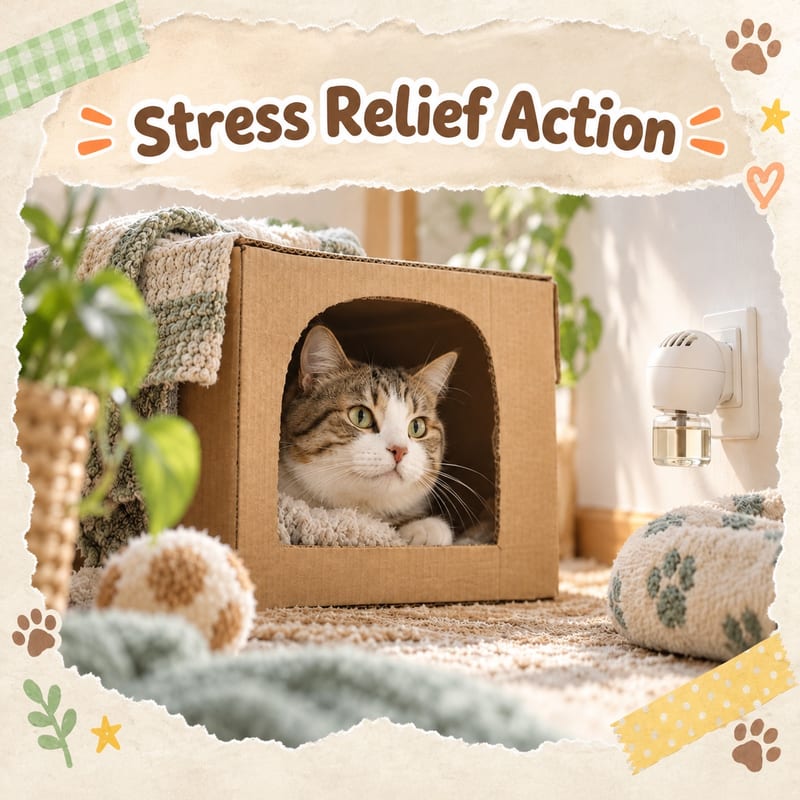
Hong Kong practical guide: de-stressing in small flats × vet-visit action checklist
The biggest practical constraint of keeping cats in Hong Kong is cramped space, old buildings and dense neighbours. Many stressors simply cannot be eliminated (e.g. renovation across the street, long-term noise downstairs, flats with no windows or poor ventilation), so the focus is not 'eliminating stress' but 'building a controllable safe zone' + 'mastering the local vet-visit rhythm'.
Practical checklist for small Hong Kong flats: • Don't use a fully enclosed cat room for the whole flat — humid heat actually raises stress; instead use the 'safe corner' concept: choose a room with the fewest windows, furthest from the lift/stairwell, lay thick mats, put cardboard boxes + a raised cat bed (use vertical space to provide retreat), and add a separate litter box and water fountain (avoid the same area as food bowls). • Hong Kong summers are hot and humid; keep air-conditioning at 26–27°C with a dehumidifier; too cold or fluctuating temperatures themselves trigger stress. • Multi-cat resource competition is more obvious; litter boxes must be ≥ number of cats + 1, spread across different areas (avoid concentrating in the corridor or kitchen), because Hong Kong flats rarely have true 'private corners'.
When to see a vet? Practical Hong Kong execution points: • If you find '24 hours of complete anorexia' or 'male cat with no urine for 24 hours', don't wait for an appointment — call the clinic immediately to ask if they have an emergency slot, or go directly to a 24-hour animal hospital (e.g. Mong Kok pet clinic, Causeway Bay VetHK, Sha Tin PetMed). Some clinics state 'no night emergency', but urinary blockage, rapid breathing and persistent vomiting/diarrhoea are priority cases. • If the cat shows moderate symptoms (e.g. inappropriate urination for two consecutive days, appetite dropped by more than half) and you have already checked environmental factors (new litter, visitors, renovation) with no improvement, book a specialist vet or behaviourist within 3 days to avoid developing chronic cystitis or habitual inappropriate urination. • Remember: Hong Kong vets generally recognise 'stress cystitis' as a common diagnosis; you don't need to prove 'there is stress' yourself — as long as behaviour changes + clinical signs match, the vet will manage along the stress pathway, including prescribing pain relief, anti-anxiety medication and environmental adjustment advice.
Further reading
Related articles
- Cat environmental stress management guide | Essential reading for moving in small Hong Kong flats →
- Moving house × stress management for sensitive breeds | Full guide to adapting to a new home →
- Cat anxiety: chronic anxiety scale + 7 environmental modifications (Hong Kong version) →
📌 Key takeaways
- ✅ Hiding is self-regulation; don't chase to comfort or force the cat out
- ✅ If you can't remove the stressor, use white noise + a distant room to isolate stimulation
- ✅ Eating and litter box use are key indicators; eating = crisis easing
- ❌ Don't wait for the cat to 'get better on its own'; 24 hours of complete anorexia is already a red line
- ❌ Small Hong Kong flats lacking high places, humid heat and neighbour renovation are all real stressors
- ❌ If a male cat has no urine for 24 hours after inappropriate urination, urinary blockage is highly likely and can be fatal within 48 hours
 Wellness Core full guide →
 Almo Nature full guide →
 Fuji One full guide →

