

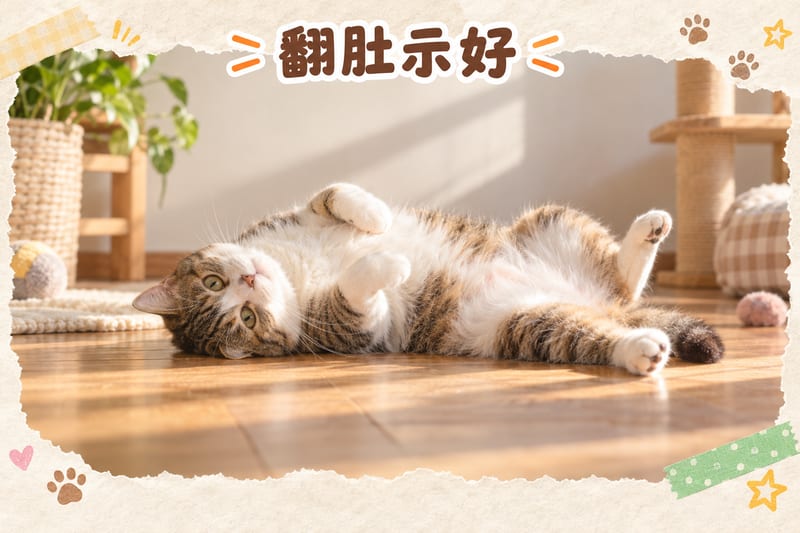
Quick answer: A cat rolling belly-up has 4 meanings: extreme relaxation, social trust, play invitation, defensive readiness. Judge by the tail, ears, and body tension, not just the belly. If you want to touch, use the 5-second test (chin → chest); being bitten is a normal reaction, not betrayal—the key is not to punish afterwards.
A cat lies down, belly to the sky, four legs relaxed—almost every owner can't resist reaching out. Then the next second: wrist grabbed, hind legs kicking. Many people think 'they're being naughty' or 'they're getting revenge'. Actually no: you just misread a signal.
3 key points
- Belly-up is a dual signal: 'I'm safe now' or 'I'm ready to fight back', not 'rub my belly'.
- Judge by three things: tail (flicking = escalating), ears (flattened back = alert), body tension (any stiffening = stop).
- After being bitten, do not punish—punishment only teaches the cat to attack earlier and hide signals next time.
The 4 meanings of belly-up comparison table
| Situation | Body language | True meaning | Suggested response | Triage |
|---|---|---|---|---|
| Lying on the floor stretching | Body soft, tail slow sway, eyes half-closed | Extremely relaxed, feels safe | Respond with a slow blink; no need to touch | 🟢 Normal |
| Belly-up after waking | Just got up, after a stretch | Stretching, temperature regulation | Ignore, let them get up on their own | 🟢 Normal |
| Rolls belly-up as soon as they see you | Looks at you, tail high then lies down | Social greeting, showing trust | Say hello, slow blink, let them come to you | 🟢 Normal |
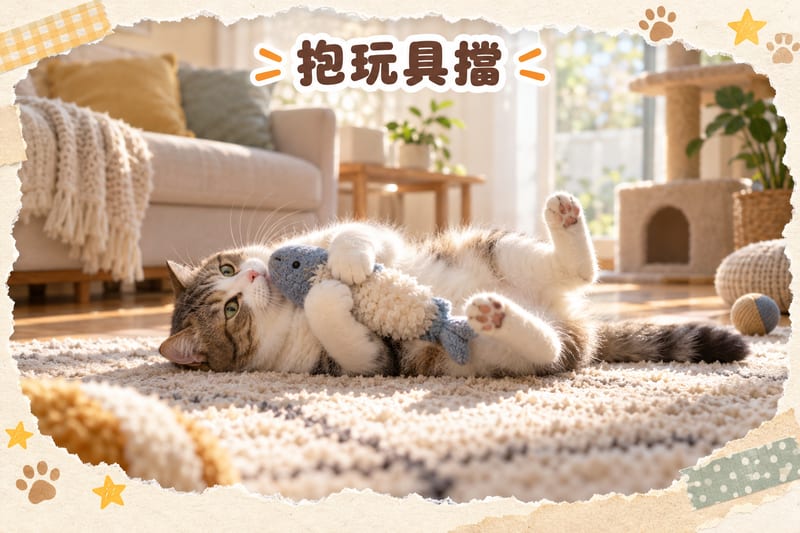
| Belly-up mid-play | Pupils dilated, hind legs ready, tail flicking | Play invitation (or guard position) | Redirect with a wand toy, not hands | 🟡 Hands = likely bite |
| Belly-up immediately after being touched | Body tense, ears turning back | Defensive readiness: enough | Stop immediately, let go and back off | 🟡 Stop |
| Belly-up + rapid tail flicking | Front claws spread, pupils constricted | Emotions already escalated | Stop interacting, let them leave | 🟡 Stop immediately |
| Belly-up + panting | Fast breathing, belly heaving | Possibly pain or heat | Check room temperature; if persists, see a veterinarian | 🔴 Seek help |
| Belly-up + won't let you touch belly + poor appetite | Lethargic, hiding | Possible abdominal pain | See a veterinarian the same day | 🔴 Seek help |
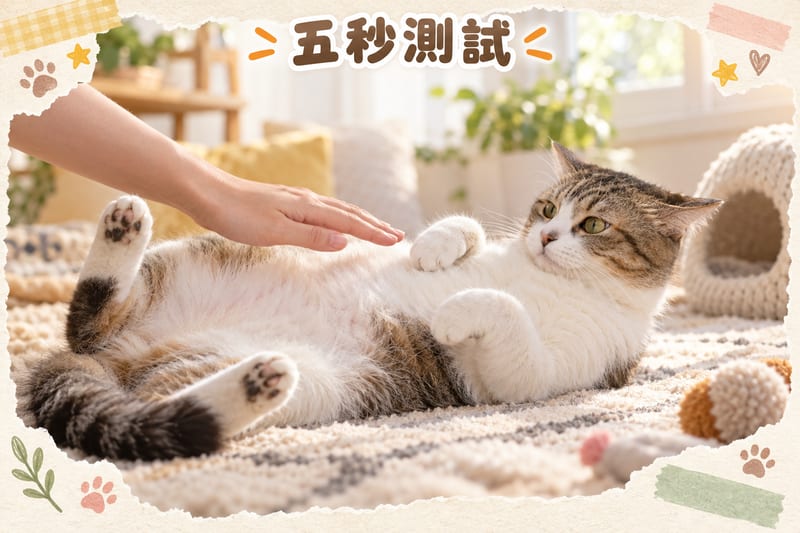
To touch or not? The 5-second test
- Pause for 5 seconds—don't touch the belly right away; wait for the cat to approach your hand.
- Stroke the chin or cheeks (safest zone)—most cats accept this, and may even head-bunt your hand.
- Watch for three signals: whether the tail starts flicking, whether the ears turn back, whether the skin twitches. Any one appears → stop immediately.
- If you want to try the chest (second safest zone): gently touch with the back of your hand for 1–2 seconds; if the cat doesn't retreat or flick their tail, you can try again.
- Belly, tail base, and hind legs are high-sensitivity zones; unless the cat pushes their belly towards your hand, don't touch them proactively.
Correct reaction to being bitten: immediately turn your hand into a 'dead object' (don't pull, don't push, don't yell), stop all interaction for 30 seconds, then leave the scene. Don't speak loudly, don't hit. This is called 'removing the reward'—play ends because of biting, and the cat will gradually learn to control their force.
What owners can do: 4 concrete steps
- Two play sessions daily (10 minutes each): use a wand toy to complete chase → pounce → catch, then finish with a meal or treat. The hunting need has an outlet, so the chance of hand play naturally decreases.
- Set up a 'belly safety zone': if you don't want to be bitten, don't reach into the belly area. To touch the cat, stroke the chin, behind the ears, cheeks, for 5–10 seconds each time, short and frequent.
- Nail maintenance: trim the front claws every 2–3 weeks (even just 1–2 claw tips at a time is fine), reward with treats in stages, to reduce scratches during interaction.
- Pain check: if a cat that used to allow belly touches suddenly bites when belly-up, and it lasts more than 3 days, arrange a veterinarian check (abdomen, teeth, joints).
Red lines: 3 situations to see a veterinarian
- Sleeping belly-up + loss of appetite, lethargy, visibly swollen belly—possible abdominal pain or fluid accumulation
- Screaming, fleeing, rapid breathing when belly is touched—acute pain
- Red skin on the belly, hair loss, constant licking of the belly—skin problem or over-grooming (stress or pain)
Hong Kong realities
- Hard floors in small flats: wooden or tiled floors are slippery, and cats can slip when getting up from belly-up; adding a non-slip mat can reduce startling.
- Humid season: belly skin in prolonged contact with the floor; if the environment is humid and not dry, the chance of mould and skin problems increases—remember to dehumidify.
- Multi-cat households: the spot where a cat sleeps belly-up is a 'core safe spot'; if two cats compete for the same spot, it's a resource concentration issue—adding a few more high resting spots solves it.
Sources
- AAFP/ISFM Feline Environmental Needs Guidelines (five pillars of environmental needs)
- AAFP/ISFM Feline-Friendly Handling Guidelines
- International Cat Care: Handling and interactions
- International Cat Care: Problem behaviour in cats
PetChill's Reminder
To reduce 'petting a cat and getting bitten', environmental support helps: wand toys, catnip toys, and scratching posts can restore the hand's role to 'care and reward' rather than prey. PetChill has interactive toys and scratching posts in stock; choose according to your cat's play style.
Disclaimer: This article is behavioural education information and does not constitute veterinary diagnosis or treatment advice. For abdominal pain, persistent refusal to eat, or sudden behavioural changes in cats, please consult a registered veterinarian.
Related articles
- The Complete Book of Cat Behaviour Decoding: The True Meaning of 30 Actions →
- Cat Biting 6 Types + 5 Steps to Correct →
- Cat Tail Language 8 States Illustrated →
- Complete Decoding of Cat Kneading Behaviour →
- Recognising and Easing Chronic Cat Anxiety →
- Hong Kong New Cat Owner 90-Day Roadmap →
 Feline Natural full guide →