Quick answers
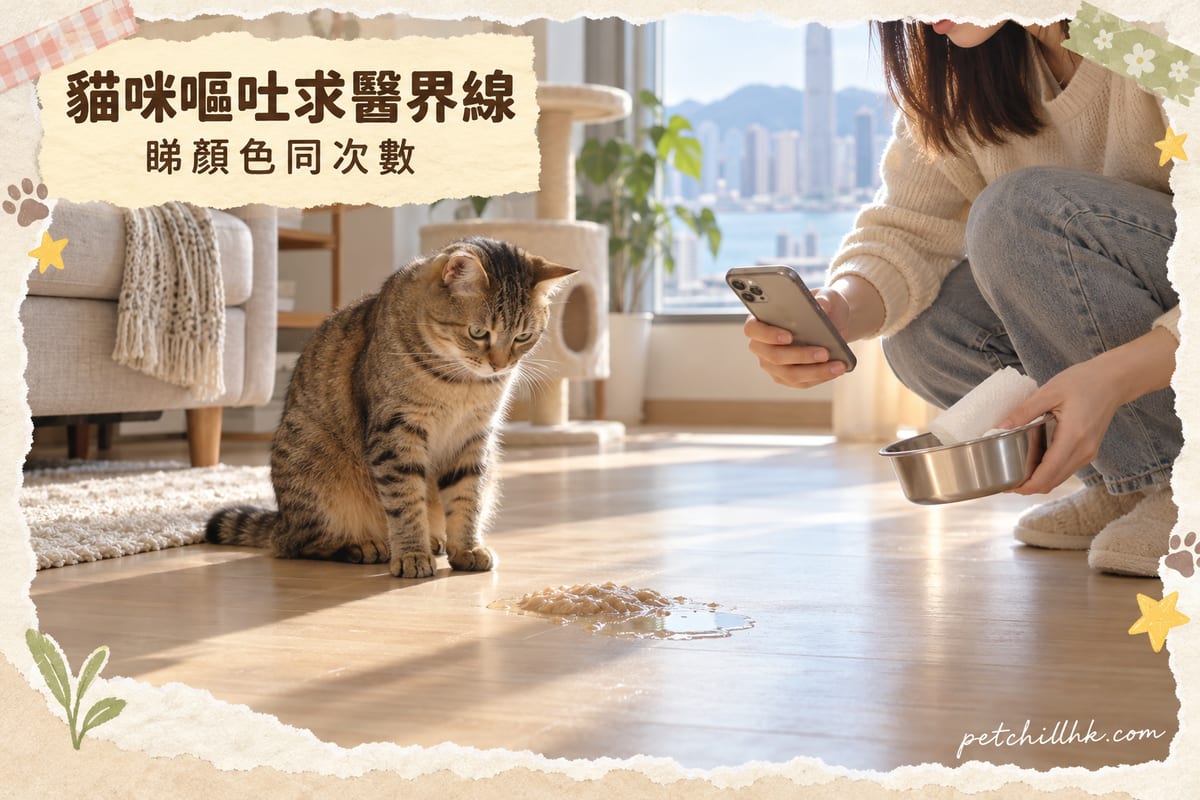
- Check three things first: the colour of the vomit, the number of times it has vomited within 12 hours, and whether there are any accompanying signs. Judge all three together.
- Bringing up yellow-green bile, fresh blood, coffee-ground material, or visible string or plastic fragments are the 4 high-risk colours. Do not wait; seek veterinary care immediately.
- For adult cats, vomiting 3 or more times in 12 hours, or vomiting with diarrhoea or lethargy, is a red line.
- A single hairball or undigested cat food, with normal energy and appetite afterwards, can be observed at home for 12 to 24 hours.
- During home observation, remove food for 4 to 6 hours, then reintroduce food in 3 to 4 small meals; kittens should not fast for more than 2 hours.
- For kittens under 6 months, cats over 7, or cats with chronic illness, the threshold is halved: if no improvement in 24 hours, see a vet; for kittens, not eating for 12 hours already needs attention.
- The observation window is at most 24 hours; do not drag it out beyond 48 hours with "wait another day". The longer you wait, the higher the risk of dehydration and fatty liver.
The question "Does my cat's vomiting need an immediate vet visit?" should not be answered with "it depends". Practical triage only needs three variables: the colour of the vomit, the number of times it has vomited within 12 hours, and whether there are any accompanying signs. If it is just a single hairball or undigested cat food pellets, and afterwards your cat still begs for food, has normal energy and normal toilet habits, you can usually observe at home for 12 to 24 hours; but if it brings up yellow-green bile, bright red blood streaks or coffee-ground material, or if vomiting is accompanied by diarrhoea, lethargy or abdominal pain, that is a situation requiring immediate attention and you should not wait until the next day.
This article will not repeat all the causes of vomiting (for causes, hairballs and food transitions, see the Complete Guide to Cat Vomiting). Instead, it focuses on triage and timing: a colour triage chart, a frequency timeline, a set of dangerous combinations of accompanying signs, plus a 24-hour home observation flow and a pre-vet preparation checklist. The whole article is written for the real situations of Hong Kong cat owners—small flats, clinics possibly closed at night, and emergency trips requiring consideration of travel time and cat carrier preparation. All decisions involving medication and prescription diets should follow veterinary instructions.
Triage step one: ask three questions before deciding whether to go to the clinic
Vomiting is a symptom, not a diagnosis. The same "vomiting" can range from eating too fast (benign) to intestinal obstruction (emergency), and the two can look similar. So triage should not be based on feeling, but on answering each question in turn.
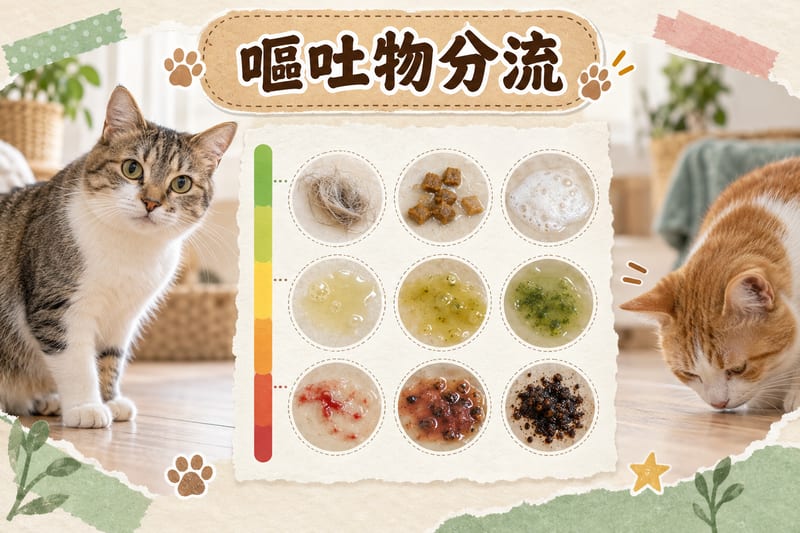
Question one: What does the vomit look like? Look at the colour and contents first. String-like hairballs and whole cat food pellets are low risk; white foam or clear mucus is mostly related to an empty stomach; yellow-green fluid, bright red blood, coffee-ground material, or visible string, plastic or fabric fragments are high risk. If the answer is unclear, take a photo—photos are the fastest diagnostic material for a vet.
Question two: How many times has it vomited in 12 hours? A single episode and repeated episodes of the same nature are two different things. Pay special attention to repeated dry heaving—"trying to vomit but nothing comes up". This is not ordinary vomiting and may be related to severe obstruction or gastric torsion, which is an emergency. Recording the time points is far more useful than remembering "it vomited today".
Question three: What is its condition after vomiting? Look at energy, appetite, whether there is diarrhoea, posture and gum colour. Cats have a high pain tolerance, and often still look normal even when moderately dehydrated, so you cannot assume everything is fine just because "it is still walking around". Skin that does not spring back when pulled up, cold ears and paw pads, and pale gums are all signs of dehydration.
The answers to the three questions should be considered together, and if any one crosses the line, the most severe one takes precedence. This is the basic principle of triage: do not average; take the worst case.
Vomit colour triage chart: from observable to immediate departure
Colour and contents are the most basic clues. The table below is arranged by danger level, with the last column giving the actual time limit for action. The table is only an aid and cannot replace a veterinary examination.
| Vomit appearance | Common possible cause | Danger level | Time limit for action |
|---|---|---|---|
| String-like hairball coated with a little stomach fluid | Hairball | Low | Observe; 1 to 2 times a month is acceptable, but if it occurs weekly, consult a vet |
| Whole or partially digested cat food pellets | Eating too fast, transitioning food too quickly | Low | Observe for 12 to 24 hours, use a slow feeder, feed small frequent meals |
| White foam or clear mucus | Empty stomach for too long, stomach acid irritation | Medium | Adjust feeding intervals; if it repeats more than 2 times in 12 hours, see a vet |
| Pale yellow fluid, small amount | Stomach fluid mixed with a little bile, empty stomach | Medium | If more than 2 times in 12 hours, or if not eating at all, see a vet the same day |
| Yellow-green or dark green fluid | Bile reflux, pancreatic or biliary problems, intestinal obstruction | High | See a vet the same day; if accompanied by abdominal bloating or pain, seek immediate care |
| Bright red blood streaks or clots | Oesophageal or gastric bleeding, foreign object scraping the mucosa | High | Seek immediate care, keep a sample and photo |
| Coffee-ground dark brown material | Old bleeding in the upper gastrointestinal tract | High | Seek immediate care, this is an emergency |
| Visible string, thread, plastic bag, fabric fragments, bones | Ingested foreign object, risk of intestinal obstruction | High | Seek immediate care, do not induce vomiting yourself |
| Large amount of undigested food with abdominal bloating | Gastric dilation or obstruction | High | Seek immediate care, do not feed or give water during transport |
There are three practical reminders for using this table. First, even a small amount of blood must be mentioned: a single streak of blood and a large amount of fresh blood have different time limits, but neither should be treated as "let's observe first". Second, keep a sample and photo: use your phone to photograph the vomit (with an object nearby for scale), and do not flush or wipe it away immediately; a vet looking at the photo can save a lot of time. Third, do not induce vomiting yourself: if you suspect ingestion of a foreign object or sharp item, inducing vomiting may cause secondary harm and must be decided by a vet.
Frequency and timeline: observation window or red line?
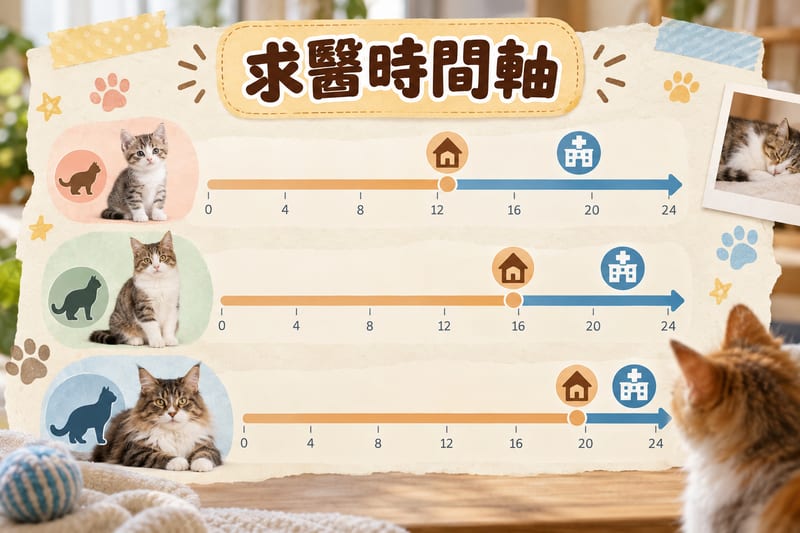
Besides colour, the second variable is frequency and time. The same single episode of vomiting has very different tolerance levels for adult cats and kittens. The table below is divided into three age groups. The principle is: the younger or older, the lower the threshold.
| Scenario | Adult cat (1 to 7 years) | Kitten (under 6 months) | Senior cat (over 7 years) |
|---|---|---|---|
| Single vomit, normal energy and appetite afterwards | Observe at home for 12 to 24 hours | Observe for 6 to 12 hours, see a vet if no improvement | Observe for 12 hours, see a vet if no improvement |
| Vomits 2 times in 6 hours | Keep recording, no main meals for 24 hours | Contact a vet immediately | See a vet the same day |
| Vomits 3 or more times in 12 hours | See a vet the same day | Seek immediate care (emergency) | Seek immediate care (emergency) |
| Still vomiting repeatedly after 24 hours | Emergency | Emergency | Emergency |
| Repeated dry heaving, trying to vomit but nothing comes up | Emergency | Emergency | Emergency |
| Not eating at all after vomiting | See a vet the same day if 24 hours | See a vet within 12 hours | See a vet within 12 hours |
| Vomiting and diarrhoea together | See a vet the same day | Seek immediate care | Seek immediate care |
The reason the thresholds differ so much is physiological reserve. Kittens are small and have a large body surface area relative to weight, so they lose water quickly; not eating for 12 hours can already cause low blood sugar. Senior cats often have concurrent kidney disease, thyroid or heart problems, and the consequences of dehydration and electrolyte imbalance are more serious than in younger cats. Adult cats are relatively more resilient, but there is still a hard line: not eating at all for close to 48 to 72 hours carries a risk of fatty liver, so you cannot rely on "it will eat when it gets hungry" for long.
Also watch for chronic trends. If your cat is not having a single acute vomiting episode but vomits once or twice a week for several weeks, even if it only brings up white foam each time, it is worth arranging a check-up with blood and urine tests, because this pattern may reflect chronic gastrointestinal or metabolic problems.
Accompanying signs: a single symptom can be observed, combinations need immediate attention
Vomiting alone provides limited information; adding accompanying signs makes things much clearer. Here are common accompanying signs and their danger level:
- Diarrhoea, especially watery or bloody: dehydration doubles, high risk.
- Lethargy, slow responses, hiding away: reflects deterioration in general condition, high risk.
- Not eating at all, even refusing favourite treats: needs attention after 12 to 24 hours.
- Abdominal pain: arched back, hen squatting, not allowing belly touch, changed vocalisation, high risk.
- Repeated dry heaving with drooling and frequent swallowing: possible severe obstruction, emergency.
- Rapid breathing or open-mouth breathing: emergency, should not wait.
- Sudden large increase in water intake: may be related to kidney disease, diabetes or thyroid problems; arrange a check-up within 24 to 48 hours.
- Continuous weight loss despite normal appetite: needs blood tests, not just a food change.
- Pale gums, cold ears, skin that does not spring back: signs of dehydration, see a vet the same day.
- Yellow ears, gums or whites of the eyes: jaundice, emergency.
A single symptom can be observed within a time window, but if two or more occur together, you should not wait any longer. The table below shows the four combinations most worth remembering.
| Combination of signs | Risk | Action |
|---|---|---|
| Vomiting + diarrhoea + lethargy | Acute gastroenteritis, infection, dehydration | Emergency, seek immediate care |
| Vomiting + abdominal bloating + repeated dry heaving | Gastric dilation or severe obstruction | Emergency, transport to clinic immediately |
| Vomiting + not eating at all for over 24 hours | Electrolyte imbalance, risk of fatty liver | See a vet the same day; immediately for kittens and senior cats |
| Vomiting + sharply increased water intake + weight loss | Chronic organ or endocrine problems | Arrange a check-up within 24 to 48 hours, and record water intake |
If your cat is currently taking vet-prescribed medication (e.g. antibiotics or other long-term medication) and vomits during this time, the correct approach is to ask the vet first; do not stop or increase the medication on your own. At the same time, record the drug name and the time of the last dose. For medication safety principles, see the Complete Guide to Pet Medication Safety and the Cat Medication Guide.
24-hour home observation flow: 6 steps
If after assessment it is a "can observe first" situation, you can follow the flow below. The key is to set checkpoints and red lines, not to observe indefinitely.
- Record and photograph immediately. Write down the time, number of times, colour, texture, approximate amount, and whether there is blood or a foreign object; photograph the vomit with your phone and keep recording until hour 24.
- Remove food, keep water. For adult cats, remove food for 4 to 6 hours to let the stomach rest; kittens should not fast for more than 2 hours—if unsure, ask a vet first. Water must be available, but do not force a large amount at once.
- Reduce stimulation. Keep the room temperature comfortable, quiet and dim; do not hold your cat frequently or allow strangers to visit; in multi-cat households, feed separately for now.
- Reintroduce food in small amounts. After the observation period, feed 3 to 4 small meals, 1 to 2 tablespoons of easily digestible food each time, spaced 1 to 2 hours apart, and observe for 30 to 60 minutes after each meal for vomiting.
- Set three checkpoints. Assess at 6, 12 and 24 hours: energy, appetite, water intake, toilet habits, and whether vomiting recurs. If two of these three worsen, do not continue waiting.
- Seek care when the line is crossed. If any red line appears (abnormal colour, vomiting 3 times in 12 hours, diarrhoea, lethargy, not eating at all, abdominal pain), contact a vet immediately; do not first try "give a little medicine and see if it improves".
Within the same flow, there are five things you must absolutely not do:
- Do not give human antiemetics, antidiarrhoeals or painkillers on your own; cats metabolise differently from humans, and some ingredients are toxic to cats.
- Do not induce vomiting yourself, especially if you suspect ingestion of sharp objects or string.
- Do not stop or increase vet-prescribed medication on your own.
- Do not introduce new foods, raw meat or large amounts of treats during observation; the simpler the better until the stomach is stable.
- Do not use "it still seems energetic" as a reason to keep waiting; cats are very good at hiding signs of illness.
Before the vet visit: what the vet most wants to see and supplies for the observation period
Before going to the clinic, prepare the following to speed up the consultation: photos or videos of the vomit; a timeline (which episode, what time, how long since the last meal); dietary changes in the last 7 days (food transition, new treats, raw meat, environmental changes); a list of medications and supplements (whether on vet-prescribed medication, time of last dose); basic cat information (age, weight, vaccination and deworming records, chronic disease history). Hong Kong clinics have limited night consultation hours; if it is an emergency, call ahead to confirm emergency arrangements and travel time, and line the carrier with a towel for warmth.
If you want to prepare some supportive supplies for the observation period, the following are related products available at PetChill's online store. All should be confirmed with your vet as suitable for your cat before use:
- Vet's Best Cat Digestive Health Probiotics 2g x 30 sachets — HK$141
- Japan PetLine Medyfas Cat Supplement Digestive Health Formula Chicken and Flying Fish Flavour 6g×8 (PL-MFS-5) — HK$16
- Nature's Protection Cat Sensitive Digestion Cat Food for Sensitive Stomach Adult Cats 400g (FD3510.4K) — HK$54
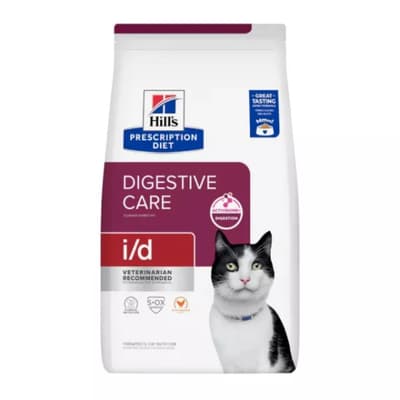
- Hills Prescription Diet Cat Food i/d Digestive Care 8.5lbs (8694) — HK$679 (available for pre-order)
Prices and stock are subject to the online store's current listed price.
The role of probiotics needs to be clear: they are supportive, not curative. Probiotics are most likely to help with dysbiosis caused by food transitions or antibiotics; if the cause is a foreign object, obstruction or acute inflammation, probiotics alone will not solve the problem and will delay veterinary care. Prescription diets (such as digestive care formulas) are dietary management tools to be used after veterinary assessment and should not be fed long-term on your own. To learn how to reduce recurring gastrointestinal problems in daily life, see the Complete Guide to Pet Digestive Health and the Cat Constipation Guide; for care priorities for kittens and senior cats, see the Complete Kitten Care Guide and the Complete Senior Cat Care Guide respectively.

Further reading
- Complete Guide to Pet Digestive Health | Causes of Vomiting, Diarrhoea, Soft Stool and Mucus Stool + How to Choose Probiotics (2026)
- Complete Guide to Cat Vomiting | Hairball or Illness? 6 Major Causes + First Aid Every Hong Kong Cat Owner Must Read
- Complete Guide to Pet Medication Safety | Dosage, Side Effects, Poisoning Management (2026)
- Cat Medication Guide
For emergencies, contact a vet immediately; this article is for reference only and cannot replace veterinary diagnosis.
Information checked as of 2026-10-12Source: PetChill Editorial Team
 Almo Nature full guide →