Quick answers
- Time is the fastest clue: In a normal wound, redness, swelling and pain peak in the first 1 to 3 days, then ease day by day; if it becomes redder and more swollen after day 3, that is the first warning sign.
- Look at the discharge: A normal scab is thin, dry and pale yellow; wet yellow-green pus that re-oozes after wiping, together with a foul smell, makes bacterial infection highly suspected.
- Look at the systemic response: A cat's normal rectal temperature is about 38.0 to 39.2°C; above 39.4°C is a fever. Combined with refusing food for more than 24 hours or hiding in a corner, you cannot wait any longer.
- Measure the size: Take photos daily at the same location and under the same lighting; if the red and swollen area expands by more than 1 cm within 24 hours, book a veterinarian appointment.
- Do not treat it yourself: Do not squeeze pus, cut scabs, or use human disinfectants or antibiotic ointments on your own; all cleaning and medication should follow veterinary instructions.
- Red lines mean same-day veterinary care: If bleeding does not stop after pressing for 5 to 10 minutes, tissue turns black or foreign material is visible, a red line creeps up the skin, breathing is rapid or the cat is dull, go to the veterinarian immediately.
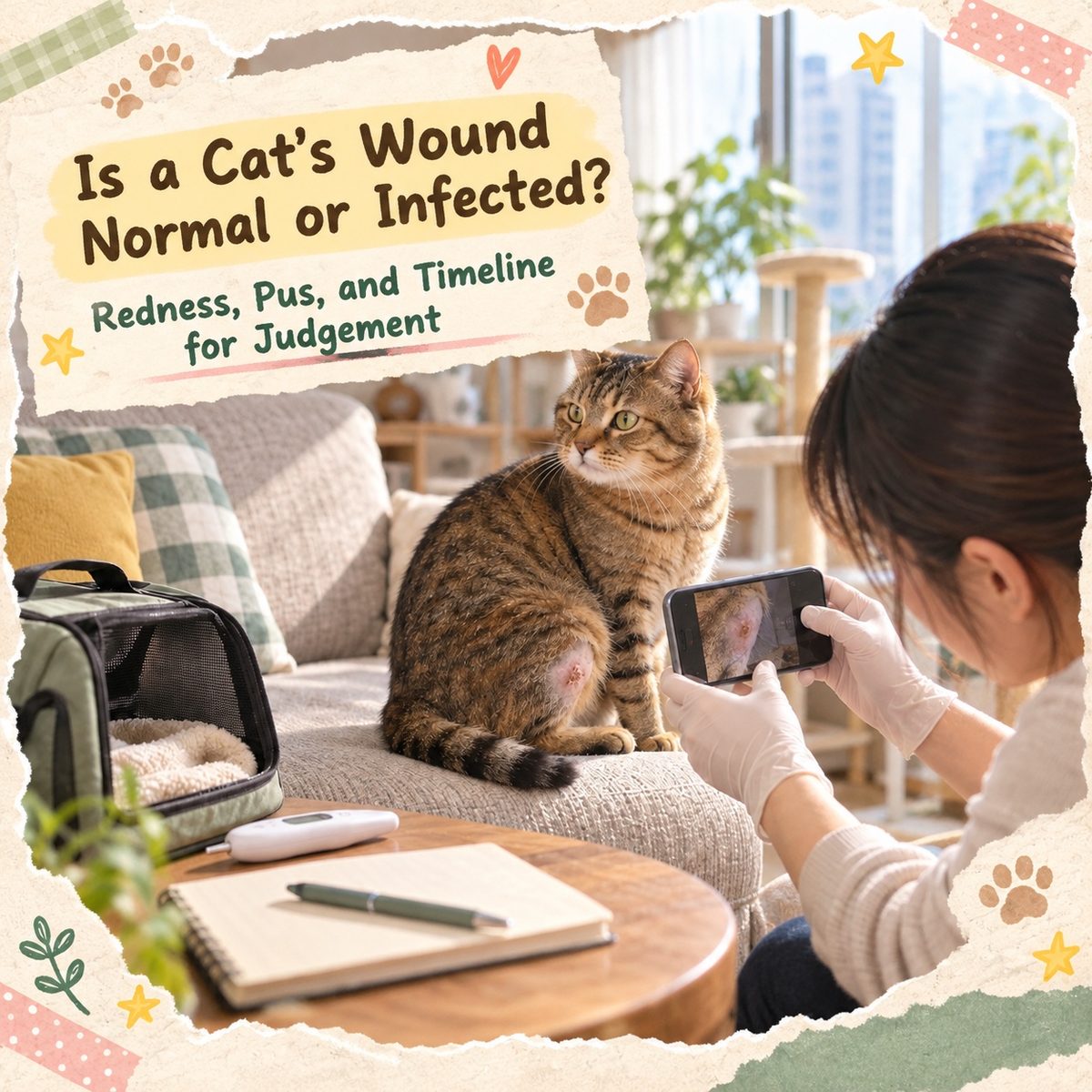
After a cat is injured, what troubles owners most is not "is there a wound" but "is this wound healing normally or is it already a bacterial infection". The answer is not a single glance but a timeline: the normal inflammatory response peaks in the first 1 to 3 days, then redness, swelling, heat and pain all gradually decrease, and scabbing and edge contraction begin on days 3 to 5; the most typical feature of bacterial infection is "getting worse after the peak". The most practical approach is to record three sets of numbers every day—the extent of redness and swelling, the nature of the discharge, and the cat's temperature and appetite—and then compare them with the red-line checklist and comparison table in this article.
Hong Kong's living environment makes this even more worth noting: units are small and cats interact frequently, so scratches and bites are common; the local humid weather also allows bacteria to multiply quickly. In addition, cats are naturally good at hiding pain, so by the time an owner notices "not eating", the infection may have been going on for several days. Below we break down the three stages of normal healing, the seven-sign infection comparison table, the daily five-step recording method, the infection risk of different wounds, and when a veterinarian must be seen. To first grasp the overall framework of skin problems, you can read Pet Skin Health: The Complete Guide.
The three stages of normal wound healing: when it scabs, when the edges contract
Cat wound healing is roughly divided into three overlapping stages; actual speed is affected by wound size, location, age, nutritional status and whether there is chronic disease. The days in the table below are general references and should not be treated as rigid standards.
- Inflammatory phase (days 0 to 3): The area around the wound is red, slightly swollen and slightly warm to the touch; this is the normal response as the body sends white blood cells and repair cells. In these few days you may see a small amount of clear or pale blood-tinged fluid, which is serum, not pus.
- Proliferative phase (days 3 to 7): Granulation tissue begins to grow, a thin scab forms on the surface, and the edges slowly contract. Redness, swelling and pain should clearly decrease, and the cat should be willing to walk, jump and eat normally.
- Remodelling phase (1 to 4 weeks or longer): The scab falls off naturally, the skin heals, and scar tissue gradually matures and fades. This is the stage when licking and biting are most harmful; one lick can reopen the wound and start the whole process again.
| Observation | Normal healing | Timing | What to watch |
|---|---|---|---|
| Redness and swelling | Mild swelling in the first 1 to 3 days, then narrowing day by day | Clearly decreasing after day 3 | Should not spread outward |
| Warmth on touch | Slightly warm, a little higher than surrounding skin | Days 1 to 2 | Getting hotter = warning sign |
| Discharge | A little clear or pale blood-tinged fluid early on, then turning to a dry scab | Turning dry on days 2 to 5 | Dry, thin, pale yellow is normal |
| Pain | More obvious in the first 1 to 2 days, easing after day 3 | Decreasing day by day | Increasing pain, shrinking when touched = see veterinarian |
| Wound edges | Together, slowly contracting | From day 3 | Open, split or underlying tissue visible = see veterinarian |
| Cat's condition | Normal energy, appetite and temperature | Throughout | Normal rectal temperature about 38.0 to 39.2°C |
One point must be made clear: treatment decisions are not for the owner to make. Even if the wound appears to be healing normally, if the cat is on medication, bandaged or has sutures, when to stop medication, when to remove sutures and when to take off the cone must all be decided by the veterinarian. Stopping medication early is a common cause of wound deterioration and bacterial resistance.
Seven signs of bacterial infection: one comparison table makes it clear
Bacterial infection usually starts at the wound edge and then spreads outward and systemically. Below, the seven signs are compared side by side with normal healing so you can check each one. When checking, remember one word—trend: normal healing gets better day by day, infection gets worse day by day.
| Observation | Normal healing | Suspected bacterial infection | When to see a veterinarian |
|---|---|---|---|
| Redness and swelling | Narrows day by day after day 3 | Spreads outward by more than 1 cm in 24 hours | Same day |
| Discharge | Thin, dry, pale yellow scab | Wet pus, yellow-green or grey-white, re-oozes after wiping | Within 24 hours |
| Odour | None or slight bloody smell | Clearly foul, sour | Within 24 hours |
| Warmth on touch | Slightly warm | Clearly hot, surrounding skin hot to touch | Within 24 hours |
| Pain | Eases day by day | Worsens, shrinks or cries when touched | Within 24 hours |
| Wound appearance | Edges together, contracting | Edges split, open, tissue black or grey | Same day (black tissue is an emergency) |
| Systemic response | Normal energy and appetite, temperature 38.0 to 39.2°C | Fever above 39.4°C, refusing food, hiding, vomiting | Same day |
Pus colour and odour are the most practical clues. A normal scab is the result of wound discharge drying on contact with air, so it is thin, dry, pale and shrinking. Infected discharge is the opposite: wet, increasing in amount, re-oozing shortly after wiping, more yellow-green or grey-white, with a pungent smell. It is worth noting that some infections may not have obvious pus early on, only increasing redness and heat around the wound; this should also be treated as a warning sign.
Cat bites are the most easily underestimated. A cat's canine teeth are fine and sharp, creating a very narrow deep puncture wound; on the surface it looks like just two small holes, but bacteria have already been sealed under the skin. Such wounds easily form an abscess 2 to 5 days later: the area feels fluctuant, the cat has a fever, refuses food and will not let you touch one side. Once an abscess ruptures, a large amount of foul-smelling pus and blood flows out; a veterinarian must assess whether drainage and medication are needed. Do not squeeze it yourself—squeezing can spread the infection deeper.
Three most easily missed spots:
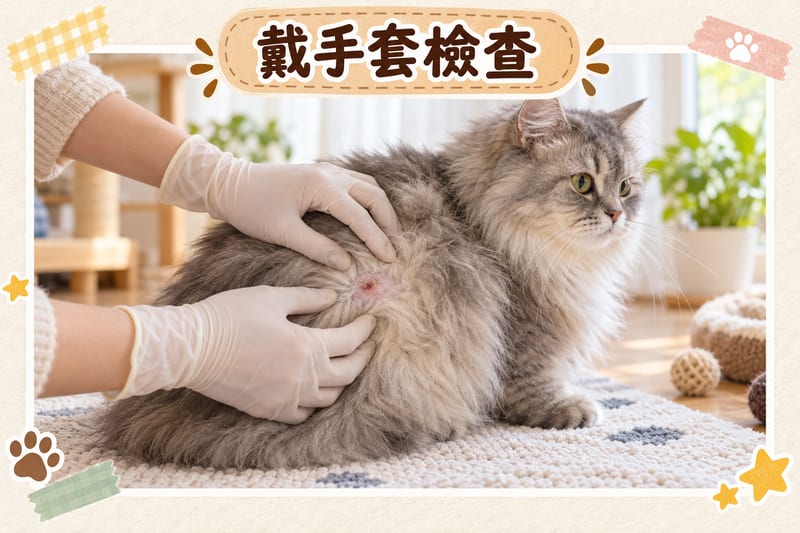
- Long-haired cats: The coat hides the wound, making redness and swelling hard to see; gently feel with your hand to compare temperature on both sides and check for lumps.
- Inner hind legs, tail base, groin: These are places the cat can lick itself and are most easily overlooked; check them when bathing or grooming.
- Coat colour changes from over-grooming: If the fur near the wound suddenly becomes darker, reddish-brown or sparse, it often means long-term licking and chronic skin irritation, not just "dirt".
Daily home check: the five-step recording method (cleaning and medication always follow veterinary instructions)
What you can do at home, and what helps the veterinarian most, is not "treating" but "recording". The following five steps do not involve self-medication and can all be started immediately.
- Put on disposable gloves before touching the wound: This prevents bacteria on your hands from entering the wound and protects you; wound discharge should not be touched with bare hands.
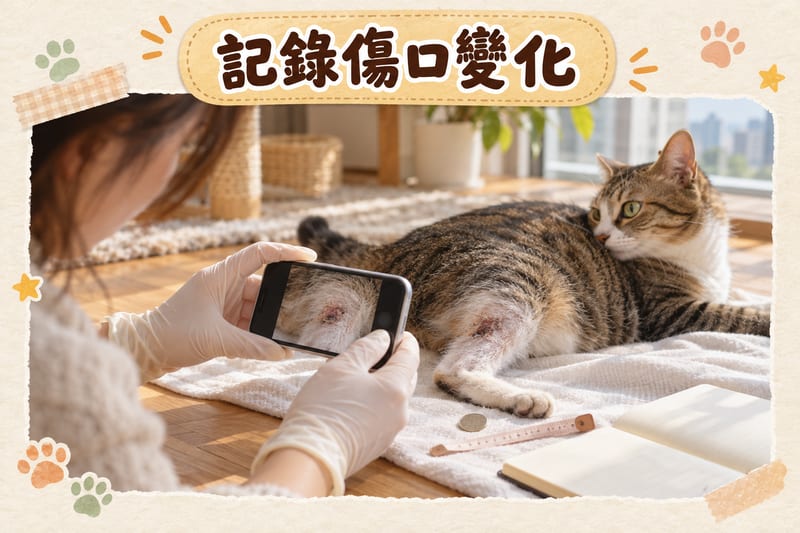
- Take photos at the same location and under the same lighting: Place a coin or soft tape measure as a size reference to compare the extent of redness and swelling before and after; do not rely on memory alone.
- Write down three sets of numbers: The extent of redness and swelling (cm), the nature of the discharge (dry scab / oozing / pus), and the cat's temperature and appetite. For the cat's temperature, use a pet-specific electronic thermometer; do not judge by feeling the ears or nose.
- Prevent licking and biting: A cone (soft or hard) is the most effective method, especially for wounds on the hind legs, tail or abdomen. Unless instructed by a veterinarian, do not bandage the wound yourself—bandaging too tightly can affect blood circulation, and if it comes loose the cat may swallow it.
- Attend follow-up appointments on time and give medication on schedule: Bring the photos and records so the veterinarian can compare changes. Prescription medication should be completed as instructed by the veterinarian; do not stop it yourself just because it "looks better".
Four things not to do:
- Squeeze pus, cut scabs, pick at the wound with a needle, or tear off gauze that has stuck.
- Use alcohol, hydrogen peroxide, bleach-based disinfectants or human antibiotic ointments on your own.
- Adjust or stop veterinarian-prescribed medication, or remove bandages or the cone early on your own.
- Skip follow-up appointments because the wound looks better, especially if there are sutures or a drainage tube.
If the veterinarian arranges for you to clean the wound at home, the clinic will explain which solution to use, how many times a day and what to note; follow the instructions. If during this time it becomes redder, more swollen, discharge increases, or the cat cries in pain, notify the clinic immediately.
Which wounds carry the highest risk? Bites, scratches and surgical incisions compared
Different sources of wounds can have very different infection risks. The table below helps you make an initial assessment, but a high or low risk does not mean you can treat it yourself—medication and cleaning methods for any wound should follow veterinary instructions.
| Wound type | Common cause | Infection risk | Notes |
|---|---|---|---|
| Cat bite (deep puncture) | Fighting with other cats, territorial conflict | Highest | The surface wound is small, bacteria are sealed under the skin, abscess easily forms after 2 to 5 days; must be assessed by a veterinarian |
| Human or other animal bite | Bitten during play, scratched or bitten when startled | Medium to high | Bite depth is often more serious than it appears; the cat should be examined; if a person is bitten, they should also seek medical attention |
| Superficial scratch | Fights between companions, over-grooming | Medium | Cleaning method follows veterinary instructions; using a cone to prevent licking is key |
| Surgical incision | Neutering, dental cleaning, lump removal | Low to medium | The incision should be dry and together; mostly sutures removed in 10 to 14 days, decided by the veterinarian |
| Wound caused by foreign object | Glass, nail, fish bone, wood splinter | Medium to high | There may be retained foreign material; must be examined and cleaned by a veterinarian |
| Burns or chemical burns | Hot water, cooking oil, cleaning agents | High | High risk of tissue necrosis; same-day veterinary care |
Location and age also affect risk. The tail base, inner hind legs, paws, armpits and groin are more prone to infection: paws are constantly in contact with cat litter and the floor, armpits and groin are moist and subject to friction, and an abscess at the tail base can make a cat so painful it refuses to sit. Kittens have immature immune systems, and older cats and cats with chronic diseases (such as diabetes or kidney disease) heal noticeably more slowly; even small wounds should be examined by a veterinarian early.
When a veterinarian must be seen: the red-line checklist
In the following situations, do not wait and observe; book a veterinarian or go to emergency care:
- The wound is bleeding heavily and does not stop after pressing for 5 to 10 minutes.
- Tissue turns black or grey, or foreign objects such as glass, nails or fish bones are visible in the wound.
- Redness and swelling expand by more than 1 cm within 24 hours, or a red line creeps up the skin.
- Temperature above 39.4°C, persistent vomiting, rapid breathing, dullness or general weakness.
- Completely not eating for more than 24 hours, or not drinking for more than 24 hours.
- Deep bites, especially from stray cats or animals of unknown origin—the veterinarian will also assess the risk of rabies and other infectious diseases.
- The cat keeps licking and biting, the wound repeatedly splits, or sutures come loose or ooze blood.
- No obvious improvement after 3 to 5 days of home care, or the wound is still open or oozing on day 7.
Timeline at a glance: Days 1 to 3 redness and swelling peak is normal → days 3 to 5 should clearly improve and begin to contract → still open, oozing or smelly on day 7 = see a veterinarian → fever, refusing food, black tissue or abnormal breathing at any time = same-day veterinary care.
Helping the wound heal steadily: nutrition, environment and preventing scratching
Wound repair needs raw materials and an environment that is not repeatedly irritated. The following points are daily support and do not involve self-medication.
- Adequate protein: Protein is the main raw material for tissue repair, and cats are carnivores, so the daily diet should be based on animal protein; during treatment, do not change food or try new treats at the same time, to avoid confusing gastrointestinal reactions with wound changes.
- Essential fatty acids: Omega-3 and Omega-6 help maintain the skin barrier. Cat foods labelled "skin and coat" formulas usually take fatty acid ratios into account, but suitability depends on the cat's condition and veterinary advice.
- Balanced micronutrients: Zinc, vitamin A and E are involved in skin repair. Unless instructed by a veterinarian, do not add supplements yourself; excessive fat-soluble vitamins are also harmful.
- Keep the wound area dry: Hong Kong's humid weather favours bacterial growth, so the cat's resting area should be dry and well ventilated, and the litter box cleaned daily to reduce contact with contaminants.
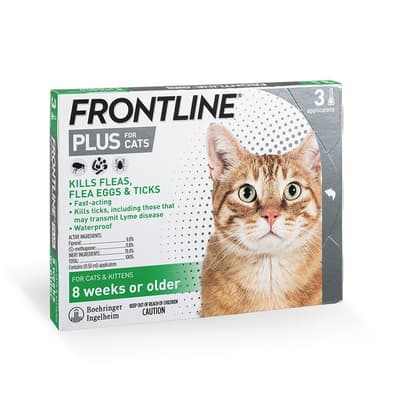
- Address the source of itching: Fleas and mites make cats scratch constantly, causing secondary infection. Regular flea treatment and cleaning the environment at the same time are the most fundamental measures; product type, dosage and frequency follow veterinary instructions, and note the minimum age and weight limits on the packaging.
- Reduce stress and conflict: Territorial conflict in multi-cat households is a major source of bites. Increasing resource points (litter boxes = number of cats + 1, spreading out water and food bowls, adding high resting places) can significantly reduce conflict; for environmental arrangements, see Why Cats Scratch Furniture: Causes and Prevention.
Examples of related products currently sold by PetChill:
- Instinct Cat Food Raw Protein Series Skin & Coat Chicken + Cod Recipe 10lb (658863) — HK$799
- Instinct Cat Food Raw Protein Series Skin & Coat Chicken + Cod Recipe 3.3lb (658504) — HK$339 (available for pre-order)
- FRONTLINE Plus for Cats & Kittens spot-on (FPCAT) (HK-53178) — HK$230
Prices and stock are subject to the live price on the online store. Flea products are medicinal; use according to the product label and veterinary instructions.

Further reading
- Pet Skin Health: The Complete Guide | Itching, Hair Loss, Rashes, Fungal Infections at a Glance (2026)
- Cat Ringworm | Complete Guide to Symptoms, Treatment and Prevention in Hong Kong
- Cats Scratching Furniture | A Must-Read for Hong Kong Cat Owners: Causes and Prevention
- Cat Coat Colour and Personality | Hong Kong Genetics Reveal Orange Cats Are the Craziest and Calicos the Most Aloof
In an emergency, contact a veterinarian immediately; this article is for reference only and cannot replace veterinary diagnosis.
Information checked as of 2026-10-12 · Source: PetChill editorial team
 Instinct full guide →
 Fuji One full guide →