Quick Answers
- Immediate first step: put on an anti-lick cone to physically separate the wound from the tongue; do not bandage the wound yourself with bandages or tape.
- Judgement line: if the same spot is licked continuously for more than 5 minutes, or redness and swelling expand by more than 1 cm within 24 hours, treat it as a warning sign.
- How long to wear a cone: generally at least 2 to 3 days after stitch removal; superficial wounds heal in 7 to 14 days, and surgical incisions usually have stitches removed in 10 to 14 days.
- There are 4 types of anti-lick methods: hard cone, soft cone, post-surgery protective suit, and neck-ring soft pad accessory; each has suitable locations and limitations, and should be chosen based on wound location.
- More than just anti-lick: itching, fleas, mites, pain and anxiety can all cause a cat to lick the same spot excessively; a cone alone cannot address the root cause, and a veterinarian must find the source.
- Record 3 things with daily photos: wound measurements, nature of exudate (dry scab or yellow-green pus), and the cat's body temperature and appetite.
- Normal rectal temperature for a cat is 38.0 to 39.2°C; if it exceeds 39.4°C, or if the cat completely refuses food and water for more than 24 hours, seek veterinary care the same day.
If your cat keeps licking a wound, there are only two immediate actions: use an anti-lick cone to separate the wound from the tongue, and record wound changes daily; all other cleaning, medication and bandaging should follow veterinary instructions. A cone is generally worn for at least 2 to 3 days after stitch removal, or until the veterinarian confirms the wound has closed. During this period, if redness and swelling expand by more than 1 cm within 24 hours, yellow-green pus oozes, there is a foul odour, or the cat's temperature exceeds 39.4°C, return to the clinic immediately.
Why does this matter? Because a cat's tongue has barbs, and excessive licking can lick away newly formed granulation tissue, causing wound edges to repeatedly split, turning 'healing in a few days' into 'not closing for two or three weeks'. Moreover, licking is often not the root cause but a symptom—itching, pain, parasites or emotional stress can all cause a cat to lick the same spot excessively. Hong Kong's small living spaces, dense multi-cat interactions, and humid weather that favours bacterial and fungal growth make wound licking very common, but many people only buy a cone without addressing the source, resulting in relapse as soon as the cone is removed. Below we break down the line between normal and excessive licking, the six major causes, how to choose among four anti-lick methods, a five-step guide to putting on a cone, daily care and a red-line list. To first grasp the overall framework of skin problems, you can read Pet Skin Health Complete Guide.
1. Licking is an instinct: the line between normal cleaning and excessive licking
Licking is a cat's main way of cleaning itself; exudate, blood stains or scabs on a wound naturally trigger the same action. So 'licking' itself does not mean there is a problem; the key is the frequency, duration per session and target location. Normal cleaning usually concentrates in the first 1 to 2 days of wound healing, mostly less than 1 minute each time, mainly licking the fur around the wound, and the frequency decreases as the scab dries.
Excessive licking is very different: the cat repeatedly licks the same spot, a single session lasts more than 5 minutes, the surrounding fur is constantly wet, and the skin becomes red, thin and hairless. This continuous stimulation causes wound edges to repeatedly split, newly grown tissue to be licked away, and the wound to go from 'almost closed' back to 'open'; severe cases can form eosinophilic granulomas or symmetrical hair loss patches, extending treatment from a few days to several weeks.
The most easily overlooked is night-time licking. Many owners see their cat sitting nicely on the sofa during the day, but wake up to find the wound wet and red again and the cone askew. A practical approach is to use a phone or pet camera to record night-time behaviour, and also check whether the sleeping mat and fur near the wound are abnormally wet, and whether the hair loss area is expanding daily.
| Observation item | Normal cleaning (acceptable) | Excessive licking (must stop) | Home action |
|---|---|---|---|
| Duration per session | Mostly less than 1 minute | Continuously more than 5 minutes | Distract with a toy or food as soon as time is exceeded |
| Frequency | More in the first 1 to 2 days, then decreasing | More frequent after day 3 | Record daily frequency and give to the veterinarian at follow-up |
| Target location | Fur and scab edges around the wound | Directly licking the wound, even biting until bleeding | Put on an anti-lick cone; do not rely on telling it to stop |
| Wound appearance | Scab intact, edges apposed, area shrinking | Scab licked away, edges split, area expanding | Take photos daily for comparison; return to clinic if expansion exceeds 1 cm |
| Skin and fur | Normal fur quality, no skin abnormalities | Hair loss, redness, thinning, skin thickening and blackening | Have a veterinarian check for secondary infection |
| Cat's condition | Normal spirit and appetite, temperature 38.0 to 39.2°C | Refusing food, hiding, temperature over 39.4°C | Seek veterinary care the same day |
One point must be clear: when to remove the cone and when to stop medication are not decisions for the owner. Even if the wound looks better, as long as the cat is on medication, has stitches or a drain, all adjustments must be confirmed by a veterinarian. Removing the cone or stopping medication on your own is the most common cause of wound deterioration and bacterial resistance.
2. Six major causes of constant licking: more than just the wound
The wound is only one trigger. If a cat continues to lick the same spot excessively after the wound surface has closed, it is usually one of the following 6 causes, and each has a different treatment direction. Getting the direction wrong leads to 'wearing a cone for two weeks, and licking again as soon as it is removed'.
- Wound itching and scab irritation: During tissue repair, substances such as histamine are released, and the scab tightening pulls on the skin, making the cat want to lick. This usually subsides as the wound matures, over about 3 to 7 days, and is the most benign type.
- Infection or abscess: Bacterial infection makes the wound itchier and more painful, with increased exudate. Deep abscesses from cat bites are particularly underestimated because the surface may only show two small holes while bacteria are sealed under the skin.
- Parasites: Fleas and mites (including the fungus that causes ringworm) both cause intense itching. Fleas most often bite the tail base, lower back and inner thighs; if symmetrical hair loss and dandruff appear in these areas, check for parasites first; see Cat Ringworm | Hong Kong Cat Ringworm Symptoms, Treatment and Prevention Complete Guide.
- Allergy or dermatitis: Food sensitivity, environmental allergens (dust mites, second-hand smoke, cleaning agents) and cat litter ingredients can all cause skin itching. This type usually involves itching in multiple body areas, not just near the wound, and the skin repeatedly reddens.
- Pain: Cats are extremely good at hiding pain; joint pain, post-surgery pain or excessive wound tension can all cause a cat to lick and bite that area. If there is also reluctance to jump or walk and poor appetite, pain is one of the main suspects.
- Emotional and environmental stress: Moving house, changes in family members or furniture, tension between cats, or insufficient activity space can all cause a cat to use repetitive grooming for self-soothing, and long-term can lead to symmetrical hair loss on both sides. These cases cannot be solved by a cone alone; behaviour and environment must be addressed; see section 5 of this article.
| Possible cause | Most commonly seen clues | What can be done at home | When to see a veterinarian |
|---|---|---|---|
| Wound itching, scab pulling | Licking more in the first 3 to 7 days, wound appearance not worsening | Put on a cone, record daily, keep dry | Still no reduction after 3 to 5 days |
| Infection or abscess | Yellow-green pus oozing, foul odour, expanding area, fever | Do not squeeze pus; book appointment immediately | Same day |
| Fleas, mites, fungus | Symmetrical hair loss at tail base or back, dandruff, black specks | Check the cat and environment; do not use medication on your own | Within 24 hours |
| Allergy or dermatitis | Itching in multiple body areas, skin repeatedly reddening | Record diet and itching locations | Within 3 days |
| Pain (post-surgery, joints) | Reluctance to jump or walk, shrinking when a certain area is touched | Reduce jumping height, add low landing spots | Within 24 hours |
| Emotional or environmental stress | Symmetrical hair loss, behaviour changes, excessive licking at night | Increase resource points, fixed routine, quiet space | No improvement within 1 week |

3. How to choose among four anti-lick methods? Comparison of cones, protective suits and accessories
Anti-lick products on the market fall roughly into 4 categories; none is 'the best', only suitable for your cat and its wound location. The following is a general comparison; actual choice should be assessed by a veterinarian based on wound size, location and the cat's temperament; if the veterinarian specifies a style or size, follow veterinary instructions first.
- Hard anti-lick cone: Traditional cone shape, most thorough physical barrier, suitable for wounds on the head, neck, front legs and various body locations. Disadvantages: blocks part of the vision, makes eating and drinking inconvenient, easy to bump into furniture when walking, and some cats resist to the point of decreased appetite.
- Soft anti-lick cone: Fabric or foam material, high comfort, can be used as a pillow to sleep on, usually better accepted for long-term wear. The key is that the cone length must extend from the neck to the tip of the nose or slightly beyond; too short and it is ineffective, as the cat can bend and lick the hind legs and abdomen; when long enough, it is equally effective.
- Post-surgery protective suit/recovery suit: Covers the body, suitable for abdomen, flanks, back and larger wounds, does not bump into furniture, allows free movement. Limitations: cannot cover the head, neck, paws or tail base, and must be checked daily for slipping, rolling edges, being too tight or urine-soaked; replace immediately once wet through.
- Neck-ring soft pad accessory: Works by limiting large neck flexion, suitable for mild licking or as an auxiliary. For deep wounds, bite wounds, paw or tail wounds, it is generally insufficient and should not be used alone as the main anti-lick method.
| Anti-lick method | Suitable wound location | Advantages | Limitations and notes |
|---|---|---|---|
| Hard cone | Head, neck, front legs, various body areas | Most thorough barrier, not afraid of wet | Blocks vision, easy to bump furniture, some cats lose appetite |
| Soft cone | Various body areas (when long enough) | Comfortable, can sleep and use as pillow | Too short is ineffective; check daily for wetness and dirt |
| Post-surgery protective suit | Abdomen, flanks, back | Does not hinder movement, can walk around daily | Cannot cover head, neck, paws, tail base; must keep dry |
| Neck-ring soft pad | Auxiliary for mild licking | More natural neck movement | Insufficient for deep wounds; not recommended alone |
Some practices are not recommended to try yourself. First, do not bandage the wound yourself with bandages or tape (unless instructed by a veterinarian): too tight affects blood circulation, too loose slips, and loose gauze may be swallowed. Second, do not apply bitter sprays, chilli water or human ointments to the wound or surrounding fur on your own; some ingredients irritate the wound, and there are risks if the cat licks them. Third, do not use a 'put on and take off' approach to let the cat have a break—the timing of cone removal is up to the veterinarian, and during brief removal periods you must watch the cat at all times and not let it lick.
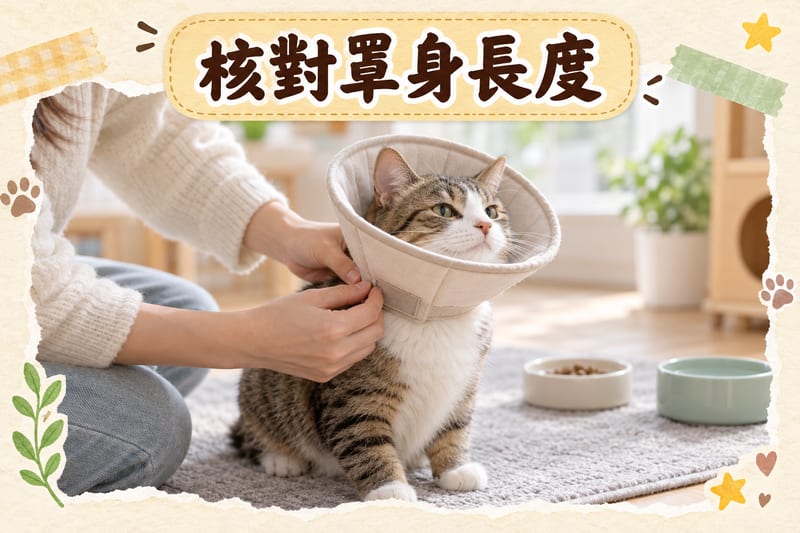
4. Five steps to putting on a cone: measure, trial wear, modify environment and daily checks
A cone worn incorrectly is as good as not worn. The following five steps are worth doing each time you change or adjust the cone.
- Measure neck circumference: Use a soft tape measure around the neck (behind the ears, at the narrowest part), leaving about 1 to 2 fingers, i.e. 1.5 to 2 cm, of slack inside the collar. Too tight constricts the trachea and affects swallowing; too loose and the cat can paw it off.
- Check cone length: Measured from the collar, the cone edge should extend to the tip of the nose or slightly beyond. Insufficient length is the most common reason soft cones fail; the cat only needs to bend slightly to lick the hind legs and abdomen.
- Trial wear for 5 to 10 minutes: See whether the cat can walk, sit, turn, eat, drink and use the litter box. Also check for friction redness at the ear base, sides of the neck and chest, and whether the buckle tightness is appropriate.
- Modify the home environment: Remove sharp corners and easily tipped items within a 1-metre radius, add gates at stairs or restrict activity range; switch to shallow wide food and water bowls, raise by 5 to 10 cm if needed so the cat does not need to lower its head too much to eat.
- Check once daily: Check the neck circumference for redness, hair loss, odour or skin damage; if the collar and cone are wet, stained with saliva or dirt, wipe dry or replace. If cracks or loose buckles are found, replace immediately.
The adjustment period is generally 2 to 3 days, during which the cat may walk backwards, bump into furniture and eat slowly; this is normal. If the cat completely refuses food or water for more than 24 hours, or vomits, notify the veterinarian the same day; do not remove the cone or reduce medication on your own. Older cats, those with joint problems or chronic illness may take longer to adjust; trying the cone a few days earlier is usually more comfortable than putting it on immediately after surgery.
5. Beyond anti-lick: four more things to do (wound care always follows veterinary instructions)
Anti-lick is only one part. The following four things determine whether the wound 'closes in a few days' or 'drags on for weeks'.
- Cleaning and medication follow veterinary instructions: Which solution to use, how many times a day, whether to bandage, when to remove stitches and change dressings—all decided by the veterinarian. Do not use alcohol, hydrogen peroxide or human antibiotic ointments on your own, and do not squeeze pus, cut scabs or tear off stuck gauze—these actions can push bacteria into deep tissue or cause the wound to re-open. If in doubt, call the clinic directly; it is safer than searching online.
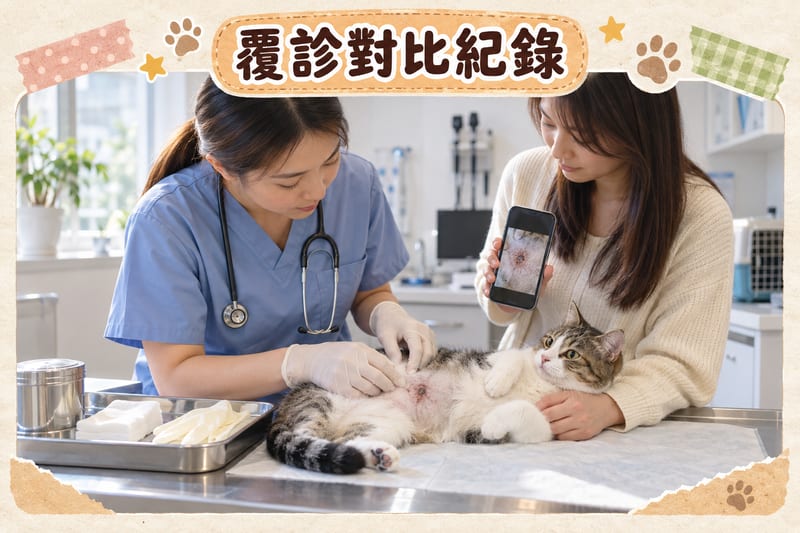
- Daily photos and records: Take photos from the same angle and lighting, and write down wound measurements, nature of exudate (dry scab or pus), the cat's temperature and appetite. Place a coin or tape measure for scale; bring the records to follow-up appointments so the veterinarian can see at a glance whether it is improving or worsening.
- Environment and humidity management: Hong Kong is humid in spring and summer; a wound that stays slightly moist slows healing and favours bacterial and fungal growth. Keep the cat's resting area dry and ventilated, and maintain indoor humidity below 60% if possible; clean the litter box daily and wash sleeping mats every 1 to 2 weeks. In multi-cat households, separate water and food bowls, add high resting spots, and provide one more litter box than the number of cats to reduce conflict-induced licking. For a complete approach to behaviour and stress management, see Cat Scratching Furniture | Causes and Prevention Complete Guide.
- Nutritional support: Wound repair requires protein; cats are carnivores and should mainly eat animal protein; fatty acids such as Omega-3 help maintain the skin barrier. Remember nutrition is only supportive and does not replace veterinary treatment; do not add supplements without veterinary instruction, and during treatment do not switch food or try new treats at the same time, to avoid confusing gastrointestinal reactions with wound changes.
Examples of related products currently sold at PetChill (for price and stock reference only, not treatment advice):
- Instinct Cat Food Raw Nature's Protein Skin & Coat Chicken & Cod Recipe 10lb (658863) — HK$799
- Instinct Cat Food Raw Nature's Protein Skin & Coat Chicken & Cod Recipe 3.3lb (658504) — HK$339 (available for pre-order)
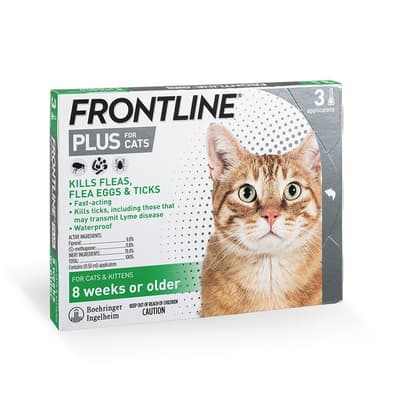
- FRONTLINE Plus for Cats & Kittens Flea Drops (FPCAT) (HK-53178) — HK$230
Prices and stock are subject to the online store's current listed price. This is a medicated flea product; usage and frequency must follow the packaging label and veterinary instructions, and note the product's age and weight minimums; do not increase frequency on your own.
6. Red-line list: when you cannot wait any longer
If any of the following occurs, you should no longer rely on your own observation or 'wait another two days':
- The wound oozes yellow-green or grey-white pus with a foul odour, and re-oozes shortly after wiping.
- Redness and swelling expand by more than 1 cm within 24 hours, or a red line spreads up the skin.
- The cat's temperature exceeds 39.4°C, or there is lethargy, rapid breathing or persistent vomiting.
- Complete refusal of food for more than 24 hours, or no water for more than 24 hours.
- The wound splits open, exposing subcutaneous tissue, or stitches loosen or the drain slips.
- Tissue turns black or grey, or foreign bodies such as glass, nails or fish bones remain in the wound.
- Symmetrical hair loss, skin thickening and blackening, hard lumps or expanding ulcers appear at the licking site.
- No improvement at all after 3 to 5 days of home anti-lick and veterinary treatment, or the wound is still open and oozing on day 7.
Timeline quick note: put on the cone and follow treatment → licking frequency should decrease and redness and swelling narrow by day 3 to 5 → wound closes or stitches removed by day 7 to 14 → still wear the cone for at least 2 to 3 days after stitch removal → if any of the above occurs during this period, return to the clinic immediately. For deep bite wounds, abscess drainage or cats with chronic illness, the treatment course and follow-up frequency should always follow the veterinarian's arrangements.
Further Reading
- Pet Skin Health Complete Guide | Itching, Hair Loss, Rashes, Fungus at a Glance (2026) — A classification framework from itching and hair loss to rashes, with symptom comparison and a home care timetable.
- How to Tell Normal Wound Healing from Bacterial Infection in Cats? Symptom Comparison — Understand the three stages of normal healing and seven major infection signs, and judge when to return to the clinic.
- Cat Ringworm | Hong Kong Cat Ringworm Symptoms, Treatment and Prevention Complete Guide — How to rule out fungal problems and avoid spreading to the whole household when itching, hair loss and dandruff recur.
- Cat Scratching Furniture | Must-Read for Hong Kong Cat Owners: Causes and Prevention of Sofa Damage — See stress sources from scratching and biting behaviour, and use home layout to reduce repetitive licking.
For emergencies, contact a veterinarian immediately; this article is for reference only and cannot replace veterinary diagnosis.
Information checked as of 2026-10-12Source: PetChill editorial team
 Instinct full guide →
 Almo Nature full guide →
 Fuji One full guide →