

Quick answer: Multi-cat households don't depend on 'whether they click' but on a resource design based on 'number of cats plus one': litter boxes, food bowls and sleeping spots placed apart, combined with a gradual 7-to-14-day introduction — isolate first, then meet — with the ultimate goal being 'having a choice' rather than 'being forced to live together'.
The key to success in a multi-cat household is not 'whether they click' but resource design: number of cats plus one, placed apart, combined with a gradual 7-to-14-day introduction for a new cat. This article covers identifying fights and the pace of introduction on the behavioural side.
First, understand: cats are not social animals
Cats are different from dogs — dogs are social and have a hierarchy; cats are facultatively solitary and in the wild only form loose colonies when resources are abundant. This biological fact determines the three underlying principles of a multi-cat household:
- There is no such thing as 'they'll work it out naturally': cats will not compromise for harmony; they will only be forced to share or avoid each other
- Avoidance is their peaceful means: if the home has plenty of escape routes and high places, cats use 'staggered use of space' to avoid conflict — meaning not meeting equals no problem
- Concentrate resources and conflict follows: competition over litter boxes, cramped feeding spots and too few sleeping spots are the root of most multi-cat conflict
So the first lesson in a multi-cat strategy is not training but changing 'forced to live together' into 'having a choice': every cat needs its own food bowl, its own sleeping spot, its own routes, and an escape route that doesn't require passing another cat. Once you understand this framework, all the methods below are just implementation details.
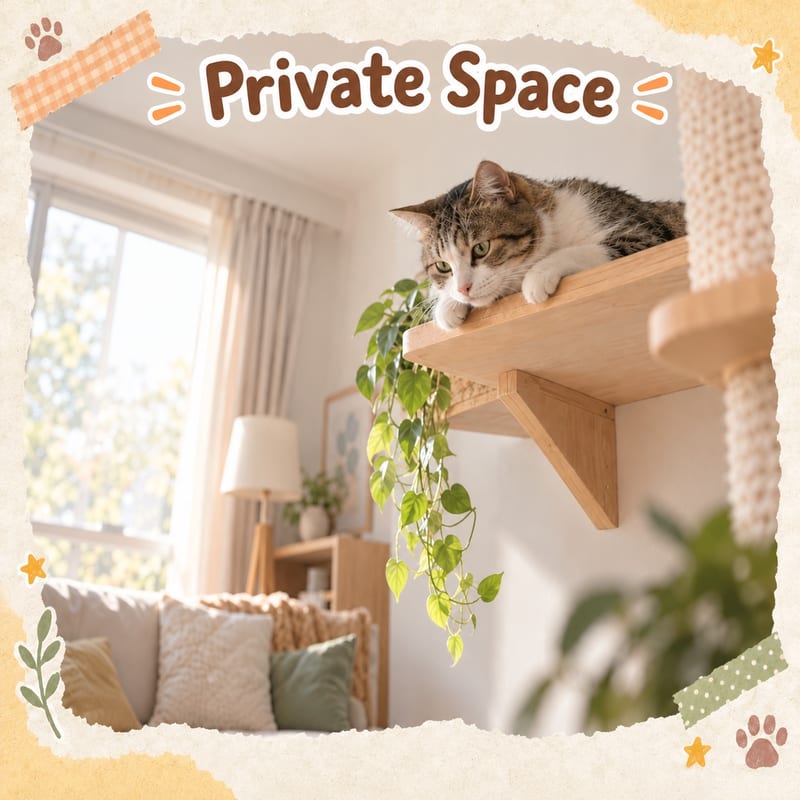
Resource allocation: putting the N+1 principle into practice
| Resource | Principle | Strategy for small Hong Kong flats |
|---|---|---|
| Litter box | Number of cats + 1 | Use covered types stacked in cabinets, one per level |
| Food bowl | One per cat, placed apart | Several meals a day, feed in separate rooms |
| Water bowl | Multiple points, far from litter boxes | One upstairs, one downstairs |
| Sleeping spots/beds | Exclusive to each cat, at different heights | Tops of cabinets and windowsills count |
| Scratching posts and toys | One set per zone | Vertical posts save space |
| Cat trees and shelves | Staggered heights with two routes | Wall-mounted shelves take the least space |
The spirit of this table is not 'buy more things' but don't concentrate all resources in the same area: to a cat, three litter boxes placed together equal one; only when placed apart do they count as three. Two easily overlooked details: don't put all the litter boxes in the same corner — a row of three litter boxes is just 'one resource point' to a cat, and the cat that guards that spot can still block all of them; separating food bowls also lets you monitor how much each cat eats — a new cat is most likely to stop eating due to stress, and only with separate spots can you see the numbers.
Fighting or playing? A table to tell the difference
| Signal | Play | Real fight |
|---|---|---|
| Sound | Silent or soft | Yowling, hissing, growling |
| Claws | Sheathed or gentle batting | Claws fully out, biting and not letting go |
| Roles | Taking turns chasing | One only flees, one only chases |
| Ears and fur | Ears forward, fur smooth | Puffed-up fur, ears flat, arched back |
| Interruption test | A human intervention breaks it up | They won't stop |
Standard action for a real fight: separate with cardboard or a large towel, or make a sudden noise (clapping, dropping a book) to interrupt — never pull them apart with your hands — you won't break up the fight, you'll just get bitten too. After separating, let them cool down for half an hour before they meet again; if they fight every time they meet, go back to the isolation stage and start again.
Five steps to introducing a new cat: slow is fast
- Isolation period (7 to 14 days): the new cat stays alone in a room with its own litter box, food, water and bed; swap bedding under the door to familiarise them with each other's scent
- Scent swapping: wipe the cheek glands with a towel and rub it on each cat so they 'smell each other's scent'
- Meeting through a door or gate: feed both cats at the same time on either side of the door, building the association 'the other cat behind the door = good food'
- Supervised meetings in the same room: open the door for short meetings while eating treats; if there is stiff staring or low growling, close the door immediately and go back a step
- Gradual freedom: after several peaceful meetings in a row, remove human supervision, including before bedtime
The timetable can be stretched but not shortened: timid cats may need more than a month, while kittens and easy-going adults often settle within a week. The most dangerous signal during the introduction period is not fighting but the new cat hiding long-term, not eating, or holding in urine/feces and not using the litter box — that is stress at its peak, and you must go back a step immediately.
Two more practical accelerators: make the cats' favourite treats (cat sticks, freeze-dried) appear 'only when they are together'; once a day, have the two cats eat a meal on either side of a glass door or barrier, then separate them after eating. After a few days, 'the other cat appearing' will automatically be linked to 'something good happening'.

More than fighting: hidden bullying is harder to spot
Many owners think 'no blood drawn' means no problem, but what is more common in the cat world is low-intensity long-term bullying — no fighting, no vocalising, just one cat using body language to control the flow of resources throughout the home. This often drags on until the bullied cat gets sick before it is noticed. Watch for:
- One cat approaches and the other cats immediately get up to give way or flee
- Litter box guarding: other cats hold their urine, or urinate outside the litter box (often mistaken for 'revenge')
- Having to wait for the guarding cat to move before eating, or only eating quickly when a human is watching
- One cat hiding long-term, losing weight, over-grooming a bald patch
- Two cats that don't actually fight, but the weaker one always waits until the stronger one has eaten and moved before daring to eat or walk — this 'staggered living', if forced to the point of not eating or not eliminating, is also a serious problem
Order of handling: first add resources (a second litter box on the other side of the room, completely separate feeding spots), then separate feeding and play times, and only then consider permanent separate zones. If the bullied cat shows refusal to eat, incontinence, or depressive behaviour, this is medical-level stress and requires a vet — this article is for reference only; consult a registered veterinarian for difficult cases.
How many counts as many? Combinations of different litters and personalities
There is no hard upper limit, but given Hong Kong's generally dense living conditions, combinations of up to three cats, raised together from kittenhood or with complementary personalities have the highest success rate. Practical experience: two kittens from the same litter easily keep each other company; adult cats usually accept kittens faster than same-age adults (lower sense of territorial threat); and adult cats that have been traumatised by fights with their own kind may forever be suited to a 'one cat, one zone' peaceful coexistence — don't force them to become best friends; 'ignoring each other' is already a happy ending in the cat world.
If two cats simply don't get along, is that a failure?
No. As long as there is 'no fighting, no illness, and each uses its own resources', the highest achievement in the cat world is ignoring each other — two cats sleeping in the same room without contact is successful coexistence. Adjusting expectations from 'loving' back to 'peaceful' immediately halves the stress in many households.
What you can do starting today
- Count: are there enough litter boxes, food bowls and sleeping spots for 'number of cats plus one'?
- Move one litter box and food bowl to another room or the other side of the corner
- Review your own cats' 'fight' footage against the table above today and decide play or real fight
- If you are considering adding a cat: prioritise adoption organisations with clear personality information for adult cats or kittens, and avoid same-age, highly territorial adults; most adoption organisations provide behavioural assessments — before choosing, ask directly 'Is this cat suitable for a multi-cat household?'
Small flat
Can't fit them all in even at a push? The sister article 'Multi-Cat Household Space Planning' covers vertical routes and same-room placement design; for choosing litter boxes and cat trees, check the product reviews on petfood.com.hk for side-by-side comparisons.
Further reading
- Multi-cat space planning →
- Cat behaviour and psychology →
- Signs your cat trusts you →
- Choosing a litter box →
- Cat behaviour course →
PetChill Cat Behaviour Team — Hong Kong's most authoritative pet knowledge platform
📌 Key points summary
- ✅ Number of litter boxes, food bowls and sleeping spots = number of cats + 1; only when placed apart do they count as independent resources
- ✅ Introduce a new cat with 7 to 14 days of isolation, gradual scent swapping, feeding through a door, and supervised meetings
- ✅ A real fight has yowling, puffed-up fur, and biting that won't let go; play is taking turns chasing, silent
- ❌ Don't break up a fight with your hands; use a towel or noise to separate them, and only let them meet again after they have calmed down
- ❌ Hidden bullying: one cat guards spots, others hide, urinate outside the box, lose weight
- ✅ The standard for peaceful coexistence is 'no fighting, no illness, each using its own resources'
 Fuji One full guide →

