
🤖 AI Summary
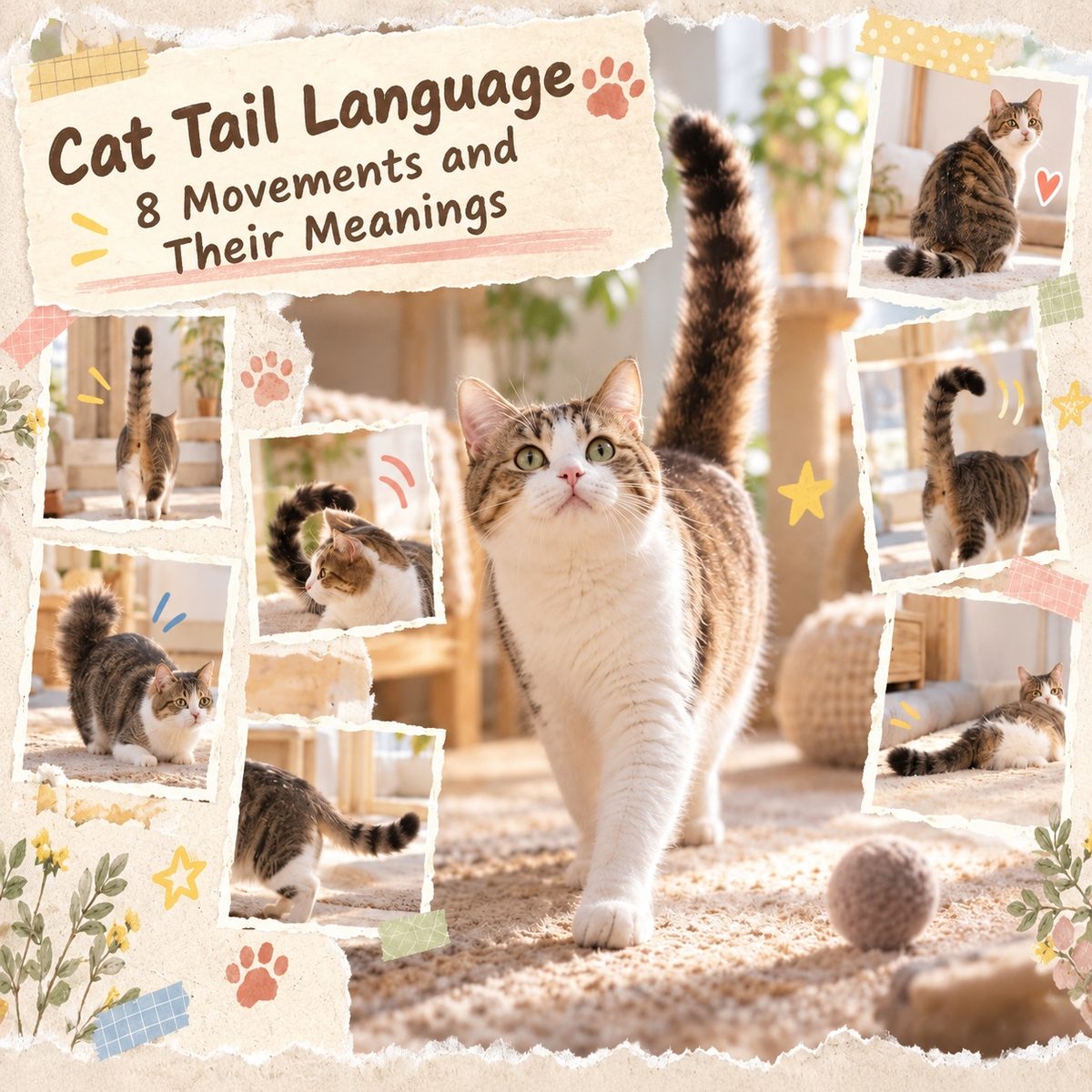
A cat's tail is made up of 18-23 caudal vertebrae and is a cat's most honest 'mood barometer'. This article breaks down 8 common tail signals: upright = happy and confident, question-mark shape = invitation to play, side-to-side sweeping = irritation, puffed up = fear, tucked = scared and submissive, wrapping around your leg = affection and claiming you.
• A wagging tail is not happiness! A cat's tail wag means the opposite of a dog's
• The tail must be read together with ears, pupils, and posture for accuracy
• The tail is an extension of the spine—never pull it, as it can damage nerves
Quick answer: An upright tail (with a slight hook at the tip) means happy and confident; a question-mark shape means wants to play; slow sweeping = focused assessment; rapid swishing = irritation warning; puffed up = fear and defence; tucked tail = scared; wrapping around your leg = affection and claiming you; tail tip flicking while sleeping = relaxed and content.
Table of Contents
-
Why does a cat's tail 'talk'?
-
Comparison table of 8 tail movements and meanings
-
Positive emotion signals (4 types)
-
Negative emotion signals (4 types)
-
The biggest misconception: a cat's tail wag ≠ happiness
-
Tail care: don't pull!
-
FAQ
Why does a cat's tail 'talk'?
A cat's tail is not just a cute accessory—it's an extension of the spine, made up of 18 to 23 caudal vertebrae and over a dozen muscle groups, densely innervated and capable of fine movement. Besides helping cats keep balance when jumping and walking on cat trees (mid-air turns rely entirely on the tail), the tail is also a cat's emotional antenna: happiness, tension, fear, irritation—all are faithfully reflected in the tail.
The most interesting thing is that cat tail language is the exact opposite of dogs': a dog's wagging tail usually means happiness, but a cat's rapid tail swishing means 'I'm impatient'. Dog owners turning cat owners most easily fall into this trap—seeing a wildly swishing tail and thinking the cat is happy, reaching out only to find they've stepped on a landmine.
Comparison table of 8 tail movements and meanings
| # | Tail movement | Emotion | What the cat wants to say |
|---|---|---|---|
| 1 | Upright, pointing up | Happy, confident | 'Feeling good today!' (common greeting) |
| 2 | Upright with tip hooked like a question mark | Friendly, curious | 'Play with me?' |
| 3 | Upright with slight quiver | Extremely excited | 'So happy!' (seeing canned food/owner coming home) |
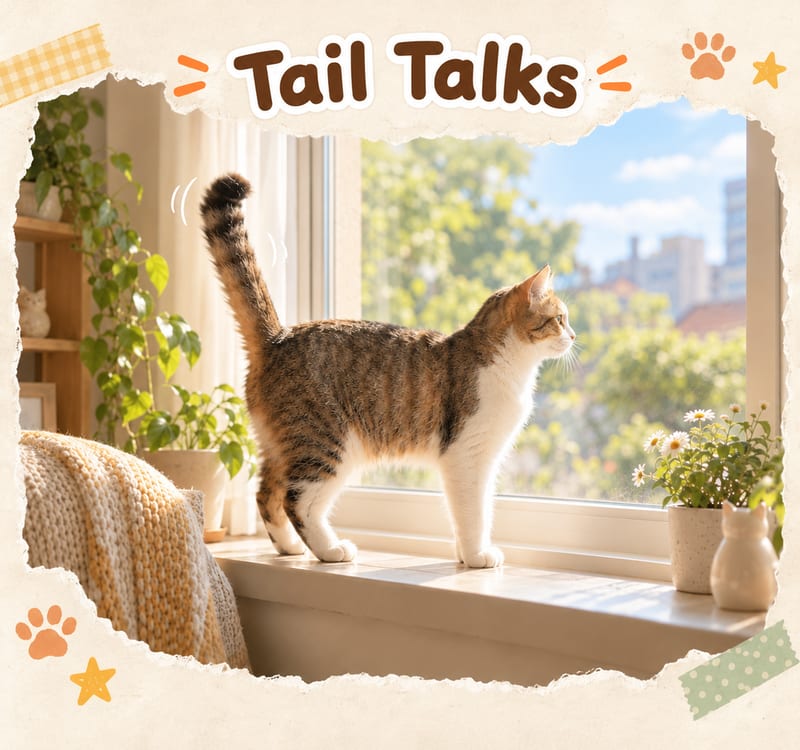
| 4 | Slow side-to-side sweep | Focused assessment | 'Let me observe...' (watching prey by the window) |
| 5 | Rapid swishing/thumping | Irritated, displeased | 'Enough! Don't touch me anymore' |
| 6 | Whole body puffed up (tail expanded) | Extreme fear | 'Don't come closer!' (startled defence) |
| 7 | Tail tucked between legs | Scared, submissive | 'I'm scared...' (low-rank signal in multi-cat households) |
| 8 | Wrapping around your leg | Affection, claiming you | 'You're mine' (classic move while waiting for food) |
Positive emotion signals (4 types)
1. Upright, pointing up (greeting flag)
A cat walking with its tail held high is the most positive signal in the cat world: happy mood, feeling safe in the environment, full of trust in you. Kittens gradually learn to 'raise tail when seeing you' after coming home—a milestone of bonding. Many cats also add a slight hook at the tip when holding their tail up, doubling the affection.
2. Question-mark shape (play invitation)
Tail raised with the tip curved into a '?'—this is an invitation saying 'Let's play!' When you see this, bring out the teaser wand; the success rate is as high as 90%.
3. Quivering tail (excitement overload)
An upright tail with a slight quiver usually appears when you're holding something they love (canned food, treat bag) or the moment you come home. The cat is so excited its tail quivers—pure love.
4. Wrapping around your leg (claiming ritual)
Wrapping its tail around your calf is firstly a friendly physical contact between felines, and secondly a way to leave a 'this is my human' mark using the scent glands on its cheeks. Usually accompanied by waiting for food or asking for pets.
Negative emotion signals (4 types)
1. Slow tail sweep (do not disturb mode)
Tail close to the ground, slowly sweeping side to side, usually when the cat is focused on prey or assessing the environment. This is not anger, but a signal of 'I'm busy, don't disturb'—don't pet at this time.
2. Rapid tail swishing (red alert)
Tail swinging widely and rapidly side to side, thumping the floor—the cat is at peak irritation. If you're petting and see the tail start swishing wildly, stop immediately or it will strike. This is the cat's final warning; many people get 'unexpectedly' scratched because they miss this signal.
3. Puffed up (maximum fear)
All fur (especially the tail) puffed up like a brush, back arched, body turned sideways—the cat is startled or feels threatened and makes itself look bigger to scare off the opponent. Common triggers: sudden loud noises, seeing a strange cat, on the way to the vet. Give it space to calm down; don't chase or force a cuddle.
4. Tucked tail (fear and submission)
Tail tightly tucked between the hind legs, body even lowered—extreme fear, no way out. In multi-cat households, a tucked tail is also a signal of submission from a lower-ranking cat to a higher-ranking one. At this time, what they need most is security: let them go to a hiding spot, don't force them to face the source of fear.
The biggest misconception: a cat's tail wag ≠ happiness
Let me emphasise this most common misunderstanding again:
| Situation | Dog's meaning | Cat's meaning |
|---|---|---|
| Tail wagging widely | Happy and excited | Irritated, displeased, hesitant |
| What to do | Continue interacting | Stop, give space |
A cat's tail wag is mostly a release of emotional tension—it could be focus before hunting (slow sweep) or unbearable irritation (wild swishing). The only exception is 'half-closed eyes, whole body relaxed, tail tip gently flicking': that's a contented response to hearing your voice while sleeping, which is positive. Remember, besides the tail, always look at the ears, pupils, and body posture—the whole body language together gives the complete answer.
Tail care: don't pull!
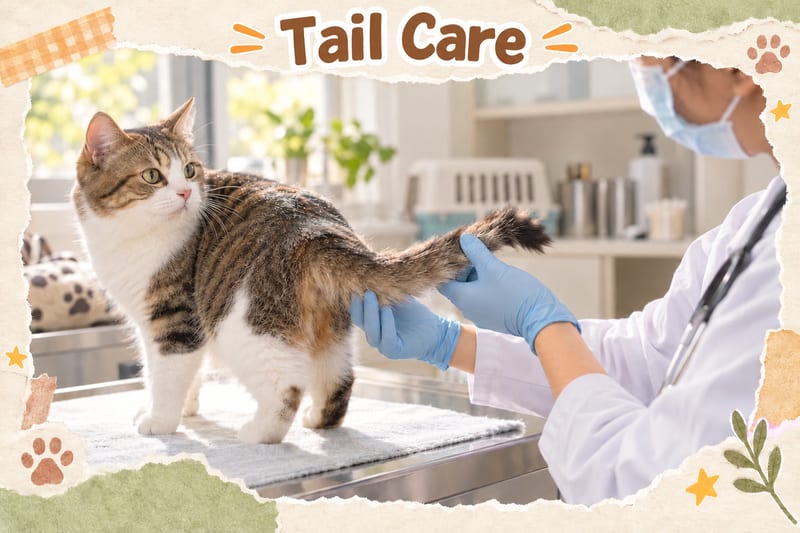
A cat's tail is an extension of the spine, densely packed with nerves, and connected to the nerves controlling urination and defecation. Pulling hard, stepping on, or shutting the tail in a door can cause severe pain and fright, damaging trust, or worse, nerve damage leading to incontinence or hind limb problems.
Care tips:
- Teach children at home: the tail is not a toy, don't pull it
- Watch where the cat's tail is before closing doors or drawers
- If the tail suddenly hangs limp and weak, unable to lift—possible nerve damage, see a vet as soon as possible
- Bald patches/scabs/constant scratching on the tail—signs of skin disease or parasites
This article is for reference only and cannot replace veterinary diagnosis. If you have health concerns, please consult a registered veterinarian.
Hong Kong small flat practical guide: read the tail + avoid risks + vet visit checklist
Hong Kong living spaces are small, and cats are more easily stressed. Here are three steps to help you read your cat's tail in a 300 sq ft space and avoid emergency traps.
1. Tail reading quick reference (stick on the fridge door)
- Before work: seeing upright tail + quivering → go out with peace of mind, your cat is in a good mood.
- When you get home: if the tail is tucked and the cat is hiding under the bed → it may have been frightened during the day (renovation noise, lightning); turn on the lights and play soft music first, don't force a cuddle.
- Before feeding canned food: question-mark tail → immediately bring out the teaser wand and play for two minutes; they'll eat happily and lose weight.
2. Small flat risk-reduction setup
- Add a buffer mat at the entrance: reduce door-closing tail accidents.
- Install corner guards in hallway corners: prevent bruising the tail base when the cat runs around puffed up.
- Educate children/domestic helpers: use stickers to mark 'tail no-go zone'; pictures are most practical.
3. When to rush to a 24-hour vet
- Tail limp for over 6 hours: possible tail spine injury or nerve compression; on Hong Kong Island go to North Point emergency vet, in Kowloon go to Prince Edward 24-hour clinic.
- Localised baldness on tail + constant biting: common in spring and summer, fleas or fungus; first use a torch to check for black spots or red rashes, then book a nearby vet dermatology appointment.
- Tucked tail + continuous hiding for over 24 hours: too much stress; try pheromone spray first, if no improvement contact vet to assess whether emotional medication is needed.
Remember: Hong Kong transport is convenient, but emergency vet fees are higher at night; it's advisable to save the clinic's WhatsApp in advance so you don't have to rush around in an emergency.
Further reading
- All articles index
- PetChill pet supplies
- Cat scratcher buying guide →
- Causes and prevention of cat scratching furniture →
- 5 steps to stop cats scratching furniture →
- 5 tips for cat scratching training →
- The secret of cat purring →
📌 Key takeaways
- ✅ Upright tail = happy greeting, slight hook at tip adds affection
- ✅ Question-mark tail is an invitation to play
- ❌ A wagging tail is not happiness; rapid swishing = irritation warning
- ❌ Never pull a cat's tail; it can damage nerves and cause incontinence
- ✅ Read the tail together with ears and pupils for accuracy
- ✅ When the tail is tucked or puffed up, give space and let them calm down
🆕 2026 update: 8 tail states illustrated + 'tail × ears × pupils' combined reading
Direct answer: A cat's tail is an emotional thermometer, but it cannot be read alone. The correct approach is 'three-in-one': tail position + ear direction + pupil size. The same tail height with different ears and pupils can mean completely opposite things.
8 tail states comparison table
| # | Tail state | Common situation | True meaning | Triage |
|---|---|---|---|---|
| 1 | Held high, tip slightly curved | Walking towards you, roaming indoors | Friendly, confident, greeting | 🟢 Normal |
| 2 | Held high and quivering rapidly | Seeing you come home, about to be fed | Highly excited, expectant | 🟢 Normal |
| 3 | Straight out horizontally | Exploring new environment | Curious, focused | 🟢 Normal |
| 4 | Low, tip pointing down | Uncertain, assessing | Mild unease | 🟡 Watch |
| 5 | Tucked between legs | Unfamiliar environment, loud noise | Fear, trying to make itself small | 🔴 Needs handling if persistent |
| 6 | Rapid side-to-side thumping | Being petted, being held | Overstimulated, about to strike | 🟡 Stop immediately |
| 7 | Slow waving | Watching out the window, before sleep | Relaxed, attention caught | 🟢 Normal |
| 8 | Tail fur all puffed up (squirrel tail) | Suddenly startled, seeing another cat | High alert/defensive readiness | 🟡 Reduce stimuli |
'Tail × ears × pupils' three-in-one reading
| Tail | Ears | Pupils | Combined reading | Suggested response |
|---|---|---|---|---|
| Held high | Forward, relaxed | Normal | Confident, friendly | Can interact |
| Held high | Slightly turned back | Slightly large | Excited but starting to overstep | Shorten interaction |
| Thumping | Pressed back | Dilated | Preparing to defend | Stop immediately, give way |
| Tucked | Fully pressed back | Dilated | Fear | Provide hiding spot, don't force |
| Low | Turned sideways | Slightly large | Hesitant, assessing | Wait for them to approach |
| Puffed up | Fully pressed back | Dilated | High alert | Remove stimulus (cat outside window, noise) |
What owners can do (specific actions)
- Daily 3-second observation rule: before approaching the cat, look for 3 seconds (tail, ears, pupils); only reach out when all three are relaxed.
- Start petting from 'chin → cheeks → behind ears', 5–10 seconds each time, avoid the tail base (a sensitive area for most cats).
- Tail thumping = stop immediately, don't 'try one more pet', otherwise it can easily escalate from 🟡 to 🔴.
- Provide 3 or more high observation points (shelves, cat trees, cabinet tops) to reduce defensive postures from ground-level conflicts.
- Window stimulus management: if the cat often puffs up at the window, partially blocking the view can significantly reduce alertness.
Sources (supplementary)
- AAFP/ISFM Feline-Friendly Handling Guidelines (body language and handling)
- International Cat Care: Handling and interactions
- AAFP/ISFM Feline Environmental Needs Guidelines
 Feline Natural full guide →