
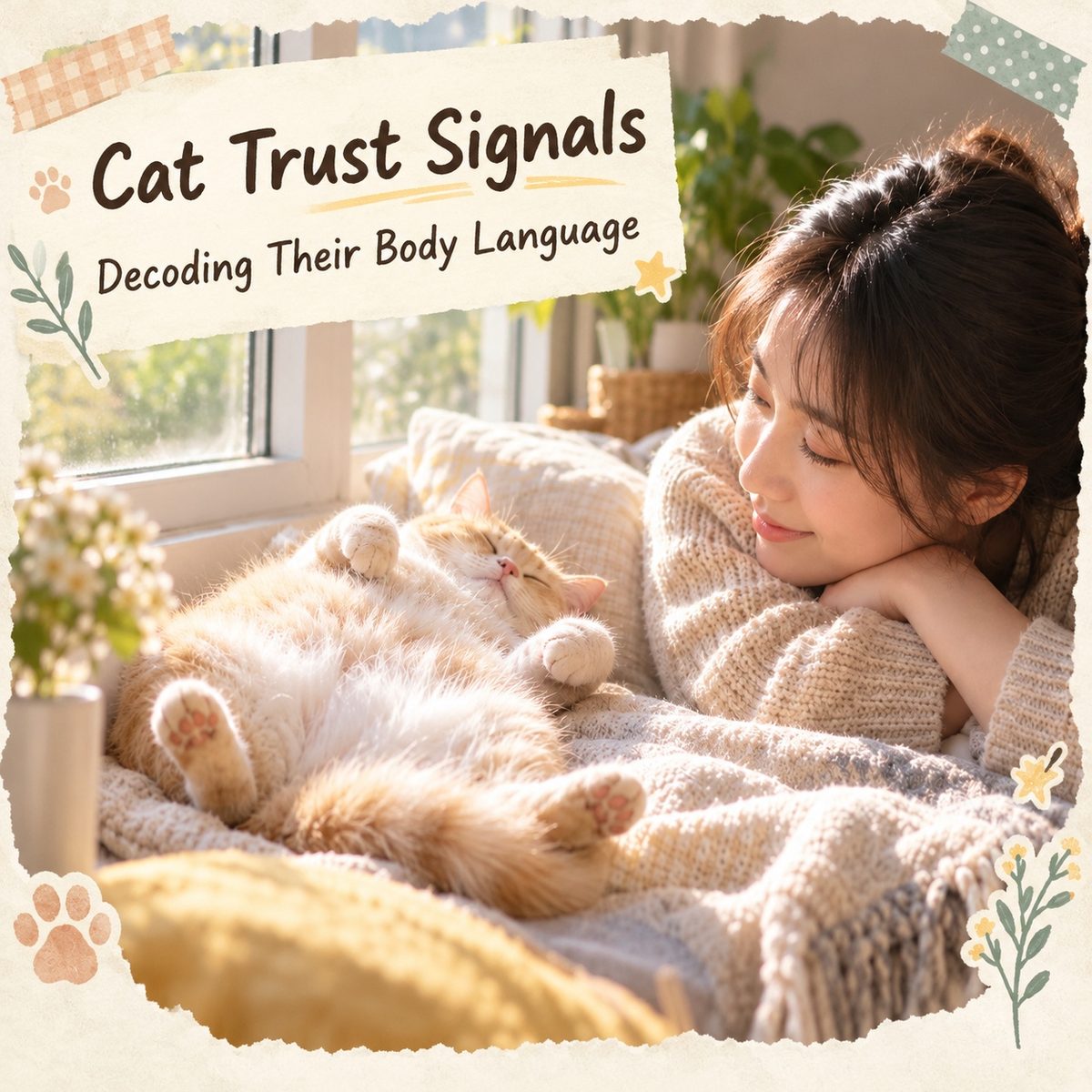
Quick answer: When a cat truly trusts you, it shows seven 'relaxed combinations': slow blinking, belly-up, kneading, head bunting, sleeping facing you, a question-mark tail, and willingness to eat with you. But remember to look at them as a group and in context — don't draw conclusions from a single action.
When a cat trusts you, it sends seven types of signals: belly-up, slow blinking, kneading, head rubbing, sleeping facing you, approaching with tail up, and eating together. This article breaks down the principle behind each signal and the traps of misreading them. This is the signal interpretation chapter.
Signal 1: Slow blinking — the cat version of 'I trust you'
In the wild, cats must be alert at all times; closing their eyes in front of another animal is a high-risk move. So slow-blinking in front of you = 'I can let my guard down around you'.
- How to tell real from fake: A true slow blink has soft eyes, eyelids slowly closing and slowly opening, usually with the head slightly lowered or tilted.
- Blink back at them: This is one of the few cross-species communications confirmed by behavioural science — if you slow-blink at a cat, it often blinks back, forming a successful 'conversation'.
- Easy to misread: Eyes half-closed but ears flattened back and body tense — that's insecurity, not trust. Don't get it wrong.
- Frequency is data too: Blinking at you once is no big deal; approaching you on its own, lying down and blinking at you several times in a day is a stable trust indicator.
Slow blinking has an advanced use too: when a cat is nervous in a new environment (e.g. a vet clinic waiting area), the owner slowly blinking and slightly narrowing the eyes is the least intrusive calming method — safer than reaching out to touch, because a startled cat will often bite the hand that reaches.
Signal 2: Belly-up — relaxed, but not an invitation
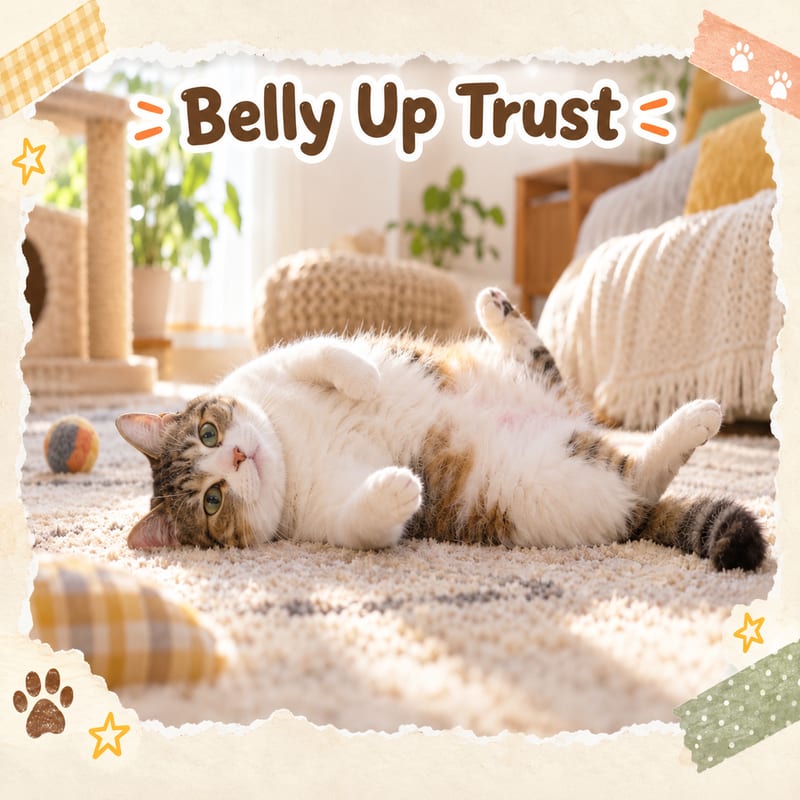
The belly is the most vulnerable part of a cat's body, where the organs are concentrated. Lying on its back in front of you is a high-level display of trust — but this signal is the most easily misread:
⚠️ Belly-up ≠ please touch my belly. To a cat, lying belly-up means 'it's so safe here I can be defenceless', not 'come and rub'. Many cats grab and bite when someone pounces on their belly — not because they're fickle, but because they never gave permission.
Correct response: admire from afar, speak softly, or toss a treat over. Only if the cat actively rubs its belly against your hand is it a real invitation.
Worth adding: kittens and young cats are more likely to lie belly-up; older cats, or cats that have been wrongly touched on the belly, may never do it. So don't make 'does it show its belly' a test — some cats express trust by sitting within a metre of you rather than rolling over. Personality differences are real.
Signals 3 to 5: Kneading, rubbing, sleeping facing you
Kneading (front paws opening and closing in a pressing motion) comes from kittens massaging their mother's mammary glands to stimulate milk flow. When an adult cat does it on a blanket or on you, it's projecting its 'happiest memories' onto you. Note two things: suddenly biting hard mid-knead is 'sensory overload' from over-excitement, not an attack on you; cats that still knead as adults usually had a very good sense of security in kittenhood.
Rubbing has two levels: rubbing you with its side and tail base marks 'territory boundaries' with scent glands; but bunting you with its head, ear base and cheeks is a level higher — the scent glands on the head leave a 'pheromone social mark', which in the cat world means 'this is one of my own'. This head bunting is a high-level social behaviour rarely seen even between cats.
Sleep orientation is also a signal: a defensive cat sleeps with its back to the wall, facing out; if it exposes its face and back to you while sleeping, or even sleeps back-to-back with you, it has decided you're on sentry duty. A cat sleeping in the same bed as you is essentially a sentry contract.
Signals 6 and 7: Question-mark tail and eating together
Tail held straight up with the tip slightly curved into a question mark, sometimes quivering gently as it approaches you — this is the clearest friendly greeting in cat society, like a human saying 'hi, good to see you'. Conversely, a tail tucked between the legs or swishing forcefully side to side means tension and impatience.
Being willing to eat in the same space as you is also an important indicator: cats are most defensive when eating. Whether it's willing to eat head-down next to you, glance back at you mid-meal before continuing, is a very reliable trust test. Conversely, if it must eat in a corner and stops when it hears you approach, it's not relaxed enough yet.
How to tell 'fake trust' from stress signals
Trust signals must be read as a group and in context; a single action is easily misjudged. Here are common 'looks like, but isn't':
| Looks like trust | Might actually be | How to tell |
|---|---|---|
| Lets you hold it | Tonic immobility (freeze stress) | Ears flat, pupils dilated, rapid breathing |
| Suddenly scratches you | Sensory overload from over-petting | Skin twitching, tail swishing twice first |
| Sleeps on you | Just wants a warm radiator | No slow blinking, no purring throughout |
| Follows you around | Hungry or wants a door opened | Turns away as soon as you look at it |
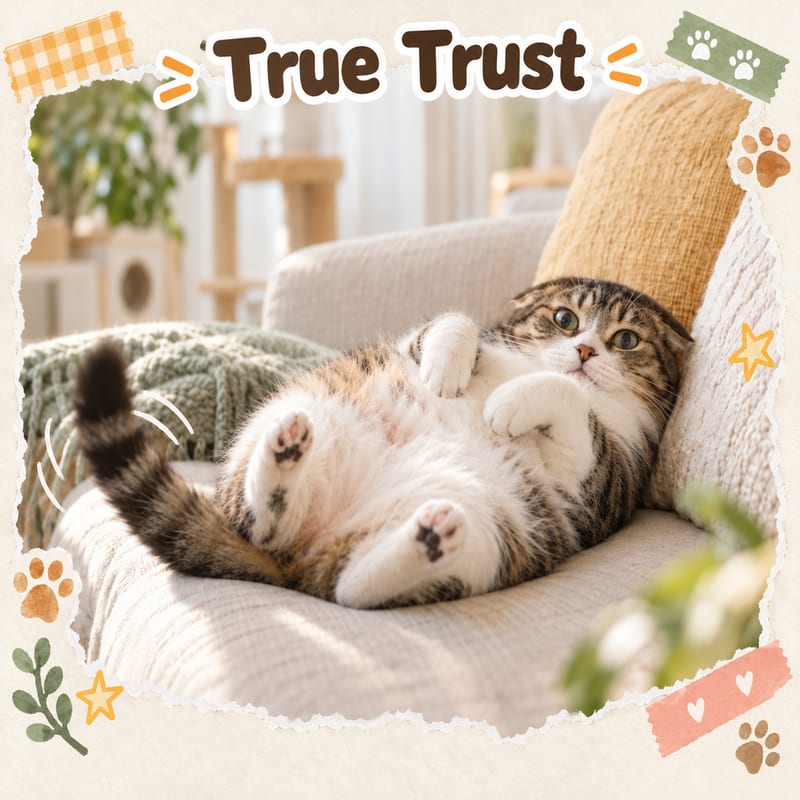
True trust is a relaxed combination: soft eyes, relaxed ears, easy breathing, tail hanging naturally or in a question-mark shape. Before accepting any one signal, first confirm there are no stress signals mixed in.
Why you shouldn't deliberately 'test' trust
Some cat owners deliberately remove hiding spots or suddenly reach out to test their cat's reaction — that's not testing, it's creating stress. Behaviourally, trust is an accumulated default value: every time you prove you're not a threat when the cat is vulnerable (sleeping, eating, grooming, ill), that default value slowly rises. Rather than testing deliberately, be a passive recorder — note down the frequency of the seven signal types over two weeks; the trend is what tells the truth.
If a cat shows no trust signals at all for a long time, along with hiding, refusing food or inappropriate urination, consider anxiety or underlying pain. You can first refer to PetChill's environmental stress guide, and consult a registered veterinarian for difficult cases.
Advanced: Turn the signals into your cat's personal vocabulary
Every cat has individualised signals: one cat's happiness is a tiny flick of the tail tip, another's is turning its ears back half a notch before approaching. Record for two weeks and you'll find your cat has a fixed set of combinations — this private vocabulary often tells you about emotional shifts earlier and more accurately than any generic list.
Three principles for reading signals
- Read as a group, not one body part: tail, ears, eyes and posture must be seen together — a puffed-up straight tail and a question-mark tail are completely different.
- Read the context: following you before meals is hunger; following you on a casual walk is wanting to join your sentry patrol.
- Read the trend, not the moment: frequency changes recorded over two weeks are more reliable than any single 'miracle moment'.
Master these three principles and the seven signal types above stop being scattered trivia and become an observation framework you can use every day.
What you can do starting today
- Starting today, look into your cat's eyes and slow-blink once, and see if it blinks back.
- Record for a week: which signal types your cat shows you and how often.
- Tell the difference between belly-up and head bunting; resist pouncing to rub the belly and respond with a treat instead.
- At mealtime, try sitting a metre away from the food bowl and see if your cat keeps eating — this is the simplest trust test.
To learn practical techniques — using feeding, grooming and interactive play to build trust step by step — see the companion piece 'Signs Your Cat Trusts You' practical guide.
Further reading
- Cat behaviour →
- Signs your cat trusts you — practical →
- Why cats purr →
- Cat kneading →
- Cat behaviour course →
PetChill Cat Behaviour Team — Hong Kong's most authoritative pet knowledge platform
- 10 signs your cat trusts you →
- Complete cat nail trimming guide →
- 5 steps to stress-free nail trimming →
- 5 cat scratching training tips →
- The secret of cat purring →
📌 Key takeaways
- ✅ Slow blinking = the cat version of 'I trust you'; blink back to start a conversation.
- ❌ Belly-up is not an invitation to touch the belly; touch it wrongly and you may get bitten.
- ✅ Head bunting is the highest-level social mark, meaning 'one of my own'.
- ❌ Letting you hold it may be freeze stress; check the ears and pupils.
- ✅ Record signal frequency for two weeks; the trend is the true trust indicator.