
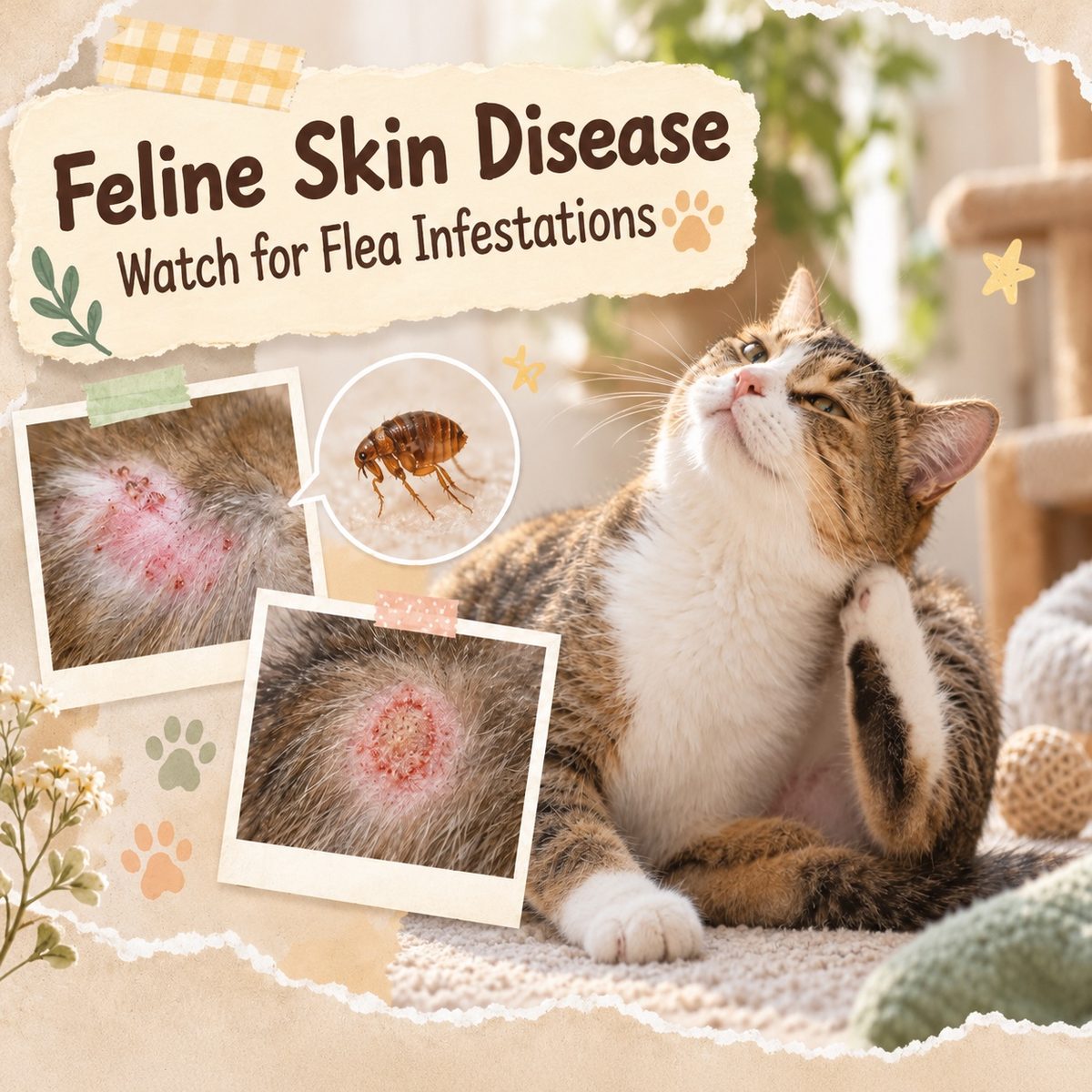
Quick answer: Is your cat scratching non-stop, losing fur or breaking out in a rash? The three most common skin diseases are flea allergy dermatitis, scabies and ringworm. Flea allergy usually shows on the lower back and tail, scabies starts around the ears and spreads, and ringworm causes round bald patches. Regular deworming, a clean environment and a balanced diet are the keys to prevention.
Have you noticed your cat scratching or licking itself constantly lately, or even losing fur and developing a rash? Cat skin disease is a very common health problem, and Hong Kong's humid, muggy climate makes it even easier for bacteria, fungi and parasites to thrive. Left untreated, a small problem can worsen into a serious infection. This article takes a close look at the 3 most common cat skin diseases and shows you how to recognise the symptoms, handle them correctly and build good daily prevention habits.
Flea Allergy Dermatitis: The Most Common Skin Problem
Flea allergy dermatitis is one of the most common skin diseases in cats. Not every cat reacts severely to a flea bite — the problem lies in the proteins in flea saliva. Some cats are sensitive to these proteins, and a single bite can trigger a severe reaction.
Typical symptoms
A rash appears on the cat's back and around the tail, along with hair loss. Because it is so itchy, the cat will bite and lick the area frequently, sometimes scratching until the skin bleeds. If you notice a rash and hair loss recurring on the lower back near the tail, flea allergy dermatitis is very likely the cause.
Treatment and prevention
Veterinarians usually prescribe steroids or anti-allergy medication to relieve symptoms. But the most important step is thorough flea elimination — not just the fleas on your cat, but also cleaning the indoor environment to kill hidden flea eggs, larvae and pupae. If you have more than one cat, every cat needs preventive treatment too, otherwise they will reinfect each other. To learn more about parasite control, see our complete cat deworming guide.
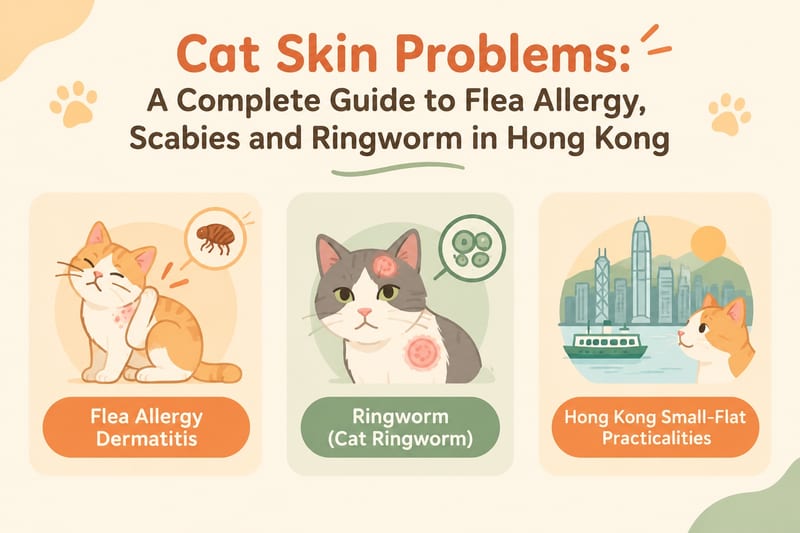
Scabies: Intensely Itchy Dermatitis Caused by Mites
Scabies is a skin disease caused by the mite Notoedres Cati burrowing into a cat's skin. It is highly contagious and spreads through direct contact.
Typical symptoms
Cats with scabies become extremely itchy, sometimes scratching until the skin bleeds. Symptoms usually start at the edges of the ears with a rash and hair loss, then spread to the head, face and limbs. Long-term inflammation makes the skin thicken, giving it a wrinkled appearance with flaking. If you notice your cat scratching its ear edges intensely and shaking its head frequently, pay close attention. To learn how to spot signs that something is wrong with your cat, see our article on hidden signs of illness in cats.
Treatment and prevention
Veterinarians treat scabies with parasite-killing medication. At the same time, the cat bed, bedding and towels your cat uses regularly must be thoroughly disinfected, and the indoor environment fully cleaned. If you have multiple cats or other pets, all of them need treatment together to avoid repeated infection. Always isolate and observe a new cat before bringing it home, and only introduce it to the group once you have confirmed there are no skin problems.
Ringworm (Cat Ringworm): A Fungal Skin Infection
Ringworm is a skin disease caused by a fungal (mould) infection, and kittens and cats with weakened immunity are especially susceptible. It can also spread to humans, so handle it with extra care.
Typical symptoms
Roundish patches appear on the face, ears and limbs, along with hair loss, scaling and crusts. Unlike the previous two conditions, ringworm is usually not very itchy, so owners often overlook it. If you find round bald patches on your cat with flaking and crusts at the edges, take it to the vet as soon as possible.
Treatment and prevention
Veterinarians prescribe antifungal medication, or use antifungal medicated shampoo and ointment. During treatment, the fur around the affected area needs to be clipped short — this makes applying medication easier and helps stop the infection spreading. Your cat's bedding and daily items should be washed and disinfected frequently. Ringworm treatment usually takes 4 to 6 weeks, and you must keep applying medication throughout — do not stop on your own just because symptoms improve. During treatment you can support medicated bathing with the correct bathing method.
Quick Comparison of the 3 Major Skin Diseases
| Item | Flea allergy dermatitis | Scabies | Ringworm (cat ringworm) |
|---|---|---|---|
| Cause | Allergy to flea saliva | Scabies mite infestation | Fungal infection |
| Common locations | Back, around the tail | Ear edges → head → limbs | Face, ears, limbs |
| Main symptoms | Rash, hair loss, intense itching | Extreme itching, thickened skin, flaking | Round bald patches, crusts |
| Itch level | ★★★★ Severe | ★★★★★ Extreme | ★★ Mild |
| Contagiousness | Spreads between cats | Very high, spreads by direct contact | Can spread to humans |
| Treatment course | Deworming + environmental cleaning | Parasite medication + full disinfection | 4-6 weeks of antifungal treatment |
5 Golden Rules for Daily Skin Disease Prevention
Prevention is always better than treatment. These 5 daily habits can greatly reduce your cat's risk of skin disease:
1. Regular deworming
Whether your cat lives indoors or goes outside, use parasite prevention regularly. Fleas, mites and other parasites can be brought indoors on people's clothes and shoes, so don't skip deworming just because your cat stays home. See the complete cat deworming guide.
2. Keep the environment clean
Wash cat beds and bedding weekly, and vacuum and disinfect the home regularly. Hong Kong's humid weather is ideal for fungal growth, so consider using a dehumidifier to keep the indoors dry.
3. Balanced diet
A balanced diet helps strengthen your cat's immunity and reduces the chance of skin problems. Foods containing Omega-3 and Omega-6 fatty acids are especially beneficial for skin health.
4. Regular brushing
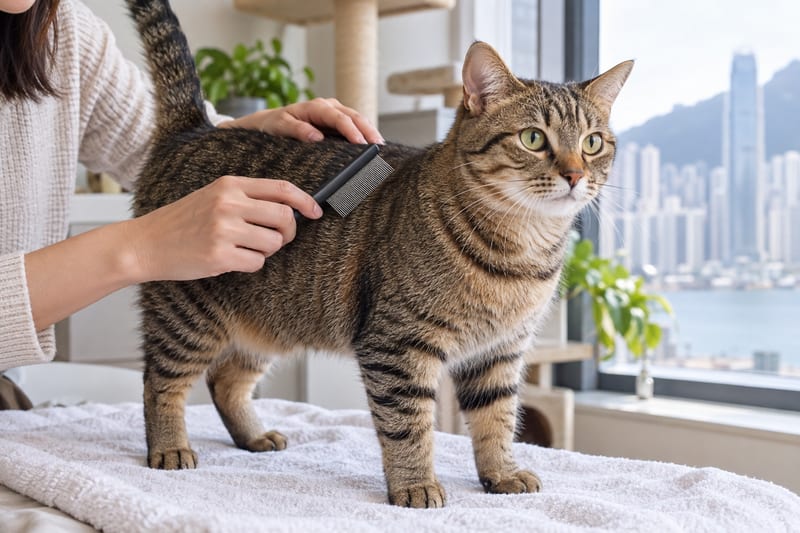
Brushing daily not only reduces loose fur but also helps you spot skin abnormalities early. While brushing, check for rashes, hair loss, flaking or crusts. Learn more brushing techniques to catch skin problems early.
5. Isolate new cats
If you plan to bring in a new cat, isolate and observe it for at least 2 weeks first, and only introduce it to the group once you have confirmed there is no skin disease. This step prevents skin disease spreading to your existing cats.
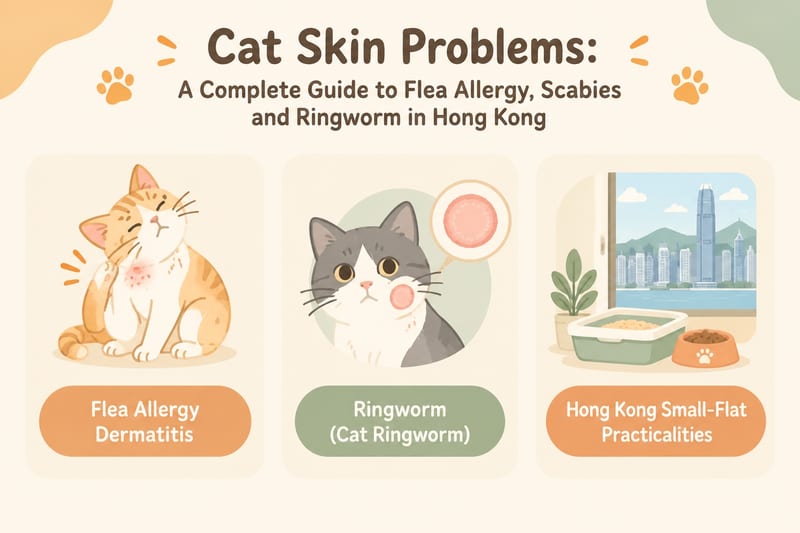
Hong Kong Small-Flat Practicalities: 3 Steps to a Skin-Disease-Safe Home
Hong Kong flats are small and crowded, so cats have limited space — which actually makes it easier for fleas and mould to build up. These 3 steps help you achieve professional-level prevention in a 300 sq ft flat.
1️⃣ Weekly "five-minute flea check"
- Tools: one white wet wipe, one comb.
- Method: while brushing, tap the combed-out fur onto the wet wipe. If a reddish-brown stain appears, that is flea faeces containing blood — immediately switch on "whole-home deworming mode": cat spot-on treatment + vacuuming + washing bedding.
- Timing: do it every Sunday so brushing and checking happen together and you never forget.
2️⃣ Dehumidify + sun-dry: use both
- Dehumidifier setting: automatic mode from 9am to 6pm, keeping humidity around 55%; switch to sleep mode at night so it isn't noisy.
- Drying bedding: Hong Kong sun is strong but space is tight, so buy a folding drying rack and put it by the window. Give cat beds and towels 3 full hours of UV, and mould will naturally go away.
3️⃣ New cat isolation: turn a wardrobe into a sick room
- Space: use a ventilated pet playpen to fence off a 4 ft x 2 ft temporary isolation area in a corner of the living room, away from the resident cat's main routes.
- Supplies: separate litter box, water bowl and small scratching board; clean daily with disposable gloves, tie up and throw away waste bags immediately to avoid cross-contamination.
- Observation chart: make a simple checklist and record appetite, bowel movements and skin condition daily. Only after two weeks with no abnormalities should the new cat officially "leave quarantine".
Follow these three steps and even in a 300 sq ft flat you can keep the risk of fleas, mould and scabies mites to a minimum — and your cat will naturally have healthy, glossy skin and coat.
🟢🟡🔴 Red-Line Triage Table: When a Skin Problem Needs a Vet Right Away
| What you observe | 🟢 Home care + book a vet appointment | 🟡 See a vet soon (within 1–3 days) | 🔴 Seek treatment immediately (same day) |
|---|---|---|---|
| Skin appearance | A little flaking, mild dryness | Localised rash, round bald patches, thickened skin | Widespread redness and swelling, oozing pus, broken skin |
| Itch level | Occasional scratching | Frequent scratching and licking, affecting daily life | Scratching until bleeding, licking and biting non-stop until fur is lost, unable to rest |
| Extent of hair loss | Seasonal shedding, symmetrical pattern | Localised or symmetrical hair loss | Rapid, widespread hair loss with ulcerated skin |
| Signs of parasites | An occasional flea found | Fleas or black flea faeces seen while brushing | Severe flea infestation, obvious anaemia (pale gums) |
| Energy and appetite | Normal | Slightly irritable, eating less | Refusing food, lethargic, fever |
| Skin lumps | Small, unchanged | New lump or nodule appears | Lump growing rapidly, bleeding, ulcerated |
| Household members | No one has skin symptoms | A family member develops a suspected ringworm red ring | A child or immunocompromised person develops symptoms |
| Response to treatment | Improving within 2 weeks as instructed by the vet | No improvement after 2–4 weeks of medication | Worsening or spreading over the whole body after medication |
Hong Kong's Humid Weather: A Guide to 8 Types of Skin Problems
Here are the 8 most common types of skin problems in cats, with how common they are in Hong Kong and the key points for telling them apart:
| Type | Cause | Typical appearance | Itch level | How common in Hong Kong |
|---|---|---|---|---|
| Ringworm (cat ringworm) | Fungal infection | Round hair loss, flaking and crusts at the edges | Mild to moderate | High (humid season) |
| Flea allergy dermatitis | Allergy to flea saliva | Hair loss and rash on lower back, tail base | Very high | High |
| Ear mites | Mites in the ear canal | Coffee-ground-like earwax, scratching ears and head shaking | High (concentrated in ears) | High |
| Scabies (cat scabies mite) | Mites burrowing into the skin | Crusts on face and ear edges, thickened skin | Very high | Medium |
| Food allergy | Adverse reaction to food proteins | Itching and hair loss on head, face and neck | Moderate to high | Medium |
| Environmental allergy (atopic dermatitis) | Sensitivity to dust mites, pollen, mould | Symmetrical hair loss, reddened skin | Moderate to high, seasonal | Medium (rises in humid season) |
| Bacterial infection (pyoderma) | Secondary infection after scratches | Redness, swelling, pustules, oozing, foul smell | Moderate | Medium |
| Eosinophilic granuloma complex | Immune-related reaction | Swollen lips, skin nodules, painless ulcers | Varies widely | Medium |
Key comparisons: itching concentrated at the tail base and lower back = suspect fleas; round hair loss + flaking at the edges = suspect ringworm; crusts on the face and ear edges + extreme itching = suspect scabies.
Shampoo and Medicated Baths: The Iron Rule on Frequency
- General cleansing shampoo: should not be too frequent — over-bathing damages the skin barrier. Follow your cat's needs and the product instructions.
- Medicated baths (vet-prescribed): frequency depends entirely on the diagnosis and the type of medication, and must follow your veterinarian's instructions and the product label. Do not increase frequency on your own. Medicated baths require leaving the medication on for the specified time before rinsing (follow the product instructions).
- What not to do: use human shampoo, use dog flea shampoo, add tea tree oil or essential oils yourself (toxic to cats), or use human ointments containing steroids.
A diagnosis is essential before starting treatment — using the wrong shampoo is not only ineffective but can irritate the skin and make diagnosis harder.
Sources
- International Cat Care — Itchy cat: when it is not fleas — common causes of itching and hair loss in cats (allergies, mites, infections) and diagnostic directions
- International Cat Care — Eosinophilic granuloma complex in cats — a common immune-related skin condition in cats (eosinophilic granuloma complex)
- International Cat Care — Ringworm in Cats — recognising and managing fungal skin infections
Disclaimer
This article is general pet health information and cannot replace veterinary diagnosis or treatment. Skin diseases look similar but have different causes, and must be confirmed by a veterinarian through skin examination, microscopy or laboratory tests. Never use human or dog skin medications on your own — some ingredients are toxic to cats. If your cat develops widespread redness and oozing, scratches until bleeding, loses fur rapidly, or has a fever and refuses food, seek veterinary care immediately.
Hong Kong Vet Fee Reference (Published on Clinic Websites)
- LAMCVET (Yau Ma Tei): basic consultation $350 | night consultation $600 | emergency consultation $600 | referral consultation $600 (official fee schedule)
- Creature Comforts (East District Animal Hospital / Tseung Kwan O Veterinary Clinic): Tseung Kwan O from $420 | East District daytime (8am–9pm) from $370 | evening (9pm–12am) from $550 | late-night emergency (12am–8am) from $1,100 | home visits from $1,050 (official information)
Consultation fees cover only the consultation and basic examination; blood tests, imaging, medication and hospitalisation are charged separately and quoted by the clinic according to the actual situation. Prices are subject to the clinic's latest announcements; this article is for reference only.
Disclaimer
This article is general pet health information and cannot replace veterinary diagnosis or treatment. Every cat's condition, medical history and medication contraindications are different, and any assessment of symptoms and treatment plan (including medication type, dosage and course length) must be decided by a registered veterinarian after an in-person consultation. If your cat shows any of the red-line symptoms in this article, go immediately to a veterinary clinic or a 24-hour emergency animal hospital. The fee information in this article is taken from clinic official websites; prices may change at any time and the clinic's latest announcements prevail.
Further Reading
- Chronic kidney disease (CKD) staging in cats →
- The feline urinary system and FLUTD →
- Warning signs of abnormal breathing in cats →
- Guide to observing your cat's poop →
- Complete guide to cat hairballs →
- Cat symptom self-check guide (12 major symptoms quick reference + 🟢🟡🔴 red-line triage table) — compare the severity of each symptom and when to see a vet, all in one place