
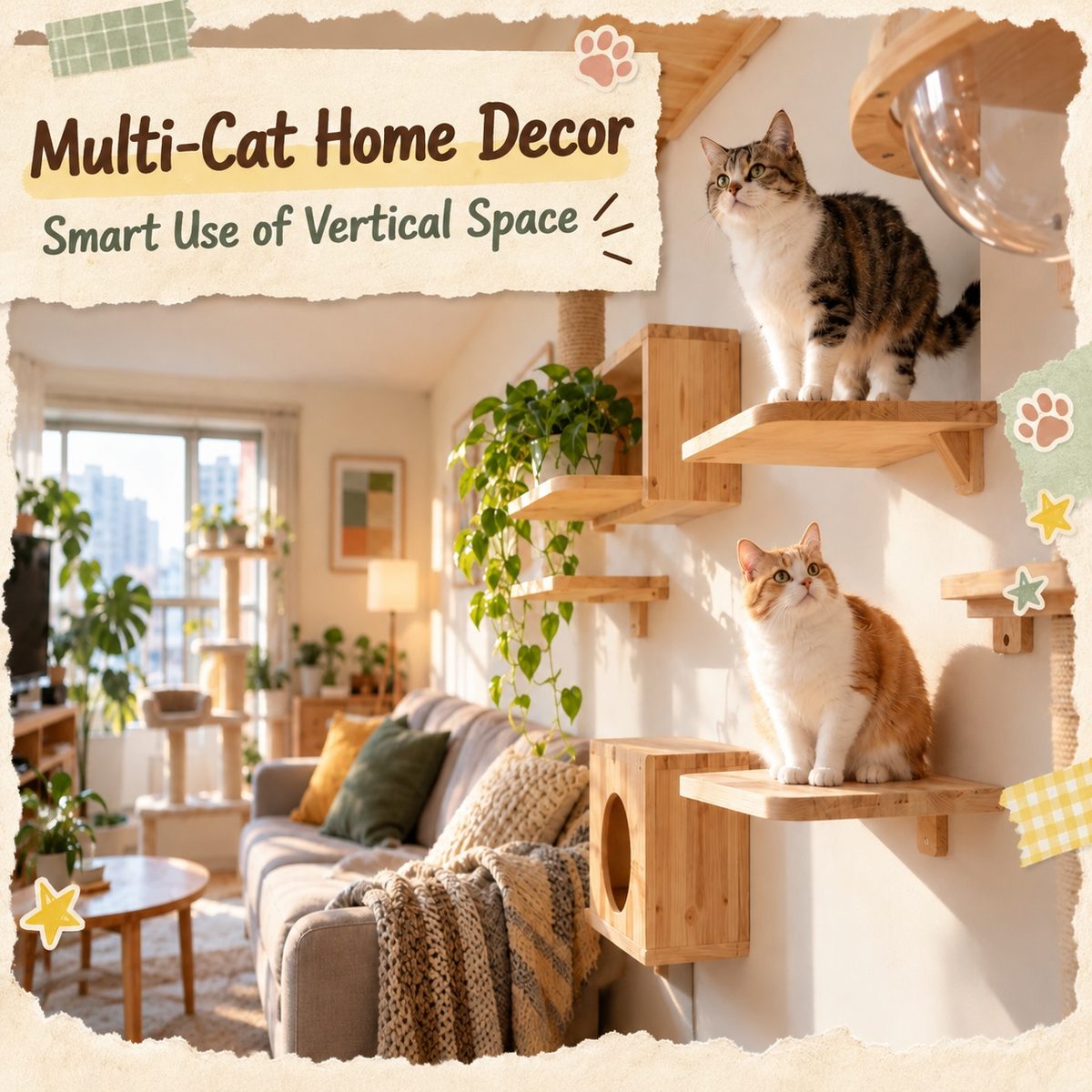
Quick answer: In a small flat with multiple cats, the key is to 'borrow space upwards': wall shelves, cabinet-top second floors, and over-door cat holes give each cat an independent route; place litter boxes, food and water, and sleeping spots in three separate zones, avoiding single-exit dead ends, and conflicts naturally decrease.
The secret to multi-cat harmony also lies in how you place things: separate litter box spots, staggered food and water, and a route for each cat that avoids face-to-face encounters. Vertical space is the multiplier for small flats. This article covers space placement; for behavioural issues, see the sister article.
Three dimensions cats see space—completely different from humans
Humans measure space in square metres; cats measure it in height, escape routes, and resource distribution:
- Height = security: The floor is the most dangerous place; the higher the lookout, the more you can see everything. A cat forced to stay on the floor all day naturally has a higher stress level.
- Escape routes = choice: A dead end is a trap for cats. Every sofa and every cat tree must have two or more ways down, so no cat gets 'cornered'.
- Resource distribution = social map: A cat's daily life is a patrol route—sleep spot → water → food → litter box → sleep spot. If the route is forced into a single cluster, that's a breeding ground for conflict.
When planning, just ask yourself: 'If two cats don't want to see each other, can they still get around?'—If yes, you've got most of the design right.
Vertical routes: five ways without drilling walls
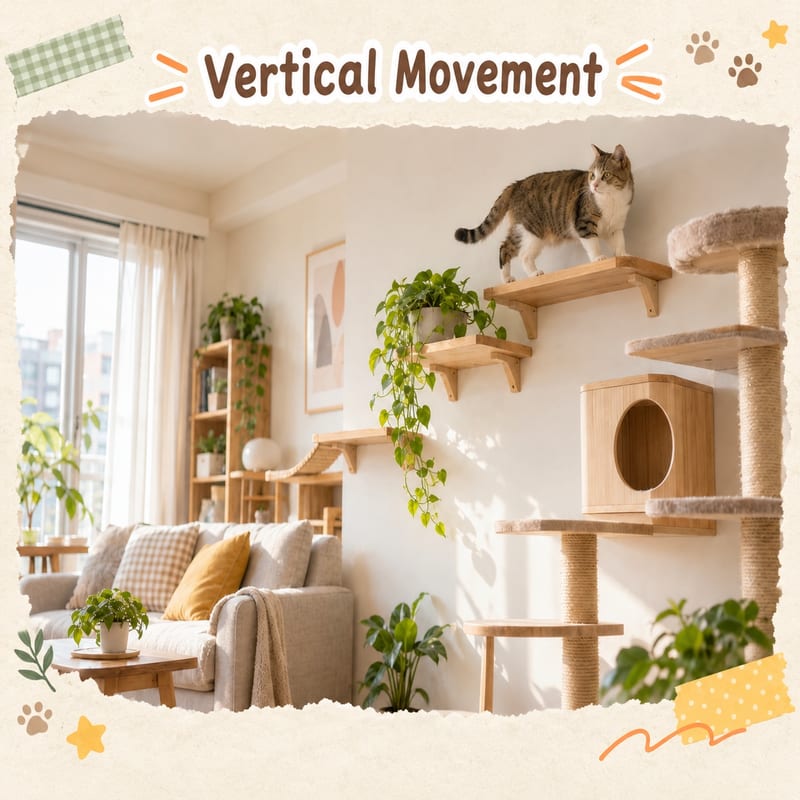
Hong Kong's high price per square foot means you can't afford a big flat, but you can 'borrow space upwards':
- Wall shelves: Each shelf 25-30 cm wide, 30-40 cm apart, add soft padding to make a catwalk; leave a starting step from the floor up to 60 cm for elderly cats and kittens.
- Activate cabinet tops: Lay non-slip mats on top of wardrobes and bookshelves to create a connected 'second floor' at zero construction cost.
- Over-door cat holes: Cut holes above bedroom and living room doors or add gate-style cat doors so rooms are truly connected.
- Window perch: Suction-cup cat hammocks or widened window boards—the best stress-relief spot outside the feeding area.
- Sofa back route: Add a non-slip running strip along the sofa back, giving the living and dining area another high route.
Key principle: high places must be easy to get down from. A jump platform with no ramp or steps will trap timid cats in mid-air, creating panic spots instead.
Budget can be divided into three levels: zero cost (cabinet tops + sofa back + window pads), low cost (no-drill wall shelf accessories + second-hand solid wood shelves), advanced (custom wall-mounted cat routes). You don't need to do it all at once—first activate the high spots you already have, observe how the two cats use them, then decide where to install wall shelves. Custom work that costs effort and money should be the last step.
Resource placement in practice: litter boxes, food and water, sleeping spots
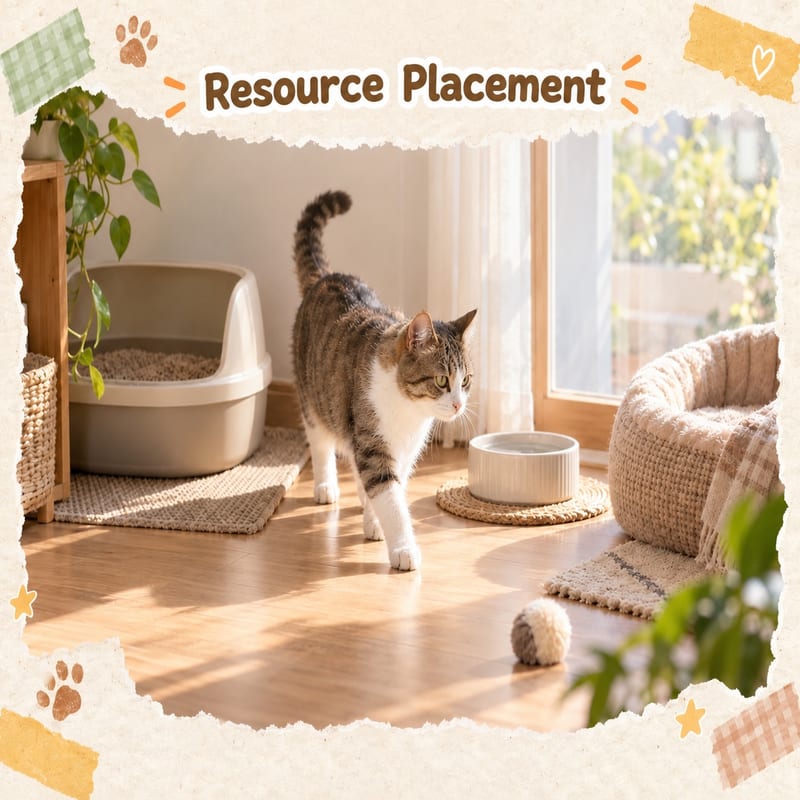
Litter box area: Separate spots is the first principle—one in a corner of the living room, one in the bedroom, one on the balcony (if enclosed); avoid noise sources (next to the washing machine) and single-exit dead ends; for cats, a spot where 'someone can sneak up from behind while eating' is also a minefield. Covered litter boxes reduce smell but not stress; for sensitive cats, open uncovered types are recommended.
The distance between litter box and food bowl also matters: cats won't eat 'next to the toilet'. If placed too close, at best they eat faster, at worst they hold it in and go elsewhere—many 'sudden inappropriate urination' cases are simply because the litter box was moved closer to the food bowl. The ideal setup is: food in an open area (with two exits), litter box in a quiet spot (but with a view of the entrance)—the two needs are exactly opposite.
Food and water area: Place food and water bowls separately (many cats dislike mixed water and food smells), and keep water bowls at least one metre away from litter boxes. In multi-cat homes, feed each cat at its own spot and remove bowls after eating, which also helps monitor each cat's intake—during the introduction period, this is the earliest stress radar.
Sleeping spots: Each cat should have at least one dedicated soft bed, placed at different heights and in different rooms; do not concentrate all cat beds in one 'cat zone'—that's human aesthetics, but a source of territorial conflict for cats.
By the way, the invisible dimension of 'scent management': a cat's sense of security is largely built on 'the whole house smells like me'. During deep cleaning, don't wash all bed covers and sheets at once—wash them one by one, keeping at least half with the old scent; similarly, before a new cat arrives, don't replace all the old cat beds—mutual scent mingling is the shortcut to integration.
Three plans: follow the template by flat size
| Flat size | Core setup | Key point |
|---|---|---|
| 300-500 sq ft, two cats | One wall shelf route + cabinet-top second floor + 3 litter boxes in two rooms | Ensure two routes with staggered use |
| 500-800 sq ft, three cats | Complete resource set on each floor + bedroom cat door | Avoid cross-floor competition for resources |
| Over 800 sq ft / multi-level | Litter box and food/water on each floor + fixed retreat room | Reserve permanent zoning space |
Special reminder for small flats: don't cram all cat supplies onto the balcony for convenience. To cats, the balcony is 'exile island'—an isolated resource area only makes it easier for the boss cat to control, and summer heat and winter drafts are health risks.
Common layout mistakes
- Litter boxes in a row: Three in a row equals one; change to three separate spots.
- Single passage: Only one route to food/litter box in the whole house; weaker cats get cornered.
- Resources facing each other: Food bowl facing litter box, water bowl facing cat tree entrance—scent routes all messed up.
- Only add, never replace: Before moving new cat items, don't immediately dismantle old sleeping spots and beds; scent interruption makes cats re-explore their territory.
- High spot becomes exclusive: Only one best lookout in the whole house forces two cats to fight for the throne—better to build two than fight.
- Ignoring human-cat shared spots: Whether to leave cat space under the big table or desk determines whether that cat will step on your back at night.
- Neglecting scent pathways: New paint, aromatherapy, disinfectants masking old scents is like erasing the cat's social map—the whole house has to re-confirm territory.
When to adjust the layout + signs to see a vet
If after rearranging you still see: one cat refusing to come down to the floor long-term, recurrent cystitis (frequent urination, blood in urine), one cat suddenly urinating in the same spot, or one cat's weight continuously dropping—these are beyond what space design can solve. See a vet to rule out disease and severe anxiety—especially male cats frequently visiting the litter box with no urine, which is an emergency and needs immediate attention. This article is for reference only; consult a registered veterinarian for problems.
Why no-drill restrictions in rented flats
Many leases prohibit drilling walls, but you don't have to give up on wall shelves: use floor-to-ceiling cat trees (tension rod fixed, no wall damage), stacked bookshelves with non-slip boards, and door-frame no-drill cat doors—all compliant. The only test: the setup must not wobble or fall when two cats jump on it simultaneously.
What you can do starting today
- Walk around your home from a cat's perspective: count any 'single-exit' spots and 'cornering' black spots.
- This week, move one litter box to another room.
- Clear a cabinet-top route and add non-slip mats—costs only a few dozen dollars but equals half a floor more space.
- Add an extra water bowl, place it in a different corner from the food bowl, and put a damp mat next to it for non-slip.
For behavioural issues (telling fights apart, hidden bullying, the seven-to-fourteen-day rhythm for isolating a new cat), please see the sister article 'Complete Multi-Cat Household Guide'; for which cat trees, litter boxes, and water fountains save space, check the product reviews on petfood.com.hk and pick what's most practical against your floor plan.
Further reading
- Multi-cat behaviour guide →
- Cat litter box selection →
- Cat behaviour psychology →
- Cat trust signals →
- Cat behaviour course →
PetChill Cat Behaviour Team — Hong Kong's most authoritative pet knowledge platform
- Cat tail language decoded →
- Cat scratcher buying guide →
- Why cats scratch furniture and how to prevent it →
- 5 cat scratching training tips →
- The secret of cat purring →
📌 Key takeaways
- ✅ Vertical space = security; wall shelves + cabinet tops = multiplied usable area
- ✅ Three separate litter box spots, away from food bowls and noise sources
- ✅ Each cat has its own sleeping spot; don't concentrate them in one 'cat zone'
- ❌ Litter boxes in a row = effectively only one
- ❌ Only one high spot forces cats to fight for the throne
- ❌ Washing all bed covers at once causes scent gaps and triggers re-fighting for territory
 Wellness Core full guide →
 Fuji One full guide →

