
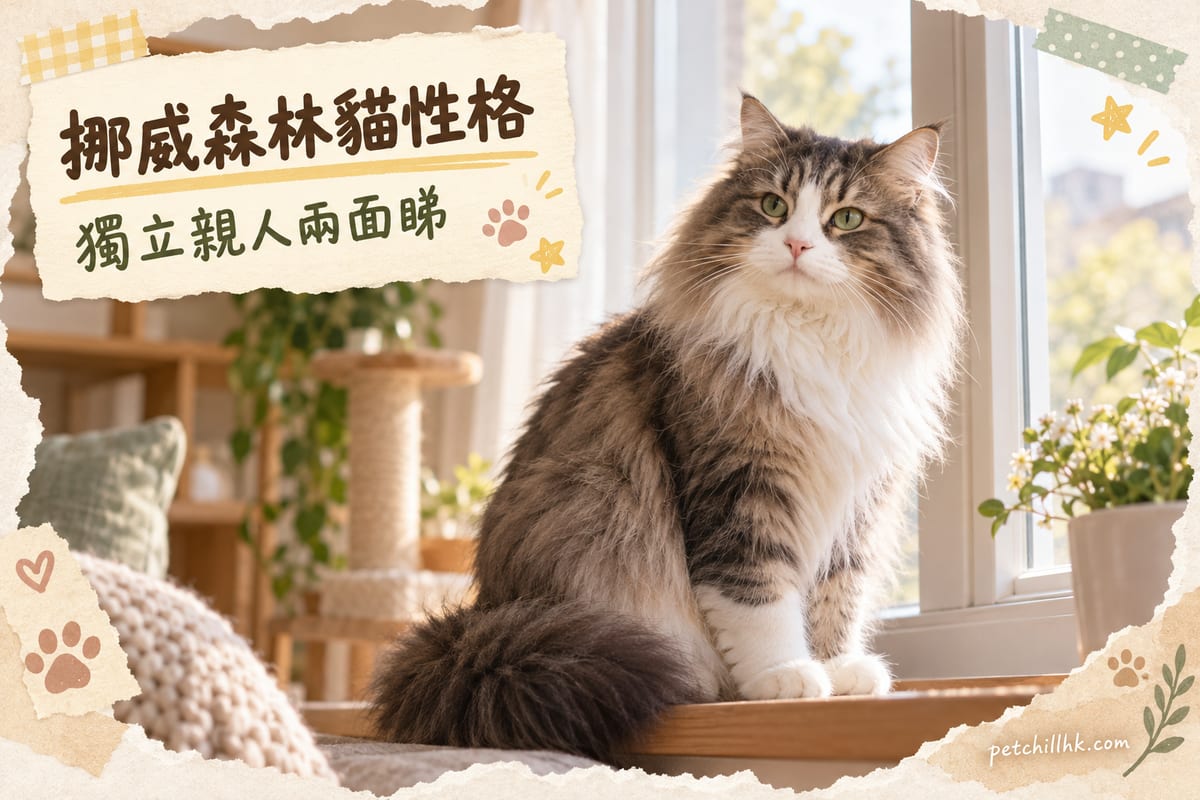
Quick answer: The Norwegian Forest Cat is the independent yet loyal type: it will follow you around and join in family life, but doesn't necessarily want to be held all the time. It has a gentle, calm nature, good learning ability, and is not prone to separation anxiety. If you want a 'friendly companion with a sense of distance' rather than a 'clingy shadow', it will suit you well.
Want to learn more about the Norwegian Forest Cat? Continue reading the series below.
Norwegian Forest Cat Personality: Independent yet Loyal
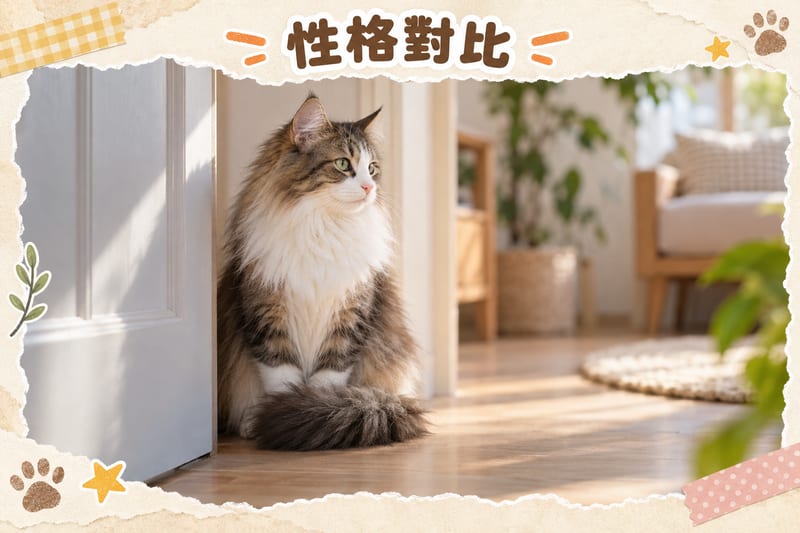
The Norwegian Forest Cat's personality can be summed up in one sentence: present, but keeps its distance. It's not like a Ragdoll that lies on you all the time, nor is it afraid of people like some breeds. Its typical behaviour is—when you're in the living room, it sleeps nearby on a high spot; when you go into the kitchen, it slowly follows; when you sit down, it might come over for a rub, but mostly won't stay on your lap for long.
This personality comes from its historical background. The Norwegian Forest Cat is a working cat from Nordic farms, responsible for catching mice, and long-term independent foraging and activity have shaped its confident, alert but non-aggressive temperament. It has a sense of control over its environment, so it generally observes strangers rather than hiding, and won't randomly pounce or bite.
For Hong Kong families, this personality is actually very practical: if you work long hours and no one is home often, it's not prone to separation anxiety. But note that independence means it can be on its own, not that it resists interaction. It still needs fixed daily play and stroking time, otherwise in the long run it may become distant or destructive due to boredom.
Intelligence and Training Potential
When it comes to 'Norwegian Forest Cat intelligence', one thing must be made clear first: there is no authoritative breed ranking for cat intelligence; any 'intelligence score' is a colloquial expression. What can be objectively said is learning ability and behavioural plasticity.
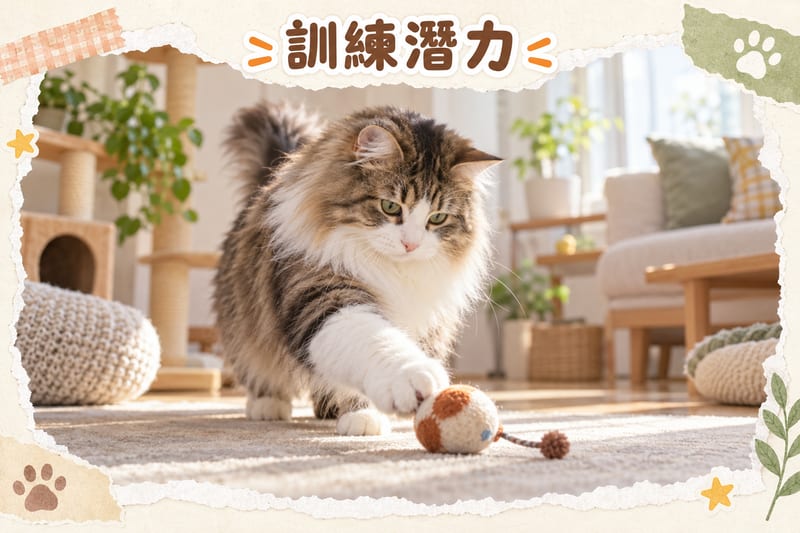
The Norwegian Forest Cat's learning characteristic is 'observe first, act later'. It will watch how you open doors and cabinets, then try itself. In breeding experience, they can learn to open doors, play fetch games, respond to their name, and even follow simple commands like 'up' and 'down'. Large cats also have particularly good body coordination and jumping judgement, and their success rate with puzzle toys (such as treat-dispensing balls and mazes) is usually high.
Training tips:
- Use positive reinforcement; treats and praise are far more effective than punishment.
- Keep sessions short and frequent; a few minutes each time, several times a day, is better than half an hour at once.
- Establish rituals from a young age, such as fixed play times and fixed feeding spots; it will remember and cooperate.
- Don't use fright or hitting; large cats hold grudges, and once trust is lost it takes a long time to repair.
Getting Along with Children and Other Pets
With children. The Norwegian Forest Cat has a gentle nature and high tolerance, and generally gets along well with children. But remember two points: first, its size can reach 9 kg, so it's not a small toy; second, children don't know how to control their strength. So education must be two-way—teach children to stroke gently, not to grab the neck or chase, and at the same time give the cat high escape space and don't force it to accept hugs. With this arrangement, most can build a good relationship.
With other pets. Its sociability is moderate, not domineering. If raised together from a young age, or using a slow, isolated introduction method (first sniffing under the door, then short periods together, gradually extending), most can get along. Ensure each pet has its own food bowl, water bowl, and litter box to reduce resource competition. If the companion is a small cat or small animal, note that the Norwegian Forest Cat's size may unintentionally cause stress.
Personality Differences Between Male and Female Cats
| Trait | General Observation | Suggested Response |
|---|---|---|
| Affection level | Males more outgoing, females more independent | If you want more clinginess, consider a male, but individual differences are large |
| Size | Males noticeably larger (up to 9 kg) | Space and litter boxes should be sized up |
| Sensitivity to environment changes | Females usually more sensitive | Moving house or renovation should be gradual, giving ample adjustment time |
| Play preference | Both like interactive games | Treat-dispensing toys and fetch games both suit |
| Relationship with own kind | Differences greater than gender | When matching, look at personality more than gender |
Most important reminder: gender is only a statistical tendency; individual differences often exceed gender differences. Some female cats are very clingy, some male cats very independent. If possible, try to learn the cat's own personality before adopting or buying, rather than deciding based solely on 'male or female'.
Interaction Tips: How to Spend Time with It Daily
- Two fixed play sessions daily, 10 to 15 minutes each, using a wand toy to simulate hunting and satisfy its instincts.
- Make good use of high places; interact with it by the window or on top of a cat tree, where it will be more relaxed.
- Respect its sense of distance; if it walks away, don't chase, wait for it to approach on its own.
- Puzzle feeding; use treat-dispensing toys to replace some bowl feeding, prolonging eating time and reducing boredom.
- Establish rituals; groom at fixed times, and check skin and mats along the way.
- Observe changes; if a normally independent cat suddenly becomes overly clingy or hides, it may be unwell, so pay attention.
Norwegian Forest Cat vs Maine Coon: Personality Differences
Both are gentle and intelligent, but their social orientation differs. Maine Coons are generally more outgoing and more likely to actively seek strokes, enthusiastic like 'big dogs'; Norwegian Forest Cats are more independent and calm, with a more reserved way of keeping company. If you want a cat that follows you closely all the time, a Maine Coon may suit better; if you like a 'friendly companion with a sense of distance', the Norwegian Forest Cat's pace will be more comfortable. Both are large long-haired cats, with equally high requirements for space and weight management.
Key Summary
- ✅ Core personality is 'present but keeps its distance': independent, loyal, gentle, calm.
- ✅ Highly independent, not prone to separation anxiety, suits Hong Kong families with long working hours.
- ✅ Good learning ability, observes before acting, usually performs well with puzzle toys.
- ✅ Mostly gets along with children and other pets, provided there is two-way education and escape space.
- ✅ Gender is only a tendency; individual differences exceed gender differences, matching by personality is more practical.
- ✅ Compared with Maine Coons, Norwegian Forest Cats are more reserved and independent; Maine Coons are more outgoing and enthusiastic.
Related Reading
- Norwegian Forest Cat Lifespan and Health Key Points
- Norwegian Forest Cat Pros and Cons Explained
- Norwegian Forest Cat Growth and Weight Tracking
- Norwegian Forest Cat Hong Kong Keeping Key Points
- To prepare for interaction and environmental enrichment: visit PetChill pet supplies for wand toys, treat-dispensing toys, and cat tree series.
The behavioural descriptions in this article are general breed observations; please refer to the individual cat's own behaviour for its personality.
 Wellness Core full guide →



