
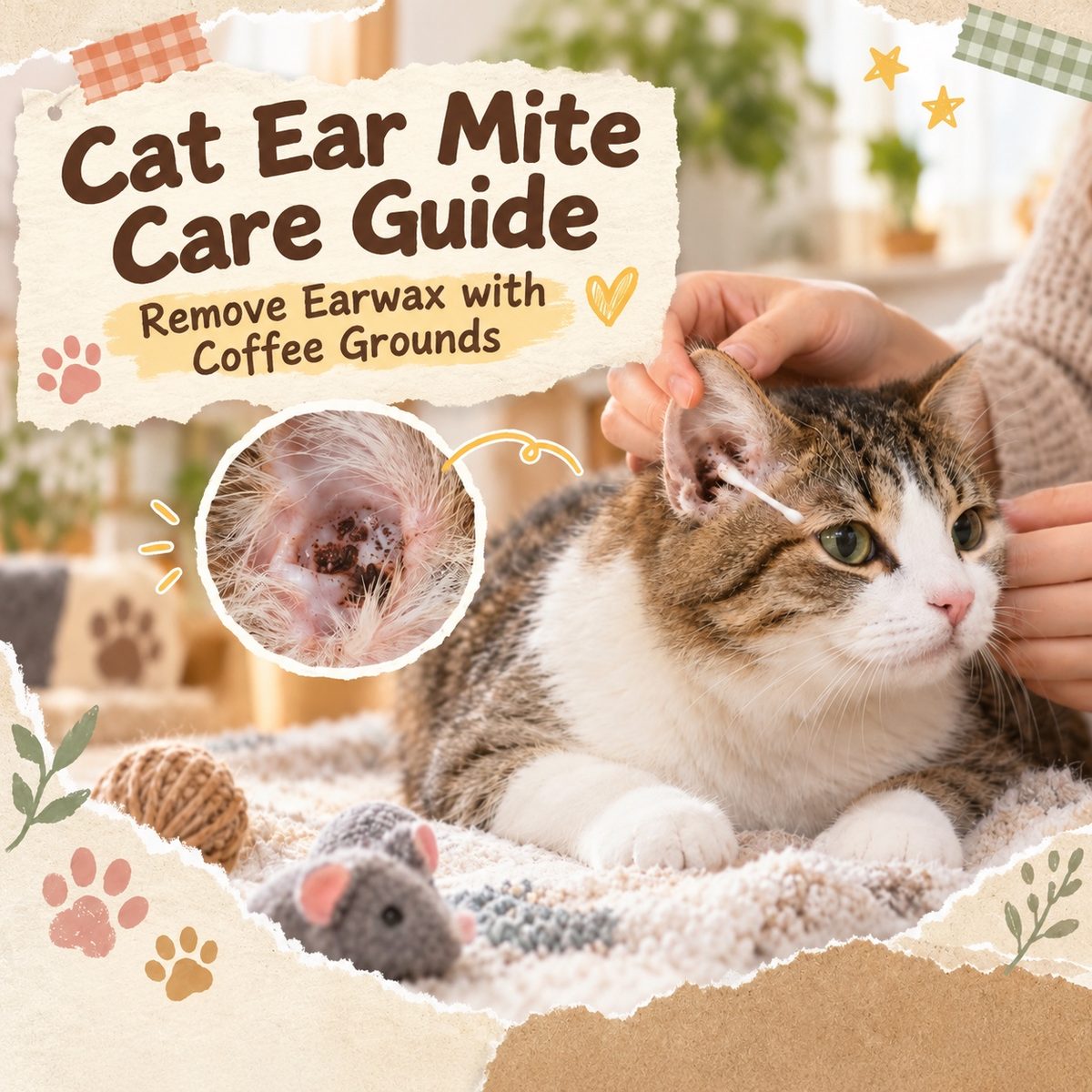
Quick answer: Cat ear mites are ear canal parasites. The typical sign is dark 'coffee-ground' earwax plus frantic ear scratching. They are highly contagious and must be diagnosed by a veterinarian, then treated with ear-cleaning solution and anti-mite medication for several weeks. During treatment, isolate the affected cat and treat the whole house at the same time. Never dig in the ears yourself or stop the medication early.
The answer first: Cat ear mites are tiny parasites that live in the ear canal. The most typical sign is dark brown 'coffee-ground' earwax plus frantic ear scratching and head shaking. They are highly contagious. Treatment requires a veterinarian to prescribe ear-cleaning solution and anti-mite medication, continued for several weeks, and the affected cat must be isolated. If you see coffee-ground earwax, do not dig it out yourself — see a veterinarian early.
What are cat ear mites? How do cats catch them?
Ear mites are tiny parasites that can only be seen clearly under a microscope. They mainly live in the ear canals of cats (sometimes dogs too), feeding on skin flakes, earwax and tissue fluid. They burrow and breed in the ear canal, causing intense itching and inflammation.
The route of transmission is direct: close contact. Ear mites do not fly, but cat-to-cat contact, sharing beds and grooming each other are enough to pass them on. So multi-cat households, adoptive households, and cats that have had contact with strays are high-risk. Hong Kong's humid weather makes the ear canal environment prone to problems, and with many street cats and adopted cats moving around, ear mites remain a common ear canal parasite in local cats.
The smallest cats are most vulnerable: kittens have immature immunity and often huddle together, so one mite-infested cat often means the whole household is affected. If your cat suddenly starts scratching its ears frantically, first check whether other cats or dogs in the home show the same signs.
It is important to note that ear mites are not an indicator of 'poor hygiene' — even if your home is spotless, one cat bringing mites in from outside is enough to infect the whole household. So never rule it out just because your cat stays indoors. Checking the ears should be part of your daily routine, just like trimming nails and checking teeth.
How to tell it's ear mites: 5 typical symptoms
- Dark brown/black earwax — large amount, granular, like coffee grounds; this is the most typical sign
- Frantic ear scratching — constantly digging at the ears with the hind legs, scratching the ear flap, sometimes until hair loss and broken skin
- Head shaking — the head constantly flaps and shakes, and the cat may walk with a tilted head
- Red and swollen ear canal — the inside of the ear flap and the ear canal opening are red and swollen, sensitive and painful to touch
- Bad smell, secondary infection — if left too long, bacteria or yeast take advantage, producing pus and a foul odour
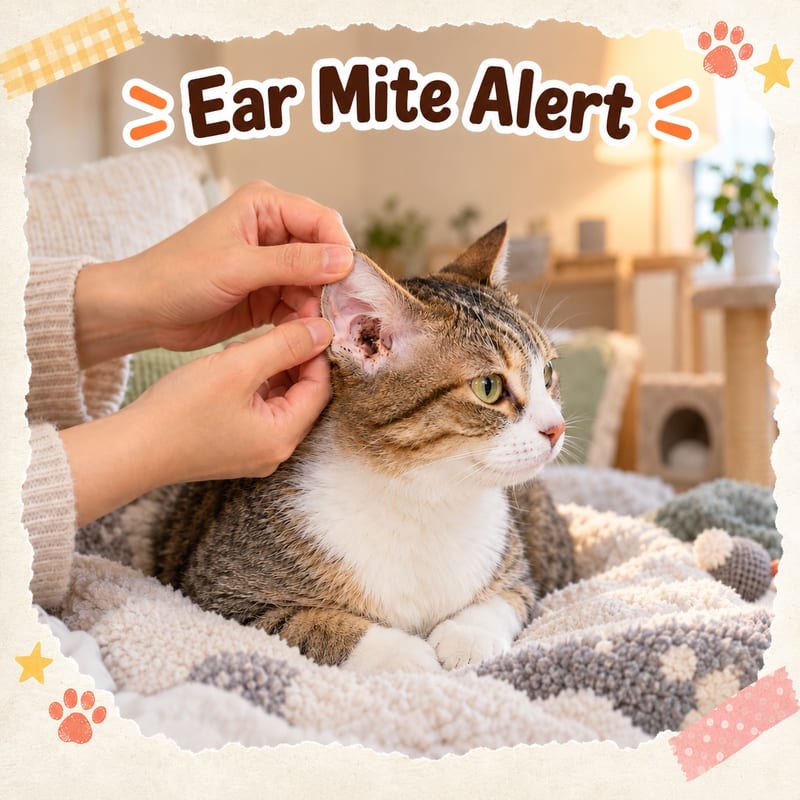
Note: Dark earwax does not necessarily mean ear mites — normal oxidised earwax is also brown. But the combination of a large amount of granular coffee-ground wax plus frantic scratching is highly suggestive of ear mites. Do not rely on your nose for diagnosis — a veterinarian will examine with an otoscope and take an earwax sample to look for mites or eggs under the microscope before confirming. Similarly, yellow-green pus, redness and swelling are more likely a bacterial/yeast ear infection, which has a different treatment direction; guessing on your own can easily be wrong.
5 steps to treat ear mites
- See a veterinarian for diagnosis — otoscope examination plus earwax testing to confirm whether it is ear mites or another ear infection
- Clean the ear canal — use the veterinarian-prescribed ear-cleaning solution to soften and flush away debris so the medication can penetrate
- Prescription anti-mite medication — ear ointment or topical drops to kill adult mites (never use human or over-the-counter medications on your own)
- Continue the course for several weeks — most anti-mite medications cannot kill all the eggs; you need to wait for the eggs to hatch and then kill the new mites. Stopping as soon as it looks better is the easiest way to cause a relapse
- Treat the whole house — all cats and dogs in the household should be examined together, and treated together if necessary
During treatment, never use cotton buds to dig deep into the ear canal — this pushes debris deeper and can even damage the eardrum. If the cat has scratched the ear flap until the skin is broken and bleeding, ask your veterinarian whether an Elizabethan collar or other anti-scratch measures are needed. At follow-up, ask the veterinarian to examine again with the otoscope and confirm there are no live mites before finishing.
| Step | Key action | Common mistake |
|---|---|---|
| 1. Diagnosis | Veterinary otoscope + microscope examination | Guessing by smell or colour |
| 2. Ear cleaning | Veterinarian-prescribed ear-cleaning solution | Using cotton buds to push debris deeper |
| 3. Anti-mite | Prescription ear ointment or drops | Buying unknown 'miracle helps manage' online |
| 4. Course | Continue for several weeks to kill eggs | Stopping as soon as it looks better |
| 5. Whole house | Examine all cats and dogs together | Treating only the affected cat and ignoring the rest |
4 daily care points during treatment
- Use an Elizabethan collar — to prevent secondary damage before the scratches heal. The cat may not be used to it for the first few days; use treats to distract it
- Do not clean the earwax yourself — rubbing the ear canal when it is red and swollen will worsen inflammation. Leave ear cleaning to the solution and instructions given by your veterinarian
- Keep a medication schedule — set daily reminders on your phone for medication and follow-up dates. Completeness of the course directly determines whether it will relapse
- Watch for complications — if the cat starts walking with a tilted head, has nystagmus (eye twitching), or loses appetite rapidly, contact your veterinarian immediately and do not wait for the next appointment
Treatment usually shows results in a few weeks, but 'no scratching = cured' is a wrong judgement — relapses are mostly due to too short a course or not treating the whole house. At follow-up, ask the veterinarian to use the otoscope to confirm that mites and eggs are cleared before considering it truly resolved. Never buy 'miracle helps manage' online and apply them yourself for convenience: unknown ingredients and wrong concentrations will only make things worse when the ear canal is already inflamed, and delay the real diagnosis.
Can it spread to humans and other animals?
It spreads easily between cats and dogs; humans are a secondary concern. Ear mites prefer cats and dogs. If you have both dogs and cats at home, treat them as high-risk and examine them together. Humans may occasionally be bitten, developing itchy red bumps on the neck or arms, but ear mites cannot complete their life cycle on humans and usually do not establish long-term. There is no need to panic excessively; sensitive individuals and children just need to wash their hands after contact.
The real issue to address is cyclic infection in multi-cat households: if one cat is not fully cleared, the others can be re-infected at any time. So isolating the affected cat, treating the whole house, and following the full course are the three keys to eradication.
When to see a veterinarian
Ear mites themselves require veterinary diagnosis and prescription — there is no 'handle it yourself' option. But if the following occur, do not delay:
- Pus, blood or foul odour from the ear canal — secondary bacterial or yeast infection has developed
- Large areas of scratched broken skin, scabbing, redness and swelling, or even facial swelling
- Persistent head tilt, stumbling, nystagmus — the infection may have affected the inner ear; this is an emergency
- Infection in kittens, senior cats or sick cats — weak individuals deteriorate quickly; treat early
- Symptoms persist after completing the course — possible resistance, re-infection or misdiagnosis; needs follow-up

Prevention: don't wait until earwax piles up like coffee grounds
- Check the ears regularly — lift the ear flap once a week to check colour, smell and amount of earwax
- Keep the ear canal dry — after bathing or wiping, remember to dry the ears, but do not over-clean as this damages the ear canal barrier
- Isolate and observe new cats — isolate new members or adopted cats for about two weeks first, and check the ear canals before introducing them to the family
- Reduce high-risk contact — check your cat after going outside or contact with stray cats
- Monthly deworming habit — some flea and tick treatment options cover ear mites; discuss with your veterinarian what suits your cat
What you can do starting today
- Tonight, lift your cat's ear and take a look: is there dark coffee-ground-like earwax?
- Is your cat constantly scratching its ears and shaking its head? Note when the symptoms started and book a veterinary appointment for an otoscope examination
- If you have other cats or dogs at home: examine them together and treat them simultaneously if necessary
- Preparing to bring a new cat home: allow a two-week isolation period, and make ear canal examination the first item
- During treatment, follow the schedule and attend follow-ups; do not stop just because it looks better
Want to prepare ear-cleaning supplies or a monthly deworming plan for your cat? You can first visit PetChill to browse the pet supplies guide, then discuss with your veterinarian the best combination for your cat.
This article is for reference only. If in doubt, consult a registered veterinarian.
🟢🟡🔴 Red-flag triage table: when ear mites require an immediate vet visit
| Observation | 🟢 Home observation (book a vet for diagnosis first) | 🟡 Book a vet as soon as possible (within 1–3 days) | 🔴 Seek veterinary care immediately (same day) |
|---|---|---|---|
| Earwax appearance | Small amount of light-coloured earwax | Coffee-ground-like, dark brown earwax | Pus, blood, foul odour from the ear canal |
| Head shaking/ear scratching | Occasional scratching | Frequent head shaking, constant ear scratching | Scratching until bleeding, violent head shaking, continuous crying |
| Ear appearance | No obvious redness or swelling of the ear flap | Red and swollen ear canal, hair loss on the ear flap | Obvious swelling of the ear flap (haematoma), severe narrowing of the ear canal |
| Energy and appetite | Normal | Slightly irritable, slightly reduced appetite | Refusing food, lethargic, fever |
| Balance and posture | Normal | Occasional slight head tilt | Severe head tilt, circling, loss of balance, nystagmus |
| Ear canal odour | No odour | Mild odour | Strong foul odour (possible bacterial or fungal infection) |
| Other pets | No symptoms in other cats or dogs | Other pets starting to scratch their ears | Multiple pets with severe symptoms at the same time |
| Response to treatment | Veterinary diagnosis completed (microscopy) | No improvement after 1–2 weeks of medication | Worsening after medication, hearing loss |
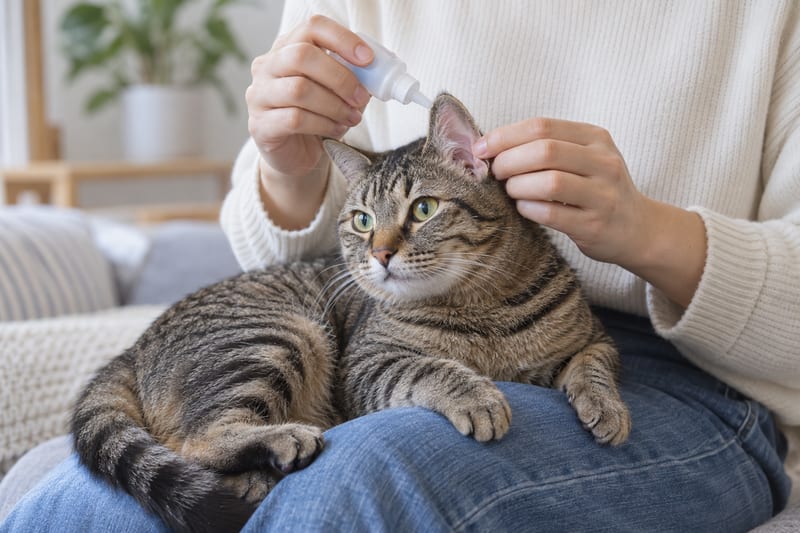
Correct use of ear drops (step-by-step)
| Step | Action | Note |
|---|---|---|
| 1. Prepare | Prepare veterinarian-prescribed ear drops, cotton or gauze, towel | Warm the bottle in your hands to room temperature first (some drops need shaking) |
| 2. Restrain | Wrap the cat's body in a towel, or ask a family member to help hold | Reduce struggling and avoid splashing into the eyes |
| 3. Instil | Gently pull the ear flap to straighten the ear canal, then instil the drops into the ear canal | Do not insert the dropper tip too deep, to avoid contaminating the bottle |
| 4. Massage | Gently massage the base of the ear (outside the ear canal) for about 20–30 seconds | A 'squelching' sound means the drops have entered the ear canal |
| 5. Shake head | Let go and allow the cat to shake its head | This step brings out debris and excess medication |
| 6. Wipe dry | Use cotton to gently wipe away visible debris and medication on the outer ear | Do not insert cotton buds deep into the ear canal |
| 7. Reward | Give a treat immediately | Build a positive association for future care |
The frequency and duration of the course are entirely decided by the veterinarian, because it depends on whether it is ear mites, bacteria or fungal infection, and whether the eardrum is damaged. Increasing the frequency yourself or stopping early will affect efficacy.
Hong Kong home environment: why do ear mites recur?
Recurring ear mites are usually not because the medication is ineffective, but because of these three common Hong Kong reasons:
- Not treating all pets at the same time — ear mites are highly contagious. Treating only the symptomatic one means the others will pass them back.
- Environment not cleaned — sleeping mats, blankets, grooming tools and scratching posts may harbour mites and need hot-water washing and cleaning.
- Course not completed — disappearance of symptoms does not mean the mites are completely cleared. Stopping early is the most common cause of relapse.
Hong Kong living spaces are small and multi-pet households are common, so cats often share beds and scratching posts. Therefore 'treat all pets together + clean the environment + complete the course' are the three key points.
Frequently asked questions
Q: Can ear mites spread to other cats, dogs or humans? A: Ear mites (Otodectes cynotis) are highly contagious and spread through direct contact between cats, and even between cats and dogs. So multi-pet households must examine and treat all pets together, otherwise cross-infection can easily recur. As for humans, ear mites usually do not live long-term on people, but occasional contact can cause mild skin itching.
Q: How do I tell ear mites from ordinary earwax/ear infection? A: The symptoms are very similar and difficult to distinguish accurately at home. The typical feature of ear mites is earwax that is dark brown and coffee-ground-like, along with intense itching; bacterial or fungal ear infections may have no obvious itching but a strong odour. Diagnosis requires a veterinarian to examine with an otoscope, and possibly take an earwax sample to see mites or eggs under the microscope.
Q: Can I buy ear drops for my cat myself? A: Not recommended. First, using the wrong medication (e.g. antibacterial ear drops) is ineffective against ear mites; second, if the eardrum is perforated, some ear drop ingredients can enter the middle ear and cause serious damage. A veterinarian will first check the eardrum status, then choose appropriate ear drops or antiparasitic medication (some dewormers can treat ear mites systemically).
Q: Can ear mites cause deafness or more serious consequences? A: Yes. Persistent ear scratching and head shaking can cause ear flap haematoma (blood accumulating between the ear cartilages, requiring surgery). Severe infection can affect the middle and even inner ear, causing balance problems, head tilt, and even hearing damage. So early treatment is not just about stopping the itch.
Q: How should I clean my cat's ears correctly? A: Use a veterinarian or pet-specific ear cleaning solution (do not use human products). Instil an appropriate amount into the ear canal, gently massage the base of the ear for about 10 seconds, then let go and allow the cat to shake its head. Finally, use cotton to gently wipe away visible debris on the outer ear. Never insert cotton buds deep into the ear canal — this pushes debris deeper and can even perforate the eardrum.
Q: How should I clean the home to prevent recurrence? A: Ear mites can survive briefly in the environment, so besides treating the pets, also wash their sleeping mats and blankets (hot water), clean grooming tools, and temporarily avoid sharing. After completing the course, check the ear canals regularly, especially in breeds prone to ear problems (e.g. folded ears, long ears, or narrow ear canals).
Q: What products does PetChill have for ear care? A: [PetChill HK] offers pet-specific ear cleaning solutions, sterile cotton, cleaning wipes, pet shampoo and environmental cleaning products. Self-pickup is available at the Fo Tan, Yuen Long and Fanling stores.
Sources
- International Cat Care — Ear problems in cats — symptoms, diagnosis and treatment principles of cat ear mites and various ear canal problems
- International Cat Care — Itchy cat: when it is not fleas — common causes of itching other than ear mites (helps distinguish ear mites from allergic itching)
Hong Kong veterinary fee reference (published on clinic websites)
- Hong Kong Leo Animal Medical Centre (LAMCVET, Yau Ma Tei): basic consultation $350 | night consultation $600 | emergency consultation $600 | referral consultation $600 (official fee schedule)
- Creature Comforts (East District Animal Hospital / Tseung Kwan O Veterinary Clinic): Tseung Kwan O from $420 | East District daytime (8am–9pm) from $370 | evening (9pm–12am) from $550 | late-night emergency (12am–8am) from $1,100 | home visit service from $1,050 (official information)
Consultation fees only cover the consultation and basic examination; blood tests, imaging, medication, hospitalisation, etc. are extra and will be quoted by the clinic according to the actual situation. Prices are subject to the clinic's latest announcement; this article is for reference only.
Disclaimer
This article is general pet health information and cannot replace veterinary diagnosis or treatment. Every cat's condition, medical history and medication contraindications are different. Any judgement of symptoms and treatment plans (including medication type, dosage and course duration) must be decided by a registered veterinarian after an in-person consultation. If your cat shows any red-flag symptoms mentioned in this article, please go to a veterinary clinic or 24-hour emergency animal hospital immediately. The fee information in this article is excerpted from the clinics' official websites; prices may change at any time and are subject to the clinics' latest announcements.
Further reading
- Pet Health Care →
- Cat Ringworm →
- Cat Fleas →
- Pet Deworming →
- 8 Types of Cat Skin Diseases →
- Chronic Kidney Disease (CKD) Staging in Cats →
- Feline Urinary System and FLUTD →
- Cat Poop Observation Guide →
- Complete Guide to Cat Hairballs →
- Cat Symptom Self-Check Guide (12 major symptoms quick reference + 🟢🟡🔴 red-flag triage table) — compare the severity of each symptom and when to seek veterinary care at a glance
Hong Kong small-flat practicalities: ear mite isolation + daily care checklist
Hong Kong homes are small, so isolating a sick cat is not easy, but not doing it means the whole house will take turns getting infected. Here is a practical checklist that works even in a small flat — follow it and you can eradicate ear mites without moving house.
1. How to set up the isolation space
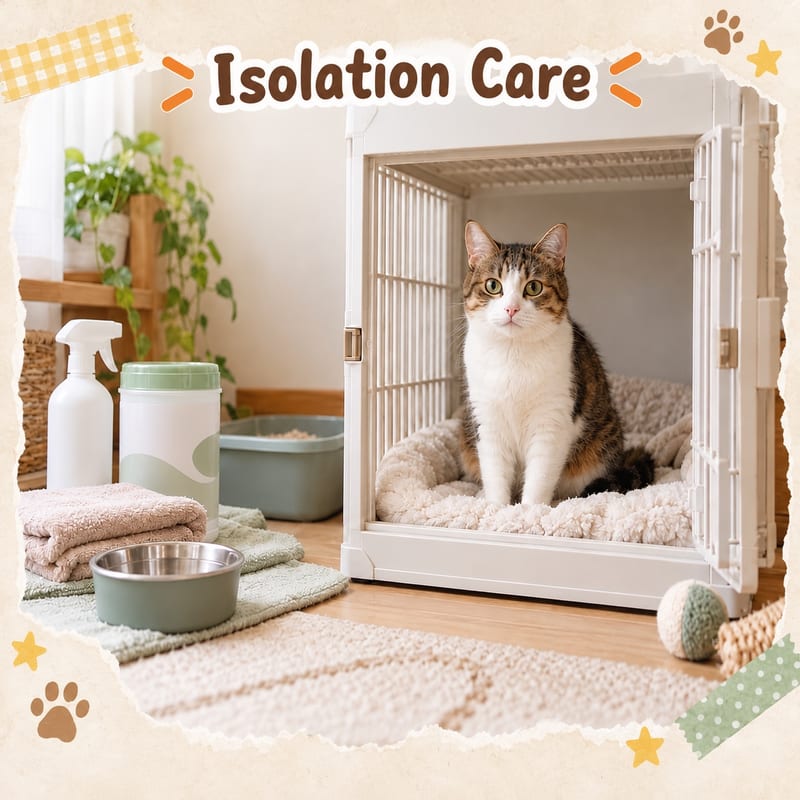
- Use a study/wardrobe/ bathroom to isolate the sick cat, add a baby gate or mesh screen at the door to keep ventilation while preventing escape.
- Essentials: separate litter tray, water bowl, food bowl, small sleeping bed; clean daily to avoid cross-infection.
- Isolation period: at least two weeks from the first medication, and release only after a follow-up confirms no live mites.
2. Daily check schedule
- Every night before feeding, lift the ear for 30 seconds: smell, check colour, feel the ear flap for redness and swelling.
- Use your phone camera to photograph the earwax colour for easy comparison; show the photos at follow-up.
- Multi-cat households: check each cat in turn and record on the same memo stuck on the fridge, so you can see which cat started scratching when.
3. Applying ear drops without making a mess
- Before instilling, lay a large towel on the coffee table, place the cat on it, wrap the upper body with one person and one towel, leaving the head out to prevent struggling.
- Reward with a small treat immediately after instilling to build a conditioned reflex of 'drops = food', reducing struggling next time.
- Keep the bottle by the fridge door and pick it up before daily tooth brushing so you don't forget.
4. When to rush to emergency
- If after 11pm you notice the cat walking with a tilted head or nystagmus: go directly to a 24-hour emergency vet (e.g. Kowloon City, North Point), do not wait until morning.
- Pus and blood from the ear canal: first send a photo via WhatsApp to your regular vet; if they say come immediately, go immediately, do not delay.
- Traffic jam on follow-up day: take a taxi earlier; if you are more than 15 minutes late the vet may reschedule, and a broken course makes relapse more likely.
5. Where to buy prevention supplies
- Ear cleaning solution, anti-mite drops: after a vet prescription, restock at PetChill; remember to buy the same product by checking the label.
- Elizabethan collar: choose a soft-edged version so the cat doesn't bump into walls when sleeping; Hong Kong is hot, so choose breathable nylon mesh.
- Monthly deworming: confirm with your vet which brand covers ear mites, then order via PetChill's subscription delivery so you are not caught unprepared.
Follow this checklist and you can beat ear mites even in a small Hong Kong flat, without fear of relapse.
📌 Key summary
- ✅ Coffee-ground earwax + frantic ear scratching = see a vet immediately
- ❌ Do not dig deep into the ear canal with cotton buds
- ✅ The course takes several weeks; kill the eggs, then kill the mites
- ❌ Stopping as soon as it looks better is the easiest way to relapse
- ✅ Multi-cat households must examine and treat the whole house together
- ❌ Over-the-counter or human medications can damage the ears
 Feline Natural full guide →