
Quick answer: The golden window for kitten socialisation is 3 weeks to 3 months (5-7 weeks is the most critical). The method is simple: give the kitten a small amount of new experience every day during this time—different people, sounds, touches, objects—all 'gentle, short, with treats'. Cats that miss this window grow up afraid of people and the vet, and remedial work requires double the patience.
What is socialisation and why is it so important
Socialisation is the process by which a kitten learns that 'the world is safe'. The book My First Cat Book states clearly: kittens enter the socialisation period around 3 weeks and until around 3 months should be accustomed to various things and litter trained; 5-7 weeks is the critical period.
Whatever the cat encounters during this period, it will treat as 'normal' as an adult; what it hasn't encountered, it will treat as a 'threat'. So a cat that has seen everything during the golden window will, as an adult:
- Not be afraid when strangers visit
- Not freak out at the vet clinic
- Not resist being touched on the belly, paws, or having its nails trimmed
- Not hide when it hears the vacuum or hairdryer
Week-by-week guide (Hong Kong household practical version)
| Age (weeks) | Focus | Specific actions |
|---|---|---|
| 3-5 weeks | Handling habit | Gently touch all over several times a day: ears, around the mouth, belly, paws, base of tail; 1-2 minutes each time, follow with a treat |
| 5-7 weeks | Critical period: people + sounds | Invite different friends over (1-2 at a time); play doorbell and vacuum sounds (start at low volume); let it explore different rooms |
| 7-12 weeks | Broaden experience | Get used to the carrier (put treats inside), grooming, the sound of nail clippers; in Hong Kong's humid weather, start getting it used to a hairdryer's gentle breeze from a distance |
| 3-4 months | Consolidation | Maintain the rhythm of daily new experiences; this stage can wind down but don't stop completely |
The book particularly emphasises handling habits: during the nursing period no special care is needed, but for future grooming and cooperation at the vet, get the cat used to being touched as early as possible. Start physical contact as soon as you bring the kitten home, so it doesn't find being touched unpleasant.

The three rules of socialisation
- Gentle: once a cat is scared stiff, it goes into 'negative learning', which is worse than doing nothing. If it wants to leave, let it leave.
- Short and frequent: several times a day for a few minutes each is better than one half-hour session.
- With treats: new experience + treat = positive association. This is the core of all positive training.
Multi-cat households: integrating a new kitten
Many Hong Kong households are 'adding another' rather than 'the first one'. The book's four steps are very practical:
- Separate rooms for 3 days: the new cat stays in another room, unable to see each other but able to smell each other's scent
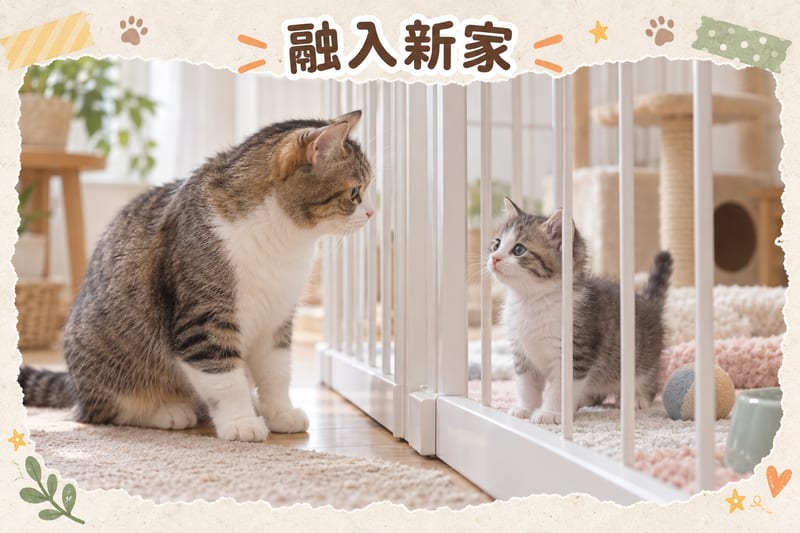
- Meet through the carrier: put the new cat in a carrier and let them meet through the bars; swapping used towels beforehand makes acceptance easier
- Supervised contact: hold the new kitten and let the resident cat approach voluntarily; if either gets angry, separate immediately and try again later
- Resident cat first: meals, cuddles—resident cat first. Not favouritism, but to prevent stress-related problems in the resident cat
⚠️ Cats that haven't completed their vaccinations should not come into contact with other cats within two weeks after vaccination. For the vaccination schedule, see Kitten Vaccination Schedule.
Hong Kong context notes
- Noise in old walk-up buildings: nearby renovation noise is the norm; get the kitten used to drilling sounds from an early age (play sounds online, start at low volume), so it won't hide every time there's renovation.
- Frequent visitors: Hong Kong homes are small, and when friends come over the kitten has nowhere to escape—teach it early that 'the top of the cat tree = safe spot', so it has its own retreat and won't bite.
- Full-time work: socialisation doesn't need to be all day; two sessions morning and evening, 10 minutes each, is enough; schedule new experiences for weekends.
Remedial plan for missed golden window (4-week version)
If the cat you've taken in is already older than 4 months or very afraid of people, use this gradual plan:
- Week 1: just 'coexist'—do your own things near it, don't look at it or touch it; feed at fixed times so it associates you with good things
- Week 2: sit on the floor at its eye level, place treats from your hand onto the floor; progress is when it comes to you, not you chasing it
- Week 3: start short interactions—5 minutes with a wand toy, touch its head for two seconds then walk away; end each session while it still wants to play
- Week 4: introduce one new experience (e.g., grooming, carrier practice), always with treats
The mindset throughout is 'it must initiate'. The same logic applies to biting; see How to Stop a Kitten Biting.
Balancing socialisation and the vaccination period
Many Hong Kong cat owners ask: the golden window overlaps with the incomplete vaccination period—what to do? The principles are:
- ✅ Indoor socialisation (people, sounds, touch, objects) continue as normal, unaffected by vaccines
- ✅ Invite friends who don't have cats—low risk
- ⚠️ Before vaccinations are complete, don't let it contact other cats, don't take it outside on the ground
- ⚠️ The vet clinic itself is a necessary contact—use a carrier, don't put it on the floor, and treat it as 'going out socialisation' training
Vaccination schedule: Kitten Vaccination Schedule.
Carrier training: the hidden key to socialisation
Many Hong Kong cat owners only discover at vet time that their cat absolutely refuses to go into the carrier. In fact, carrier training is part of socialisation and easiest to do within 3 months:
- Leave the door open: place the carrier in a corner of the home, door open, with a soft mat inside, so it becomes a resting spot
- Introduce treats: put a few treats inside daily; the first step is when it goes in to eat on its own
- Close the door for 30 seconds: when it goes in to eat, gently close the door, open after 30 seconds—no need to go anywhere
- Gradually extend: within a week extend to 5 minutes with the door closed; then try lifting the carrier and taking two steps before putting it down
A cat trained this way will be much less stressed on its first car ride to the clinic. For the actual first outing procedure (what to pack, how to travel, what to do at the clinic), see Cat Follow-up Visit Preparation Checklist—although the title says follow-up, the 'going out checklist' part applies equally.
Weighing is also socialisation
Take this opportunity to get it used to being weighed: place a kitchen scale where it walks, put treats on it, and let it step on by itself. Then daily weighing (Kitten Weight Chart) won't require catching it. For a master list of first-year tasks: Kitten First Year Preparation Checklist.
Kittens and other pets
If you have a dog or other animals at home, the socialisation principles are the same, but the sequence should be more conservative:
- Scent swapping first (towels, blankets)
- Meet through a door or baby gate
- The dog must be on a leash, the cat must have an elevated escape route (cat tree)
- All contact in the first week must be supervised
Don't assume 'the dog grew up with cats so it's fine'—every new cat is a new individual, and a gradual introduction must be done again. Before vaccinations are complete, don't let the kitten contact any animal of unknown origin. If things go smoothly, within a few weeks you'll see them peacefully occupying the same room—that's the goal state.
Socialisation can't be reversed, but it's never too late to start. Even if the golden window is missed, with a gradual approach and a few minutes a day, most cats can slowly become more friendly. The key is patience and consistency.
References
- Agriculture, Fisheries and Conservation Department (Hong Kong Government) — Pet Care Information
- Veterinary Surgeons Board of Hong Kong
- The knowledge points in this article are compiled from cat encyclopaedia books (see publication details at the end) and public veterinary guidelines
Related products (available in Hong Kong)
- RONRON Kitten Complete Wet Food Duck, Chicken & Chicken Liver 75g (reference price HK$8.5)—treat-sized portions for socialisation training
- ZiwiPeak Kitten Canned Food Chicken with Lamb 85g (reference price HK$34)
Key summary
- ✅ Golden window 3 weeks-3 months, 5-7 weeks most critical
- ✅ Daily short exposure to new things + treats for positive association
- ✅ Get used to being touched all over early (so it won't resist at the vet later)
- ❌ Don't force, don't do too long at once, don't contact other cats before vaccinations are complete
- 📌 Missed golden window can still be remedied, but requires double patience
The above is for reference only and cannot replace veterinary diagnosis and treatment. If the kitten shows any abnormality, seek veterinary help as soon as possible; consult your veterinarian about feeding, vaccinations, neutering and other arrangements.
 ZiwiPeak full guide →