Quick answer: Kitten weight standards — birth 100-120 g, then daily gain of 10-20 g: 1 week 200-250 g, 4 weeks 500-700 g, 2 months 700-1000 g, 3 months over 1 kg. Use a kitchen scale to weigh once daily; no weight gain for two consecutive days = see a veterinarian. The obesity threshold is ideal weight +15%.
Why weight is a kitten's "life dashboard"
Kittens can't speak; they won't tell you when they feel unwell — but their weight will. The book My First Cat Book records: a healthy nursing kitten that drinks milk daily and grows smoothly will gain weight every day; daily gain of 10-20 g is a sign of health. Conversely, weight stagnation or loss is often the first (and sometimes only) signal that something is wrong.
So weighing during kittenhood is not just a "cute record" — it's health monitoring.
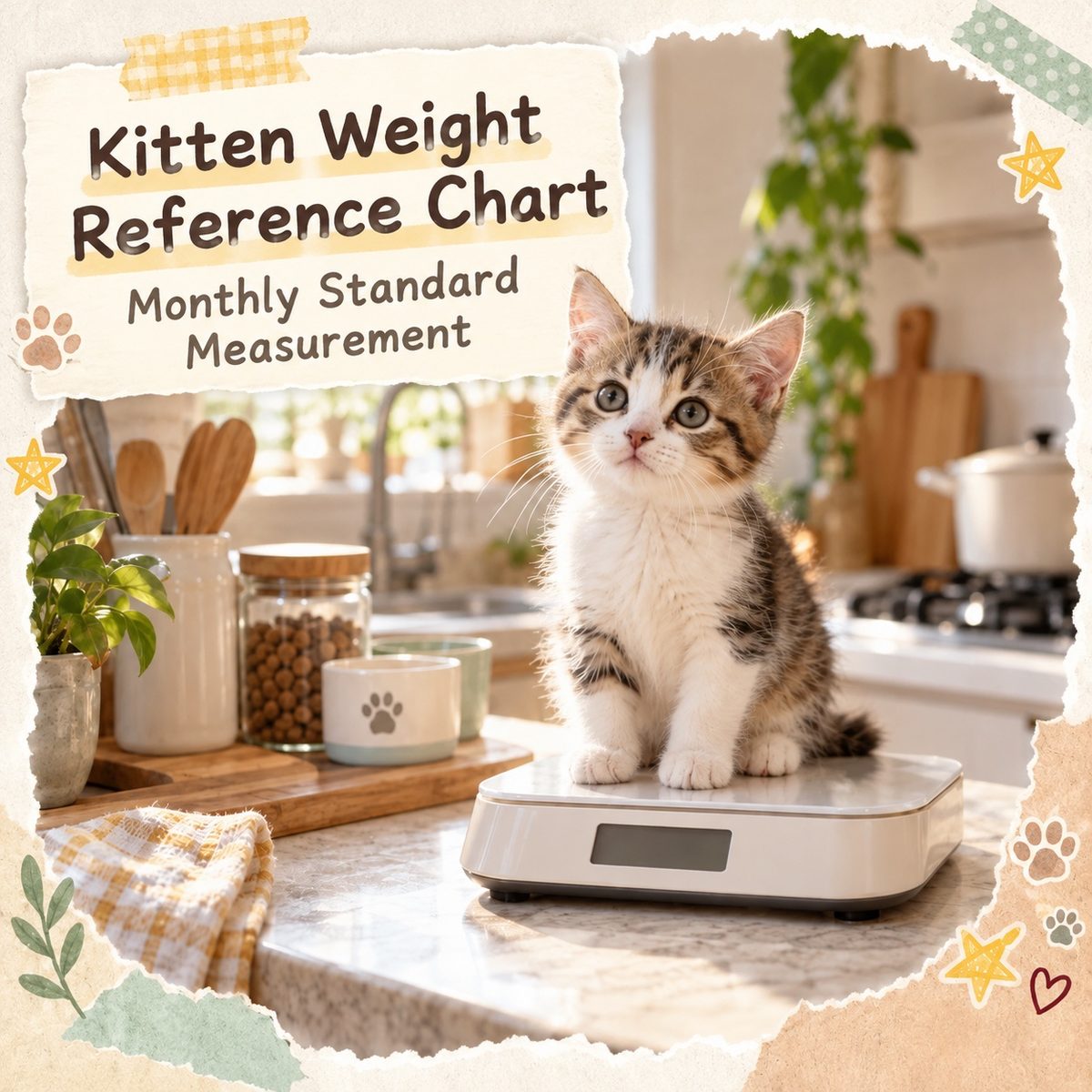
Week-by-week weight standard table (book data)
| Age | Weight standard | Milestones at this stage |
|---|---|---|
| Birth | 100-120 g | Eyes closed, relies on smell to find milk |
| 1 week | 200-250 g | Umbilical cord falls off |
| 2 weeks | 250-300 g | Eyes open, begins to hear |
| 3 weeks | About 500 g | Baby teeth appear, starts weaning food |
| 4 weeks | 500-700 g | Baby teeth mostly complete |
| 2 months | 700-1000 g | Fully weaned |
| 3 months | 1000-1500 g | Permanent teeth, first vaccination |
| 3 months-1.5 years | Kitten period 1-5.5 kg | Rapid growth phase |
| 1.5-7 years | Adult period 3.5-5.5 kg | Physique stabilises |
※ The book notes: growth standards are averages and individual variation exists. Large breeds like Maine Coons will exceed the range; domestic shorthairs generally stay within it.
Home weighing tutorial (Hong Kong edition)
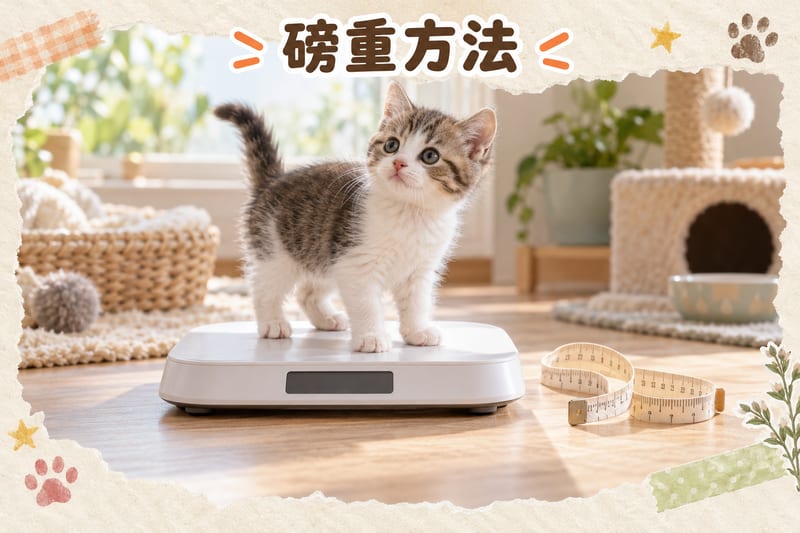
- Tool: Kitchen electronic scale (1 g precision, available in Hong Kong for $50-100). The book confirms: use a kitchen scale, it can measure changes as small as 1 g.
- Method: Place a small basin or towel on the scale (tare to zero), put the cat in. Cat won't sit still? Weigh yourself holding the cat, then subtract your own weight.
- Time: Same fixed time daily (recommended before morning feeding) so numbers are comparable.
- Record: Phone notes or spreadsheet, date + grams. After a month you'll have a growth curve.
How to read the curve
- ✅ Daily +10-20 g: Normal, continue
- ⚠️ Slow but steady gain: Check food intake — if it still licks the bowl frantically after eating, add one-tenth to the next portion
- ❌ Stalled for two consecutive days: Be alert, check appetite, bowel movements, energy
- ❌ Losing weight: Do not just observe, see a veterinarian
For the correlation between food amount and weight (grams of food per day), see the gram table in Kitten Feeding Schedule.

Verifiable formulas (calculate once yourself)
Not sure if the weight is good? These three formulas can be calculated each time; all numbers are derived from the standard table above:
- Daily gain = today's weight − yesterday's weight (target +10–20 g/day)
- Weekly gain = day 7 weight − day 1 weight (target +70–140 g/week, i.e., 10×7 to 20×7)
- Obesity threshold = ideal weight × 1.15 (e.g., ideal 4 kg → 4 × 1.15 = 4.6 kg; above that is obese)
Another example for formula 3: the upper limit for 3 months is 1,500 g, so 1,500 × 1.15 = 1,725 g is the threshold; if the cat is 1,650 g, it's heavier but not over the line — judge by daily gain rate and waistline, not an immediate need to diet.
The other side: can kittens get fat?
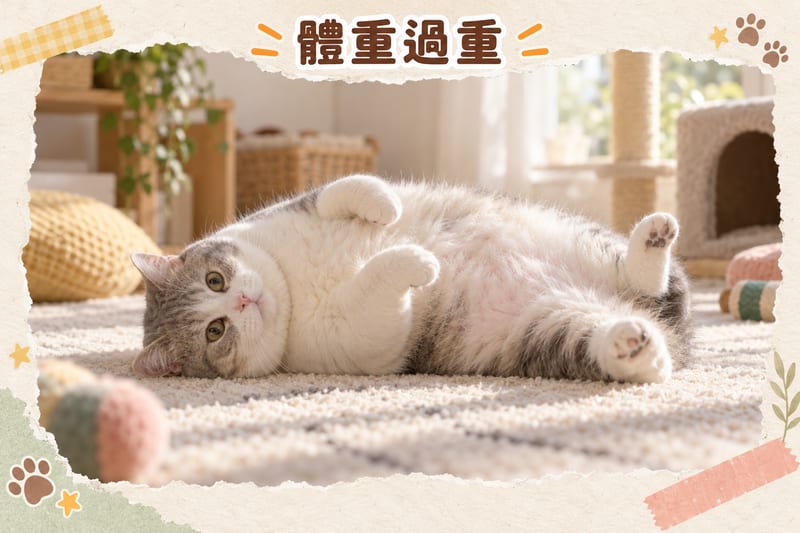
The book defines obesity as "15% or more above ideal weight". Obese cats are prone to diabetes, heart disease, cancer, and joint problems. Although kittens need to eat enough, it's not an all-you-can-eat buffet:
- Weight gain is very fast before 3 months, stabilises after 4-5 months, and food amount should be adjusted accordingly
- After physique stabilises at 10-11 months, continued weight gain is usually fat
- Metabolism slows after neutering, the most common turning point for obesity
Self-check (book checklist): heavier than at 1 year old / don't know the cat's correct weight / unsure of daily food amount / can't feel a waist indentation when touching the belly — if you answer yes to half or more, consider weight loss and consult your veterinarian.
Hong Kong context
- Summer appetite drop: Hong Kong summers are hot, kittens may eat slightly less — as long as the weight trend continues upward, don't panic, but distinguish between "no appetite due to heat" and "no appetite due to illness" — the difference is whether weight stalls.
- Treat trap: Treats are high in calories; daily treats for kittens should not exceed 10% of total calories.
Using the weight curve to communicate with your veterinarian
Keeping a weight record is not just for yourself — bring the curve to follow-up visits, and the veterinarian can see the trend in a minute, ten times more useful than saying "he seems to have lost weight recently". Suggested format:
Date | Weight(g) | Food intake | Notes
10-12 | 1050 | Normal |
10-13 | 1058 | Normal | Switched to new food
10-14 | 1055 | 70% |
Record date, grams, food intake, and abnormal events consecutively. For more follow-up tips, see Checklist for Taking Your Cat to the Vet — although that article is for cats with chronic illness, the principle of "record first" is the same.
Weighing in multi-cat households
Multi-cat households are common in Hong Kong; weighing kittens has two practical issues:
- How to separate who eats how much: Kitten and adult cat food are different, so feed separately — different rooms, or one on the kitchen counter and one on the floor
- Don't mix up weights: Use the same towel on the scale for each cat to reduce resistance; record immediately after weighing whose number it is
The food amounts for kittens and adult cats differ greatly; don't feed from one bowl for convenience — kittens need the high nutrient density of kitten food, and adult cats eating kitten food will get fat.
Troubleshooting order for weight stagnation
If you weigh a kitten and it hasn't gained weight for two consecutive days, troubleshoot in this order:
- Food intake: Has it finished? Still licking the bowl = not enough, add one-tenth
- Food condition: Switched to new food? Is the weaning paste soft enough? (See Kitten Weaning Guide)
- Bowel movements: Any diarrhoea or constipation? Litter box records are evidence
- Energy: Still playing? If not playing, it's not just a food amount issue
- Environment: Moved house / more strangers / changed litter? Stress can affect appetite
If no improvement within 48 hours after adjusting 1-2, or if any of 3-5 applies, don't try on your own — take the weight record to the veterinarian. Kittens' "loss of appetite" cannot be delayed — for more warning signs, see Early Warning Signs of Chronic Disease in Cats (although it's about chronic disease, the logic of "weight drop + appetite change" is the same).
Common weighing errors
Inaccurate numbers are mostly due to these reasons:
- Different times: Before morning feeding vs. after a full meal at night can differ by 50-100 g — so fix the time
- Uneven scale: Kitchen scale must be on a hard flat surface; on a carpet it will be inaccurate
- Cat moving: If it's still moving at the moment of weighing, the number will jump — wait until it sits still before reading
- No tare: If you put a towel or basin, press "tare" to zero, otherwise you're calculating the weight of the towel
After 6 months, the kitten starts to outgrow the kitchen scale; you can switch to the "hold the cat" method: weigh yourself holding the cat once, subtract your own weight. Bathroom scales have 100 g precision, enough for trends but not for daily changes — so kittenhood is the golden period for kitchen scales.
When to switch from kitten weighing to regular weighing
Daily weighing during kittenhood, weekly after 6 months, monthly after 1 year — but one situation requires more frequent weighing: after neutering. Post-surgery metabolism slows, and the book reminds that neutered cats are prone to obesity, so for three months after neutering, it's advisable to return to weekly weighing to confirm no rapid weight gain. Adjust portions with the food amount table to avoid the most common trap of "neutering fat". Adult cat weight management and dietary adjustment share principles with chronic disease diets; you can refer to the calorie calculation method in Diet Management Guide for Cats with Chronic Disease.
The real value of a weight chart is not a single number but the line. Ten minutes of weighing each day gives you the most accurate "how is he today" sensor in all of Hong Kong. Many experienced cat owners start this habit during kittenhood, and it remains useful into adulthood and old age.
For a complete growth curve for a single breed, see British Shorthair Standard Weight and Growth Curve.
References
- Agriculture, Fisheries and Conservation Department (Hong Kong Government) — Pet Care Information
- Veterinary Surgeons Board of Hong Kong
- The knowledge points in this article are compiled from cat encyclopedia books (see publication details at the end) and public veterinary guidelines
Related products (available in Hong Kong)
- WELLNESS CORE Grain-Free Kitten Growth Formula 250g (reference price HK$40) — trial pack makes portioning easy
- Nulo Freestyle Grain-Free Kitten Dry Food Chicken + Cod 12lb (reference price HK$600)
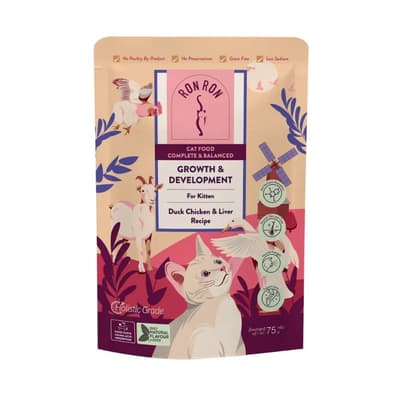
- RONRON Kitten Complete Wet Food Duck Chicken Chicken Liver 75g (reference price HK$8.5)
More kitten food choices: Complete Guide to Kitten Food.
Key summary
- ✅ Daily gain of 10-20 g = healthy; stalled for two consecutive days = see a veterinarian
- ✅ Weigh with a kitchen scale at a fixed time daily, record numbers to see trends
- ✅ Obesity threshold = ideal weight +15%; pay special attention after neutering
- ❌ Don't judge only by "looks not thin" — weighing is the evidence
- 📌 Use the weight chart together with the Kitten Month-by-Month Guide for the most comprehensive view
The above content is for reference only and cannot replace veterinary diagnosis and treatment. If your kitten has any abnormalities, seek medical attention as soon as possible; consult your veterinarian for feeding, vaccination, neutering, and other arrangements.