
Quick answer: Kitten biting is a hunting instinct, not naughtiness. There are only three steps to train them: ① Don't tease them with your hands, use toys; ② The moment their teeth or claws touch your skin, immediately stop the game, say nothing; ③ Don't punish (spraying water or caging has the opposite effect). Stick with it for a few weeks and they'll learn that 'human skin is off-limits'.
Why kittens bite
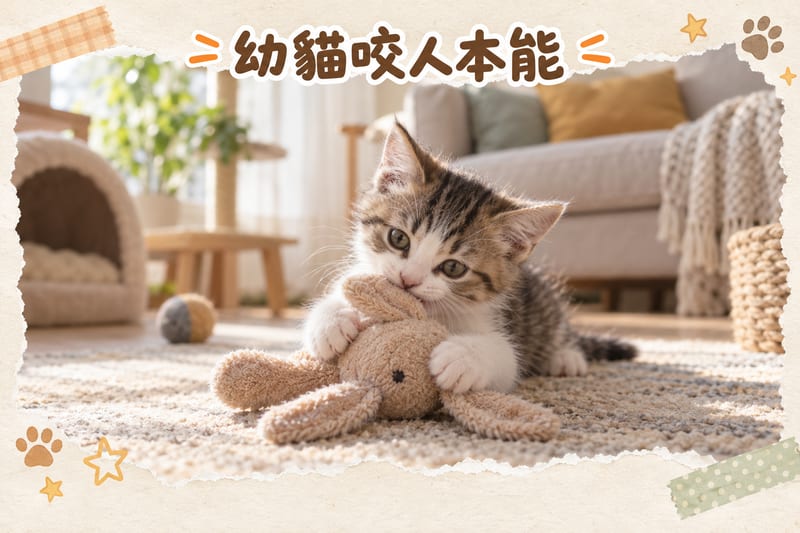
The book My First Cat Book explains it clearly: cats see moving objects as prey or toys. So kittens will:
- Dash to your feet and pounce on your legs
- Bite your hand when you move it in front of them
- Bite your feet through the duvet when you move them in bed
They don't hate you – they're just a little hunter who hasn't learned boundaries yet. And kittens have extremely high energy; their desire to move and explore must find an outlet, and your moving hands and feet are the most convenient outlet.
The correct training: 3 steps to 'skin is off-limits'
Animal behaviour expert Katja Rüssel (from the book The Complete Book of Cat Care) has a very clear method:
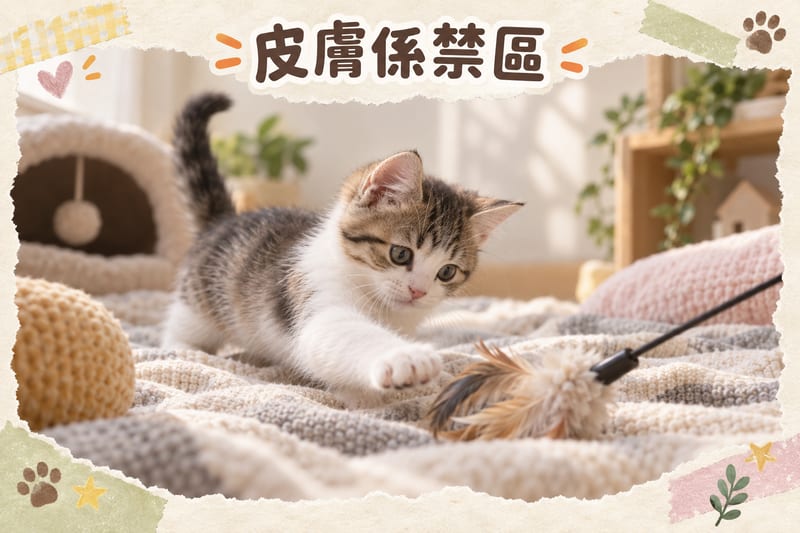
Step 1: Always use toys, never your body From today, stop playing with your fingers, toes, or wrists. Use toys for all play: wand toys, rope balls, moving small toys. Your hands are only for petting, holding, and feeding – so they associate 'hands' with 'affection/food', not 'prey'.
Step 2: Touch skin = game ends immediately During play, the moment their teeth or claws touch your skin, say nothing, immediately stop the game, get up and walk away. Don't scold, don't push, don't say 'Ow!' – any reaction is an invitation for the cat to 'keep playing'. Quietly stopping is the most powerful message.
Step 3: Calm down, repeat After they calm down (a few minutes later), you can start again with a toy. Repeat this cycle for a few weeks and they'll internalise 'touching human = no play'.
Three common mistakes (that make it worse)
| Mistake | Why it fails | Correct approach |
|---|---|---|
| Teasing them with your fingers | Teaches them 'hand = prey' | Use toys, keep distance |
| Shouting/hitting after being bitten | Cat sees it as interaction, or becomes afraid of you | Silence, stop the game |
| Spraying water, dunking face, caging as punishment | Books explicitly say it has the opposite effect | Just calmly walk away |
When biting needs a vet
The book has an important reminder: if they suddenly get angry and bite when you touch a certain part of their body, and they're not usually like that – this might not be play, but a pain response (injury or illness). Don't treat this as a behaviour problem to train; take them to the clinic for a check-up as soon as possible.
Also, during teething (4-7 months), their gums itch and the urge to bite is especially strong – giving teething toys can soothe it. For details, see the kitten teething guide.
Practical tips for Hong Kong homes
- No escape in small flats: If a kitten has no outlet for energy, they'll bite you. Two sessions of 10-15 minutes of wand toy play daily is the root solution.
- Night biting: Being bitten on the toes at dawn is a pain for many Hong Kong cat owners. A high-intensity play session before bed plus a late-night snack can greatly reduce it.
- Families with children: Teaching children 'don't tease the cat with your fingers' is as important as training the cat; children are often bitten because they move quickly and get excited.
- Protect electrical cords: During teething, the urge to bite is strong, so keep cords tidy – see the kitten home safety guide.
Relationship with socialisation
The earlier you train against biting, the easier it is to handle, because 3 weeks to 3 months is the golden learning period. The 'touch skin = stop' rule established during this time will stay with them for life. Full socialisation timeline: kitten socialisation guide; what to do each month: kitten month-by-month guide.
Energy-burning schedule: reduce biting at the source
Biting is often due to pent-up energy. According to the book, kittens need daily 'exercise and exploration desires to be released'. A feasible schedule for Hong Kong homes:
- Morning 10 minutes: Fast chase with wand toy (before leaving home)
- After work 15 minutes: Main session – chase, jump, ambush toys, play until they're panting with tongue out
- Before bed 5 minutes: Light play + late-night snack, so they 'eat and sleep'
- Weekends: Rotate new toys, cardboard box castle (free and effective)
Toy rotation is important: they get bored of the same toy after a week; hide it for two weeks and it's new again.
How to choose toys (safety perspective)
- ✅ Wand toys (you control, they chase) – top choice, enough distance so your hands aren't the target
- ✅ Rope balls, small plush toys – okay, but put away after play (risk of swallowing strings, see kitten home safety guide)
- ✅ Teething toys/freeze-dried – especially useful during teething (kitten teething guide)
- ❌ Toys small enough to swallow
- ❌ Toys with loose small parts (bells, plastic eyes)
Treating bite wounds
During training, occasional skin-penetrating bites will happen. How to handle:
- Immediately wash the wound with soap and running water for a few minutes
- Disinfect, observe for 24-48 hours
- ⚠️ Cat bites are notorious for becoming infected: if the wound becomes red, swollen, hot, more painful, or you develop a fever, see a doctor
- People with diabetes or weakened immunity should consult a doctor directly after a cat bite breaks the skin
This is also why you should train from kittenhood – adult cats bite much harder, so training early is a safeguard for everyone. What else to establish in the first year: kitten first-year checklist.
Multi-cat households: will a biting kitten teach the older cat bad habits?
No, they won't 'teach bad habits', but the older cat will teach the kitten boundaries in their own way – if the kitten bites too hard, the older cat will hiss, swat, and walk away. This is normal cat-to-cat education; no need to intervene (unless there's blood). Conversely, a kitten raised alone doesn't have these 'cat teachers', so the owner must play that role: touching skin = game over is your 'hiss'. Full steps for introducing a new cat: kitten socialisation guide; if you haven't adopted yet and are considering it, see the Hong Kong cat adoption guide.
When to see a behaviour expert
Most kitten biting can be solved with 'toys + stop the game'. Consider seeing a vet for a referral to a behaviour expert if:
- After 6-8 weeks of training there's no improvement, and biting is getting worse
- Biting is accompanied by other aggressive behaviours (unprovoked pouncing, chasing and biting until bleeding)
- They actively attack people even when not playing
- You suspect pain (biting only when a specific area is touched)
Remember the book's advice: when unsure how to handle it, staying calm is better than trying random methods. Punishment should never be considered. The boundaries you teach at home will determine how they interact with you, your family, and vets for the next ten years – these few weeks of persistence are worth it.
Biting is the most patience-testing part of kittenhood, but it's completely trainable. Remember two things: toys not hands, touch skin = stop. Two months later you'll have a cat with boundaries, not a 'biter' – and your bond will actually be deeper because of this process, because you never scolded them, just consistently showed them the rules.
References
- Agriculture, Fisheries and Conservation Department (Hong Kong Government) – Pet Care Information
- Veterinary Surgeons Board of Hong Kong
- This article's knowledge points are compiled from cat encyclopaedia books (see publication details at the end) and public veterinary guidelines
Related products (available in Hong Kong)
Nutritional supplement after play, for kittens:
- RONRON Kitten Complete Wet Food Duck, Chicken & Chicken Liver 75g (reference price HK$8.5)
- ZiwiPeak Kitten Can Chicken with Lamb 85g (reference price HK$34)
Key summary
- ✅ Biting = hunting instinct; use toys not hands
- ✅ Teeth or claws touch skin → quietly stop the game immediately
- ✅ Two play sessions daily to burn energy, the root solution
- ❌ No spraying water, caging, or hitting – all have the opposite effect
- ⚠️ Biting only when a specific area is touched = possible pain, see a vet
The above content is for reference only and cannot replace veterinary diagnosis and treatment. If your kitten shows any abnormalities, seek medical attention as soon as possible; consult your veterinarian about feeding, vaccinations, neutering, and other arrangements.
 ZiwiPeak full guide →