Quick answer: A kitten's first year is the fastest growth period—birth weight around 100-120 grams, eyes open at 2 weeks, milk teeth and socialisation start at 3 weeks, weaning food at 4 weeks, fully weaned at 2 months, first vaccination at 2-3 months, neutering at 6 months to 1 year, transition to adult food at 10-11 months. Hong Kong cat owners who follow the milestones monthly, check and record weight, won't miss critical periods.
Why kittens need care by month age
A cat's first year is roughly equivalent to 16-18 human years. The age conversion table in the book My First Cat Book makes it clear: a 1-month-old cat is already ≈1 human year, 3 months ≈5 years, 1 year ≈17 years. That means every month of a kitten's change equals several years of growth for a human child—if you miss a key period in a certain month (e.g., socialisation, weaning), you can't make it up later.
So caring for a kitten can't be done "roughly"; you need to go by month age.
0-2 months: Nursing period (weight 100-700 grams)
At this stage, kittens should theoretically still be with their mother. Weekly milestones:
| Week age | Growth milestones | Weight reference |
|---|---|---|
| Birth | Eyes closed, ears not hearing, rely on smell to find mother's milk | 100-120 grams |
| 1 week | Umbilical cord falls off, gains 10-20 grams daily | 200-250 grams |
| 2 weeks | Eyes open, start to hear sounds | 250-300 grams |
| 3 weeks | Milk teeth appear, claws can retract freely, start eating mushy weaning food, enter socialisation period | About 500 grams |
| 4 weeks (1 month) | Milk teeth mostly in, kittens start playing together, can regulate body temperature | 500-700 grams |
| 2 months | Fully weaned, start eating kitten food, very curious | 700-1000 grams |
The book specifically reminds: if the mother cat is not around, the owner should feed with kitten milk replacer (heated to about 38°C), and use warm water-soaked gauze to gently wipe near the anus to help them excrete—these are tasks the mother cat would do with her tongue. Never feed human cow's milk; many cats stop producing lactase after weaning, and drinking milk causes diarrhoea.

3-6 months: Early kitten period (weight over 1-2 kilograms)
| Month age | What to do |
|---|---|
| 3 months | Weight over 1 kilogram; first combined vaccine + health check; start training to eat and use the toilet |
| 4 months | Permanent teeth start coming in; female may have first heat; weight over 2 kilograms |
| 5-6 months | Kittens can be fully independent from mother; milk teeth gradually replaced by permanent teeth |
At this stage, two things Hong Kong cat owners most easily miss:
- Vaccination window: Maternal antibodies are used up at 2.5 to 3 months, so the first shot should not be later than 3 months. If it's a stray or adopted cat, ask clearly when you take over whether it has been vaccinated and when.
- Socialisation wrap-up: The critical socialisation period is 5-7 weeks, still important up to 3 months, and basically complete around 4 months. During this time, expose them to different people, sounds, and environments. For details, see Kitten Socialisation Guide.
7-12 months: Towards adulthood
- Before 7 months is a period of rapid physical growth; provide enough high-nutrition kitten food.
- 6 months to 1 year: Both male and female cats are recommended to be neutered during this time. Male cats reach sexual maturity at 6-8 months; from 10 months, unneutered males start spraying urine to mark territory; females can come into heat as early as 4 months.
- 10-11 months: Physique is basically set; you can transition from kitten food to adult food, two meals a day. For transition methods, see Kitten Feeding Schedule.
- 1 year: ≈17 human years, officially adult.
Weight standards summary (book data)
| Stage | Age | Weight standard |
|---|---|---|
| Nursing period | 0-2 months | 100-700 grams |
| Kitten period | 3 months-1.5 years | 1-5.5 kilograms |
| Adult period | 1.5-7 years | 3.5-5.5 kilograms |
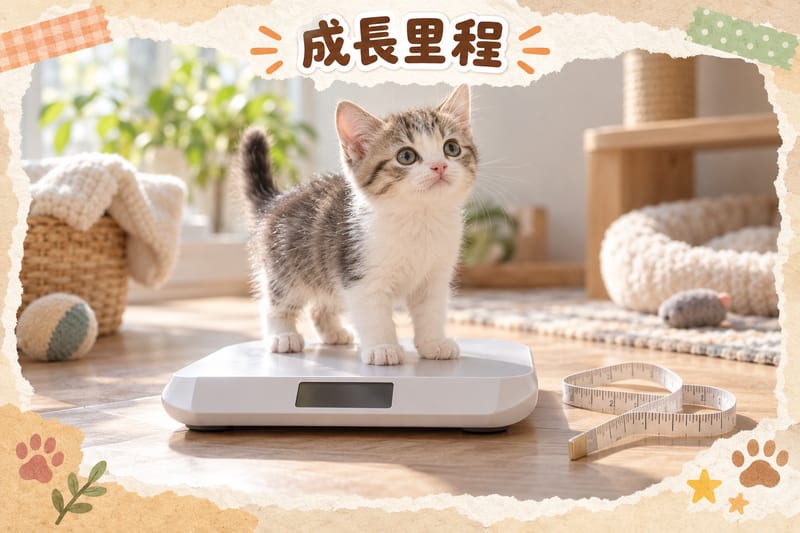
Healthy nursing kittens should gain 10-20 grams daily. The easiest monitoring method for Hong Kong households: use a kitchen scale (1-gram precision) to weigh once daily at the same time, and record the number. If there's no gain for two consecutive days, or weight drops, that's a signal to see a veterinarian. For weekly weighing and interpretation, refer to Kitten Weight Chart Guide.
Cat age × human age conversion
| Cat | Human |
|---|---|
| 1 month | 1 year |
| 3 months | 5 years |
| 6 months | 10 years |
| 1 year | 17 years |
| 2 years | 23 years |
| 7 years | 44 years |
| 15 years | 75 years |
Remember this ratio, and you'll understand why a 3-month-old kitten is so naughty—they're equivalent to a 5-year-old child.
Hong Kong practical scenarios
- Adoption vs. from a cattery: Hong Kong adoption organisations (e.g., SPCA) usually only let kittens go for adoption at 2-3 months, meaning when you take over they should already be weaned and toilet-trained. If someone says "you can take them at 1 month", ask clearly how to feed. For adoption process, see Hong Kong Cat Adoption Guide.
- Air-conditioning in summer: Kittens under 1 month can't regulate their own body temperature; don't let air-conditioning blow directly on the nest; after 1 month they can slowly adapt to room temperature.
- Subdivided flats/small units: During the nursing period, they need a quiet corner for a nest, away from the door and windows.
Neutering surgery: detailed information from the book
Many Hong Kong cat owners' most concerned month-age event is neutering. Information from the book My First Cat Book:
Male cat neutering
- Procedure: removal of testicles; discharged same day or stay one night; no stitches to remove
- Suitable time: around 6 months to 1 year
- Advantages: reduced territoriality and aggression, prevents urine marking
- Disadvantages: anaesthesia has some risk; post-surgery fat metabolism decreases, prone to obesity
Female cat spaying
- Procedure: removal of ovaries and uterus; hospital stay several days; stitches removed 1-2 weeks after surgery
- Suitable time: around 6 months to 1 year
- Advantages: prevents uterine diseases, reduces breast cancer incidence, avoids accidental pregnancy
- Disadvantages: same as above, prone to obesity after surgery
The book reminds: unneutered male cats reach sexual maturity at 6-8 months, and from 10 months start marking territory; surgery is best done before heat and sexual maturity. For post-surgery weight management, use the Kitten Weight Chart and weigh monthly.
Monthly "abnormal" red lines
Besides watching milestones, you must recognise red lines—if the following occur, don't wait for next month, see a veterinarian directly:
- Any month age: no weight gain for two consecutive days, refusing food for over 24 hours, persistent diarrhoea
- Before 2 months: low body temperature (ears and paws feel cold), unwilling to suckle
- 3-6 months: completely not eating during teething, mouth bleeding that won't stop
- 6-12 months: persistent howling and not eating during heat, wound oozing after neutering
Treating illness early is especially important for kittens—they weigh only a few hundred grams to two kilograms, and the consequences of a two-day delay are much more serious than for adult cats.
Five questions to ask on takeover day
Whether adopting or taking over from a cattery, these five questions determine how you arrange the first month:
- What is the birth date? (Starting point for calculating month age)
- What food were they eating, and how many meals a day? (Starting point for food transition)
- Have they been vaccinated? Is there a vaccination card?
- Have they been dewormed?
- How long were they with the mother/siblings? (Clue to socialisation level)
After asking, compare with the month-age table in this article, and you'll know what stage your kitten is at and what to do next.
Coordination with other articles
This is the master table; in-depth guides for each topic are in separate articles:
- How much to feed, how many meals a day: Kitten Feeding Schedule
- How to wean: Kitten Weaning Guide
- Teething care: Kitten Teething Guide
- How to stop biting: How to Stop Kitten Biting
- First-year supplies and budget: Kitten First Year Checklist
References
- Agriculture, Fisheries and Conservation Department (Hong Kong Government) — Pet Care Information
- Veterinary Surgeons Board of Hong Kong
- This article's knowledge points are compiled from cat encyclopedia books (see publication details at the end) and public veterinary guidelines
Related products (available in Hong Kong)
Kittens need high-nutrition food specially formulated for kittens; kibble size and nutrient balance differ from adult food:
- WELLNESS CORE Grain-Free Kitten Growth Formula Trial Pack 250g (reference price HK$40) — small pack for tasting, suitable for newly taken-over kittens to try flavours
- Nulo Freestyle Grain-Free Kitten Dry Food Chicken + Cod 12lb (reference price HK$600) — large pack for long-term feeding
- RONRON Kitten Complete Wet Food Duck Chicken Chicken Liver 75g (reference price HK$8.5) — wet food for hydration
For more kitten food comparisons, see Complete Kitten Food Guide and Best Kitten Food Recommendations.
Key summary
- ✅ Weigh daily: healthy nursing kittens gain 10-20 grams per day
- ✅ First vaccination at 2-3 months, neutering at 6 months to 1 year
- ✅ Start weaning food at 3 weeks, fully weaned at 2 months
- ❌ Don't let kittens under 2 months leave their mother
- ❌ Don't feed human cow's milk
- 📌 Every month of the first year has milestones; bookmark this article for monthly reference
The above content is for reference only and cannot replace veterinary diagnosis and treatment. If your kitten has any abnormalities, seek medical attention as soon as possible; consult your veterinarian for feeding, vaccination, neutering, and other arrangements.