
Quick answer: Dogs are partners humans began domesticating during the Ice Age, when ancient grey wolves approached human campfires; after thousands of years of evolution and selective breeding, they have become the 'fur kids' in Hong Kong living rooms today.
Dogs were the first animals humans domesticated — before farming appeared, hunter-gatherers were already working with wolves. Around 15,000 years ago during the last Ice Age, a group of now-extinct ancient grey wolves began approaching human campfires; through long evolution and human selective breeding, they became everything from Arctic sled dogs to the fur kids in Hong Kong living rooms today. This article pieces together this shared human-dog history using archaeological and genetic evidence.
This article is an extension of the Hong Kong pet culture history overview series.
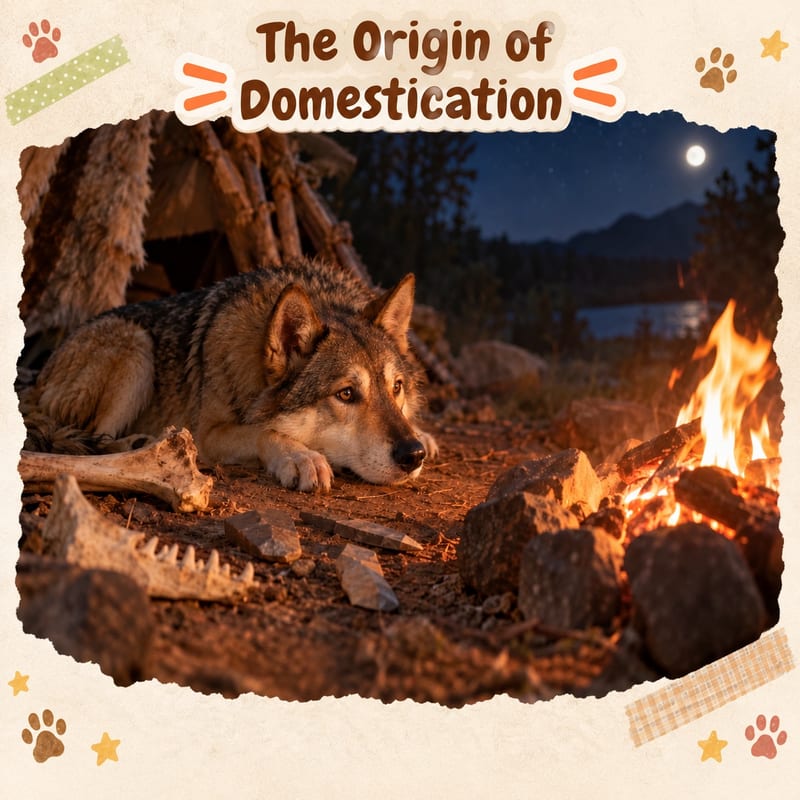
The Ice Age Encounter: Wolves Approach the Campfire
During the last Ice Age (around 30,000 years ago), a group of now-extinct ancient grey wolves began approaching human camps. The mainstream theory is 'self-domestication':
- Food attraction: Wolves were drawn by camp food scraps and scavenged at the edges of camps.
- Advantage for the tamer ones: Individuals less afraid of humans gained a stable food source, improving their chances of survival and reproduction.
- Gradual divergence: Over thousands of years, these 'camp wolves' evolved different body sizes and behaviours from wolves.
Some scholars suggest that early human-wolf relationships may have been more 'equal partners' than master-servant — hunter-gatherer communities cooperated with wolf packs in hunting, benefiting both sides. This cooperative relationship predates the domestication of any other animal by humans.
Archaeological Evidence: The Heart-Stopping Moment 12,000 Years Ago
- Around 15,000 years ago: Bones identifiable as domestic dogs were found at multiple sites.
- Around 12,000–14,000 years ago: Clear domestic dog traits begin to appear in the archaeological record — shorter skulls, narrower snouts, and a juvenile 'baby face'.
- A grave in Israel around 12,000 years ago: An adult woman was buried with her head resting on the remains of a puppy — this posture strongly suggests an emotional bond and is regarded as the earliest and most moving evidence of human-dog friendship.
What Genetic Research Tells Us
Modern genetic research provides key consensus on the origin of dogs, while leaving some mysteries unsolved:
| Question | Current understanding |
|---|---|
| What is the ancestor? | An extinct ancient grey wolf |
| When was it domesticated? | Around 15,000–20,000 years ago or earlier |
| Where was it domesticated? | Still debated (multiple Eurasian sites) |
| Once or several times? | Single or double domestication, still debated |
| Starch digestion genes | Early dogs had more copies than wolves, reflecting human diet |
One of the most interesting findings: early domestic dogs evolved a stronger ability to digest starch than wolves — meaning they were not just eating meat scraps, but truly 'eating human food', genetically tied to human settled life.
The Age of Division of Labour: Dogs' Professional Careers
As human civilisation developed, dogs diversified into an astonishing variety of professions:
| Profession | Examples | Characteristics |
|---|---|---|
| Hunting partners | Various hunting dogs | Tracking, flushing, retrieving game |
| Herding dogs | Border Collie | Managing flocks, extremely intelligent |
| Guard dogs | German Shepherd | Guarding property and family |
| Sled dogs | Husky | Polar transport, amazing endurance |
| Military and police dogs | German Shepherd, Malinois | Detection, drug sniffing, search and rescue |
| Companion dogs | Poodle, Shiba Inu | Lap dogs of royalty and nobility |
As dogs migrated with humans around the world, they evolved specialised breeds adapted to different environments: Arctic sled dogs, tropical hunting dogs, highland dogs, and even breeds raised specifically for wool production.
Dogs Arrive in Hong Kong: From Guarding to Fur Kids
Hong Kong's dog history has also gone through a shift 'from practical to emotional':
- Early colonial period: Village house guard dogs, warehouse guard dogs, fishermen's working dogs
- 1960s–80s: Purebred dogs (Pomeranians, Pekingese, etc.) became family pets and status symbols
- Police Dog Unit: The Hong Kong Police Dog Unit was established, with German Shepherds and others serving
- After 2000: Adoption culture emerged, and the status of mixed-breed dogs (Tong Gau) rose
- Today: Dogs are 'fur kids' and family members, with dog restaurants, dog parks and pet-friendly malls

Humans and Dogs Shape Each Other: Domestication Is Two-Way
There is an important view in the scientific community: domestication did not only change dogs, it also changed humans. Over thousands of years:
- Dogs learned to read human expressions, gestures and eye contact — things wolves cannot do
- Humans and dogs co-evolved a cross-species emotional understanding
- Research shows that when humans and dogs gaze into each other's eyes, both release oxytocin (the 'love hormone') — the same mechanism as mother-infant bonding
From Ice Age campfires to Hong Kong living rooms today, humans and dogs have travelled together for over ten thousand years. Next time your dog looks at you, you are looking at a friendship spanning ten thousand years.
What You Can Do Starting Today
- Understand that your dog's 'clingy following' is a cooperative instinct evolved over ten thousand years.
- Use eye contact and hand gestures more in training — these are exactly the signals they are best at reading.
- Consider adoption: Tong Gau are equally smart and loyal, and the best choice for a Hong Kong-style 'fur kid'.
- To learn about breed divergence, see the Shiba Inu origin story and the dog breed guide.
Further Reading
- Hong Kong pet culture history overview
- Hong Kong dog history: police dogs, AFCD, adoption culture
- Shiba Inu origin story: Japanese mountain hunting dog
- Golden Retriever origin story: Scottish gundog
- Cat domestication history: from Egyptian sacred cats to Hong Kong families
Practical Guide to Keeping a Dog in a Small Hong Kong Flat: Ice Age Genes Meet the Concrete Jungle
Hong Kong living spaces are small, but dogs' ten-thousand-year cooperative genes still apply. To practise human-dog coexistence in 300 square feet, you can refer to the following approaches:
Space management
- Use vertical space: place the dog bed on top of a cabinet or on a windowsill, mimicking the sense of security wolves get from observing the environment from high ground.
- Zoning concept: use pet fences to create a 'rest area' and a 'play area', echoing the territorial awareness evolved from scavenging at the edges of camps.
Training gestures
- Hong Kong homes are noisy, so verbal commands may not be heard clearly. Use eye contact and hand gestures more (pointing fingers, palm down) — these are exactly the signals dogs are best at reading, stemming from their ability to read hunter cues ten thousand years ago.
- Five minutes of 'gazing training' daily: look into your dog's eyes, and reward immediately when they look back, strengthening the emotional bond through oxytocin release.
Adopting a Tong Gau
- The Hong Kong Society for the Prevention of Cruelty to Animals and the Society for the Prevention of Cruelty to Animals (HK) have many Tong Gau available. They are adaptable, medium-sized, and ideal for small flats.
- Before adopting, ask clearly about the dog's background: has it had village house guarding experience? Is it overly alert? These traits can help you judge whether it is suitable for concrete jungle life.
Daily application
- After work, go to a dog park (such as Wan Chai waterfront or Tseung Kwan O) to meet their need for group activity.
- Hiking on holidays: Hong Kong has many hiking trails; taking your dog hiking mimics the cooperative mode of ancestral hunting partners while burning energy.
Remember: it doesn't matter if your home is small; what matters most is continuing the ten-thousand-year spirit of human-dog cooperation — understanding and caring for each other.
 Fuji One full guide →

