
Quick answer: 10,000 years ago, Near Eastern farmers' granaries attracted mice, mice attracted wildcats, and cats gradually entered human homes by 'applying' for the job of mouse-catcher. Their genes have barely changed, and today's Hong Kong little masters still retain that granary hunting spirit.
The domestication of domestic cats began about 10,000 years ago in the Near Eastern Fertile Crescent: agricultural humans' granaries attracted mice, mice attracted wildcats—rather than humans domesticating cats, it's more accurate to say cats 'applied' to be mouse-catchers and step by step entered human homes. This article takes you through 10,000 years, tracing how domestic cats evolved from wildcats into today's 'little masters' in Hong Kong households.
This article is an extension of the Hong Kong Pet Culture History Overview series.
The earliest encounter: a human-cat burial in Cyprus
Scientists discovered a grave in Cyprus dating to around 7500 BC: next to a human skeleton lay a cat's skeleton. This arrangement shows that cats already held a special place in human hearts at that time—not food, not a tool, but a companion worthy of being buried together.
It is generally believed that cat domestication began in the Near Eastern Fertile Crescent:
- Humans began farming and storing grain
- Granaries attracted mice, mice attracted wildcats (the African wildcat Felis lybica lineage)
- Tame individuals that could tolerate human presence gained a stable food source
- Humans received free mouse-catching services—a mutually beneficial relationship began
Ancient Egypt: the golden age of cats

Ancient Egypt is the most glorious chapter in cat history:
- Goddess Bastet: The cat-headed goddess Bastet symbolised family protection, fertility and gentle power, and was one of Egypt's most important deities
- Sacred status: According to ancient Greek historians, killing a cat (even accidentally) could be punishable by death; after a cat died, the family would shave their eyebrows in mourning
- Cat mummies: Archaeologists have found numerous cat mummy cemeteries, proving the religious status of cats
- Export controls: Egypt once strictly banned the export of live cats; smuggling cats was a serious crime
Cats travel east: the golden ages of Tang and Song China
After cats entered China via the Silk Road, Eastern cat culture began:
Tang dynasty (618–907): Duan Chengshi's Youyang Zazu records brown patterned cats from Chuzhou and red 'chichibo' cats from Lingwu—one of China's earliest records of local cat breeds, showing that Tang people already paid attention to cat coat colours and lineages.
Song dynasty (960–1279): The first peak of Chinese cat-keeping culture:
- Both court and commoners enjoyed keeping cats, and 'li nu' became an elegant term for cats
- Song painters left behind cat paintings such as Li Nu Tu and Xi Mao Tu
- Xianchun Lin'an Zhi records that Hangzhou people kept 'lion cats': long-haired white cats that did not catch mice and were purely ornamental—one of the world's earliest records of 'pet cats'
- In the Qing dynasty, Huang Han's Mao Yuan compiled cat knowledge from past dynasties, China's first monograph on cats
💡 Fun fact: As early as 800 years ago, Song dynasty Lin'an residents already practised 'keeping cats for looks'—lion cats were so beautiful that even if they didn't catch mice, their value was a hundredfold.
Medieval Europe: the dark age of cats
In contrast to the prosperity in the East, cats in medieval Europe experienced a dark period: cats were associated with witchcraft and heresy and were killed in large numbers during the witch hunts. Some historians believe the sharp decline in cat populations led to uncontrolled rodent infestations, indirectly worsening the spread of the 14th-century Black Death (this claim is still debated, but it is a fact that the status of cats only gradually recovered in modern times).
Molecular archaeology: cats haven't actually changed much
Modern genetic research (including a large 2017 study of ancient cat DNA) provides new evidence for the domestication history:
| Finding | Significance |
|---|---|
| Domestic cats originate from Near Eastern African wildcats | Same lineage as Egyptian cats |
| Later Egyptian cats added southern lineage | Trade routes drove cat migration |
| Very few domestication gene variants | Cats are 'semi-domesticated' animals |
| Tabby patterns show signs of selection | Humans only tweaked appearances |
Genetic research shows that the genetic difference between domestic cats and wildcats is extremely small—compared to dogs, which humans thoroughly transformed, cats have retained almost their 10,000-year-old selves. This is why domestic cats still have hunting instincts, independent personalities, and that air of 'I domesticated you'.
Cats arrive in Hong Kong: from mouse-catchers to little masters
Cats came to Hong Kong with merchant ships and migrants, and early on also served as mouse-catchers:
- 1894 Hong Kong plague: The government encouraged cat-keeping to control rodents; warehouse cats in Sai Ying Pun's dried seafood street and salted fish rows became community guardians
- Markets and shops: Domestic cats became part of Hong Kong's market culture, evolving into today's 'cat shopkeepers'
- Family pets: After the 1980s, cats officially became members of Hong Kong families, and 'cat slave' and 'little master' culture emerged
To learn the full story of Hong Kong domestic cats, see The Story of Hong Kong Cats: A Century of Change for Street Cats.
Frequently asked questions
Q: Why are cats described as 'semi-domesticated'? A: Because cats have not undergone strict human selective breeding; genetically they differ very little from wildcats, and their instincts, body shape and behaviour retain their original form.
Q: Are African wildcats and domestic cats the same species? A: Domestic cats descend from the Near Eastern lineage of African wildcats, sharing the same evolutionary line, but wildcats cannot be kept as pets.
Q: When did household cats become 'domestic cats'? A: From a domestication perspective, cats are a population that gradually adapted to human environments; they did not suddenly become domestic cats in any single year.
What you can do starting today
- Observe your cat's hunting play behaviour—those are 10,000-year-old granary instincts.
- Use a wand toy to satisfy hunting needs; don't blame your cat for 'hunting' at midnight.
- Seal the rice bucket and snack cupboard: cats' obsession with grain stores has historical basis.
- To learn more about Chinese cat culture, see Chinese Cat Culture History.
Further reading
- Hong Kong Pet Culture History Overview
- The Story of Hong Kong Cats: A Century of Change for Street Cats
- Chinese Cat Culture History: From the Book of Songs to Modern Times
- The Influence of Japanese Cat Culture on Hong Kong
- Hong Kong Cat Breed Guide
Practical cat-keeping in small Hong Kong flats: bringing 10,000 years of granary instinct to life
Hong Kong living spaces are small, but a cat's hunting genes won't disappear because of 300 square feet. To satisfy your little master's primal urges in a concrete jungle, you can copy ancient wisdom and localise it:
1. Turn the granary into a kitchen cabinet Ancient people used granaries to keep cats; today, turn your kitchen cabinet into a 'granary scene'. Transfer all dry food and snacks into sealed plastic containers and add safety locks to cabinet doors. When cats smell the food but can't find an entrance, they will naturally release energy in your designated 'hunting zone'—wand toys, cardboard box tunnels.
2. The domestic cat night stalker Hong Kong domestic cats retain a strong nocturnal rhythm; 3 a.m. parkour is the norm. The solution is 'crazy play one hour before sunset': use a fishing-rod-style wand toy to mimic a mouse's movements, then after 15 minutes of high-intensity chasing, feed a main meal, mimicking the primal sequence of 'hunt → eat → groom → sleep'. Ninety percent of cats will sleep soundly until dawn.
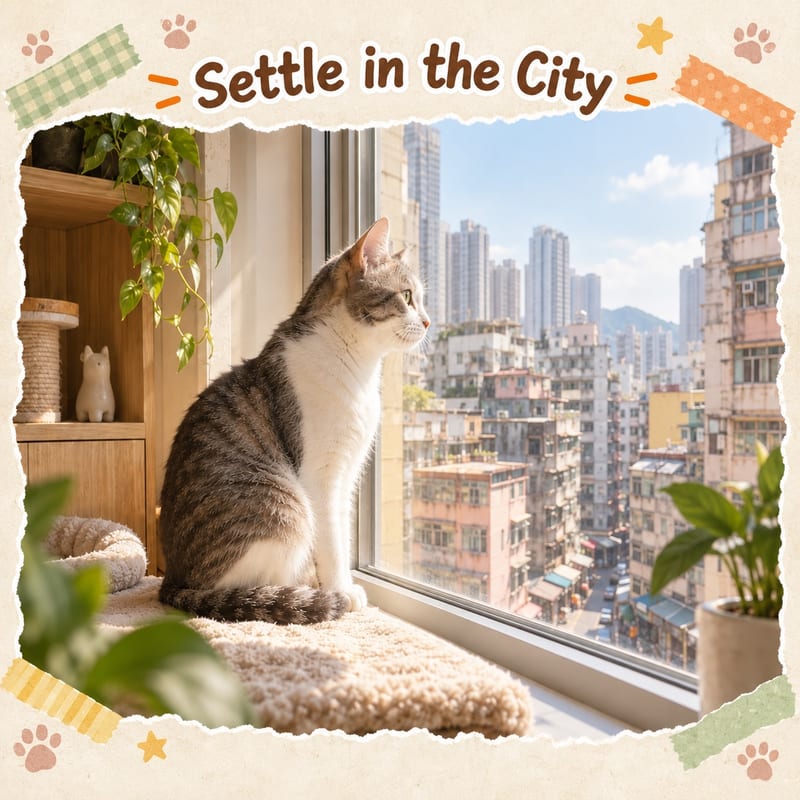
3. Lessons from market cat shopkeepers In the old days, domestic cats sat on counters in dried seafood shops; today you can set up a 'cat shopkeeper spot' on the windowsill: place a soft cushion, hang a 'Open for Business Today' sign, and let your cat watch the street view and monitor 'rodents'. With enough visual stimulation, they won't ambush your feet as prey.
4. When to see a vet If your little master suddenly shows zero interest in hunting games and won't even go into its favourite cardboard box, it could be toothache or arthritis—hunting movements require full-body coordination, and pain makes them lazy. If there's no improvement after two days of observation, book a vet appointment immediately; don't dismiss it as 'laziness' and delay.
Remember: Hong Kong spaces are small, but history is long. As long as you recreate the three major scenes—granary, night stalking, and surveillance—your little master can be a mouse-catching hero from 10,000 years ago even in a tiny flat.

📌 Key summary
- ✅ Cats are 'semi-domesticated' animals, genetically very similar to wildcats
- ✅ 'Keeping cats for looks' already existed in the Song dynasty: lion cats were worth a hundredfold even if they didn't catch mice
- ❌ Medieval European witch hunts killed cats, indirectly worsening rodent infestations
- ✅ After the 1894 Hong Kong plague, the government encouraged cat-keeping to control rodents
- ✅ Domestic cats evolved from market mouse-catchers to today's cat shopkeepers