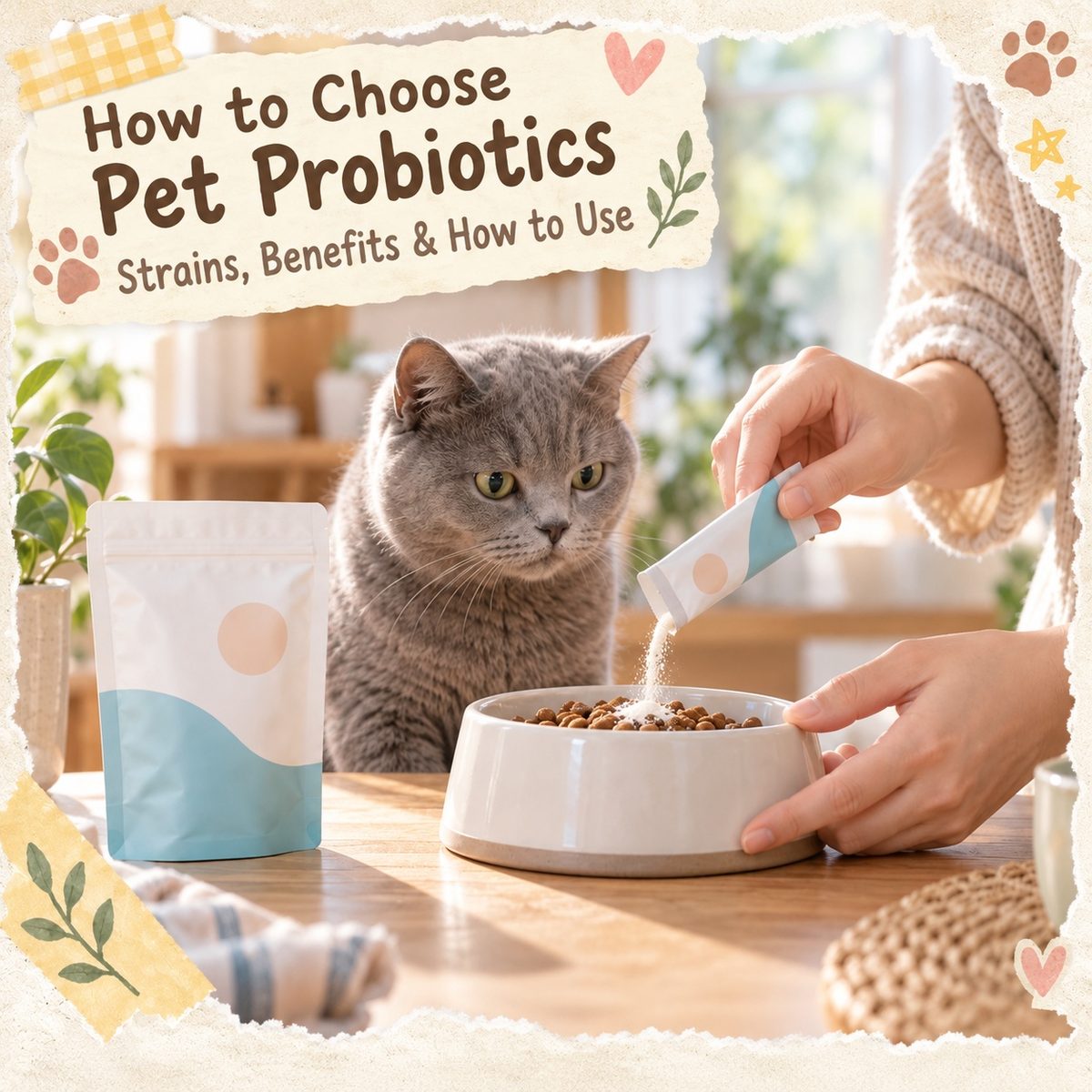
Quick answer: Probiotics are good bacteria for cats' and dogs' guts, specifically helping to balance the flora during food transitions, after antibiotics, and with mild soft stools. But they are only a health supplement; persistent diarrhea or bloody stool requires immediate veterinary attention.
In one sentence: Probiotics are a health supplement that helps cats and dogs balance their gut flora—most valuable during food transitions, after antibiotics, and during recovery from soft stools; they are not medicine. Persistent diarrhea, bloody stool, or weight loss must be seen by a vet. This article explains the principles, timing, selection, and feeding details.
What are probiotics? Why are they related to gut health?
The gut is home to thousands of microorganisms, with good and bad bacteria constantly competing. Probiotics are "good bacteria" that can be safely consumed, mainly to:
- Balance flora—when good bacteria are abundant, bad bacteria struggle to thrive
- Assist digestion—help break down food and maintain the gut environment
- Support the barrier—the gut lining is the first line of immunity; stable flora helps maintain it
- Competitive exclusion—occupy space so bad bacteria have nowhere to settle
Cats' and dogs' guts are actually very sensitive: food changes, stress, medication, and dietary changes are immediately reflected in the stool. Supplementing probiotics at these times helps the gut quickly return to balance.
Expectation management: Probiotics are positioned to "help" improve soft stools and gut discomfort, not as anti-diarrheal drugs, and certainly not to treat disease. Effects take one to two weeks to observe and vary with individual gut conditions.
By the way, distinguish two common terms: Prebiotics are the "food" for good bacteria, such as inulin and fructooligosaccharides. Many pet probiotic products combine probiotics and prebiotics (together called synbiotics) so that good bacteria have food to work with after entering the gut. When buying, don't get bogged down in terminology; just check the strains, live bacteria count, and storage requirements.
When are they most likely to be useful?

| Situation | Why it helps | Suggested duration |
|---|---|---|
| Food transition | Flora needs to adapt to the new formula | One week before and after |
| After antibiotics | Good and bad bacteria are killed together | Separate from antibiotics by two hours; continue for a week |
| Mild soft stool | Helps during recovery | Until stool forms |
| Stressful periods | Moving house, new pet, travel | Start a few days beforehand |
| Sensitive gut constitution | Daily extra support | Intermittent supplementation |
Antibiotics and probiotics must be staggered: Antibiotics will kill the good bacteria you supplement, so feed them at least two hours apart, and continue probiotics for a week after the antibiotic course ends. This is one of the most common scenarios where veterinary clinics recommend probiotics: after the course, the gut ecology takes days to weeks to recover, and supplementation can help "restore order."
Also note: Soft stools during food transition are not necessarily due to bad food; often it's just the gut flora not yet adapted to the new protein source. Unless the soft stool is severe or bloody, maintaining the transition pace and adding probiotics for a week will usually stabilize on its own; if diarrhea occurs with every food change, then consider food sensitivity and ask your vet to evaluate.
How to choose: three checks and one question
- Check the strains—Lactic acid bacteria, bifidobacteria, and enterococcus species are common in pet products; those with specified strain numbers are more reliable than vague "mixed strains"
- Check the live bacteria count—Higher CFU is not necessarily better, but it must be stated; also pay attention to technology (encapsulation, acid resistance) to ensure bacteria survive to the gut
- Check the form and storage—Powder is most common; check the label for refrigeration requirements; individual sachets are cleaner than large tubs and less prone to losing viability
- Ask clearly—"Can I use human probiotics?" The answer is best not to: human strains may not be suitable for cats' and dogs' guts, dosage is hard to convert, and some products contain xylitol and other additives harmful to pets
⚠️ Red flags when buying: Products with no strain specification, no CFU number, claims to "helps manage all diseases," or that require long-term high doses to be effective—skip them.
Feeding details: small techniques make a big difference
- Water temperature for mixing: Use room-temperature water or mix with room-temperature food; the only iron rule is not to use hot water—water hotter than body temperature will kill live bacteria
- Mix and serve immediately: Wet food mixed with probiotics should not sit for more than half an hour
- Start with half the dose: For the first one or two days, use half the recommended amount, observe for gas or soft stool, then gradually increase to the standard amount
- Fixed time: Same time every day helps the gut adapt faster
- Record stools: Use a simple stool score (formed, soft, watery) to record daily status; compare after a week with the start to see if it's working
Long-term or short-term? Goal-oriented: one week before and after food transitions; one week after antibiotics; for chronic gut sensitivity, intermittent use (two weeks on, one week off). If no improvement after two weeks, do not increase the dose; book a vet appointment.
Beyond probiotics: three daily things for gut health
Probiotics help, but long-term gut health depends on daily habits; three things are more important than any strain:
- Stable diet—Regular meals and portions; do not casually add anything outside the human menu; the gut fears "sudden big changes"
- Clean utensils—Wash wet food bowls daily and scrub water bottles regularly; illness enters through the mouth, and this applies to cats and dogs too
- Regular parasite checks—A fecal test every six months; parasites are a cause of soft stool that even indoor cats in Hong Kong cannot escape
Doing these three well can improve half of "gut sensitivity" cases; only then do probiotics come into play.
Which "gut problems" are not related to probiotics?
In the following situations, do not waste time trying probiotics on your own; see a vet directly:
- Diarrhea lasting over 48 hours, with blood or mucus, or black stool
- Vomiting and diarrhea occurring together, especially in kittens and puppies (rapid fluid loss, high risk)
- Loss of appetite, lethargy, significant weight loss
- Gut reactions after suspected ingestion of foreign objects or toxins
- Long-term recurrent soft stool—may be parasites, food allergies, exocrine pancreatic insufficiency, etc., requiring investigation of the cause
Gut symptoms are often just the tip of the iceberg; "probiotics not working" itself is an important diagnostic clue.
When to see a vet?
To reiterate the bottom line: Probiotics address "health maintenance" and "mild imbalance," not disease. Acute diarrhea in kittens and puppies, bloody stool, vomiting with diarrhea, poor spirit and refusal to eat—if any of these occur, see a vet first before considering supplements. In multi-cat households, if one cat has persistent soft stool, bring a fresh stool sample for testing to rule out parasites and infectious diseases.
What you can do starting today
- Check your cat's or dog's stool once: formed hardness is the health baseline
- Keep a small box of trusted pet probiotics at home for immediate use during food transitions and after antibiotics
- Check the probiotics you are currently using: are strains and CFU stated? If not, switch
- Plan a 7 to 10-day food transition schedule, adding probiotics for a week before and after
- Set a phone reminder: separate antibiotics and probiotics by two hours, and continue for a week after the course
- Do a fecal parasite test for your cat or dog every six months to rule out parasites, a common cause of soft stool
Want to know which supplement is most targeted for gut health? PetChill's pet food review section has breakdowns of probiotic product strains and dosages; use the "three checks and one question" from this article to screen them.
Further reading:
- Pet Health Care →
- Fish Oil/Taurine Supplement →
- Cat Vitamin Supplement →
- Pet Nutrition Supplement Course →
This article is for reference only; probiotics are a health supplement and cannot replace treatment; consult a registered veterinarian for any concerns.
🩺 2026 Update: What the book says about gut flora (basic knowledge)
The book 'Forever Dog' has a very clear passage worth noting:
- The book states about 70-80% of the immune system is located in the gut wall, so gut condition is closely related to overall health.
- Gut bacteria help digest food, absorb nutrients, and participate in producing some vitamins (e.g., B12, thiamine, riboflavin, and vitamin K needed for clotting).
- These microorganisms also participate in metabolic and neurotransmitter synthesis pathways; the book describes them as "invisible partners."
- The book points out that adding probiotics and digestive enzymes before food diversification helps the gastrointestinal tract accept new foods and nutrients more smoothly, reducing digestive stress and bloating discomfort.
These are the book's descriptions of the gut flora's role, not efficacy claims for any disease; probiotic products are daily nutritional supplements, not medicines.
Digestive enzymes: another commonly mentioned alongside probiotics
The three digestive enzymes mentioned in the book and their directions of action:
| Enzyme | Action described in the book |
|---|---|
| Amylase | Helps digest carbohydrates |
| Lipase | Helps digest fats |
| Protease | Helps digest proteins |
The book suggests that if providing such nutrients long-term, you can rotate different brands and products to achieve better diversified support.
When is it most worth using (book scenarios)
- Food transition: The book clearly states that adding probiotics and digestive enzymes before food diversification is helpful, along with gradual food transition (see Cat Food Transition Guide)
- Sensitive gut constitution: The book has a dedicated chapter on "extra support for sensitive stomachs"
- During surgery or medication: The book reminds that if a pet is unwell or on medication, discuss with your vet before starting or stopping any supplement; before surgery or starting new prescription drugs, also inform your vet what supplements are currently being taken
- After diarrhea or vomiting: First have a vet rule out the cause; supplements are not a treatment
Feeding methods (book recommendations)
- Mix into food: The simplest and most direct
- Hide in small meatballs, almond butter, or fresh cheese: The book mentions research showing fresh cheese containing probiotics is beneficial for gut flora
- Never force-feed powder: It damages trust and poses a choking risk
- Do not add to hot food: High heat affects activity; let food cool to room temperature before adding
- Record reactions: Stool condition, gas, appetite—patterns can be seen in two weeks
How to coordinate with other topics
- How to use during food transition → Cat Food Transition Guide
- Do supplements need to be taken → Cat Vitamin Supplement
- How to read main food labels → Complete vs Complementary Food
- What annual checkups test → Pet Annual Health Checkup
- Cat and dog deworming calendar → Pet Deworming Guide
Related products (available in Hong Kong, checked 2026-10-13)
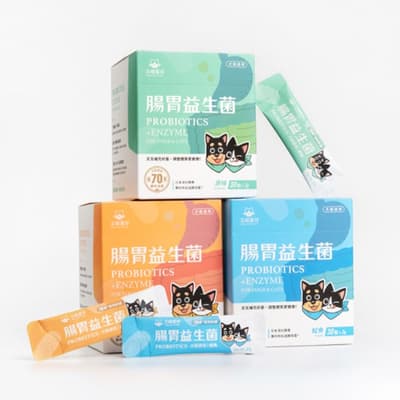
- DogCatStar Probiotics DogCatStar Gut Probiotics (Original) 2g*30 — reference price HK$188 (ingredients are probiotics; daily nutritional supplement, not medicine)
- Mao Zhang Medical Cat Gut Health Probiotics 2g x 30 sachets — reference price HK$141 (ingredients are probiotics and prebiotics; daily nutritional supplement, not medicine)
- Monster Tribe Probiotics Cat & Dog Supplement OK! Probiotics 1.5g x 30 sachets — reference price HK$158 (ingredients are probiotics; daily nutritional supplement, not medicine)
References
- Agriculture, Fisheries and Conservation Department (AFCD) — Hong Kong pet health information
- Veterinary Surgeons Board of Hong Kong (VSBHK) — registered veterinarian register
- Book references: 56 'Forever Dog', 68 'The Complete Guide to Raising a Dog for the First Time', 74 'Cat Family Medicine Encyclopedia'
The above content is for reference only and cannot replace veterinary diagnosis and treatment. For ingredients, dosages, and suitability of probiotics and digestive enzyme products, please consult your registered veterinarian.
📌 Key summary
- ✅ Best used during food transitions, after antibiotics, and stressful periods
- ✅ When choosing products, check strain numbers, CFU counts, and storage methods
- ❌ Human probiotics are not suitable for cats and dogs; dosages and additives pose risks
- ❌ Probiotics are not anti-diarrheal drugs; if diarrhea persists for 48 hours, see a vet
- ✅ Daily stable diet, clean utensils, and regular parasite checks are more important than supplementing bacteria
 DogCatStar full guide →
 Fuji One full guide →