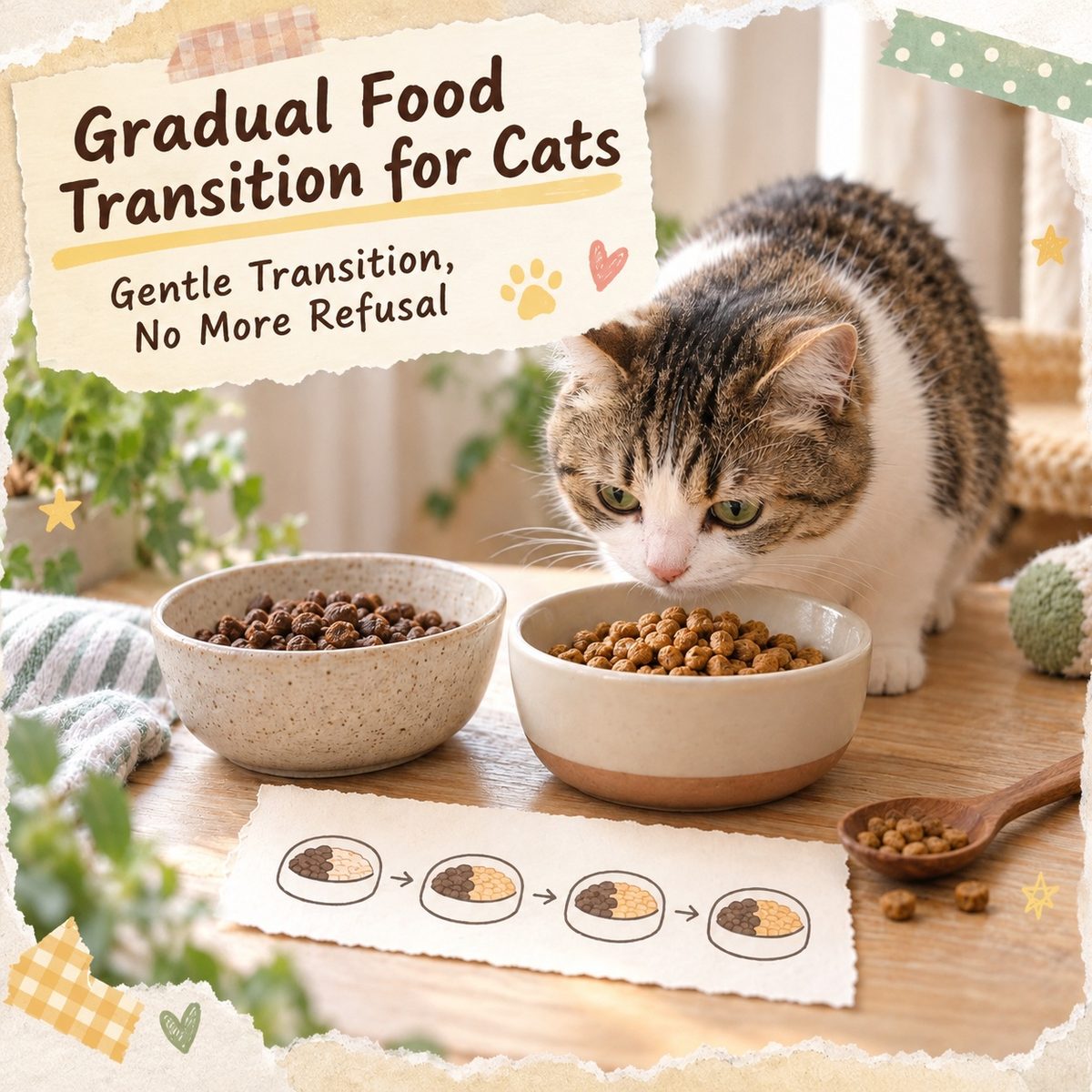
Quick answer: Use the gradual method for food transitions—the book recommends replacing only 10% new food at a time; if stool is normal the next day, add another 5-10% daily until fully replaced, typically completing in 7-10 days. Stop immediately if stool softens and wait until it firms up before continuing. Remember: slow and steady, don't rush.
Why transition slowly? The book's digestive principle
The book Forever Dog puts it plainly: too drastic a change in diet can cause severe gastrointestinal problems. The reason is that the gut microbiome needs time to adapt to new food; if you switch all at once, the digestive system doesn't have enough time to establish a new digestive rhythm, resulting in soft stool, diarrhoea, and vomiting.
The book summarises this principle in one sentence: "Slow and steady wins the food diversity race." This applies not only to transitioning food but also to adding any new food (new protein, new canned food, new treats).
Transition steps (1-2-3)
Step 1: Calculate ratios, not just eyeball First decide today's old-to-new ratio, then calculate the respective grams based on calories. Because canned food is about 1 kcal/g and dry food about 3.5 kcal/g, the same 50g does not mean the same calories.
Step 2: Increase by only 5-10% daily After each addition of new food, observe the stool within 24 hours—stool is what the book calls the "ideal barometer".
Step 3: Stop at soft stool, neither increase nor decrease The book's guidance: if stool is soft, do not increase the amount of new food; wait until it firms up before continuing; if diarrhoea occurs, you can revert to the last successful ratio.

10-day transition ratio table (example: dry to dry)
| Day | Old food | New food |
|---|---|---|
| Days 1-2 | 90% | 10% |
| Days 3-4 | 80% | 20% |
| Day 5 | 70% | 30% |
| Day 6 | 60% | 40% |
| Day 7 | 50% | 50% |
| Day 8 | 35% | 65% |
| Day 9 | 20% | 80% |
| Day 10 | 0% | 100% |
For sensitive stomachs, double the time for each step, i.e., complete in 2-4 weeks. Dry to wet (or wet to dry) involves large differences in texture and calorie density, so 2 weeks or more is recommended.
4 steps for managing soft stool
- Stop adding new food: maintain the current ratio for 2-3 days until stool forms
- Add pure pumpkin: the book recommends 100% pure pumpkin (fresh steamed or canned pure pumpkin, unsweetened), about one teaspoon per 10 pounds of body weight—i.e., about one teaspoon for a 4.5kg cat—to help firm up soft stool
- Review treats and other variables: the book reminds that sometimes soft stool is not due to the main food but to treats; stop all treats for 3 days and reassess
- Supplement probiotics: the book suggests adding probiotics and digestive enzymes before food diversification to help the stomach accept new food more smoothly
If diarrhoea persists for more than 24 hours, there is blood or mucus in the stool, or the cat appears lethargic/refuses food, see a veterinarian immediately—these are beyond the scope of "transition reaction".

Other practicalities during transition
- Don't run out of old food too early: the book suggests that if you decide to switch to a healthier option, buy the new food before the old food runs out, to avoid "forced rapid transition due to running out"
- Storage after opening new food: sealed, cool, away from light; see Pet Food Storage Guide
- Change only one thing at a time: during transition, do not simultaneously change litter, environment, or add new members, otherwise you won't be able to identify the cause of problems
- Record: note daily ratios, stool condition, appetite; after two weeks you will see a clear pattern
Mixed feeding calculation example (by calories, not volume)
Suppose a 4kg indoor cat needs 238 kcal per day, transitioning from dry food (3.5 kcal/g) to complete wet food (1.0 kcal/g), with a 50:50 ratio on day 7:
| Source | Calories | Grams |
|---|---|---|
| Old dry food 50% | 119 kcal | 119 ÷ 3.5 ≈ 34g |
| New canned food 50% | 119 kcal | 119 ÷ 1.0 ≈ 119g |
If you mistakenly use "50g old food + 50g new canned", the actual calories become 175 + 50 = 225 kcal, and the ratio is actually 78:22—this is why you must calculate by calories.
Monitoring and recording table
| Date | Old food % | New food % | Stool (1-5 score) | Appetite | Notes |
|---|---|---|---|---|---|
| Day 1 | 90 | 10 | 3 | Normal | Start |
| Day 3 | 80 | 20 | 3 | Normal | Increase |
| Day 5 | 70 | 30 | 2 | Normal | Soft stool → stop increasing for 2 days |
| Day 7 | 70 | 30 | 3 | Normal | Resume increasing |
(Stool score: 1 watery, 2 soft, 3 formed, 4 firm, 5 dry and hard; ideal is 3)
Special situations
- Cat with a history of food sensitivity: introduce only one new protein at a time, for 2-3 weeks each, and record skin and stool changes
- Senior cats (7+ years): slower digestive adaptation; complete over 3-4 weeks; also monitor water intake and weight
- Kittens: kittens need growth calories; do not reduce total amount because of transition; ratios can be gradual, but total kcal must be maintained
- Multi-cat households: feed separately (different rooms or staggered times) to prevent one cat from eating another's food, otherwise monitoring is impossible
- Changing meal frequency at the same time: do not do it together with food transition; wait 2 weeks before changing meal frequency
The four most common reasons for transition failure
- Too fast: skipping intermediate ratios and going straight to 50:50—the digestive system hasn't established a new rhythm
- Mixing by volume: dry and wet food differ 3 times in calorie density, so the ratios are completely different
- Ignoring treats: old treats still contain old formula ingredients, interfering with observation
- Changing other variables simultaneously: changing litter, moving house, adding new members, changing meal frequency—all make it hard to identify what caused the soft stool
Special notes for switching from canned to dry (or vice versa)
- Switching to dry food: actively monitor water intake; the book states that cats eating dry food cannot rely on voluntary drinking to compensate for the moisture in canned food
- Switching to canned food: lower calorie density means grams will increase significantly (about 3 times the weight for the same calories); recalculate portions
- Cats with a history of urinary disease: discuss any food transition with your veterinarian first
How to know the transition is successful
Success is when three indicators are met simultaneously: stool consistently formed (1-2 times per day), normal appetite, stable weight. Afterwards, maintain the new food for at least 4 weeks, and record the brand and batch for future repurchase or troubleshooting.
The book also reminds: if your dog's or cat's stool is stable, you can start preparing to change the diet; conversely, if it has always been unstable, address the gastrointestinal issue first (consult a veterinarian) before transitioning.
Common mistakes
| Mistake | Problem | Correct approach |
|---|---|---|
| Complete switch within a week | Digestive system not adapted | At least 7-10 days; sensitive cats 2-4 weeks |
| Mixing by volume instead of calories | Calorie miscalculation, over- or under-feeding | Calculate kcal first, then determine grams |
| Adding probiotics and continuing new food when stool softens | Masks the problem, worsens | Stop adding first, wait for normal stool |
| Starving the cat if it refuses food | Risk of fatty liver | Do not starve for more than 24 hours; seek veterinary care immediately |
| Changing food and meal frequency simultaneously | Too many variables | Change only one thing at a time |
Related cluster articles
- How to calculate daily calories and grams → Cat Calorie Calculator
- Dog feeding amounts → Dog Feeding Amount Guide
- Difference between complete and complementary wet food → Complete vs Complementary
- How to choose canned food and store after opening → Cat Wet Food Guide
- Food storage → Pet Food Storage Guide
- Basic nutritional needs → Cat Nutrition Complete Guide
References
- Forever Dog chapter on food diversity and transitioning (veterinary advice cited in the book)
- National Research Council (NRC) Nutrient Requirements of Dogs and Cats (2006)
- Agriculture, Fisheries and Conservation Department (AFCD): AFCD
- Veterinary Surgeons Board of Hong Kong: VSBHK
Related products (available in Hong Kong, checked 2026-10-12)
- Mao Zhang Medical Probiotic Health Meat Paste for Pets, Gastrointestinal Health, Soft Stool Nemesis, 6g x 30 sticks (for cats and dogs) — reference price HK$220
- Mao Zhang Medical Cat Gastrointestinal Health Probiotics 2g x 30 packs — reference price HK$141
- AIME Kitchen Cat Canned Food Grain-Free Mousse Nutritional Cat Can Tuna Pumpkin Mousse 75g — reference price HK$14/can
The above content is for reference only and cannot replace veterinary diagnosis and treatment. If your cat continues to have diarrhoea, vomiting, or refuses food, please consult your veterinarian.
How to calculate calories and feeding amounts? (Formulas + reference values)
All calories/grams in this article can be recalculated using the following formulas:
- RER (Resting Energy Requirement) = 70 × body weight(kg)^0.75
- MER (Maintenance Energy Requirement) = RER × activity factor
- Activity factor reference: neutered adult cat 1.2 / intact adult cat 1.4 / indoor adult dog 1.6 / active dog 2.0 / weight loss 0.8 (must be supervised by a veterinarian)
- Example (4kg neutered indoor cat): RER = 70 × 4^0.75 ≈ 198 kcal → MER = 198 × 1.2 ≈ 238 kcal/day
- Dry food grams = daily kcal ÷ food calorie density (kcal/g; packaging often lists kcal/kg, remember to ÷ 1000)
⚠️ All the above are reference values: each pet's body condition, age, activity level, and disease status differ; actual feeding amount should be based on veterinary assessment and product packaging recommendations.
📌 Key summary
-
Use only 10% new food at a time (book data)
-
Do not increase when stool is soft (book data)
-
Start with 10%, increase by 5-10% daily, complete in 7-10 days
-
Stop increasing immediately at soft stool, wait until firm before continuing
-
Pure pumpkin about one teaspoon per 10 pounds of body weight can help soft stool
-
Adding probiotics/digestive enzymes can reduce gastrointestinal stress during transition
-
If a cat does not eat for more than 24-48 hours, seek veterinary care immediately