
Quick answers
- A sudden drop in a cat's blood sugar is an emergency. If the cat is unsteady, slow to respond or having a seizure, do not wait, and do not set a 1 to 2 hour observation window.
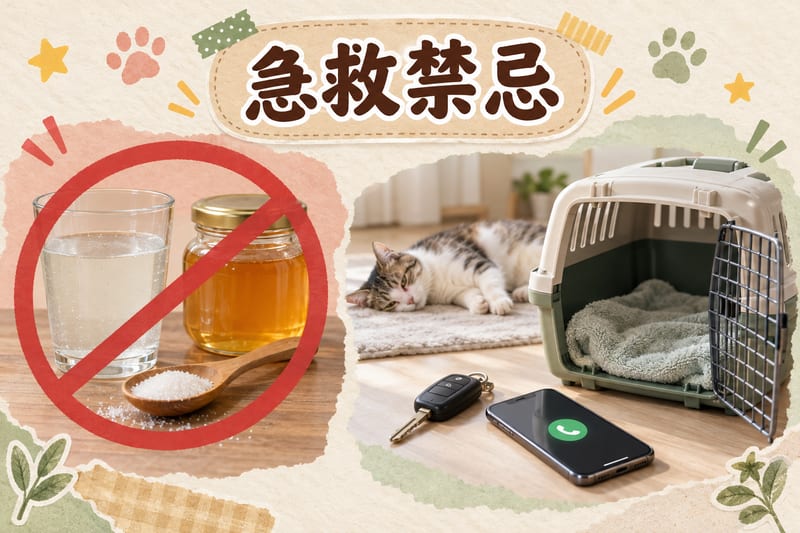
- Do not feed sugar water, honey, syrup or any of these 3 types of sugary foods yourself: when swallowing is difficult, inhaling them into the lungs can cause pneumonia, which is the most common secondary harm.
- Do not wait for the cat to "wake up on its own" or set a 30-minute observation period: the longer the brain is deprived of glucose, the higher the risk of irreversible damage.
- Do not give an extra shot, skip a shot or change the insulin dose yourself: a wrong extra shot can trigger more severe hypoglycaemia 4 to 8 hours later, and all such decisions must be made by the vet.
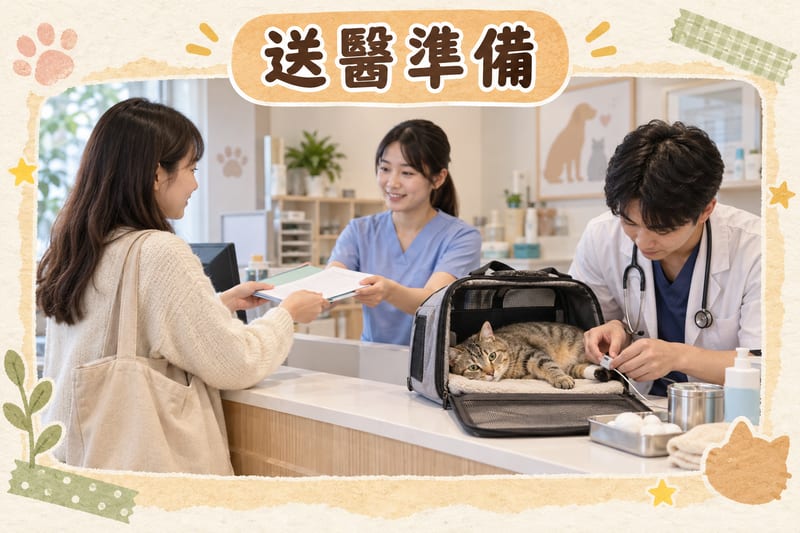
- Before you leave, prepare 4 pieces of information: the time and dose of the last insulin injection, the insulin product name and concentration, the time of the last meal, and whether there has been vomiting or suspected ingestion of something harmful.
- Kittens, diabetic cats on insulin treatment, cats with liver disease and cats that have not eaten for a long time are all high risk; for kittens under 6 months, 12 hours of complete fasting already needs to be addressed.
- On the way to the vet, keep the cat on its side with a clear airway, keep it warm at room temperature, and put nothing in the mouth; call the clinic once before you leave to say you are on your way.
"When a cat's blood sugar drops sharply, what should you absolutely never do?" The answer to this question is actually more important than "what should you do". Hypoglycaemia is not a minor ailment that an owner can observe slowly; it is an emergency that directly affects the brain: once blood sugar falls below a certain level, brain cells no longer have enough glucose available, and signs can progress rapidly from dullness, hind-leg weakness and unsteady walking to muscle tremors, seizures and coma. At this point, what actually makes things worse is often "doing the wrong thing" — feeding sugar water, honey or sugary foods yourself, deciding to "watch for a few more hours", or giving an extra insulin shot yourself; all three can make the situation worse.
This article focuses on the five things you should not do and the reason behind each, and also provides a three-stage danger-sign table, a high-risk cat table, and five preparation steps for the journey to the vet. The premise throughout is: managing hypoglycaemia is within the vet's scope, and this article will not provide any self-treatment method or any dosage. If your cat is already having a seizure, cannot be roused or is comatose, you do not need to read on — take it to the vet clinic immediately, and call the clinic before you leave to say you are on your way.
Why a sudden drop in blood sugar is an emergency: why "waiting" makes it worse
First, let's be clear about what "urgent" means here. A cat's brain can use almost only glucose as fuel, and the brain has no significant glucose reserve, so when blood sugar falls, signs come quickly. The general veterinary reference range is: in adult cats, blood sugar below about 3.9 mmol/L (about 70 mg/dL) is hypoglycaemia; below about 2.8 mmol/L (about 50 mg/dL), most cats show obvious neurological signs such as unsteady standing, head tilt, tremors and even seizures. Reference ranges vary slightly between laboratories, and in diabetic cats whose blood sugar has been high for a long time, signs can appear even if blood sugar has not fallen to these numbers, as long as it drops too quickly — so judgement should not rely on a single number but should be "signs first".
There are three practical reasons why "waiting" is dangerous. First, the progression of hypoglycaemia is not linear: a cat can go from low energy to a seizure within ten-odd minutes, and home observation will not yield more useful information, only consume time before getting to the vet. Second, cats are good at hiding discomfort; by the time you see "it can still walk around", the earliest stage may already have passed. Third, every minute the owner is not at the clinic is a minute of continued glucose deprivation, and the longer the brain is deprived of glucose, the higher the chance of irreversible damage.
It is also important to distinguish "hypoglycaemia" from "suboptimal blood sugar control". The former is an emergency requiring immediate action; the latter is an outpatient issue requiring an appointment to adjust the plan. The degree of discomfort is proportional to the urgency of action: if the cat can still walk normally and has only eaten less, that is in the outpatient scope; once neurological signs appear, no further grading should be done and it should always be treated as an emergency.
The five things you must never do
The following five things are the most common mistakes in hypoglycaemia first aid and are the most important section of this article. The table lists "what not to do", "how it makes things worse" and "the correct approach"; no dosages or self-treatment steps appear in the table because that part is for the vet to decide.
| What not to do | How it makes things worse | Correct approach |
|---|---|---|
| Feed sugar water, honey, syrup, sugary drinks or glucose gel yourself | The cat's swallowing reflex is already impaired, and viscous liquids are easily inhaled into the trachea, causing aspiration pneumonia; blood sugar spikes and then crashes, making later assessment harder | Put nothing in the mouth and get to the vet immediately; the method and dose of glucose supplementation are decided by the vet via intravenous or injection routes |
| Wait for the cat to "wake up on its own", or watch for a few more hours before deciding whether to go out | The longer the brain is deprived of glucose, the higher the chance of irreversible neurological damage; home observation will not change the outcome, only delay treatment | Treat unsteady standing, slow responses and hind-leg weakness as an emergency; set no observation window and leave immediately |
| Give an extra shot, skip a shot or change the insulin dose yourself | An extra shot can trigger a more severe hypoglycaemic episode next time; skipping a shot lets blood sugar run out of control; changing things yourself also makes it hard for the vet to work out the true cause | Keep the original dose and injection-time records and hand them unchanged to the vet for judgement; never stop or add medication yourself |
| Give human medication, supplements or online folk remedies | Some human drugs are toxic to cats, and supplements do not help raise blood sugar immediately; oral items can mask the condition and delay diagnosis | Bring only the medication list and packaging to the clinic; do not add any oral items yourself |
| Assume that "eating again means all is well" and cancel or delay the vet assessment | Hypoglycaemia is a symptom, not a diagnosis; the cause can be insulin overdose, liver problems, severe infection or prolonged not eating; without investigating the cause it will recur soon | Even if the cat seems to return to normal, arrange a check-up the same day, and record when the episode happened and how long it lasted |
Besides the five things, there are two easily overlooked actions to avoid. First, do not hold the cat down by the limbs during a seizure — squeezing will not stop the seizure and may get you bitten or cause the cat to injure itself; the correct approach is to clear hard objects around it and cushion the side of the head with a towel. Second, do not put fingers, spoons, toothbrush handles or any object into the cat's mouth; the jaw bite force during a seizure can cause serious bites, and putting things in the mouth itself increases the risk of aspiration.
Danger signs: three stages from early to severe
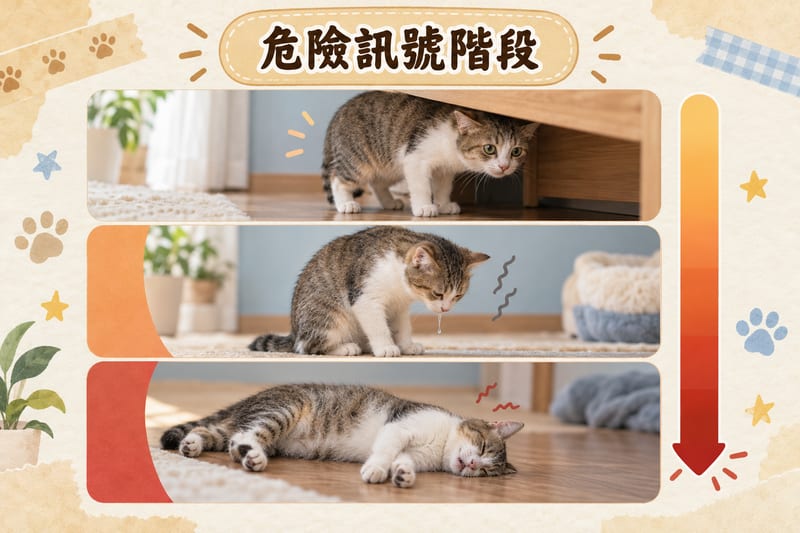
Hypoglycaemia has stages, but the time between stages can be very short. The table below is arranged by severity, with the last column giving practical action advice. The purpose of this table is to help you recognise the situation faster; it cannot replace a vet examination, and it should not be used to judge that "it can wait".
| Stage | Common signs | Recommended action |
|---|---|---|
| Early | Sudden low energy, slow responses, hiding away, noticeably reduced appetite, hind-leg weakness, slightly unsteady walking, dull eyes | Do not wait for the next appointment. If the cat is on insulin treatment, contact the vet immediately and prepare to go out; if you already have a glucose meter at home that the vet has taught you to use, take one reading and record it |
| Middle | Obvious weakness, unsteady standing and leaning against the wall or sitting down, head tilt, dilated pupils, drooling, muscle tremors, low body temperature, changed vocalisation | Treat as an emergency: call the clinic first to say you are on your way, then leave immediately; do not spend more time measuring blood sugar or searching online |
| Severe | Generalised seizures, stiff limbs, coma, cannot be roused, abnormal breathing or heartbeat, no response to sound or touch | A seconds-count emergency: keep the cat on its side with a clear airway, move hard objects away, keep it warm at room temperature, put nothing in the mouth, and transport it to the clinic immediately |
A few points need special emphasis. First, "drooling plus dilated pupils" is not necessarily fear; in a diabetic cat it can be a sign of hypoglycaemia, and it should not be explained away as "it's probably just nervous". Second, the brief dull period after a seizure is the time most easily misjudged as "recovered"; in fact blood sugar may still be low and must be assessed by the vet. Third, if the cat has a chronic disease (kidney disease, heart disease, pancreatitis) or is on other long-term medication, signs can be more confusing, and the threshold for judgement should be lower.
The six types of cats most at risk
Hypoglycaemia is not evenly distributed. The following six types of cats are at highest risk; if your cat fits one of them, you should write down emergency contacts and the clinic address in advance, rather than looking for them on the day of an episode.
| High-risk category | Why the risk is high | Numbers or practices to note |
|---|---|---|
| Diabetic cats on insulin treatment | Problems arise when dose, injection time and food intake do not match; not eating enough but injecting anyway is the most common | The peak effect of some intermediate-acting insulins is about 4 to 8 hours after injection; record food intake around each injection |
| Kittens under 6 months | Small glycogen reserves, low body weight, rapid fluid loss, very low fasting tolerance | 12 hours of complete fasting already needs to be addressed; kittens should not fast for more than 2 hours |
| Adult cats that keep not eating or are underweight | The body has insufficient glycogen reserves, so there is no buffer when blood sugar falls | Complete fasting for 48 to 72 hours is the danger line; seek veterinary care immediately |
| Cats with liver disease or liver shunts | The liver's ability to store glycogen and release glucose is impaired | Do not delay the blood-test review schedule; seek veterinary care the same day if energy drops |
| Cats with critical illness, sepsis, severe infection or low body temperature | Systemic metabolic imbalance; blood sugar can fall very quickly and electrolyte problems can accompany it | These cases are monitored by the vet and should not be "observed" at home |
| Cats that have ingested medication or human diabetes drugs | Some human diabetes drugs have a strong and long-lasting effect in cats, and signs can be delayed for hours or even days | Seek veterinary care immediately after ingestion and bring the packaging; do not wait for signs to appear |
Besides the six categories, two situations need attention: around prolonged fasting (for example, before anaesthesia for surgery or during long-distance relocation) and in kittens after vigorous activity. The former should be managed by the vet with pre-surgery fasting times and blood sugar monitoring; the latter is why kittens that play very hard still need rest and opportunities to eat. These are not within the scope of emergency management but are part of what can be prevented.
Five preparation steps on the way to the vet
Once hypoglycaemia is suspected, the only job at home is "safe transport", not any treatment. Just follow these five steps.
- Call first. State clearly "suspected hypoglycaemia", whether the cat has had a seizure and whether it can be roused, the time and dose of the last insulin injection, when the last meal was and how much was eaten, and whether the clinic can see you immediately. Night consultation hours in Hong Kong are limited, so confirm the emergency arrangement and travel time first.
- Keep the airway clear and the cat safe. Lay the cat on its side with the head and neck in a natural position so breathing is unobstructed; move hard objects away. Do not put anything in the cat's mouth, do not forcibly hold down the limbs, and avoid being bitten during a seizure.
- Keep warm. Cats with hypoglycaemia easily become hypothermic; wrap the body with a towel or thin blanket and keep the room temperature stable, but do not place a hot-water bottle directly against the skin to avoid burns.
- Bring four pieces of information. The insulin product name and concentration label, the syringe or pen, records of the last few injection times and doses, the most recent blood test report and medication list. During transport, do not place insulin directly above an ice pack or in a hot place.
- Transport safely. Use a hard-bottomed cat carrier rather than carrying the cat in your arms, and have another person accompany you to watch the cat's condition. If you already have a glucose meter at home that the vet has taught you to use, take one reading and record it, but if the cat is already having a seizure or cannot be roused, do not spend time measuring — leave directly.
Do a final check before leaving: have you brought the medication and medical records? Has the clinic confirmed it can see you? Is there a towel in the carrier? Once these three questions are answered, you can set off and leave everything else to the clinic.
At the clinic: what the vet will check and what the owner should note down
At the clinic, the vet will usually measure blood glucose immediately, then arrange a blood glucose curve or continuous glucose monitoring, blood tests (including liver and kidney function and electrolytes), urinalysis, and a review of the insulin type, dose and injection schedule as appropriate. If the cat has vomiting, diarrhoea or a sudden drop in appetite, the vet will also check whether gastrointestinal problems are causing insufficient eating and hence hypoglycaemia.
The information the owner can provide directly affects the speed of diagnosis: the exact time of the episode, how long it lasted, what activity and eating occurred in the hours before, the insulin injection record, whether there has been a change of food or new medication, and whether there was any chance of ingesting medication or human food. It is advisable to keep a notebook or phone memo recording these items in normal times so that you do not have to rely on memory on the day.
One point should be made clear: hypoglycaemia is preventable, but the prevention method must come from adjustments to the vet's treatment plan, not from the owner adding or reducing meals or doses on their own. If your cat is a diabetic cat, you can proactively ask three things at the review — how much should be eaten before injection, what to do if not enough is eaten, and which signs mean seeking veterinary care immediately. When these three answers are clear, the actual risk will be much lower.
As for preparing the home environment during recovery, the focus is on making observation easy, not on treatment. Keeping the litter box clean and easy to observe for urination and defecation helps you record excretion daily; low-dust cat litter and regular cleaning also help reduce respiratory and skin irritation. Below are related products available at the PetChill online store; they are home accessories, not medication, do not affect blood sugar, and cannot replace a vet visit. Please confirm with your vet that they suit your cat before use:
- Astkatta Cat Quick-Absorb Dust-Free Mixed Pearl Cat Litter 1kg (P00179-1) — HK$28
- Bella & Molly's Ultra-Fast Clumping Premium Clay Cat Litter Baby Powder Scent 10L — HK$35
- Bella & Molly's 2.0mm Tofu Cat Litter Natural Ultra-Clumping Green Tea Scent 6L - Official Import — HK$24
Prices and stock are subject to the live price shown on the online store.
Further reading
Daily care is the foundation of prevention; following a schedule for grooming, nail clipping, ear cleaning and weight monitoring helps you notice changes in your cat earlier: Complete Daily Care Guide for Cats and Dogs | Grooming, Bathing, Nail Clipping, Ear and Eye Cleaning Schedule (2026)
If you have a kitten at home, the hypoglycaemia risk is completely different from that of an adult cat; this article covers first-year supplies and the medical schedule: Kitten First-Year Preparation Checklist | Hong Kong New Cat Owners: Supplies, Medical Care and Schedule in One Article
Body language can help you spot discomfort earlier, including early signs of pain and weakness: Complete Guide to Cat Airplane Ears | Hong Kong Cat Owners' Traffic-Light Table + 5 Meanings at a Glance
Cleaning and care during recovery should be gentle so as not to add extra stress: Does My Cat Need a Bath? | Must-Read for Hong Kong Cat Owners: Busting Bathing Myths + Correct Cleaning Guide
In an emergency, contact your vet immediately; this article is for reference only and cannot replace a vet's diagnosis.
Information checked as of 2026-10-12 · Source: PetChill editorial team
 Fuji One full guide →


 Bella & Molly's full guide →


 K9 Natural full guide →