Quick answer: The percentages on the label are on an as-fed basis, including moisture. For a fair comparison, first convert to a dry matter basis: nutrient% ÷ (100 − moisture%) × 100. Food kcal ME/kg. Calculate carbs using the difference method: 100 − (crude protein + crude fat + crude fibre + moisture + ash). The book's example: 100 − (26 + 14 + 4 + 10 + 6) = 40% carbs.
The 5 numbers in expected analysis you need to know
Dog foods available in Hong Kong usually show the following items on the packaging (called "expected analysis"):
| Item | Label format | What to note |
|---|---|---|
| Crude protein | Minimum % | "Minimum" means at least that much; actual may be higher |
| Crude fat | Minimum % | Determines calorie density; can vary greatly between formulas of the same brand |
| Crude fibre | Maximum % | Too high affects digestibility; the book mentions fibre is generally limited to below 10% |
| Moisture | Maximum % | Dry food 6-10%, semi-moist 15-30%, canned about 75% |
| Ash | Maximum % | Indicator of total minerals |
| Calories | kcal ME/kg | The most important item; feeding amount depends on it |
Typical ranges from Table 12-1 of the book Nutrient Requirements of Dogs and Cats:
| Form | Moisture | Crude protein | Crude fat | Carbs | ME (kcal/kg) |
|---|---|---|---|---|---|
| Dry food | 6-10% | 16-30% | 7-20% | 41-70% | 2,800-4,050 |
| Semi-moist | 15-30% | 17-20% | 7-10% | 40-60% | 2,550-2,880 |
| Canned | about 75% | 7-13% | 5-8% | 4-13% | 875-1,250 |
Note: Canned food's "7-13% crude protein" looks low, but converted to dry matter basis it is 28-50%—a completely different conclusion. This is why conversion is essential.
Dry matter conversion (1-2-3)
Step 1: Calculate dry matter percentage DM% = 100 − moisture%. Dry food with 10% moisture → DM 90%; canned with 75% moisture → DM 25%.
Step 2: Convert a single nutrient Dry matter basis protein% = labelled protein% ÷ DM% × 100. Example: canned food labelled protein 10%, moisture 75% → 10 ÷ 25 × 100 = 40%.
Step 3: Compare on the same basis Both formulas must be converted to the same basis (usually dry matter) before comparison. Do not directly compare dry food's 26% with canned food's 10%.

Carb calculation method (difference method)
Carb% = 100 − (crude protein + crude fat + crude fibre + moisture + ash)
Book example: labelled crude protein 26%, crude fat 14%, crude fibre 4%, moisture 10%, ash 6% → 100 − (26 + 14 + 4 + 10 + 6) = 40% carbs
This method calculates "nitrogen-free extract" plus fibre; it is an approximation but sufficient for comparing brands.
The book's stance on choosing dog food (for reference):
- Good choice: starchy carbs < 20%
- Better: < 15%
- Best: < 10%
- The book also states that healthy dogs do not need to obtain most of their calories from carbs; except for medical reasons (e.g., pregnant bitches), follow veterinary advice.
Calorie density: the key to feeding amount
For the same 10kg dog, eating food at 2,800 kcal/kg requires 221g, while eating food at 4,050 kcal/kg requires only 153g. Therefore:
- When changing food, always recalculate the portion using the new food's kcal/kg (see Dog Feeding Amount Calculation)
- Canned food calorie density is about 1/3 of dry food; using "number of cans" instead of "grams" will severely underestimate the portion
- Weight loss formulas usually "reduce calorie density" rather than simply reducing quantity

Seeing through vague nutritional claims
The book warns to be wary of vague claims, such as "added kelp and omega-3, balanced diet for better health"—no specific doses, no AAFCO/FEDIAF complete and balanced statement—treat it as marketing language, not a nutritional guarantee.
Also note the concept of "rotational feeding" (rotating several meats, bones, organs on a schedule): the book points out that few people and companies can prove this meets multifaceted micronutrient needs. Rotating brands is good (the book supports rotating between different brands and proteins for nutritional diversity), but only if each formula itself is complete and balanced.
| Claim wording | What it means | How to handle |
|---|---|---|
| "Meets AAFCO nutritional levels for all life stages" | Complete and balanced | Can be fed as staple long-term |
| "Meets AAFCO nutritional level for a specific life stage (e.g., adult maintenance)" | Complete and balanced, limited to that stage | Puppies or seniors need the corresponding formula |
| "Complementary food/treat" | Not complete | Only as treat or ≤10% of calories |
| "Added XXX, balanced health" | Vague | Check for complete and balanced statement |
| Only ingredient list, no AAFCO/FEDIAF statement | Unclear | Recommend asking the manufacturer |
Example: comparing two formulas
Suppose two dog food formulas are labelled as follows:
| Item | Formula A (dry) | Formula B (canned) |
|---|---|---|
| Moisture | 10% | 78% |
| Crude protein (min) | 26% | 9% |
| Crude fat (min) | 14% | 5% |
| kcal ME/kg | 3,600 | 1,050 |
Convert to dry matter basis:
- Formula A: protein 26 ÷ 90 × 100 = 28.9%
- Formula B: protein 9 ÷ 22 × 100 = 40.9%
Looking at as-fed numbers, you might think A has much higher protein, but after conversion B is actually higher. This is why you need to convert to the same basis.
Calorie comparison: The same 10kg dog needs about 618 kcal per day → Formula A about 172g, Formula B about 589g. Canned food's "large volume" is normal and does not mean high calories.
Quick checklist
- Is kcal ME/kg present? If not → ask the manufacturer
- Is there a complete and balanced statement? If not → treat as complementary
- How much moisture? → determines conversion basis
- Are all five expected analysis items present? → only then can you calculate carbs
- What is the first ingredient? → for reference only; do not judge by order alone
Label wording mini-dictionary
| Term | Actual meaning | What to note |
|---|---|---|
| Natural | Claim of no synthetic additives | Not equal to complete and balanced |
| Grain-free | Contains no grains | Not equal to low carb; may contain legumes |
| Human-grade | Quality claim | No legal definition |
| By-product | Non-meat parts such as organs | Nutritionally usable, but look at overall formula |
| All life stages | Meets minimum standards for all stages | Puppies and kittens still need portion adjusted by weight |
| Limited ingredient | Usually means single protein source | Useful for food sensitivity elimination |
Units and conversion cheat sheet
| Common unit | Conversion |
|---|---|
| kcal/kg | ÷ 1,000 = kcal/g |
| kcal/cup | ≈ kcal/100-120g (depends on kibble density; recommend weighing to verify) |
| oz (ounce) | 1 oz ≈ 28.35g |
| lb (pound) | 1 lb ≈ 454g |
| kJ (kilojoule) | 1 kcal = 4.184 kJ |
If the packaging uses kJ, divide by 4.184 to get kcal for easier comparison with numbers elsewhere.
Tip: Different flavours of the same brand can have different kcal/kg (especially low-fat/high-protein lines), so recheck the numbers every time you change flavour; do not carry over the previous portion.
Common mistakes
| Mistake | Problem | Correction |
|---|---|---|
| Directly comparing dry and canned % | Moisture difference creates illusion | Convert to dry matter basis |
| Only looking at protein % and not calories | High protein but high fat and calories | Look at kcal ME/kg |
| Judging by ingredient list order | Fresh meat contains water and weighs more | Look together with expected analysis |
| Seeing "grain-free" and assuming low carb | Grain-free may use legumes or potatoes | Calculate using difference method yourself |
| Seeing "natural" and feeling reassured | Not equal to complete and balanced | Look for AAFCO/FEDIAF statement |
Related cluster articles
- After reading the label, calculate daily portion → Dog Feeding Amount Calculation
- Calorie formula for cats → Cat Calorie Calculator
- How to choose wet vs dry → Wet vs Dry Food
- Staple vs complementary → Complete vs Complementary
- Storage after opening → Pet Food Storage Guide
- Basic nutrition → Cat Nutrition Complete Guide
References
- National Research Council (NRC) Nutrient Requirements of Dogs and Cats (2006)
- AAFCO Dog and Cat Food Nutrient Profiles (as cited in the book)
- Forever Dog chapters on carbohydrate calculation and labelling
- Agriculture, Fisheries and Conservation Department (AFCD): AFCD
- Veterinary Surgeons Board of Hong Kong: VSBHK
Related products (available in Hong Kong, checked 2026-10-12)
- Nulo Freestyle Grain-Free Cat and Kitten Dry Food Chicken + Cod Recipe 12lb — reference price HK$600
- WELLNESS CORE Cat Food Grain-Free Kitten Growth Formula Trial Pack 250g — reference price HK$40
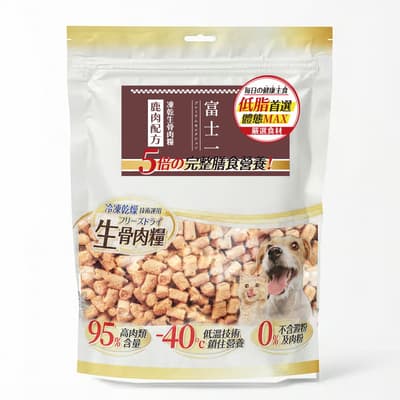
- Fujiichi Freeze-Dried Raw Dog and Cat Food Complete Raw Meat Venison Recipe 500g — reference price HK$158
The above is for reference only and cannot replace veterinary diagnosis and treatment. For nutritional needs and dietary adjustments for diseases, please consult your veterinarian.
How to calculate calories and feeding amount? (Formula + reference values)
All calorie/gram figures in this article can be recalculated using the following formulas:
- RER (Resting Energy Requirement) = 70 × body weight(kg)^0.75
- MER (Maintenance Energy Requirement) = RER × activity factor
- Activity factor reference: neutered adult cat 1.2 / intact adult cat 1.4 / indoor adult dog 1.6 / active dog 2.0 / weight loss 0.8 (must be supervised by a veterinarian)
- Example (4kg neutered indoor cat): RER = 70 × 4^0.75 ≈ 198 kcal → MER = 198 × 1.2 ≈ 238 kcal/day
- Dry food grams = daily kcal ÷ food calorie density (kcal/g; packaging usually states kcal/kg, remember to ÷ 1000)
⚠️ All the above are reference values: each pet's body condition, age, activity level and disease status differ; actual feeding amount should be based on veterinary assessment and product packaging recommendations.
📌 Key takeaways
- expected analysis % is on a moisture-included basis; convert to dry matter before comparing
- Dry matter conversion: nutrient% ÷ (100 − moisture%) × 100
- Carbs = 100 − (protein + fat + fibre + moisture + ash)
- Feeding amount depends on kcal ME/kg, not weight
- Treat vague nutritional claims as marketing language; only complete and balanced statements qualify as staple food

 K9 Natural full guide →
 Feline Natural full guide →
 Fuji One full guide →