Quick answer: An adult indoor cat needs roughly 50-60 kcal/kg per day. Using the basic formula from Nutrient Requirements of Dogs and Cats, RER = 70 × body weight (kg)^0.75, a 4kg cat's RER is 198 kcal, and multiplying by an activity factor (1.0-1.2 for indoor neutered cats) gives 198-238 kcal. In food terms: about 57-68g of dry food, or 198-238g of canned food. These are reference values; adjust the actual amount based on your veterinarian and the food bag's recommendation.
Step 1: Calculate RER (Resting Energy Requirement)
The book Nutrient Requirements of Dogs and Cats points out that an animal's energy requirement is not directly proportional to body weight, but is most closely related to metabolic body weight (body weight^0.75). The formula proposed by Kleiber, still widely used today, is:
RER (kcal/day) = 70 × body weight (kg)^0.75
For a few common weights:
| Cat weight | RER (kcal/day) |
|---|---|
| 2 kg | 118 |
| 3 kg | 160 |
| 4 kg | 198 |
| 5 kg | 234 |
| 6 kg | 268 |
Note: The book also points out that cats' metabolic body weight exponent (0.4-0.67) is lower than dogs', because domestic cats don't vary much in weight; using 0.75 directly slightly overestimates, but the difference is negligible. So this formula is a very practical starting point for domestic cats.
Step 2: Multiply by the activity factor (MER)
RER is the base amount you burn "just lying there"; the actual daily requirement (MER) needs a multiplier:
| Situation | Factor | 4kg cat (kcal/day) |
|---|---|---|
| Losing weight | 0.8 | 158 |
| Indoor neutered, low activity | 1.0 | 198 |
| Typical indoor adult cat | 1.2 | 238 |
| Active / plays all day | 1.4 | 277 |
| Kitten (growth period) | 2.0-2.5 | 396-495 |
A worked example: 4kg indoor neutered adult cat → RER 198 × 1.2 = 238 kcal/day.

Step 3: Cross-check against the book's measured reference values
After calculating with the formula, it's worth checking against the book's measured data:
- Maintenance metabolisable energy range for adult cats: 31-100 kcal/kg body weight (the book's Table 3-6 compiles several studies); most studies fall at 37-55 kcal/kg
- For a 4kg cat, that's about 148-220 kcal/day — broadly overlapping with the 198-238 kcal from the formula
- The book mentions the earliest experiment (1852): a 3kg cat needed 180 kcal ME per day to maintain weight
- Young adult male cats and all cats under 4kg tend to have higher energy requirements
- The effect of neutering on energy requirement is not settled: some studies suggest neutered cats use less energy per kg body weight, but when converted to "per kg of lean tissue" there is no difference — so monitor weight after neutering rather than guessing
- The thermic effect of food accounts for about 10% of metabolisable energy (possibly slightly higher in cats, because of their high protein proportion and small frequent meals)
Step 4: Convert to grams (dry food / canned food comparison)
The book's Table 12-1 shows that calorie density differs enormously between the two forms:
| Form | Moisture | Metabolisable energy (kcal/kg) |
|---|---|---|
| Dry food | 6-10% | 2,800-4,050 |
| Semi-moist food | 15-30% | 2,550-2,880 |
| Canned food | about 75% | 875-1,250 |
Conversion formula: daily grams = daily kcal ÷ kcal per gram
Assuming dry food at 3.5 kcal/g and canned food at 1.0 kcal/g:
| Cat weight | Daily kcal (indoor 1.2) | Dry food | Canned food (85g cans) |
|---|---|---|---|
| 2 kg | 141 | about 40g | about 1.7 cans |
| 3 kg | 191 | about 55g | about 2.2 cans |
| 4 kg | 238 | about 68g | about 2.8 cans |
| 5 kg | 281 | about 80g | about 3.3 cans |
| 6 kg | 322 | about 92g | about 3.8 cans |
Important: Always check the actual kcal/kg of the food you buy (the packaging usually states kcal ME/kg); different formulas can differ by 20-30%, so applying another brand's gram amounts directly will feed your cat wrongly.

Hong Kong reality: how many meals a day?
The book is very clear on feeding regimes for dogs and cats: dogs can do fine on one meal a day, but cats generally need several meals a day — the book states that most cats do not adapt to being fed only once a day. Practical approaches for Hong Kong working owners:
- One wet food meal in the morning and one in the evening (fixed times, making appetite easier to monitor)
- Leave a small amount of dry food out during the day, or use a slow feeder / puzzle toy to lengthen eating time
- Divide the daily total calculated above by kcal, rather than "eating until full at every meal"
- Weigh every two weeks; if weight rises, cut 5-10%, if it falls, add it back
The book also warns: free feeding (leaving food out all day) causes 30-40% of dogs and cats to overeat, eventually leading to overweight and even obesity.
Hong Kong examples: how to calculate three common situations
Situation A: 4kg indoor neutered adult cat, dry food only RER 198 × 1.0 (low activity) = 198 kcal/day → at 3.5 kcal/g dry food = about 57g/day, split into two meals (about 28g each), with 5-8g in a puzzle toy during the day to increase activity.
Situation B: 5kg overweight cat, needs to lose weight RER 234 × 0.8 = 187 kcal/day. The approach is to switch first to a lower-calorie-density complete wet food (about 1 kcal/g), i.e. about 187g of canned food, split into 3-4 meals; weigh every two weeks, aiming to lose 1% of body weight per week.
Situation C: 3-month-old kitten, growth period Kittens use a growth factor of 2.0-2.5, and their weight changes every week. For a 1.5kg kitten: RER = 70 × 1.5^0.75 ≈ 95 kcal; × 2.0 = 190 kcal/day, fed in 3-4 meals of kitten-specific food. Weigh and recalculate every two weeks; don't fix the portion all the way to adulthood.
Monitoring table: do this every two weeks
| Item | How to do it | What it tells you |
|---|---|---|
| Weight | Same time, same scale | Rising/falling trend |
| Body condition score | Feel the ribs, look at the waistline | 3 is ideal (5-point scale) |
| Water intake | Measure daily water added with a measuring cup | A sudden big increase may relate to kidney/diabetes issues |
| Faeces | Observe daily | How the cat is adapting after a change in food amount |
| Energy and appetite | Note abnormal days | Early signs of illness |
The limits of the formula (what the book itself says)
The book is very honest about "using formulas to predict an individual animal's requirement": current predictions of an individual dog or cat's energy requirement are based on a certain amount of scientific evidence, but the result may well deviate from the true value by 50%. Reasons for the deviation include:
- Fat proportion: fat tissue has low metabolic activity, so for fat animals, calculating by body weight overestimates the requirement
- Neutering status: after neutering the proportion of lean tissue may fall, indirectly affecting energy metabolism
- Age: young adult cats and cats under 4kg tend to have higher requirements
- Activity level and environment: indoor living, temperature and playtime all have an effect
- Breed differences: different breeds can have very different requirements even at the same weight
Practical conclusion: The formula is a starting point, not the standard answer. The real calibration method is "weighing + body condition scoring + small adjustments every two weeks".
How to check the calorie density of common Hong Kong foods
- Check whether the packaging states "kcal ME/kg" or "metabolisable energy" (some brands state kcal/can or kcal/cup)
- If it only states kcal per cup: 1 cup ≈ 8 oz ≈ about 100-120g (depending on kibble size); weighing is most accurate
- Canned food is usually stated on the side of the can, mostly in kcal/kg
- Record the kcal/kg of the 2-3 foods you use most often, so you can calculate straight away when you switch foods
Common mistakes
| Mistake | Problem | Correct approach |
|---|---|---|
| Using "cups" instead of "grams" | Different foods vary hugely in density | Use a digital scale, measure in grams |
| Ignoring canned food's calorie density | Assuming canned food is always lower in calories | Canned food is 1 kcal/g; large amounts need calculating |
| Adding treats by feel | Treats can make up 20-30% of total calories | Count treats in the daily total (recommended ≤10%) |
| Cutting food drastically to lose weight | Too-rapid weight loss in cats risks hepatic lipidosis | Lose at most 1% of body weight per week, and ask your veterinarian first |
| Looking only at weight, not body condition | Muscle mass isn't reflected on the scale | Also do a body condition score (feel the ribs) |
Related guides
- Want to know the total kcal per day, then split it between wet and dry food → see Complete Cat Nutrition Guide
- Want to know how to choose canned food and water-adding tips → Cat Wet Food Guide
- Want to compare the cost and health effects of wet vs dry food → Wet vs Dry Food
- How to calculate calories for weight loss → Cat Weight Loss Diet
- How to transition foods → Cat Food Transition Guide
- Breed differences → Breed-Specific Nutrition
- Proportions for home-prepared fresh food → Fresh Food Nutrition
References
- National Research Council (NRC), Nutrient Requirements of Dogs and Cats (2006), energy chapter
- Agriculture, Fisheries and Conservation Department (AFCD) pet care information: AFCD
- Veterinary Surgeons Board of Hong Kong: VSBHK
- FEDIAF (European Pet Food Industry Federation) energy requirement standards cited in the book
Related products (available in Hong Kong, checked 2026-10-12)
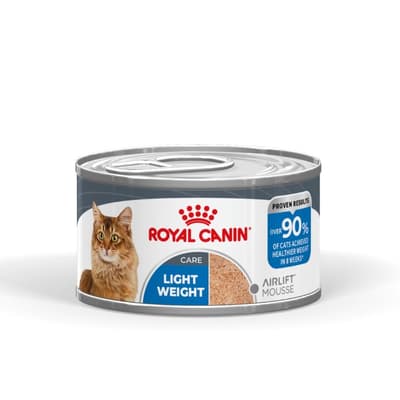
- Royal Canin AIRLIFT Adult Cat Weight Control Complete Wet Food 85g — reference price HK$25.2/can
- Farmina N&D Quinoa Functional Cat Complete Wet Food Skin Care Formula Quail & Coconut 80g — reference price HK$23.4/can
- Smart Pet Circulating Water Fountain 1000ml (random style) — reference price HK$168
The above is for reference only and cannot replace veterinary diagnosis and treatment. Calorie requirements vary enormously between individuals; please consult your veterinarian and treat the recommendation on the food packaging as the final basis.
📌 Key points
-
Dry food 6-10% (book data)
-
RER = 70 × body weight (kg)^0.75; 4kg cat = 198 kcal
-
Multiply by activity factor (weight loss 0.8 / indoor 1.0-1.2 / active 1.4 / kitten 2.0-2.5)
-
Book measurements: adult cat maintenance 31-100 kcal/kg body weight, mostly 37-55
-
Canned food calorie density is about 1/3 of dry food (875-1,250 vs 2,800-4,050 kcal/kg)
-
Measure in grams, check the packaging's kcal ME/kg, weigh and fine-tune every two weeks

 Royal Canin full guide →
 Fuji One full guide →