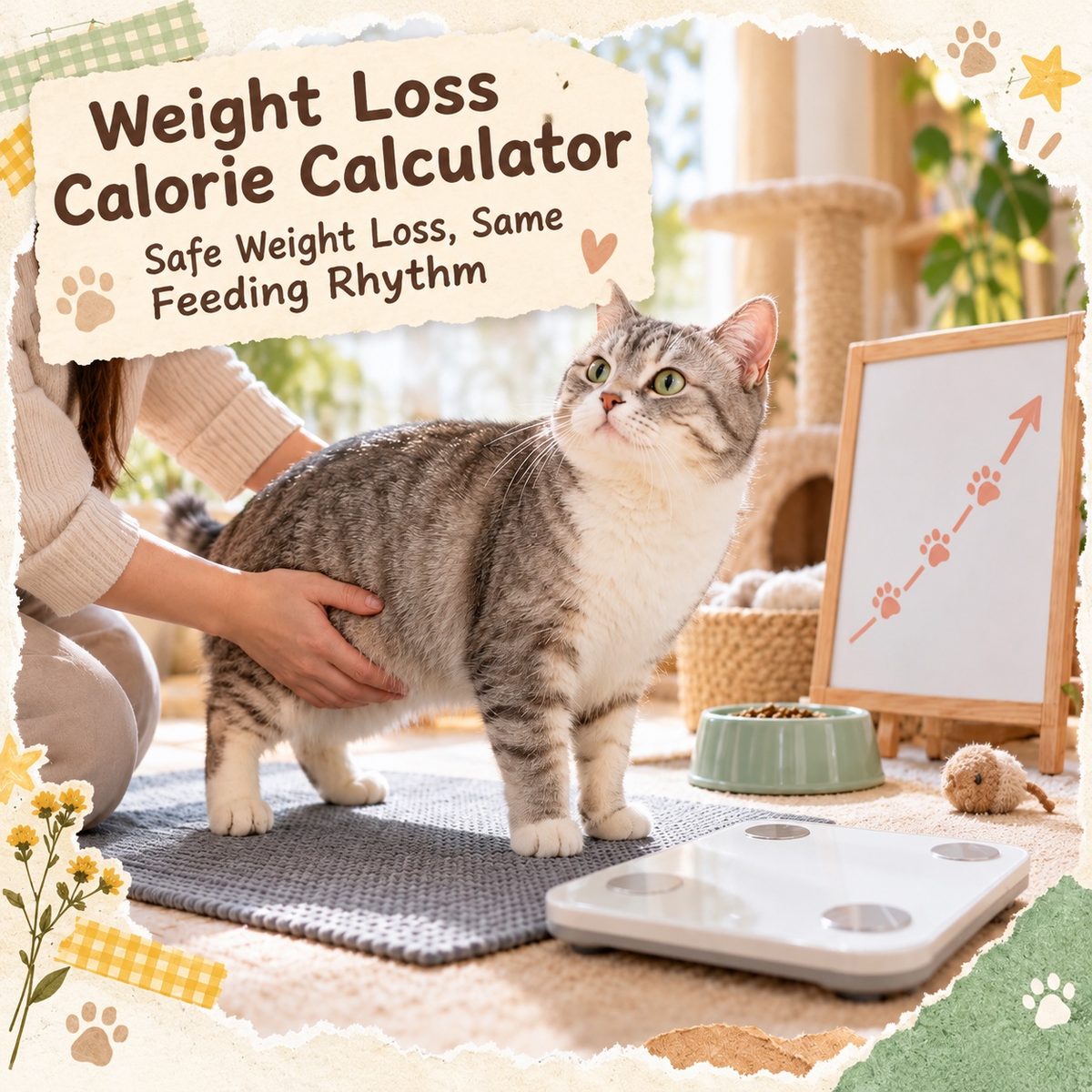
Quick answer: Start cat weight loss with RER × 0.8—a 5kg cat has an RER of 234 kcal, × 0.8 = about 187 kcal/day; the goal is 1% body weight loss per week (about 50g). The book recommends fitting the day's calories into a 10-hour feeding window (later shortened to 8 hours), weighing weekly, and no food for at least two hours before bed. Cats must never fast: rapid weight loss carries a risk of hepatic lipidosis and must be monitored by a veterinarian.
Step 1: First confirm overweight (body condition score, not just the scale)
The book uses a 5-point body condition score: 1 very thin, 2 thin, 3 average, 4 overweight, 5 obese. How to do it:
- Feel the ribs: lightly press the side of the chest—can feel but not prominent = 3; have to press hard to feel = 4-5
- Look at the waistline: from directly above, there should be a slight tuck behind the ribs
- Feel the belly: when standing, the abdomen should be flat; a noticeable sagging pouch = overweight
- Consider breed: large breeds like Maine Coons and Norwegian Forest Cats have bigger frames; judge by breed standards (see Breed-specific nutrition)
Step 2: Calculate weight-loss calories
RER (kcal/day) = 70 × body weight (kg)^0.75 Weight-loss calories = RER × 0.8
| Cat weight | RER | Weight-loss calories (×0.8) | Weekly goal (1%) |
|---|---|---|---|
| 4 kg | 198 | 158 | about 40g |
| 5 kg | 234 | 187 | about 50g |
| 6 kg | 268 | 214 | about 60g |
| 7 kg | 301 | 241 | about 70g |
Important: This is a starting point, not the end point. If there is no change after two weeks, adjust by 5-10%; if weight drops too fast (more than 1.5% in a week), increase it back. For background on the formula, see Cat calorie calculator.

Step 3: Arrange feeding window and number of meals
The book gives specific recommendations for feeding during weight loss:
| Practice | Book recommendation |
|---|---|
| Start | For the first two weeks, put all calories within 10 hours |
| Later | Shorten to 8 hours |
| Number of meals | Split into 2-3 meals (increase frequency, reduce portion per meal) |
| After reaching goal | Maintain 8-hour feeding window, 1-2 meals |
| Before bed | No food for at least two hours |
| Weighing | Weigh weekly to confirm normal progress |
Example (5kg cat, 187 kcal/day, 8-hour window):
- 09:00 First meal: canned food 60g (about 60 kcal)
- 13:00 Second meal: canned food 60g (about 60 kcal)
- 16:30 Third meal: canned food 50g + small amount of dry food 5g (about 67 kcal)
- After 17:00 provide only fresh water
Step 4: Choose food (calorie density is key)
- Canned/wet food: about 1 kcal/g; larger volume for the same calories, easier to satisfy appetite (see Cat wet food guide)
- Weight-loss formula: usually lowers calorie density and raises protein ratio at the same time
- Adequate protein: if protein is insufficient during weight loss, what is lost will be muscle
- Fibre: moderate fibre increases satiety, but the book mentions dietary fibre is generally limited to below 10%
- Don't rely on "grain-free" or "natural" labels: look at kcal/kg and a complete and balanced statement (see Complete vs complementary wet food)

Safety red lines (cats are different from dogs)
| Item | Cat | What not to do |
|---|---|---|
| Weight-loss speed | 1% per week (slower is safer) | Rapid drop, fasting |
| Minimum calories | Set by veterinarian; do not go below RER on your own | Long-term below RER |
| Monitoring | Weekly weighing + energy and appetite | Only looking at the scale |
| Warning signs | Not eating, vomiting, jaundice, lethargy | Just observing |
Hepatic lipidosis warning signs: A cat not eating for 24-48 hours, yellow gums or whites of the eyes, extreme lethargy, vomiting—seek veterinary care immediately, do not wait.
Environmental management (especially important in multi-cat households)
- Separate feeding: different rooms or staggered times to prevent food stealing
- Remove free feeding: leaving food out is the biggest obstacle to weight loss
- Use slow feeders/puzzle toys: lengthen eating time and increase activity
- Increase interactive play: 2-3 times daily, 5-10 minutes each, with a wand toy
- Treat replacement: use a small amount of complete food as treats, or replace with play
- Whole-family consensus: no one secretly feeding—stick a record sheet on the fridge door
Monitoring chart (fill in once a week)
| Date | Weight | Weekly change | Body condition score | Appetite | Notes |
|---|---|---|---|---|---|
| Week 1 | 5.00 kg | — | 4 | Normal | Started 187 kcal |
| Week 2 | 4.95 kg | −50g | 4 | Normal | On target |
| Week 3 | 4.92 kg | −30g | 4 | Normal | Slightly slow, adjust −5% |
Three-week gradual meal plan example (5kg cat)
| Week | Daily kcal | Meals | Feeding window | Notes |
|---|---|---|---|---|
| Week 1 | 234 (maintenance) | 3 | 10 hours | Switch to complete wet food first, observe digestion |
| Week 2 | 210 | 3 | 10 hours | Reduce about 10%, start weighing |
| Week 3 | 187 | 3 | 8 hours | Enter target weight-loss calories |
Food allocation (Week 3 example):
- 09:00: canned food 60g
- 13:00: canned food 60g
- 16:30: canned food 50g + dry food 5g
- After that, water only
After reaching goal: increase calories to the maintenance level for the new weight (e.g., from 5kg down to 4.5kg, maintenance about 198 × 1.0 = 198 kcal), maintain the 8-hour feeding window, and continue weekly weighing for 4 weeks.
Psychological and behavioural aspects
- Crying from hunger: use interactive play, grooming, window observation spots to distract
- Waking you at dawn: do not feed immediately; fixed times help build expectations
- Stealing food: put away other pets' food, human food and the bin
- Multi-cat households: feed in separate rooms, or use microchip feeders (if available)
Four most frequently asked questions
"It cries so pitifully, I can't bear it" Crying is behaviour, not a hunger signal. Fixed times, fixed portions, more play—new expectations form in about two weeks. Adding food midway only teaches it that "crying gets food".
"Weight-loss food is expensive, can I just reduce the amount myself?" Yes—provided the original food is itself a complete and balanced complete food, and the portion is calculated by calories. But if you only reduce the amount and protein is insufficient, what is lost will be muscle, so it is best to combine with veterinary advice.
"Can I replace dietary control with exercise?" No, it cannot replace it. Indoor cats have limited exercise; the calorie deficit mainly comes from dietary control; exercise is supplementary and helps maintain muscle.
"When can I stop?" After reaching ideal body condition (score 3) and target weight, switch to maintenance calories and continue weekly weighing for 4 weeks; if weight rebounds by more than 5%, review portions.
Feeding tool recommendations
| Tool | Purpose |
|---|---|
| Digital scale (1g) | Accurate daily portions |
| Slow feeder | Lengthen eating time, increase satiety |
| Puzzle toy | Increase activity, reduce bored crying |
| Wand toy | Interactive play 2-3 times daily |
| Record sheet/phone reminder | Track weight and stools |
"Can I free-feed weight-loss food?" No. Any food must be portioned by kcal; lower calorie density in weight-loss food only makes control easier, it does not mean unlimited supply.
Common mistakes
| Mistake | Consequence | Correction |
|---|---|---|
| Cutting food by half at once | Nutritional deficiency, muscle loss | Adjust by 5-10% every two weeks |
| Not feeding at all | Risk of hepatic lipidosis | Keep above RER, split into more meals |
| Feeding only dry food without measuring | Calories hard to control | Use a scale, or switch to canned food |
| Using treats to soothe | Calories exceed target | Treats ≤10%, replace with play |
| Not weighing | Cannot see the trend | Weigh at the same time weekly |
Coordination with the cluster
- Complete assessment of overweight and ideal weight chart → Cat weight management
- Detailed calorie formula → Cat calorie calculator
- Canned food selection and adding water → Cat wet food guide
- Wet vs dry food comparison → Wet vs dry food
- Transition method → Cat food transition guide
- Complete vs complementary → Complete and balanced vs incomplete
References
- "Forever Dog" body condition score, feeding time and weight loss chapters
- National Research Council (NRC) "Nutrient Requirements of Dogs and Cats" (2006)
- Agriculture, Fisheries and Conservation Department (AFCD): Agriculture, Fisheries and Conservation Department (AFCD)
- Veterinary Surgeons Board of Hong Kong: Veterinary Surgeons Board of Hong Kong (VSBHK)
Related products (available in Hong Kong, checked 2026-10-12)
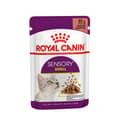
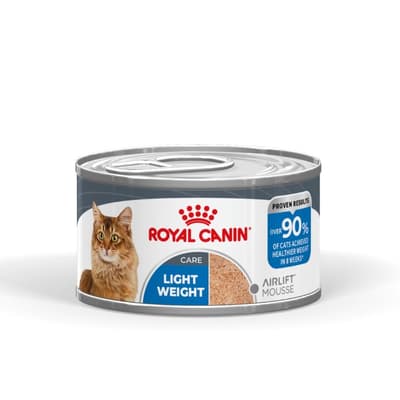
- Royal Canin AIRLIFT Adult Cat Weight Control Complete Wet Food 85g — reference price HK$25.2/can
- Signature7 Cat Can Nutritional Pate Health Digestion + Weight Control Chicken + Barley 80g — reference price HK$13/can
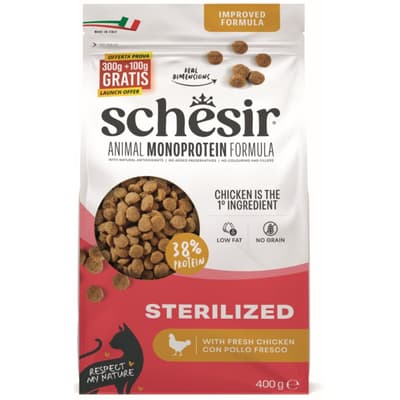
- Schesir Cat Food Neutered Weight Control Formula Chicken 400g — reference price HK$58
The above content is for reference only and cannot replace veterinary diagnosis and treatment. Cat weight loss involves risks such as hepatic lipidosis; please consult your veterinarian first and attend regular follow-ups.
How to calculate calories and feeding amounts? (Formula + reference values)
All calories/grams in this article can be recalculated using the following formulas:
- RER (Resting Energy Requirement) = 70 × body weight (kg)^0.75
- MER (Maintenance Energy Requirement) = RER × activity factor
- Activity factor reference: neutered adult cat 1.2 / intact adult cat 1.4 / indoor adult dog 1.6 / active dog 2.0 / weight loss 0.8 (must be supervised by a veterinarian)
- Example (4kg neutered indoor cat): RER = 70 × 4^0.75 ≈ 198 kcal → MER = 198 × 1.2 ≈ 238 kcal/day
- Dry food grams = daily kcal ÷ food calorie density (kcal/g; packaging mostly states kcal/kg, remember to ÷ 1000)
⚠️ All of the above are reference values: every pet's body condition, age, activity level and disease status differ; actual feeding amounts should be based on veterinary assessment and product packaging recommendations.
📌 Key summary
- Weight-loss calories = RER × 0.8; a 5kg cat about 187 kcal/day
- Goal: 1% body weight loss per week; weigh weekly
- Feeding window narrows from 10 hours to 8 hours; no food 2 hours before bed
- Cats must never fast; hepatic lipidosis warning signs require immediate veterinary care
- Canned food has lower calorie density, protein must be adequate, treats ≤10%

 Royal Canin full guide →