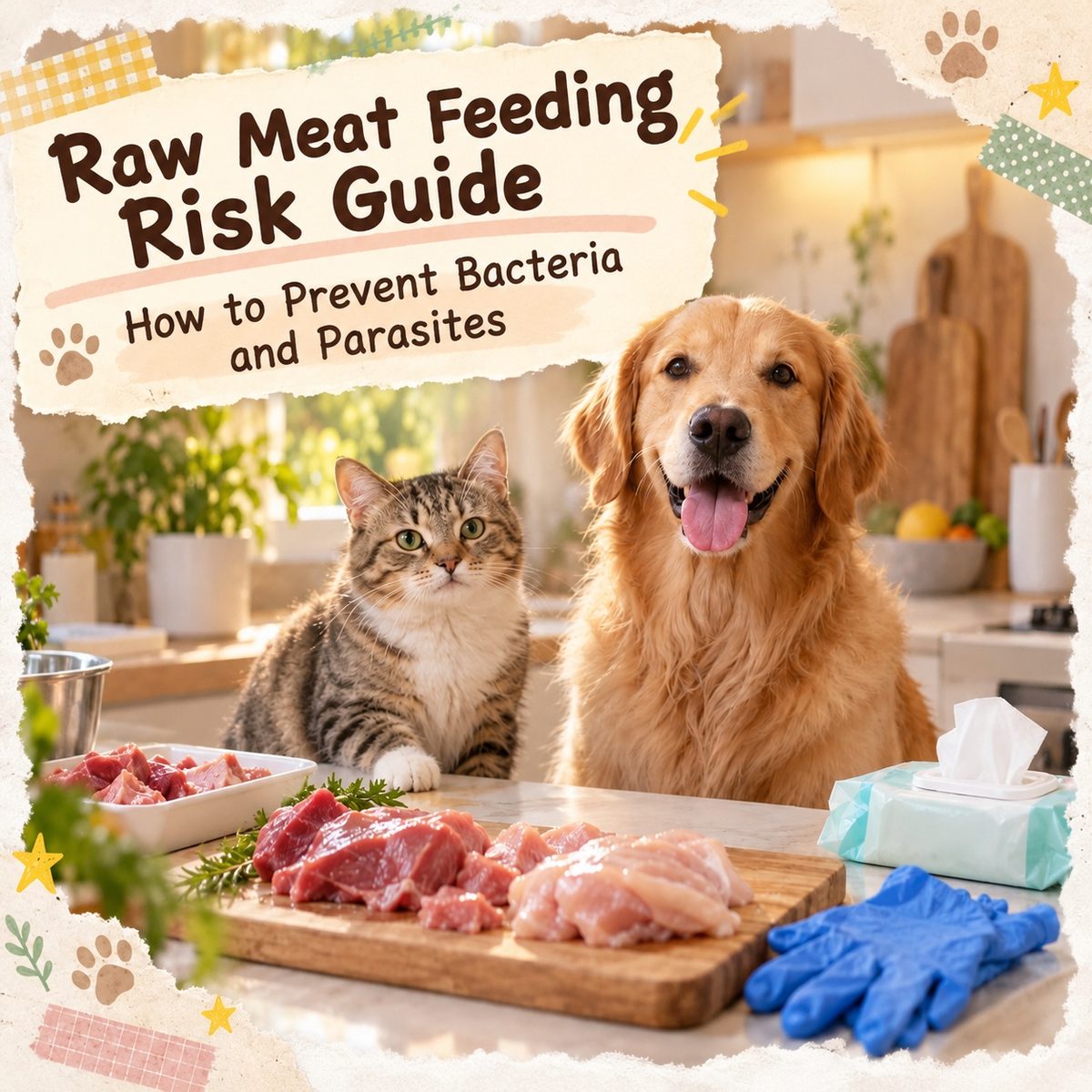
Quick answer: Raw feeding / raw meaty bones (BARF, RMBDs) carry three major risks: pathogenic bacteria (Salmonella, Listeria), physical injury from bones, and nutritional imbalance. The book also clearly states that feeding dogs in a 'wolf-like' way is not recommended. If you are still considering raw feeding, the minimum requirements are: a reliable source, strict freezing, a separate handling area and utensils, a family risk assessment, and a balanced recipe from a veterinary nutritionist. If you do not feed raw, reducing ultra-processed foods already brings significant benefits.
Risk 1: Pathogenic bacteria and public health
The issue raised in the book is not just about the animal: 'We would not feed our dogs anything that could make them sick'—but at the same time, raw meat can also expose family members (especially children, pregnant women, and immunocompromised members) to pathogenic bacteria.
FDA 2012-2019 pet food recall statistics (cited in the book):
| Category | Pounds recalled |
|---|---|
| Treats | 153,068,940 |
| Kibble (dry food) | 151,082,905 |
| Canned | 94,265,262 |
| Raw food | 1,986,035 |
| Other | 218,374 |
The book states that the top four reasons for recall are: bacterial contamination (Salmonella), toxic levels of synthetic vitamins, unapproved antibiotics, and pentobarbital contamination. The book also reminds of an important limitation: the FDA does not require manufacturers to test for other foodborne toxins, so 'not recalled' does not equal 'no risk'.
Risk 2: Physical injury from bones
- Cooked bones splinter more easily, and fragments can pierce the mouth, oesophagus, or intestines
- Large bones can cause oesophageal or intestinal blockage
- Small bones can get stuck between teeth or in the throat
- Raw bones are relatively more flexible, but that does not mean no risk: swallowing a large piece of bone can still cause blockage
If any of the following occur, seek medical attention immediately: vomiting, retching, drooling, difficulty breathing, abdominal pain, difficulty defecating, or bloody stool.

Risk 3: Nutritional imbalance
The book explains: NRC sets minimum nutritional requirements—that is, the basic amounts of vitamins and minerals needed to avoid nutritional deficiencies; AAFCO and FEDIAF build their standards on this basis.
The problem is: a random combination of meat, bone, and organs will not automatically meet these standards. Taurine, calcium-phosphorus ratio, vitamin D, zinc, iodine, and similar items are most likely to go wrong. Long-term imbalance can cause metabolic and physiological stress, and symptoms often appear only later.
The book's comment on 'rotating on time' (alternating several meats, bones, and organs) is quite direct: very few people and companies can prove that this can meet multifaceted micronutrient needs.
If you want to use a raw food recipe: Have a veterinary nutritionist calculate and review each item according to your animal's weight, age, and health status, and recheck regularly.
The book's balanced stance (not a blanket rejection)
It is worth noting that the book does not oppose raw feeding across the board, but rather:
- The term 'raw food' gives people a stereotype of dirty, rotting food, but the minimally processed fresh food category also includes pasteurised raw food
- If you do not plan to feed raw, 'you can make or buy lightly cooked fresh food'
- As long as you reduce the intake of ultra-processed foods, there will be significant benefits for dog health
- 'Wolf-style' feeding is not recommended—dogs and wolves are different
So the focus is not necessarily 'raw or cooked', but degree of processing, ingredient quality, and recipe completeness.

If you decide to feed raw: 5 steps to reduce risk
- Source: Choose a reputable supplier with a complete cold chain and clear labelling; avoid loose, unlabelled meat from wet markets
- Freezing: The book mentions that the minimally processed category includes sterilised (e.g., pasteurised) raw food; parasite risk requires sufficiently low temperature and time
- Separate handling area: Dedicated chopping board, knife, and gloves; clean immediately after handling with hot water and disinfectant
- Personal hygiene: Wash hands before and after handling; do not handle family food in the same area; wash bowls after every meal
- Family risk assessment: If there are children, pregnant women, or immunocompromised members, reconsider and consult a veterinarian
Monitoring indicators (regardless of what you feed)
| Indicator | Ideal state | What to do if abnormal |
|---|---|---|
| Stool | Formed, stable colour | If soft, slow down the transition speed |
| Weight | Weigh every two weeks, stable trend | Adjust portion if increasing or decreasing |
| Energy and appetite | Stable | If persistently worsening, seek medical attention immediately |
| Coat and skin | Glossy, no itching | May be related to fatty acid ratio |
Freezing and thawing safety
| Step | Method | Reason |
|---|---|---|
| Portioning | Seal each meal separately, label date | Avoid repeated thawing |
| Freezing | Home freezer below -18°C | Inhibits most microbial activity |
| Thawing | Thaw in refrigerator at low temperature (0-4°C) | Safest, avoids rapid warming at room temperature |
| After thawing | Consume within 24 hours, do not refreeze | Reduces bacterial growth opportunities |
| Cleaning | Utensils immediately with hot water + detergent | Prevents cross-contamination |
The book reminds that the key to risk control for fresh/minimally processed food is low temperature, hygiene, and source all done together; missing one will increase risk.
Common myths
| Myth | Fact |
|---|---|
| 'Dog stomach acid can kill all bacteria' | Salmonella and others can still pass through and be shed in faeces, contaminating the home environment |
| 'Raw bones are definitely safe, cooked bones are dangerous' | Cooked bones splinter more easily, but raw bones can also cause blockage or injury |
| 'Adding garlic/apple cider vinegar can kill bacteria' | No reliable evidence supports this, and some are harmful to pets |
| 'Freeze-dried equals sterile' | Freeze-dried is not heat-sterilised, so pathogen risk remains |
Common mistakes
| Mistake | Problem | Correction |
|---|---|---|
| Assuming raw food is necessarily more natural and safer | Ignoring pathogens and family risk | Weigh the risks before deciding |
| Feeding only meat without supplementing micronutrients | Calcium-phosphorus ratio, taurine imbalance | Have a veterinary nutritionist balance it |
| Giving cooked bones as treats | High risk of splintering | Avoid cooked bones |
| Using the same chopping board for raw and cooked food | Cross-contamination | Separate utensils and areas |
| Following online recipes blindly | Large differences in nutrient density | Professional review |
Coordination with the cluster
- How to distinguish main food/complementary food → Complete and balanced vs incomplete
- How to calculate calories → Cat calorie calculator / Dog feeding amount guide
- Food storage and thawing → Pet food storage guide
- How to read labels → Dog food label guide
- Existing raw vs cooked comparison article → Raw vs cooked
- Fresh food proportions → Fresh food nutrition
References
- National Research Council (NRC) 'Nutrient Requirements of Dogs and Cats' (2006)
- US FDA pet food recall data (2012-2019, cited in the book)
- Agriculture, Fisheries and Conservation Department (AFCD): AFCD
- Veterinary Surgeons Board of Hong Kong: VSBHK
Related products (available in Hong Kong, checked 2026-10-12)
- Fujiichi Freeze-Dried Raw Meaty Bone Complete Food for Cats and Dogs, Ostrich Recipe, 500g — reference price HK$158
- Northwest Naturals Grain-Free Freeze-Dried Dehydrated Dog Food, Whitefish + Salmon, 340g — reference price HK$228
- VITAL ESSENTIALS Freeze-Dried Dog Treats, Chicken Breast Pieces, 2.1oz — reference price HK$79.2
The above content is for reference only and cannot replace veterinary diagnosis and treatment. Raw feeding involves zoonotic disease risks; please consult your veterinarian before deciding.
How to calculate calories and feeding amount? (Formula + reference values)
All calories/grams in this article can be recalculated using the following formulas:
- RER (Resting Energy Requirement) = 70 × body weight (kg)^0.75
- MER (Maintenance Energy Requirement) = RER × activity factor
- Activity factor reference: neutered adult cat 1.2 / intact adult cat 1.4 / indoor adult dog 1.6 / active dog 2.0 / weight loss 0.8 (must be under veterinary supervision)
- Example (4kg neutered indoor cat): RER = 70 × 4^0.75 ≈ 198 kcal → MER = 198 × 1.2 ≈ 238 kcal/day
- Dry food grams = daily kcal ÷ food calorie density (kcal/g; packaging mostly states kcal/kg, remember to ÷ 1000)
⚠️ All of the above are reference values: each pet's body condition, age, activity level, and disease status are different; actual feeding amount should be based on veterinary assessment and product packaging recommendations.
📌 Key summary
- Three major risks: pathogenic bacteria, physical injury from bones, nutritional imbalance
- Book: 'Wolf-style' feeding is not recommended; reducing ultra-processed foods already brings benefits
- FDA 2012-2019 raw food recalls about 1.986 million pounds; top four reasons include Salmonella
- If feeding raw: reliable source + freezing + separate utensils + family risk assessment + professional recipe
- Monitor stool, weight, energy; seek medical attention if abnormal

 K9 Natural full guide →
 Feline Natural full guide →
 Fuji One full guide →