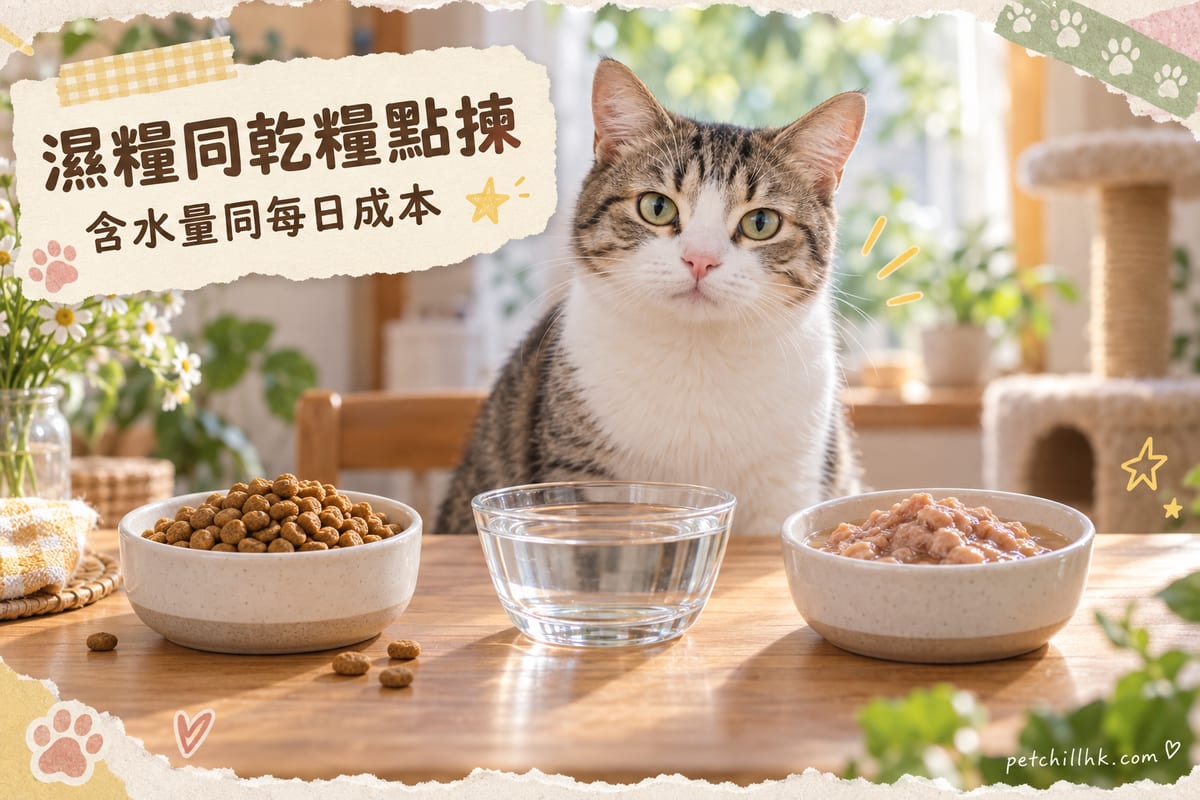
Quick answer: Canned food is about 75% moisture, dry food only 6-10%; in terms of calorie density, dry food is 2,800-4,050 kcal/kg, canned food 875-1,250 kcal/kg (about 3 times difference). For cats with a history of urinary issues or low water intake, increasing the proportion of wet food is generally recommended — the book states that dry cat food is a risk factor for feline lower urinary tract disease, and when food moisture increases from 10% to 75%, average daily urine volume in cats increases from 63 mL to 112 mL.
Cat canned food (complete wet food) has a moisture content of about 78-89%, while dry food has only about 8-12%. For the same daily calories, all-wet food can provide over 150 ml of water, while all-dry food provides only a few millilitres. To improve water intake, the most effective step is to increase the proportion of wet food; to control expenses, compare 'cost per 100 kcal' rather than price per pack.
3 Key Points
- The moisture gap is structural: It's not simply that 'wet food is better'; it's that for the same calories, dry food provides almost no water.
- Compare price per 100 kcal: Wet food costs 1.5-3 times more per kilogram than dry food, but water makes up 80% of the weight, so direct per-kilogram comparison is misleading.
- All-wet is not mandatory: One meal of complete wet food per day can already significantly increase total water intake, and is the most feasible middle option in Hong Kong.
How big is the moisture difference? Compare using packaging labels
All figures below are taken from the packaging labels (expected analysis) on PetChill product pages, not estimates:
| Product | Type | Labeled moisture | Labeled protein | Hong Kong real price |
|---|---|---|---|---|
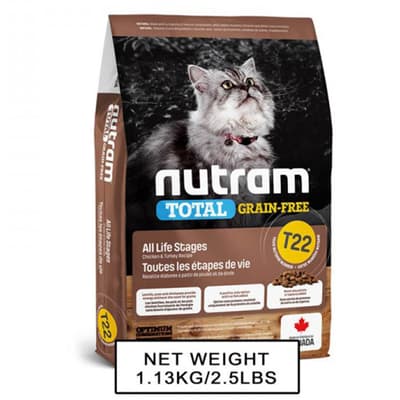
| nutram T22 Grain-Free Potato-Free All-Life-Stages Cat Food Chicken & Turkey 5.4kg | Dry food | Labeled moisture 10% | 36% | $568 |
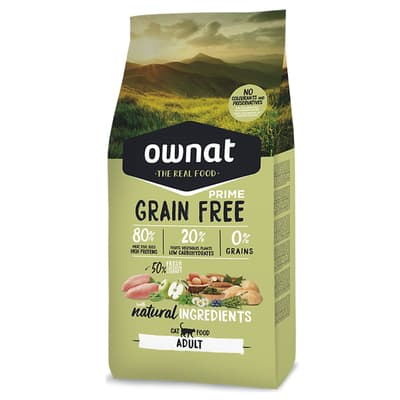
| ownat Free-Range Chicken & Turkey Easy Digestion 400g | Dry food | 8% | 40% | $70 |
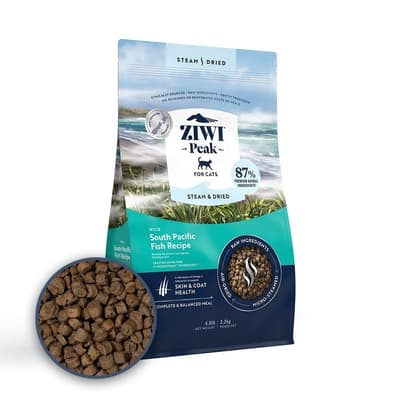
| ZiwiPeak Steam-Dried 2.2kg | Air-dried | 12% | 40% | $652 |
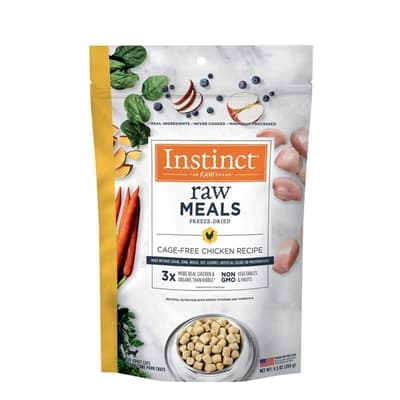
| Instinct Freeze-Dried Raw Adult Cat Food Free-Range Chicken 9.5oz | Freeze-dried | 6% | 38% | $248 |
| now FRESH Grain-Free Senior Cat Pâté 70g | Wet food | 78% | 8% | $20 |
| Harlow Blend Maple Leaf Complete Wet Food 80g | Complete wet food | 81% | 15% | $12 |
| WeRuVa Complete Wet Food Kitten Chicken Soup Chicken Pumpkin Tuna 3oz | Complete wet food | 83% | 11.5% | $12.6 |
| AIME Senior Cat Can 75g | Complete wet food | 85% | 10% | $14 |
| AIXIA 15+ Senior Cat Can 40g | Wet food | 88% | 5.6% | $6.2 |
Why is the protein label on wet food so much lower? Because the label is on a 'wet basis' (as fed) — for the same amount of protein, with 80% more water, the percentage is naturally diluted. To compare, convert to dry matter basis: AIME Senior Cat Can labeled protein 10%, moisture 85%, dry matter basis protein ≈ 10 ÷ (100−85) × 100 = about 67%, higher than most dry foods. So 'canned food protein is only 10%' is a typical misreading.
Note (updated 2026-10-15): The table above was re-checked on 2026-10-15: discontinued models have been replaced with current versions of the same series, and prices updated accordingly; all linked products in the table are currently available. Labeled values are from packaging expected analysis; prices and stock are subject to the online store's real-time display.
Daily water intake: dry-fed cats must drink on their own, wet-fed cats don't need to
The National Research Council (NRC 2006) recommends a total daily water intake for cats of about 50-60 ml/kg body weight, i.e., about 200-240 ml for a 4kg cat. This figure includes water from food and water drunk on their own.
Using the labeled moisture from the table above: a 4kg indoor adult cat needs about 250 kcal per day.
- All-dry: about 60g dry food per day (10% moisture) → about 6 ml of water from food, the remaining nearly 240 ml must be drunk.
- All-wet: about 330g complete wet food per day (80% moisture) → about 264 ml of water from food, theoretically meeting most needs.
- Half-wet half-dry: 30g dry food + 170g complete wet food → about 139 ml from food, much less pressure on drinking.
Observations from journal literature are consistent with the above: cats eating a diet of about 75% moisture had total daily water intake between 145-293 ml; cats eating a diet of about 5% moisture had only 103-109 ml (Buckley 2011; Thomas 2017). Veterinary literature also indicates that increasing dietary moisture increases total water intake, even if free water intake decreases.
Practical conclusion: For indoor cats with low water intake, rather than buying a second water fountain, add one meal of complete wet food per day.
Daily cost calculation (Hong Kong real prices)
Comparing 'cost per 100 kcal' is fairest: daily cost = cost per 100 kcal × 2.5 (a 4kg adult cat needs about 250 kcal per day). The following products have labeled calories on packaging, so can be calculated directly:
| Product | Hong Kong real price | Price per kg | Labeled calories | Cost per 100 kcal | Daily cost (250 kcal) |
|---|---|---|---|---|---|
| ownat Easy Digestion Chicken Turkey 400g | $70 | $175/kg | 4,175 kcal/kg | about $4.2 | about $10.5 |
| ZiwiPeak Steam-Dried 2.2kg | $652 | $296/kg | 4,400 kcal/kg | about $6.7 | about $16.8 |
| AIME Senior Cat Can 75g | $14 | $187/kg | 690 kcal/kg | about $27.1 | about $67.6 |
| now FRESH Senior Cat Pâté 70g | $20 | $282/kg | 953 kcal/kg | about $29.6 | about $74.0 |
For products without labeled calories, only price per kilogram can be calculated (also real prices, no estimates):
| Product | Hong Kong real price | Net weight | Price per kg |
|---|---|---|---|
| ProSeries Weight Control Senior Cat 5.8kg | $310 | 5.8kg | $53/kg |
| Orijen Tundra Formula 5.4kg | $758 | 5.4kg | $140/kg |
| HeroMama Probiotic Crystal Core Food 4.5kg | $702 | 4.5kg | $156/kg |
| WeRuVa Complete Wet Food Kitten 3oz (85g) | $12.6 | 85g | $148/kg |
| AIME Senior Cat Can 75g | $14 | 75g | $187/kg |
In one sentence: All-wet feeding can cost 4-7 times more per day than dry food, but mixing (dry food + one 80g complete wet food can per day) usually only costs an extra $14-20/day, offering the best value.
Dry food is not necessarily bad: 4 things to check when choosing dry food
- Protein meets standards: Adult cat dry food protein (dry matter basis) ≥30%, kittens ≥35% (AAFCO Cat Food Nutrient Profiles: adult maintenance minimum crude protein 26% dry matter basis, growth stage 30%).
- First five ingredients are animal-based: Ingredients are listed by weight; meat, organs, fish fillets should be at the top; if corn, wheat, soy are too high on the list, be cautious.
- Confirm complete and balanced statement: Only food with AAFCO/FEDIAF 'complete and balanced' wording counts as a staple.
- Has calorie label: Only with kcal/kg can you calculate daily feeding amount, not rely on guessing.
Key points for choosing wet food: complete vs complementary
- Complete wet food: Packaging has a complete nutritional statement, can be used as the sole staple long-term. Hong Kong price range about $10.4-34 per can (depending on brand and weight).
- Complementary wet food: Most are labeled 'topper', 'supplement', 'soup can', with incomplete calcium-phosphorus ratio, only for mixing with food or treats. Price usually $8-18 per can, HeroMama Complementary Wet Food 80g $8, Monster Tribe Hong Kong Style Fresh Soup 80g $9 are examples.
- Don't judge by price: Some cheap cans are true complete wet food, some expensive cans are just nicely packaged complementary food. The only reliable way is to check the nutritional statement.
Mixing in practice: 3 feasible plans for Hong Kong households
| Plan | Combination | Daily food water (estimate) | Extra daily cost |
|---|---|---|---|
| A: All dry + water fountain | 60g dry food | about 6 ml | — |
| B: Dry + one can per day (recommended) | 35g dry food + 80g complete wet food | about 66-70 ml | about +$12-15 |
| C: All wet | 330g complete wet food | about 260 ml | about +$50-70 |
(Food water = daily intake × labeled moisture; dry food calculated at labeled 8-12%, complete wet food at labeled 78-88%.)
How to do Plan B in practice: put out a measured amount of dry food in the morning, open a can of complete wet food (about 85g) in the evening, add 1-2 tablespoons of warm water and mix, which both hydrates and enhances aroma, especially useful for senior cats with reduced sense of smell.
Storage and safety
- Dry food: Seal after opening, store off the floor; in Hong Kong's humid weather, ideally consume within one month; discard immediately if oily, odorous, or moldy.
- Wet food: Refrigerate after opening for no more than 24 hours; discard if left at room temperature for more than half a day. Unopened cans can be stored at room temperature.
- Transitioning food: Gradually over 7-10 days, starting with 20% new food; if diarrhea or vomiting occurs, go back to the previous ratio.
- When to see a veterinarian: Persistent vomiting, diarrhea lasting more than two days, complete refusal to eat for 24 hours, or a sudden large increase in water intake (may be related to kidney disease, diabetes, thyroid issues) — consult a registered veterinarian as soon as possible.
Book data: moisture content and urinary health
The water chapter of the book 'Nutrient Requirements of Dogs and Cats' has several figures that directly affect the 'wet vs dry' choice:
| Observation | Data |
|---|---|
| Dry food moisture | 6-10% (some studies use 5.7%) |
| Canned food moisture | about 75% |
| Food moisture from 10% → 75% | Average daily urine volume in cats from 63 mL → 112 mL |
| Gastric emptying | Dry food (low moisture) empties slower; adding water shortens emptying time |
The book also clearly states: epidemiological studies show that dry cat food is a risk factor for feline lower urinary tract disease, and mentions that cats eating dry food cannot compensate by drinking water on their own to achieve the same water intake as canned food. This is the basis for many veterinarians recommending 'add wet food for cats with a history of urinary issues'.
Ingredient comparison (Book Table 12-1)
| Item | Dry food | Semi-moist food | Canned food |
|---|---|---|---|
| Moisture | 6-10% | 15-30% | about 75% |
| Crude protein (as fed) | 16-30% | 17-20% | 7-13% |
| Crude protein (dry matter) | 18-32% | 20-28% | 28-50% |
| Crude fat (as fed) | 7-20% | 7-10% | 5-8% |
| Carbohydrate (as fed) | 41-70% | 40-60% | 4-13% |
| ME (kcal/kg) | 2,800-4,050 | 2,550-2,880 | 875-1,250 |
Note two points:
- Canned food protein as fed is only 7-13%, but on a dry matter basis it is 28-50% — so comparing formulas always requires conversion (method see Dog Food Label Guide)
- The book mentions that fat content (i.e., calories) can vary between batches of canned food, because natural animal meat itself has variable fat content; so canned food feeding requires regular weighing and fine-tuning
Degree of processing: research perspective from the book
The book cites a study on AGEs (advanced glycation end products), indicating that canned food (cooked at about 120°C) has the highest AGEs content, and proposes an order of processing steps from least to most: home-cooked, semi-cooked, raw (with pathogen control), freeze-dried, dehydrated, canned, air-dried, baked, extruded dry food, semi-moist food.
These are research discussion perspectives and do not mean a certain form is necessarily unhealthy. In practice, consider: complete and balanced statement, your pet's health condition, budget, and feasibility.
3 steps to choose your combination
- Calculate calories: First use the Cat Calorie Calculator to get daily kcal, then allocate dry/wet ratio.
- Check complete and balanced: Staple food must have an AAFCO/FEDIAF complete and balanced statement (for complete vs complementary see Complete vs Complementary).
- Observe for 7 days: During the transition, check feces, water intake, and appetite daily; if abnormal, slow down (method see Cat Food Transition Guide).
Products checked on 2026-10-15 (available in Hong Kong)
- Royal Canin AIRLIFT Adult Cat Weight Control Complete Wet Food 85g — reference price HK$25.2/can
- Country Naturals Cat Canned Food Grain-Free Pâté Ocean Fish Free-Range Chicken 80g — reference price HK$13/can
- Smart Pet Flowing Water Fountain 1000ml (random style) — reference price HK$168
The above content is for reference only and cannot replace veterinary diagnosis and treatment. If your cat has a history of urinary, kidney, or heart disease, please consult your veterinarian for dietary adjustments.
How to calculate calories and feeding amount? (Formula + reference values)
All calories/grams in this article can be recalculated using the following formulas:
- RER (Resting Energy Requirement) = 70 × body weight(kg)^0.75
- MER (Maintenance Energy Requirement) = RER × activity factor
- Activity factor reference: neutered adult cat 1.2 / intact adult cat 1.4 / indoor adult dog 1.6 / active dog 2.0 / weight loss 0.8 (must be under veterinary supervision)
- Example (4kg neutered indoor cat): RER = 70 × 4^0.75 ≈ 198 kcal → MER = 198 × 1.2 ≈ 238 kcal/day
- Dry food grams = daily kcal ÷ food calorie density (kcal/g; packaging mostly lists kcal/kg, remember to ÷ 1000)
⚠️ All the above are reference values: each pet's body condition, age, activity level, and disease status differ; actual feeding amount should be based on veterinary assessment and product packaging recommendations.
Sources
-
NRC (National Research Council) 2006, 'Nutrient Requirements of Dogs and Cats' — recommended total daily water intake for cats 50-60 ml/kg body weight.
-
AAFCO Cat Food Nutrient Profiles — adult maintenance minimum crude protein 26% dry matter basis, growth stage 30%; taurine dry food 0.10%, canned food 0.20% dry matter basis.
-
Buckley et al. (2011), Thomas et al. (2017) — at dietary moisture 5% and 75%, total daily water intake in cats is about 103-109 ml and 145-293 ml respectively.
-
WSAVA Global Nutrition Guidelines — calorie requirement assessment, body condition score (BCS) tools.
-
Product moisture, protein, calorie figures: PetChill product page packaging labels (checked 2026-10-02).
This article is general nutritional information and does not constitute veterinary diagnosis or prescription. Cats with diseases (kidney disease, urinary issues, diabetes, chronic gastrointestinal problems) should have their dietary plan determined by a registered veterinarian.
Further reading
- Which Hong Kong cat food is good? 2026 Top 10 Popular Cat Food Brands Guide
- How to distinguish complete wet food from complementary wet food? Label identification method
- 12 popular cat foods recommended by scenario (Hong Kong real prices)
- Carrageenan, guar gum and 6 other gums at a glance
- Phosphorus and kidneys: mg/100kcal comparison and prescription food choices
- Freeze-dried vs air-dried: process, rehydration and daily cost
- Kitten food guide: feeding amount curve and 14-day transition SOP
- Senior cat food guide: protein, phosphorus and water after age 7
📌 Key summary
- Canned food moisture about 75% (book data)
- Dry food moisture 6-10% (book data)
- The choice between wet and dry food should be decided together based on urinary health, water intake, budget, and pet acceptance; any transition should be gradual, with weighing and fine-tuning every two weeks.
 Royal Canin full guide →
 ZiwiPeak full guide →
 WeRuVa full guide →