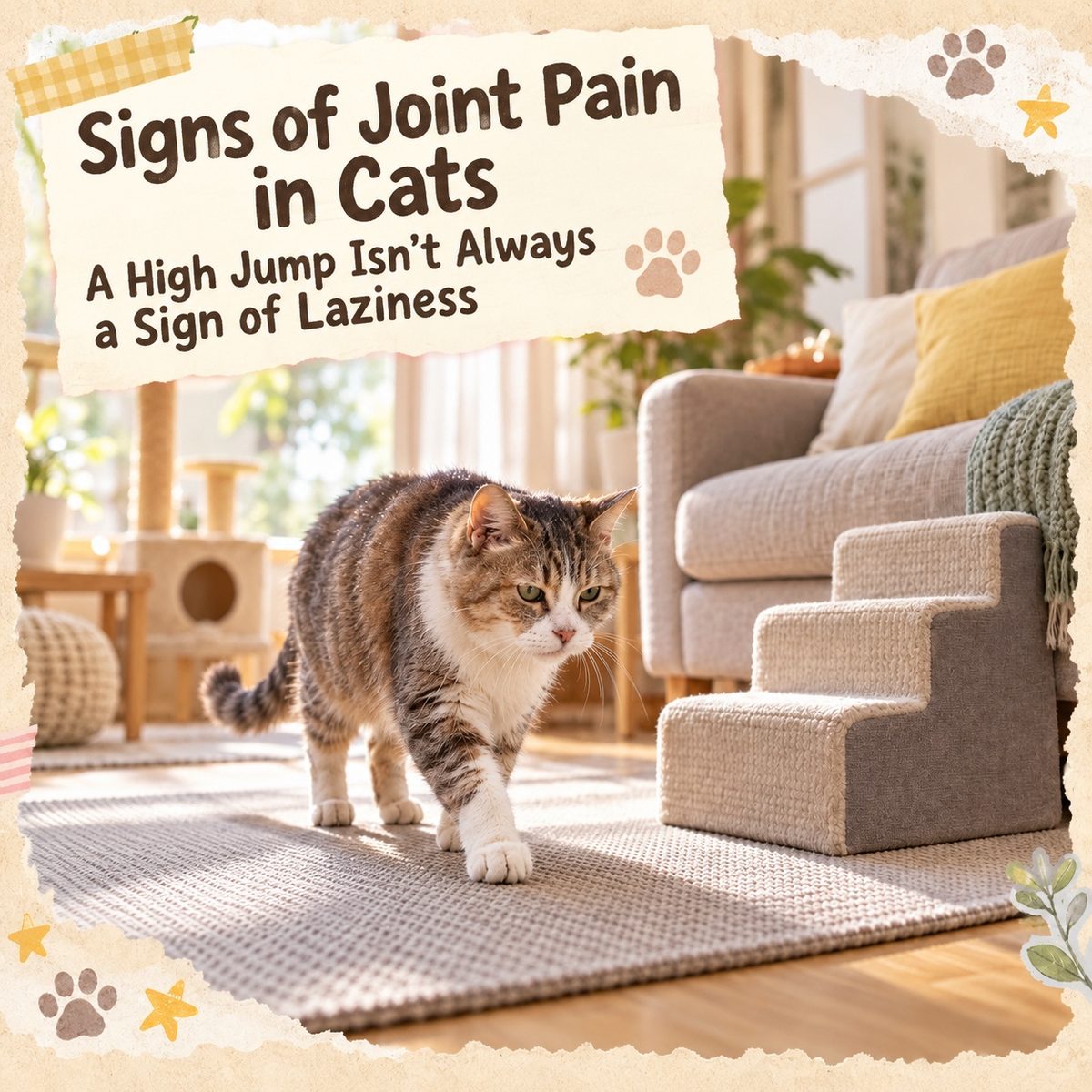
Quick answer: The most common sign of cat arthritis isn't limping — it's not jumping high, hesitating before jumping down, grooming less, and a grumpier mood. Most Hong Kong homes have hard floors and tall cat trees, which add to joint strain. The three most effective steps: weight control, anti-slip mats and low steps, and joint supplements after a vet assessment. If your cat suddenly refuses to walk at all or drags one hind leg, see a veterinarian immediately.
Why cat arthritis is so easily missed
Cats are hunters and hide pain by instinct so they don't show weakness. That's why many arthritic cats only get noticed once the pain is severe, and owners just think "he's been quiet lately."
Clinically, cat arthritis mainly affects the elbow joints, hip joints and spine, and is often slow wear and tear rather than the obvious swelling people get. Senior cats (7 and over) are at higher risk, and overweight cats put noticeably more load on their joints.
Also note that a cat's pain isn't always located at the joint. If your cat strongly resists you touching a certain area, or suddenly won't be picked up, that may be a pain-driven behaviour change.
5 signs you can see at home
| Sign | What it looks like | Often mistaken for |
|---|---|---|
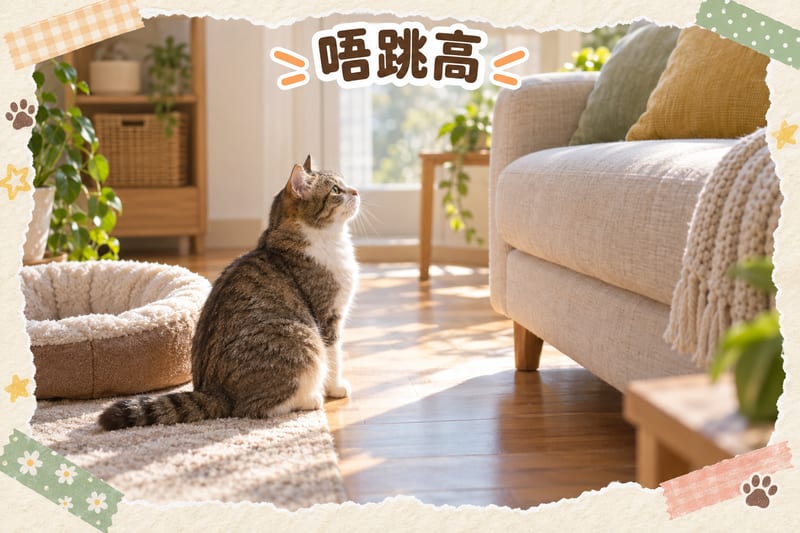
| Not jumping high | Used to reach the top of the fridge, now only the sofa | "Just slowing down with age" |
| Hesitating before jumping down | Stands at the edge looking for a few seconds, then descends slowly | "Afraid of heights" |
| Less grooming | Matted, greasy fur along the back and tail base | "Lazy about cleaning" |
| Grumpier mood | Bites when you touch the back, won't be held | "Bad temperament" |
| Litter tray difficulty | High-sided tray, pauses before going in | "Naughty / toileting outside the box" |
If two or more of these appear together, mention it to your veterinarian and film your cat walking and jumping (many clinics accept video to help assessment).
Diagnosis: what the veterinarian will do
- History + video: when the changes started, whether there's a history of falls.
- Palpation: checking muscle loss, joint range of motion and pain response.
- X-rays: to see joint space, bone spurs and the degree of degeneration; sedation is sometimes needed for clear images.
- Blood tests: especially before starting medication or supplements, to confirm liver and kidney function.
Arthritis usually can't be cured completely; the goals of treatment are reducing pain, maintaining mobility and slowing degeneration.
Home modifications: doable even in small Hong Kong flats
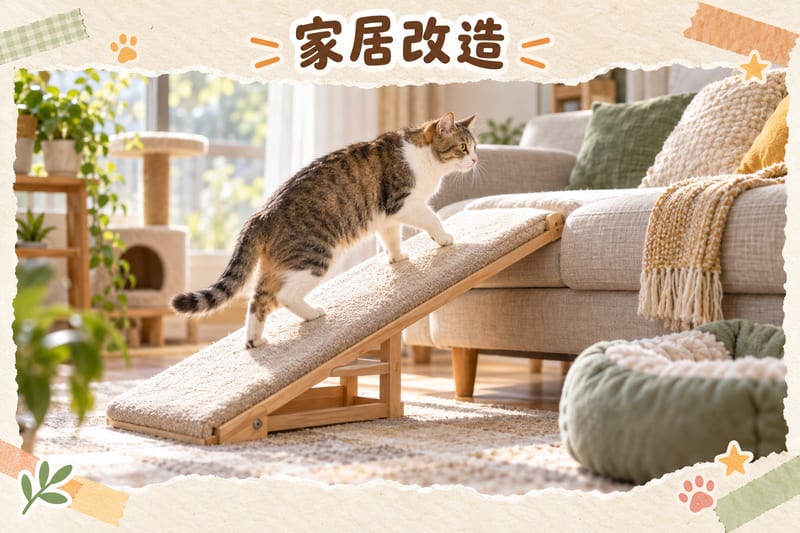
Hong Kong living spaces are small and floors are mostly polished tiles, so cats slip on landing, which makes joints hurt more. These changes are low-cost and directly effective:
- Anti-slip mats / short-pile rugs: along your cat's usual routes and in front of the litter tray.
- Add steps: put a low stool or cat step between the sofa and the table, turning one big jump into two small ones.
- Lower-sided litter tray: switch to a low-entry design, or add a ramp in front.
- Bedding: a thin memory foam pad is more comfortable than hard floor, and in winter helps prevent joint stiffness.
- Water position: don't place it too high, to reduce the number of jumps up and down.
These changes won't change your cat's personality, but they'll mean a few less painful moments every day.
Weight management: the most underrated treatment
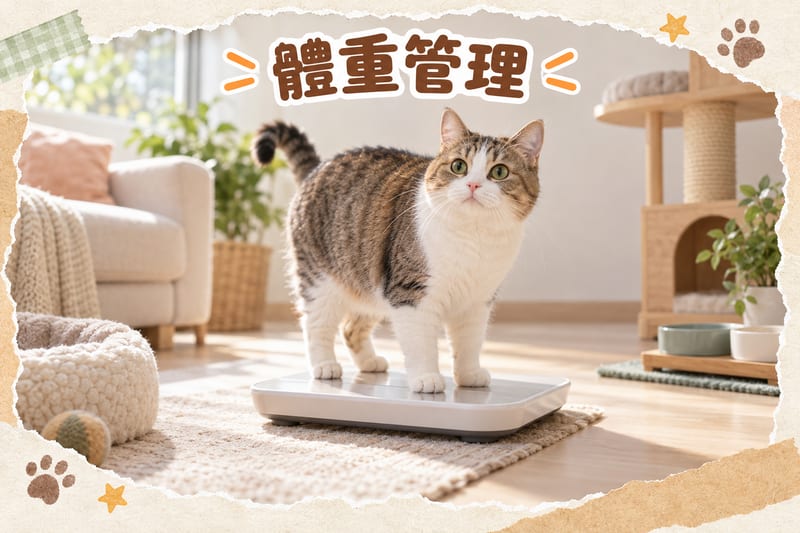
For arthritic cats, weight loss is often no less effective than supplements. The limb joints bear multiples of body weight, so every 1 kg lost noticeably reduces the load of jumping up and down.
Do it scientifically, not by "feeding half": first work out a daily calorie target using calorie calculations (see the complete cat nutrition guide), then lose weight gradually over 4 to 8 weeks, weighing every two weeks. Rapid dieting carries liver risks in cats and isn't recommended.
Choosing supplements: don't treat them as medicine
Cat joint products on the market have broadly similar ingredients, commonly:
- Glucosamine / chondroitin: raw materials for cartilage matrix; research data in cats is limited.
- Green-lipped mussel: contains natural anti-inflammatory-related components; some foods already include it.
- Omega-3 (fish oil): may benefit inflammatory response, but the dose needs vet assessment.
- Collagen / MSM: mostly supportive in nature.
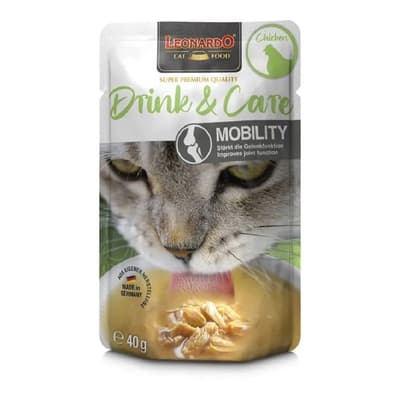
Examples available in Hong Kong: VetriScience Stage 2 Joint Support for Cats, 60 capsules (reference price HK$158), Astkatta Joint Mousse 14g×4 (reference price HK$19.9, handy as a treat to encourage eating), Leonardo Joint Care Soup Pouch 40g (reference price HK$9.3), RAWZ Joint Care Can 155g (reference price HK$30).
Important principle: supplements are supportive and cannot replace veterinary diagnosis and pain treatment; for cats with kidney disease, diabetes or heart disease, always check ingredients with your veterinarian first, especially products high in protein or calcium and phosphorus.
What you must never feed
- Human painkillers: painkillers containing paracetamol or ibuprofen are toxic to cats and can cause serious or even fatal harm. Never feed them.
- Steroids or anti-inflammatories not prescribed by a veterinarian: dose and choice must be adjusted for body weight and liver/kidney status.
Three common Hong Kong home scenarios
Scenario 1: Slippery floors, cat slips on landing. Most Hong Kong flats have polished tiles, so a cat landing has to brake hard on all four feet, adding joint strain. The simplest fix is anti-slip mats or short-pile rugs along your cat's usual routes; if you don't want to cover the whole home, focus on two spots: "where the cat tree meets the floor" and "in front of the litter tray."
Scenario 2: High-sided litter tray, senior cat can't step in. Many litter trays have sides over 15 cm high, and an arthritic cat has to strain to step in. Switch to a low-sided model, or add a ramp in front. Also place the tray somewhere that doesn't require jumping up or down.
Scenario 3: Multi-cat home, senior cat gets displaced. An arthritic senior cat moves slowly and is easily pushed off high spots or away from food bowls by younger cats. Increase the number of resource points (two litter trays, two sets of water bowls), and set the senior cat's resting spot low but in a corner where it won't be disturbed.
How veterinarians assess cat pain
Cats don't cry out in pain, so veterinarians usually combine behaviour with physical examination:
- Gait observation: back curvature when walking, symmetry of steps.
- Joint range of motion: slowly flexing and extending joints, watching for resistance.
- Muscle mass: limbs not used for a long time lose muscle.
- Video records: owner-filmed jumping and stair videos are often more truthful than behaviour in the clinic (cats get stressed at the clinic and may not walk).
- X-rays: to confirm joint wear, bone spurs and any other lesions.
Pain assessment isn't a one-off; it's compared at every recheck. That's why home video records are so useful — film every two to four weeks.
Lifting and carrying techniques
The most painful moment for an arthritic cat is often not walking but being picked up. These techniques reduce pain and resistance:
- Use a towel or carrier instead of your hands: don't lift under the armpits, as this twists the shoulder and elbow joints.
- One hand under the chest, one under the hindquarters: keep the body level, don't let the hind legs dangle.
- Lift from low down: squat down, don't suddenly pull the cat up from above.
- Don't pick up a struggling cat: if your cat resists, use a carrier instead of forcing it.
- Be careful with nail trims: twisting the limbs of a cat in joint pain hurts; ask a veterinarian or groomer to do it.
Daily interaction can be adjusted too: play with wand toys on the floor, put treats where no jumping is needed, and avoid the back and hips when stroking.
Key takeaways
- ✅ Cat arthritis often shows up as behaviour change, not necessarily limping
- ✅ Two weeks of not jumping high or hesitating before jumping down = worth a check
- ✅ Anti-slip mats + low steps are the cheapest and most effective home modifications
- ✅ Weight loss directly reduces joint load, but must be gradual
- ✅ Supplements are supportive; ask your veterinarian first
- ❌ Never feed human painkillers
- ❌ Don't dismiss pain long-term as "just old age"
The above is general information and does not replace veterinary diagnosis; if your cat has persistent symptoms, take it to a veterinary clinic as soon as possible.
Further reading: Pet Arthritis Care Guide, Early Warning Signs of Chronic Disease in Cats, Complete Cat Weight Management Guide, Cat Chronic Kidney Disease Care Guide, Pet Health Overview
 Astkatta full guide →
 Fuji One full guide →