Quick answers
- 'Fairy Water' is not an ingredient name; it is a nickname in the Hong Kong pet market. Most products sold under this name list hypochlorous acid (HOCl) as the main active ingredient.
- 'Bubble Ling' (Positive Care) is a product series whose label lists the US patented ingredient Goldshield as its active ingredient. It includes more than 5 dosage forms: first aid foam, first aid spray, ear wash, dry shampoo spray, litter tray and household spray.
- The ingredients belong to two families: Goldshield is an aqueous formula of organosilane plus quaternary ammonium that adheres to surfaces and forms a film; hypochlorous acid water is a weakly acidic electrolysed water that is consumed as it acts.
- Contact time is worded differently: hypochlorous acid products generally state a '30-second' contact kill time; Goldshield products state antibacterial protection for up to 24 hours. These two numbers mean different things and cannot be compared directly.
- Cleaning and disinfection are two steps: cleaning agents and water remove grease, urine scale and litter dust; disinfectants cannot remove dirt. Organic matter (blood, pus, urine scale) reduces the effectiveness of both types of product.
- Both are disinfecting/care products, not medicines, and cannot treat infections. If a wound is purulent, redness spreads outward, oozing lasts more than 3 days, or the animal refuses food for more than 24 hours, see a veterinarian immediately.
- Mixing contraindications: do not mix the two or any disinfectants together; hypochlorous acid water releases chlorine gas when it meets acidic or ammonia-containing cleaners, so always open windows for ventilation when using it.
The question 'What is the difference between Bubble Ling and Fairy Water?' must start from an easily confused point: 'Fairy Water' is a nickname, 'Bubble Ling' is a product series, and the two are not at the same level. In Hong Kong pet circles, 'Fairy Water' generally refers to a type of care liquid labelled for direct spraying on skin and wounds without dilution; the most common type on the market uses hypochlorous acid (HOCl) as the main active ingredient. Bubble Ling (Positive Care) is a specific product series whose label lists the US patented ingredient Goldshield as the active ingredient, and the series includes first aid foam, first aid spray, antibacterial ear wash, dry shampoo spray, litter tray and household spray, among other dosage forms.
So the comparison that truly answers the search intent is not 'which is better', but the differences between the two types in ingredients, dosage forms, labelled uses, contact time and cleaning roles. These differences directly affect practical operation: when to rinse, whether it can be sprayed around the eyes, whether it can be used on litter trays, how long it lasts after opening, and whether it can be used with other cleaning agents. Below, 3 comparison tables break down each item, followed by 8 practical scenarios, 5 common mistakes and red lines for seeking medical attention.
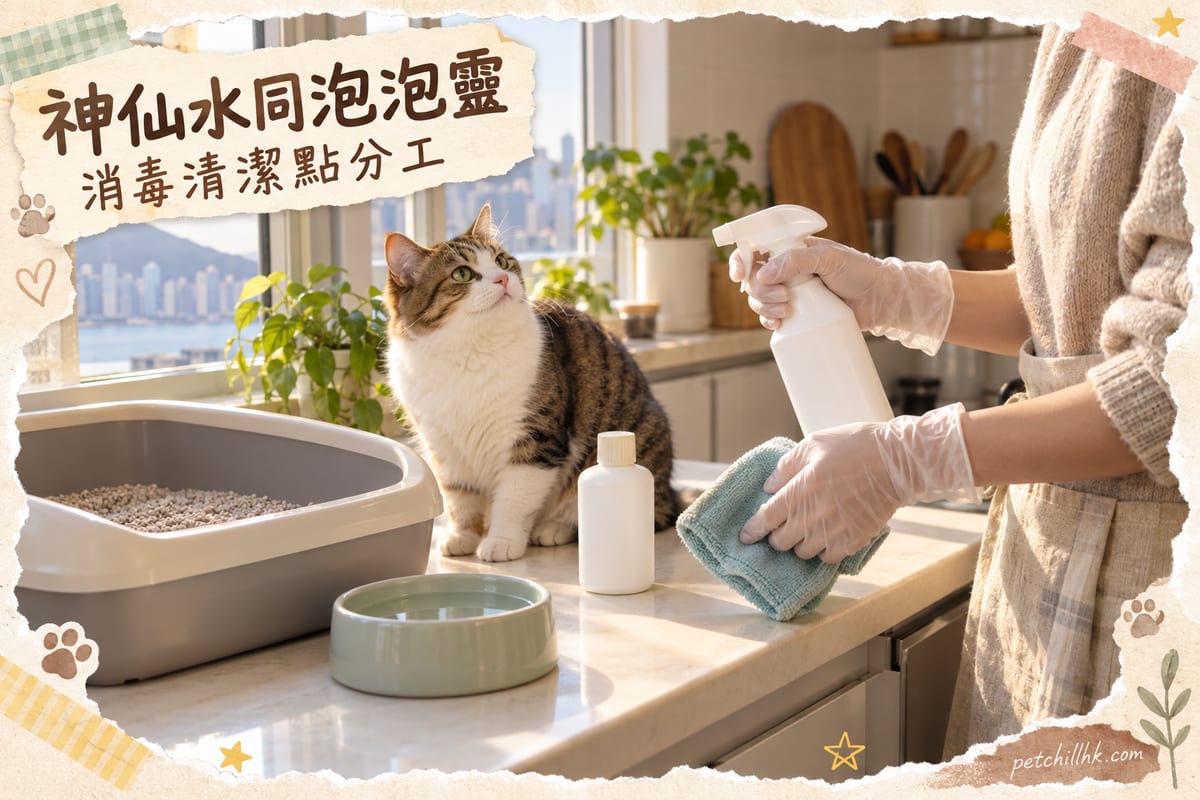
First, a principle that runs through the whole article: disinfection is not cleaning, and it is not treatment. The function of a disinfecting product is to kill surface microorganisms; it does not wash away grease, urine scale or litter dust. If dirt is on the surface, the effectiveness of any disinfectant is greatly reduced. And regardless of the ingredient, no disinfectant can treat an infection that has already developed—pus in a wound, skin redness spreading outward, or the animal becoming lethargic is a job for the veterinarian, not for a spray. To first build an overall concept of medication and accidental ingestion handling, you can start with the Pet Safe Medication Guide.
First, clarify the names: 'Fairy Water' is a nickname, 'Bubble Ling' is a product series
When asking 'What is the difference between Bubble Ling and Fairy Water?', the most confusing point is treating the two names as things at the same level for comparison. In reality, their nature is completely different:
- 'Fairy Water' is a nickname. This name does not correspond to a chemical ingredient, nor to a single brand. Under the same nickname, it could be hypochlorous acid water or a skin spray with other ingredients.
- Among products named or called Fairy Water on the market, the most common type is hypochlorous acid (HOCl) water, a weakly acidic electrolysed water. The labels of such products usually state 'available chlorine X ppm' and '30-second contact time', rather than 'how many hours of protection'.
- 'Bubble Ling' (Positive Care) is a brand series, and the label lists the US patented ingredient Goldshield as the active ingredient. The series is not just one product but covers several scenarios: skin first aid, ear canal, daily coat and environmental cleaning.
- Precisely because 'Fairy Water' is only a nickname, some retailers directly label Bubble Ling's first aid foam as 'First Aid Foam (Fairy Water)'. So 'is it Fairy Water' is not a question that can be used to distinguish products at all.
This point is important for actual purchasing. If you only look for the three characters 'Fairy Water' when buying, what you get may be hypochlorous acid water or an organosilane-quaternary ammonium formula; their storage requirements, contact time wording, wording about mucous membranes and mixing contraindications are all different. All comparisons below are based on ingredient category as the unit, not saying that a certain name necessarily equals a certain ingredient.
One more point to make clear: this article does not judge whether any product is 'good or not'. Ingredient labels and use labels are product market information, not clinical efficacy evidence, and cannot replace a veterinarian's diagnosis. The labelled figures mentioned below (e.g. 24 hours, 30 seconds, ppm) are all wordings on product packaging, not this article's judgment of effectiveness.
Comparison of ingredients, dosage forms and labelled uses
First, the basic information on the two ingredient types, because all usage differences are derived from the ingredients.
Goldshield (the patented ingredient labelled in the Bubble Ling series) is an aqueous formula of organosilane plus quaternary ammonium. Technical data describes the mode of action as: after the formula is applied to a surface, the silane groups bond with the surface to form an invisible antibacterial coating; the quaternary ammonium carries a positive charge that attracts microorganisms, and then long carbon chains disrupt the microbial cell membrane. The key characteristic of this type of ingredient is that it stays on the surface and does not evaporate, so the product label states 'antibacterial protection for up to 24 hours'—this refers to residual persistence, not immediate kill speed.
Hypochlorous acid water (the most common ingredient in Fairy Water-type products) is a weakly acidic liquid obtained by electrolysing salt water or adjusting the pH of sodium hypochlorite; the main active ingredient is HOCl. Its characteristic is that it is consumed as it acts on contact with microorganisms, so labels usually state '30-second contact time' and 'available chlorine X ppm', and do not promise residual protection. Hypochlorous acid water is sensitive to light and heat: available chlorine concentration decreases over time and with light exposure, so most labels require storage away from light in a cool place and use as soon as possible after opening.
| Comparison item | Bubble Ling (Positive Care series) | Fairy Water (nickname) |
|---|---|---|
| Name level | Brand/product series | Nickname, not an ingredient name, nor a single brand |
| Active ingredient label | US patented ingredient Goldshield: organosilane + quaternary ammonium (aqueous formula) | Most common type labels hypochlorous acid (HOCl); other ingredients may also be called Fairy Water |
| Common dosage forms | Foam, spray, ear wash, dry shampoo spray, litter tray and household spray | Mostly liquid sprays; some foam versions |
| Mode of action (per technical data/product label) | Adheres to surfaces to form a film; quaternary ammonium attracts microorganisms with positive charge; long carbon chains disrupt cell membranes | Oxidises microorganisms during contact and is consumed after acting |
| Persistence wording | Labelled antibacterial protection for up to 24 hours | Labelled as '30-second contact', not focused on residual action |
| Dilution before use | Ready-to-use versions labelled no dilution needed | Most ready-to-use versions labelled no dilution needed; concentrated versions follow label |
| Storage requirements | Aqueous formula; away from light, cool, tightly closed | Sensitive to light and heat; available chlorine decreases over time; use soon after opening |
| Mixing contraindications | Should not be mixed with other disinfectants or cleaning agents | Should not be mixed with acidic cleaners or ammonia-containing products; releases chlorine gas |
| Aquatic environment | Quaternary ammonium is toxic to fish and aquatic life; do not pour into fish tanks | Likewise should not be poured in large amounts into fish tanks or closed environments |
The information in the table is a summary of ingredient categories and common market labels; formulations, concentrations and label wording can vary greatly between products. Always refer to the label of the product in your hand and your veterinarian's instructions. Note two easily overlooked points: first, '24 hours' and '30 seconds' cannot be compared directly—the former refers to protection time, the latter to contact time; second, the antibacterial percentage on the label is manufacturer marketing information and does not mean it is effective for the specific problem on your pet.
Disinfection and cleaning are two different things: roles, order and 3 common misconceptions
This section is the most practical part of the article, because most people's problem is not 'which one to buy' but using it wrongly even after buying. Cleaning, disinfection and parasite prevention are three different things, each with different tools, and they cannot replace each other.
| Step | Purpose | What to use | When to do it | What it cannot replace |
|---|---|---|---|---|
| Cleaning | Physically remove grease, urine scale, litter dust, food residue, hair | Water + pet-safe cleaning agent or diluted neutral detergent, cloth, brush | After every soiling, always before disinfection | Cannot kill microorganisms |
| Disinfection | Reduce surface microorganism numbers | Bubble Ling/Fairy Water-type products, or a disinfectant specified by the veterinarian | After cleaning, rinsing and drying | Cannot wash away dirt, nor replace medication |
| Parasite prevention | Prevent fleas, ticks, internal parasites | Deworming products, flea drops, etc., per label or veterinarian's instructions | Per label cycle; an independent procedure | Disinfectants have no flea or tick prevention function at all |
Misconception 1: No need to wipe after spraying disinfectant. Organic matter (blood, pus, urine scale, grease) immediately consumes the disinfecting ingredients and also blocks contact. The order is always 'clean first, disinfect after'; never reverse it. Misconception 2: The more frequent the disinfection, the better. The skin surface has normal flora and new tissue; frequent use of disinfectants disrupts this balance. Regardless of which product, the frequency and area should follow the label or veterinarian's instructions; do not increase on your own. Misconception 3: One product can handle the whole body and the whole house. Skin, ear canal, litter tray, hard household surfaces and feeding utensils are different scenarios with completely different requirements for residue, rinsing and irritation. Using the right product is more important than using more.
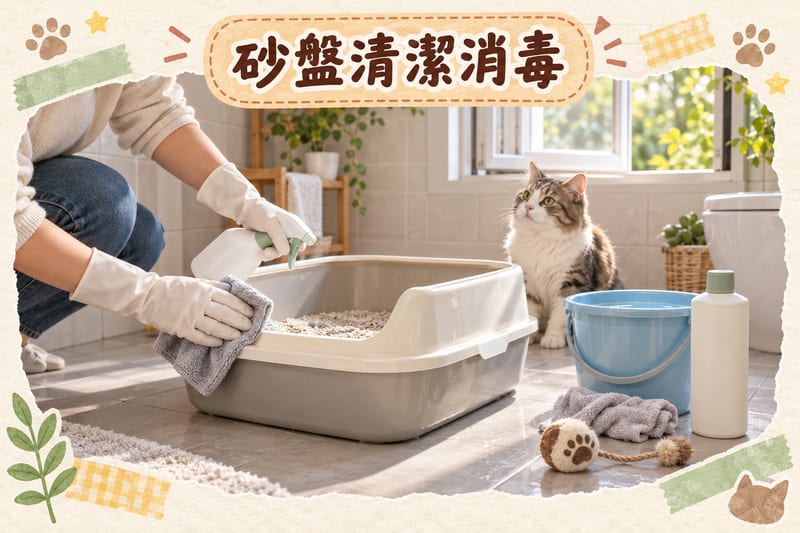
The standard order for cleaning the environment can be simplified into 6 steps:
- Remove the animal. Put your pet in another room during cleaning; do not let it watch while you spray.
- Remove solid waste first. Use paper towels or bags to remove faeces, litter dust and food residue; do not wash them away with water.
- Wash with cleaning agent. Wipe or scrub with water and a pet-safe cleaning agent; use a toothbrush for crevices.
- Rinse and dry. Residual cleaning agent itself can irritate skin and paws, so rinse thoroughly and dry.
- Disinfect per label. Spray or wipe the disinfecting product; follow the label on whether rinsing is needed; if rinsing is required, do it.
- Air-dry completely before letting the animal back in. A damp environment is unfriendly to skin and respiratory tract.
Comparison of 8 practical scenarios
Below, scenario by scenario, the usage distribution of the two product types is explained. Again: the table shows the uses labelled on the products, not this article's evaluation of effectiveness, nor does it mean every product in the same category is the same.
| Scenario | Bubble Ling series (labelled ingredient Goldshield) | Fairy Water type (most commonly labelled hypochlorous acid HOCl) |
|---|---|---|
| 1. Superficial skin abrasion | First aid foam/spray labelled once daily, applied directly to the affected area | Labelled for repeated daily spraying until the skin dries, generally stating no rinsing needed |
| 2. Post-surgical wound surface | Relevant dosage forms exist, but must follow the veterinarian's discharge instructions | Some products labelled for use on post-surgical sites, also follow the veterinarian's instructions |
| 3. Around eyes, ears, mouth | General disinfectant dosage forms mostly labelled to avoid mucous membranes; ear wash is a separate product | Some products labelled for use around eyes, ears and mouth, but wording varies by product; check the label |
| 4. Ear canal cleaning | Antibacterial ear wash available (separate product line) | Ear versions available; ingredient is not necessarily hypochlorous acid |
| 5. Daily coat cleaning | Antibacterial coat dry shampoo spray available | Rare; most not focused on this use |
| 6. Litter tray | Litter tray spray available, labelled for use on elimination areas | Some products labelled for use on elimination area surfaces |
| 7. Hard household surfaces (floors, cages, carriers) | Household spray available | Depends on individual product label; most products positioned for skin |
| 8. Feeding utensils, water bowls, toys | Depends on individual product label; general practice is wash with cleaning agent, rinse, dry | Depends on individual product label; likewise wash first, then treat |
From the table, a practical conclusion can be drawn: the Bubble Ling series is positioned to cover 'skin + ear canal + environment' with one series; Fairy Water-type products are positioned for 'skin and wound surfaces', with environmental cleaning secondary or product-dependent. This is a result of differences in dosage forms and ingredients, not about which is better—because if a veterinarian has already diagnosed a wound that needs treatment, the choice of which product, how often and for how many days is up to the veterinarian.
Regarding environmental cleaning, several safety points must be stated clearly:
- Do not mix. Any two disinfecting products should not be used together or layered one after the other; chemical reactions may produce irritants or neutralise each other.
- Hypochlorous acid water must avoid acidic and ammonia-containing cleaners. Contact between the two releases chlorine gas, harmful to the respiratory tracts of both humans and pets; always open windows for ventilation when using, and concentrated products must be diluted according to the label.
- Quaternary ammonium must not be poured into fish tanks. Quaternary ammonium is toxic to fish and aquatic life; avoid splashing when cleaning near aquariums.
- Exposure risk for cats should be narrowed further. Cats groom frequently, so ingredients applied to the coat are easily swallowed; toxicology data show cats are more sensitive to quaternary ammonium irritation, and oral exposure can cause drooling and oral and oesophageal irritation. After using any such product, it is advisable to put on a soft cone or recovery suit immediately until the surface is dry.
- Do not spray directly at the animal's face. Spraying towards the face irritates eyes and respiratory tract; the correct method is to spray onto a cloth or hand and then wipe, avoiding eyes, nose and mouth.
5 most common mistakes and correct practices
Mistake 1: Using a disinfecting product instead of cleaning. When there is urine scale or grease on the surface, most disinfecting ingredients are consumed by organic matter, wasting the product and giving a false sense of cleanliness. The correct practice is to clean first. Mistake 2: Thinking disinfection can treat an infected wound. If a wound is already purulent, smelly or continuously oozing, microorganisms have penetrated deeper; surface treatment only masks the condition. The correct practice is to see a veterinarian. Mistake 3: Adding water to dilute on your own. 'Adding a little water' is not the correct ratio; a wrong concentration can make the product ineffective or irritate the skin. The correct practice is to follow the label; if a concentrated version specifies a ratio, use that ratio. Mistake 4: Ignoring storage conditions. Hypochlorous acid water is sensitive to light and heat; storing it by a window or in a car boot accelerates the loss of available chlorine; diluted solutions should be used the same day and not poured back into the original bottle. The correct practice is to keep the original bottle away from light in a cool place, tightly closed, and note the opening date. Mistake 5: No anti-licking, no ventilation. Without a cone after use, the animal immediately licks off the ingredients; spraying in large amounts in a closed space means humans and pets inhale it together. The correct practice is ventilation, avoiding the animal, and anti-licking after use.
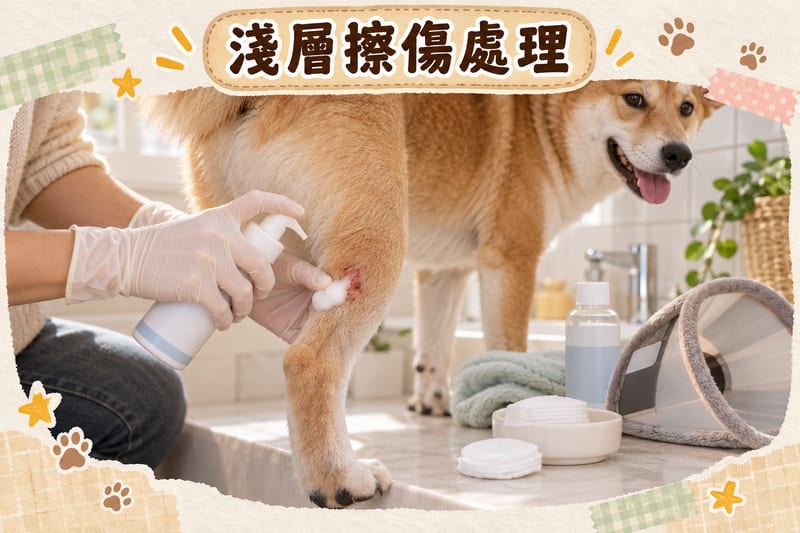
Practical operation can be simplified into 6 steps, in order: assess (is it a new wound? is there pus?) → clean (water or saline) → disinfect (per label or veterinarian's instructions) → prevent licking (cone or recovery suit) → record daily (photograph at the same time and in the same light, note the area, oozing, demeanour and appetite) → seek medical attention immediately if red lines appear. The value of this process lies in step 5: at follow-up, you have continuous photos and records, and the veterinarian can immediately judge whether there is deterioration.
By the way, two things that are not about disinfection but often appear together with disinfection questions. First, disinfecting products have no flea or tick prevention function at all; a clean environment does not mean your pet has no parasites, and parasite control must be done separately; see the Pet Deworming Guide for how. Second, for pets on long-term medication or with chronic illness, ask the veterinarian before adding any supplement, because ingredients can interact. Related examples you can consider in-store (the following are general care and parasite prevention products, not the disinfecting products compared in this article):
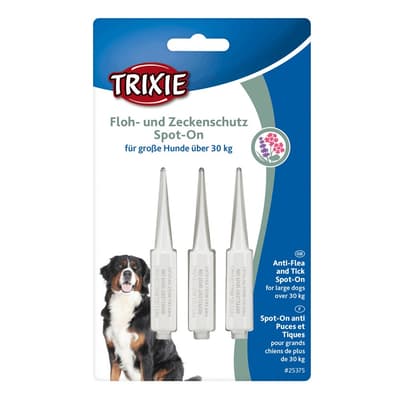
- Trixie Flea and Tick Drops Natural Flower Oil 3-pack 3 X 5ml (25375) — HK$98 (available for pre-order)
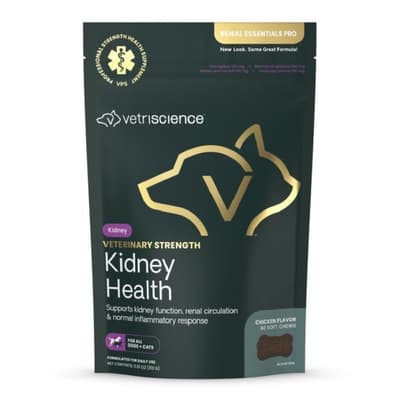
- VetriScience Kidney Support Advanced Formula for Dogs and Cats 60 tablets/bag — HK$355 (available for pre-order)
Prices and stock are subject to the online store's current listed price. These two types of products have completely different uses from disinfectant sprays and cannot replace each other; if your pet is on medication or has a chronic illness, consult a veterinarian before use.
When not to handle it yourself: red lines for seeking medical attention
No matter how correctly a disinfecting product is used, it is only auxiliary. If any of the following occurs, do not continue observing or handling it yourself; make an appointment with a veterinarian directly:
- The wound is purulent, has yellow-green discharge or a foul odour, and feels noticeably hot.
- Redness and swelling spread from the wound edge outward, or the area expands by more than 1 cm within 24 hours.
- Bleeding does not stop after 5 to 10 minutes of pressure, or blood soaks through multiple layers of gauze.
- Oozing continues after day 3, with no sign of the wound narrowing.
- The animal's body temperature exceeds 39.4°C, refuses food for more than 24 hours, is lethargic or hides in a corner.
- Foreign objects or subcutaneous tissue are visible, or tissue turns black or grey, and the animal cries in pain continuously or refuses to walk.
- The animal licks or swallows a large amount of disinfecting product: immediately wipe off skin residue with water, keep the packaging (the veterinarian needs to see the ingredients and concentration), then contact the veterinarian; do not induce vomiting yourself.
Animals are naturally good at hiding pain; often by the time the owner sees 'not eating', the infection has already been present for several days. Rather than agonising over which disinfecting product to buy, do the three most valuable things first: put on a cone to prevent licking and biting, record changes daily, and attend follow-up appointments on time. If your pet's appetite has worsened because it is taking antibiotics for an infection, you can also refer to Causes of Appetite Loss in Cats After Antibiotics and Managing Antibiotic-Related Diarrhoea and Constipation.

Further reading
- Pet Safe Medication Guide | Dosage, Side Effects, Accidental Ingestion Handling (2026)
- Cat Appetite Loss After Antibiotics? Causes and Management
- Antibiotic-Related Diarrhoea and Constipation in Cats: How to Tell Them Apart and When to Seek Medical Attention
- Pet Deworming Guide | Flea, Tick and Internal Parasite Prevention
In an emergency, contact a veterinarian immediately; this article is for reference only and cannot replace a veterinarian's diagnosis.
Information checked as of 2026-10-12 · Source: PetChill editorial team
 Fuji One full guide →


 K9 Natural full guide →
 Feline Natural full guide →