Quick answer: Homemade fresh food must be truly "nutritionally balanced" rather than just "fresh". The golden ratio is meat 75–80% + organs 10–15% + bone 5–10% + a very small amount of veg; cats must have taurine, and both cats and dogs need calcium supplementation. The recipe should be reviewed by a vet or pet nutritionist—that's what being responsible for your pet means.
Answer box: The core of homemade fresh food is not "fresh ingredients" but nutritional balance—the reference ratio is meat 75–80% + organs 10–15% + bone 5–10% + a small amount of veg; cats must have a reliable source of taurine, and both cats and dogs need attention to calcium-phosphorus balance. Starting with a recipe approved by a vet or pet nutritionist is the responsible approach for your pet.
Why isn't a single meat source a complete meal?
Many owners have good intentions when switching to fresh food: they want their pets to eat less processed food and more real ingredients. But note—feeding only boiled chicken breast or plain meat will lead to malnutrition over time. The reasons are straightforward:
- Muscle tissue mainly provides protein and some B vitamins, very little calcium and lots of phosphorus
- Long-term calcium-phosphorus imbalance affects bones and metabolism, with more serious consequences for kittens and puppies
- Cats cannot synthesise taurine themselves, and plain muscle meat does not provide enough taurine; deficiency can damage vision and the heart
Fresh food needs to "cover seven nutrient groups"—protein, fat, vitamins, minerals, taurine, fibre and water—and a single ingredient can never cover them all.
How should the fresh food ratios be divided?
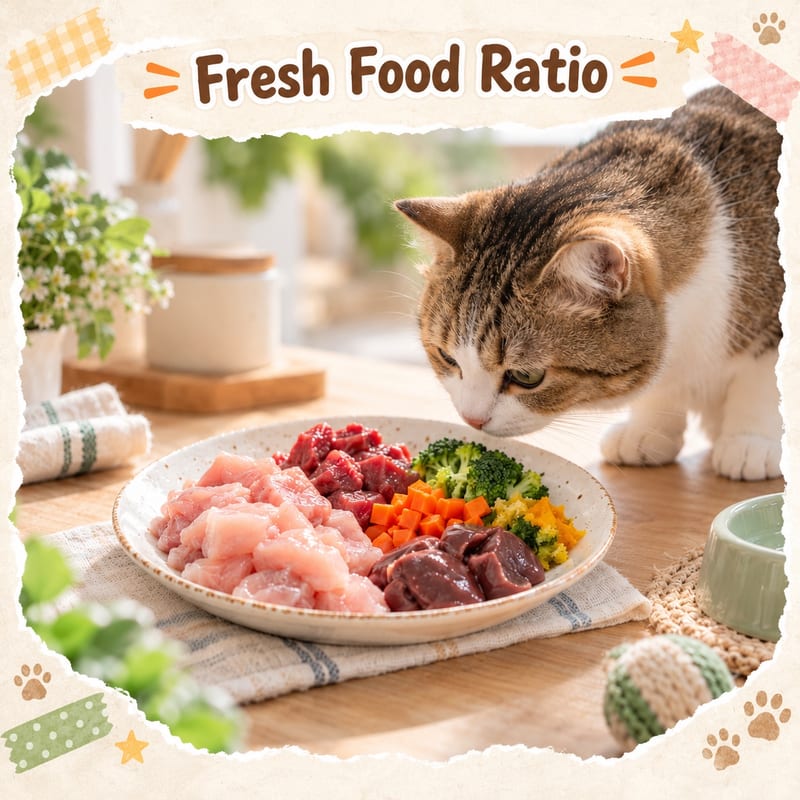
Common reference ratios (on a dry matter basis):
| Component | Ratio | Provides |
|---|---|---|
| Muscle meat | 75–80% | Protein, fat |
| Organs (mainly liver) | 10–15% | Vitamin A, B group |
| Bone (ground or substitute) | 5–10% | Calcium, phosphorus |
| Small amount of veg | Very small for cats / more for dogs | Fibre, micronutrients |
Differences between cats and dogs:
- Cats—obligate carnivores, need a higher meat ratio and can have almost no veg
- Dogs—omnivorous tendency, can include pumpkin, carrot and other vegetables for fibre
Reminder: This is a general educational reference, not a prescription for your pet. Puppies, kittens, pregnant/lactating animals, and those with chronic diseases need individual adjustments; please follow the recipe from a vet or recognised pet nutritionist.
Five most common nutritional mistakes
- Calcium—no bone or calcium supplement, plain meat is high in phosphorus and low in calcium; this is the number one trap in homemade fresh food
- Taurine (cats)—cooking destroys some taurine, so cat fresh food usually needs extra supplementation
- Vitamin E and iodine—fish-based recipes are prone to vitamin E deficiency; lack of an iodine source (such as an approved supplement) can affect the thyroid
- Excess organs—liver is extremely high in vitamin A, and too much can cause toxicity; don't be tempted to exceed 10–15%
- Eyeballing portions—the calorie density of fresh food is very different from dry food; use a scale and adjust according to body weight and activity level, not "give as much as they want"
To cook or not to cook?
Both cooked and raw are reasonable choices; the difference is risk management:
- Cooked: kills most bacteria, safer for beginners and households with elderly, young children or pregnant women; the cost is that some heat-sensitive nutrients (e.g., taurine, some vitamins) are lost and can be supplemented in the recipe
- Raw: retains nutrients most completely, but requires extremely strict sourcing, refrigeration and handling hygiene (see the raw food article for details)
Whichever method, do not add seasonings—salt, oil, onion, garlic, sauces are all out. Cats' and dogs' kidneys do not need extra sodium.
Hygiene: the other half of the fresh food test
Even if the nutrition is perfect, a hygiene failure can still cause problems. Fresh food, being high in moisture and preservative-free, is a breeding ground for bacteria:
- Cook and serve immediately as a principle; do not leave at room temperature for more than one or two hours
- Refrigerate for generally 2–3 days; if not finished, portion and freeze, thawing only as much as needed
- Use separate chopping boards and knives for raw meat, kept apart from human utensils; thoroughly clean hands and surfaces that have touched raw meat
- Thaw in the fridge, not in water at room temperature (Listeria and Salmonella love that temperature difference game)
- Wash the pet's bowl immediately after eating; do not leave leftovers for "the next meal"
If there are elderly, young children, pregnant women or immunocompromised members in the household, it is advisable to choose the cooked route and be extra careful when handling raw meat—this is not alarmist, but being responsible for the whole household.

How to check if the fresh food plan is working?
- Weekly: weigh your pet, check if the coat has become dry and dull
- Daily: observe stool consistency and energy/appetite
- Every 3–6 months: small animal check-up + blood tests (liver/kidney indicators, nutritional status)
- Recipe level: have a practising vet or pet nutritionist review your recipe once, especially for families planning to feed fresh food long-term
Homemade fresh food is a choice worth respecting—provided it is done with knowledge, not just love. Love is the starting point; the recipe is the path.
When to see a vet immediately?
- Refusing food for more than a day, or sudden vomiting or bloody diarrhoea
- Lethargy, unsteady walking, seizures (possible metabolic or nutritional emergency)
- Significant weight loss or abnormal abdominal enlargement in a short period
- Puppies/kittens on a plain meat, boneless diet showing signs of bone deformity or stunted growth
What you can do starting today
- Use a kitchen scale to measure each fresh food portion and record it in a food log
- Confirm that your cat's recipe includes a taurine source; if not, ask your vet how to supplement
- Check for a calcium source (ground bone meal/approved calcium supplement) and fill that number one gap
- Label your fridge with fresh food dates: when cooked, use-by date
- Book a vet/pet nutritionist appointment and bring your recipe for review
Want a ready-made solution? PetChill's pet fresh food guide and food reviews have nutritional breakdowns of commercial fresh food, freeze-dried and canned options, so you can eat knowledgeably even without homemade.
Further reading:
This article is for reference only; consult a registered vet for any concerns.
Hong Kong small flat practicalities: fridge, portions, hygiene all in one go
Hong Kong living spaces are small, but you can still make fresh food safely. Here are practical steps for open kitchens under 300 sq ft, all using the principles already discussed in the article, without adding anything new.
1. Fridge space allocation
- Top shelf: cooked, portioned fresh food containers, labelled with "cooked date + use-by date", maximum 2–3 days' worth.
- Middle shelf: raw meat in separate zip-lock bags, kept apart from human food, labelled "RAW"; buy only what will be used within 3 days to reduce stockpiling.
- Bottom freezer: use silicone ice cube trays to portion "one meal per day", about 100 g per cube; transfer to the fridge the night before to thaw, never thaw at room temperature.
2. Minimalist kitchen tools
- Digital kitchen scale (minimum unit 1 g)—the article emphasises using a scale, not eyeballing.
- Separate chopping board and knife set, clearly colour-coded and kept apart from human food area, wash immediately after use.
- Small blender/hand blender—to grind bone meal or puree organs, making it easier to accurately control the 10–15% ratio.
- 3–4 stainless steel containers, dedicated to fresh food, not mixed with human utensils.
3. Weekly shopping and prep flow
Sunday buy everything at once:
- From local wet markets or supermarkets, buy frozen chicken fillets, turkey liver (remember liver should not exceed 15% of total ingredients).
- Buy ground chicken bone meal (or frozen ground chicken necks) for calcium supplementation.
- Buy pumpkin/carrot (for dogs); cats can skip.
Do immediately upon returning home:
- Weigh the total weekly meat amount (body weight × 2–3% as a starting point), then divide into meat, organs, bone meal according to the ratio.
- Cook everything (if there are elderly, young children or pregnant women at home, do not feed raw), let cool, portion into ice cube trays, freeze into cubes.
- Each morning take one cube to the fridge, and before feeding in the evening check temperature and smell again.
4. Hygiene checklist (2 minutes daily)
- After handling raw meat, immediately wipe the chopping board, knife and sink with 1:99 bleach solution.
- Wash the pet's bowl immediately after eating; do not leave until the next meal.
- Check every night that the fridge temperature is maintained below 4 °C and the freezer below -18 °C.
5. When to see a vet?
The article mentions "refusing food for more than a day, sudden vomiting or bloody diarrhoea, lethargy"—go to a 24-hour vet immediately. In Hong Kong, you can go to emergency vets in Wan Chai, Mong Kok or Kowloon Tong at night; during the day, book a registered vet near your home and bring your "food log" and ingredient ratios so the vet can quickly assess whether it's a nutritional imbalance.
By following these five steps, even in a 200 sq ft subdivided flat you can safely make homemade fresh food without sacrificing space or your pet's health.
Related product recommendations
The most important thing when choosing food is to consider your pet's age, digestion and taste preferences. Here are products related to this article available at PetChill:
- Fuji One Freeze-Dried Raw Cat & Dog Food Duck Recipe 500g (Fuji One)—freeze-drying locks in nutrients
- Nutriplan Cat Canned Food Daily Nutrition Can Adult Cat Immunity & Joint Formula 85g (64656) (Nutriplan)—joint health formula
See more: Fuji One brand guide
Product prices and latest offers are subject to the product page; this article is for reference only.
Further reading
- The truth about grain-free dog food →
- Choosing cat complete wet food →
- Buying kitten food →
- Hong Kong cat food buying guide →
- Cat canned food brand comparison →
📌 Key summary
- ✅ Golden ratio: meat 75–80%, organs 10–15%, bone 5–10%
- ✅ Cats must have taurine; both cats and dogs need calcium supplementation
- ❌ Plain meat without bone = calcium-phosphorus imbalance, long-term can cause bone problems
- ❌ Organs over 15% can easily cause vitamin A toxicity
- ❌ Eyeballing portions = calorie overload or deficiency
 Fuji One full guide →


 Fuji Cat full guide →


 Nutriplan full guide →