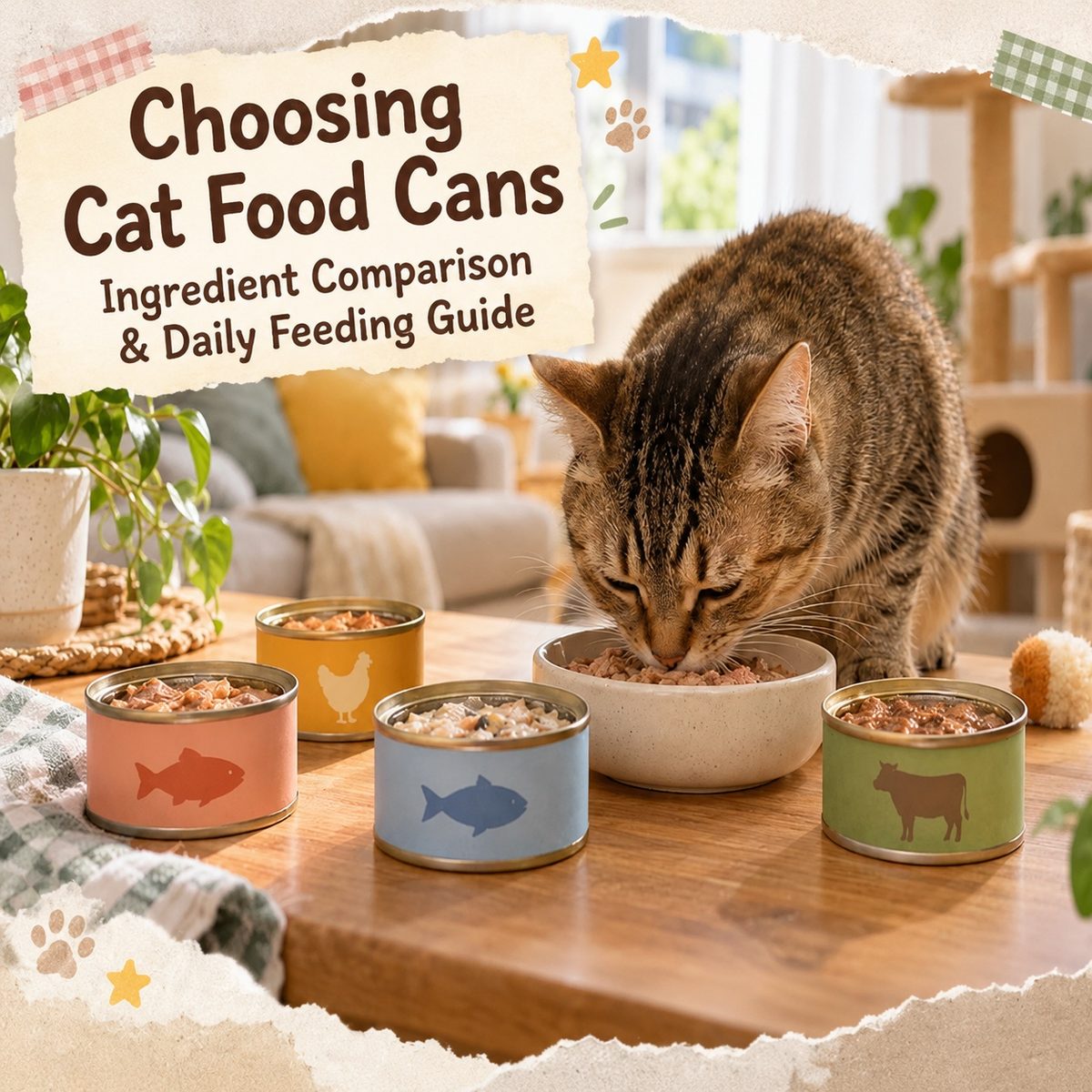
Quick answer: Complete wet food must be labeled "Complete & Balanced"; protein ≥10%, low carbs, clear meat sources, and contains taurine. Common complete lines in Hong Kong include Kakato, Applaws, Almo Nature, Ziwi Peak, etc. Always check the label on each can to be safe.
In one line: complete wet food is nutritionally complete and balanced, and can be fed as a main meal long-term; complementary wet food is just a topping. The first step in choosing canned food is to identify the "complete" label; the second step is to look at protein, carbs, and meat sources. Many tasty tuna canned foods on the market are actually complementary—if you forget to check the label, it is easy to feed the wrong thing long-term, causing nutritional imbalance in cats without the owner noticing.
What is the difference between complete wet food and complementary wet food?
"Complete wet food" is usually written in English as Complete & Balanced, meaning that this can alone already meets all of a cat's nutritional needs—protein, fat, vitamins, minerals, and taurine are all present, meeting international nutritional standards such as AAFCO, and can be fed as a main meal morning and night for life.
"Complementary wet food" (also called complementary feed) is completely different: it may have very high meat and protein, but the calcium-phosphorus ratio is unbalanced, and it lacks certain vitamins and minerals; it is designed as a "topping." Short-term feeding is fine, but long-term use as a main meal will lead to malnutrition, especially calcium-phosphorus imbalance, which has a greater impact on growing cats.
| Complete wet food | Complementary wet food | |
|---|---|---|
| Nutrition | Complete and balanced (AAFCO) | Incomplete |
| Use | Can be a main meal | Only as supplement/mixer |
| Label | Has Complete & Balanced | No such wording |
| Long-term feeding | Yes | No, will cause malnutrition |
⚠️ The most common trap: Many "tuna canned food" and "white fish canned food" are high in protein, but low in fat, relatively high in carbs, and lack taurine—these are all complementary. No matter how expensive the can or how good the fish, without a complete label it is not a meal, just a topping. It is very common in Hong Kong clinics for owners to realize after years of feeding that they have been feeding snacks all along.

Read the ingredient list: five indicators to filter out poor-quality cans
After distinguishing complete from complementary, use five indicators to assess quality:
- First ingredient is a named meat—chicken, salmon, tuna clearly stated, not generic "meat by-products"
- Protein ≥10% (wet basis)—the basic threshold for complete wet food; closer to 12% is ideal
- Low carbs (dry matter ≤5%)—cats are obligate carnivores; the less rice, flour, and gum fillers, the better
- Moisture above 75%—the natural advantage of canned food, helping cats hydrate and protect the urinary tract
- Contains taurine and added vitamins/minerals—taurine is essential for cats; complete wet food must list it clearly
Tip: A mantra—"high protein, low carbs, high moisture, clear meat sources, contains taurine." Only when all five pass is it worth putting in the shopping cart; if any one fails, ask why before buying.
Popular complete wet food brands in Hong Kong 2026
Below are the most common complete wet food lines in Hong Kong pet shops and online platforms; actual specifications are subject to the label on each can:
| Brand | Positioning | Features |
|---|---|---|
| Kakato | Familiar to Hongkongers | Natural ingredients, many flavors (chicken, fish, salmon) |
| Applaws | High-quality line | Focus on pure meat, few fillers, good palatability |
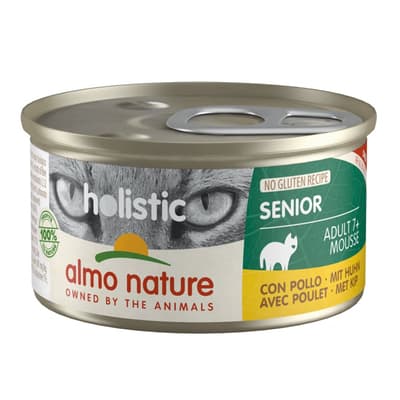
| Almo Nature | Natural line | Meat sources from different origins, many choices |
| Ziwi Peak | New Zealand premium | High protein, low carbs, refined formulas |
Don't feed only one complete wet food: Different brands have different protein and fat sources; rotate multiple brands and flavors for more diverse nutrition, and avoid sudden switches. Also note: the same brand often has both complete and complementary product lines—for example, some cans clearly state complete and balanced, while others only say "fish cooked in gravy." The two lines have different positioning; always check the label on each can.
Three-step method for choosing complete wet food
- Check the label—if there is no "Complete & Balanced" wording, treat it as complementary
- Check the ingredients—go through the five indicators above one by one, regardless of how nice the cover design or cute the spokesperson
- Check the cat's reaction—buy small cans or trial packs, observe whether they eat happily, whether stools are formed, and whether they vomit after eating
Transitioning from dry to fully wet food takes time: First replace one meal a day with complete wet food, then gradually increase the wet food proportion over 7 to 10 days; cats with sensitive stomachs can go slower. Mild soft stools during transition are common; if not improved after two weeks, reconsider whether a particular can is unsuitable or consult a veterinarian.
Portion reference: Generally, an adult cat needs about 150–250 grams of complete wet food per day, depending on weight, activity level, and product calories; start with the feeding amount suggested on the packaging, then adjust slightly based on weight changes.

Five myths about complete wet food
Myth 1: "Canned food is wet food, so any is fine"—Wrong. Feeding complementary wet food as a main meal over time leads to calcium deficiency and taurine deficiency; the cat may look full but is actually nutritionally imbalanced.
Myth 2: "Expensive canned food must be complete"—Price tag does not equal nutritional positioning. Many premium fish canned foods are complementary no matter how expensive; the standard is always the can label and ingredient list.
Myth 3: "If the cat loves it, it's suitable"—High palatability may be due to additives or high fat content. Liking it and being nutritionally complete are two different things; rely on the label.
Myth 4: "Canned food means no need to drink water"—High moisture in cans is an advantage, but it does not mean you can remove the water bowl. Fresh water should still be available between dry food meals and canned meals, especially for middle-aged and senior cats with higher kidney burden, ensure adequate water intake.
Myth 5: "Transitioning food must involve starving the cat"—"They'll eat when hungry" does not apply to cats; obese cats refusing food long-term have a risk of fatty liver. The correct approach is a 7 to 10-day gradual transition, using the aroma of the complete wet food itself as an inducement if necessary.
Freshness details for feeding canned food
Canned food is convenient, but has more freshness rules than dry food:
- Eat immediately after opening: Discard if left at room temperature for more than one to two hours, shorter in summer
- Refrigerate: Cover leftovers and put in the fridge, use within one to two days
- Warm before feeding: Take out of the fridge to room temperature, or mix with a little warm water; many cats won't accept it cold
- Wash bowls daily: Wet food bowls easily breed bacteria; don't treat them like dry food bowls washed every other day
- Check the can: Bulging, rust, leakage, or expired—do not open
When to see a veterinarian?
Whether canned food is fed correctly, the cat will tell you with its body; but some signals cannot be solved by "changing the can" and must be recognized. In the following situations, do not continue to observe on your own; make an appointment with a veterinarian as soon as possible:
- Suddenly refusing even their favorite complete wet food for more than a day
- Frequent vomiting after eating, long-term soft stools, or blood in stool
- Significant weight loss in a short time, poor spirit
- Male cat frequent urination, unable to urinate, crying (possible urethral obstruction, needs emergency treatment immediately)
- Suspected eating expired, bulging, or off-smelling cans, or abnormal thirst, sudden changes in urine output
What you can do starting today
- Take out the cans at home and flip them: Is there a complete label? If not, downgrade them to snacks immediately
- Using the five indicators, choose two new flavors of complete wet food for your cat; buy small cans for trial first
- Make a 7 to 10-day food transition schedule; do not switch all at once
- Record your cat's appetite, stools, and weight for two weeks; use data to judge suitability
- Set a date-labeling habit for opened cans in the fridge to avoid finding unknown cans
Want to compare ingredients item by item? PetChill's pet food review section has breakdowns of canned foods available in Hong Kong; just use the standards in this article to filter.
Further reading:
- 2026 Hong Kong Cat Food Recommendation Complete Guide →
- Cat Canned Food Consumer Council Analysis →
- Freeze-Dried Cat Food Guide →
- Wet vs Dry Food →
This article is for reference only; consult a registered veterinarian for problems.
Complete vs Complementary Wet Food: Hong Kong Actual Price Comparison (checked 2026-10-02)
Price cannot be used to distinguish complete from complementary wet food—look at the label. The actual prices of similar canned foods in the table below can differ by 3 times; price reflects brand, meat source, and processing, not "whether it is complete."
| Product | Positioning | Label | Hong Kong Actual Price | Price per kg |
|---|---|---|---|---|
| WeRuVa Complete Wet Food Chicken Breast with Pumpkin in Chicken Broth 156g (discontinued) | Complete wet food | Labeled moisture 84.5%, contains guar gum, taurine | $15.6 | $100/kg |
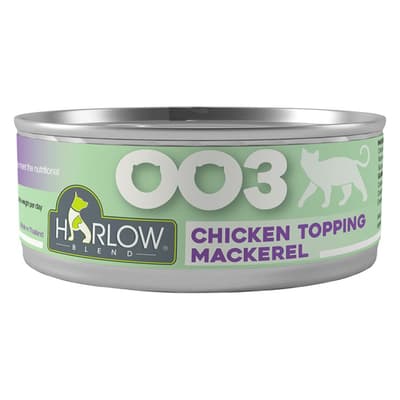
| Harlow Blend Maple Complete Wet Food 80g | Complete wet food | Labeled moisture 81%, protein 15%, fat 1.8% | $12 | $150/kg |
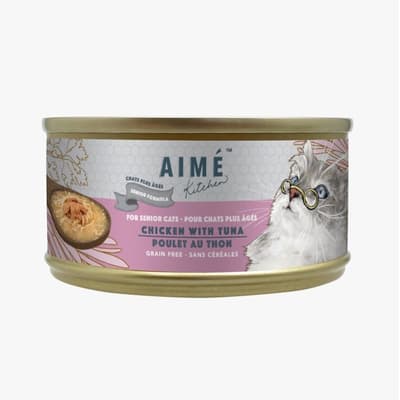
| AIME Senior Cat Can 75g | Complete wet food | Labeled calories 690 kcal/kg, moisture 85%, phosphorus 0.25% | $14 | $187/kg |
| Almo Nature Holistic Senior Care 85g | Complete wet food | Labeled protein 10.7%, fat 5.5%, phosphorus 0.16% | $11.3 | $133/kg |
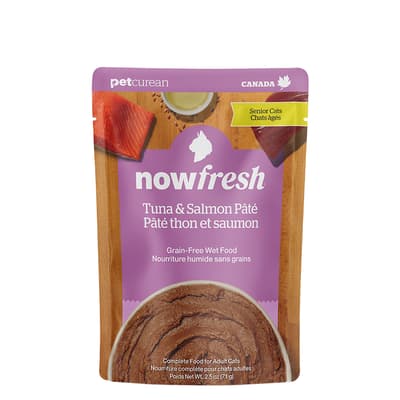
| now FRESH Grain-Free Senior Cat Pate 70g | Complete wet food | Labeled moisture 78%, calories 953 kcal/kg | $20 | $282/kg |
| HeroMama Complementary Wet Food Chunky Chicken 80g | Complementary wet food | Product positioning: side dish/supplement | $8 | $100/kg |
| Monster Tribe Hong Kong Style Fresh Soup Yam Chicken Fish Soup 80g | Complementary wet food | Product positioning: soup/supplement | $9 | $113/kg |
| Monster Tribe Buddha Jumps Over the Wall Emerald Stewed Chicken 80g | Complementary wet food | Product positioning: side dish | $9.2 | $115/kg |
| Mud Cat Road Complementary Wet Food Tuna + Chicken + Shrimp 82g | Complementary wet food | Product positioning: supplement | $18 | $220/kg |
Note the overlapping price range: Between $11-18 there are both complete and complementary wet foods. So "buying more expensive must be complete" is wrong—the only reliable method is to look at the nutritional statement.
Label identification method: 3 seconds to check
- 1st second—Look for "complete and balanced" / "Complete & Balanced" wording, usually printed on the side or upper back of the can, mostly stating compliance with AAFCO cat food nutritional standards (or FEDIAF).
- 2nd second—Look at the expected analysis: moisture, crude protein, crude fat, crude fiber, ash (some brands also list phosphorus, magnesium, sodium). Having this table usually means complete wet food; those with only one or two lines like "crude protein min x%" are mostly complementary.
- 3rd second—Look for taurine. AAFCO cat food standards require canned food taurine minimum 0.20% on a dry matter basis (0.10% for dry food); canned food loses more taurine due to high-temperature high-pressure sterilization, so the standard is doubled. If the can does not list taurine and has no complete nutritional statement = cannot be used as a staple food long-term.
Quick conversion: Canned food labeled protein 10%, moisture 85%, dry matter basis protein = 10 ÷ (100−85) × 100 ≈ 67%. So "canned food protein is very low" is an illusion; the low label is because water accounts for 80%.
Mixing ratio: you don't have to feed all canned
| Plan | Dry food : Complete wet food (calorie ratio) | Daily food moisture (estimated for 4kg adult cat 250 kcal) | Suitable for |
|---|---|---|---|
| All dry | 100 : 0 | About 6 ml | Budget priority, free feeding |
| Dry-based | 70 : 30 | About 85-95 ml | Most common balanced plan |
| Half wet half dry | 50 : 50 | About 135-145 ml | Cats at high risk of urinary/kidney issues |
| All wet | 0 : 100 | About 260 ml | Cats completely refusing dry food, cats with oral problems |
(Food moisture = daily intake × labeled moisture; dry food calculated at 8-12%, complete wet food at 78-88%. Complementary wet food is not counted in the staple food ratio.)
Correct use of complementary wet food: As a "aroma lure" for mixing or as a reward, 1/3 to half a can mixed into complete food each time, not exceeding 10-15% of total daily calories.
Daily cost: how to choose between complete and complementary wet food for value
If the packaging has labeled calories, you can directly calculate the cost per 100 kcal; a 4kg adult cat needs about 250 kcal per day.
| Product | Actual Price | Labeled Calories | Cost per 100 kcal | Daily Cost (250 kcal) |
|---|---|---|---|---|
| AIME Senior Cat Can 75g | $14 | 690 kcal/kg | About $27.1 | About $68 (all canned feeding) |
| now FRESH Senior Cat Pate 70g | $20 | 953 kcal/kg | About $29.6 | About $74 (all canned feeding) |
| HeroMama Complementary Wet Food 80g | $8 | Not labeled | Cannot calculate | Only for mixing, cannot replace staple food |
For complete wet food without labeled calories, compare by price per kilogram (also actual prices): Harlow Blend $150/kg, Almo Nature $133/kg, WeRuVa $100/kg.
Practical advice: All-canned feeding is a higher expense; most Hong Kong families use "dry food + one can per day": an extra $8-15 per day, while pulling food moisture from about 6 ml to over 60 ml, the best value for money.
Common questions
Q: Why is the price difference so large? Is expensive necessarily complete wet food? A: Not necessarily. $8 can buy complementary wet food; in the $11-18 range there are both complete and complementary. There is only one way to tell: look at whether the can has a "complete and balanced" nutritional statement, not the price.
Q: How long can complete wet food be kept after opening? A: Refrigerate for no more than 24 hours (sealed container). Discard if left at room temperature for more than half a day. Before feeding, you can add 1-2 tablespoons of warm water and mix to enhance aroma and hydration.
Q: What happens if complementary wet food is used as a main meal long-term? A: Complementary wet food (especially pure fish, pure soup types) has an incomplete calcium-phosphorus ratio and may not have added taurine; long-term use as the sole staple food will cause nutritional imbalance. It can be mixed daily, but the main meal must be complete and balanced food.
Q: How long does it take to transition to complete wet food? A: 7-10 days gradually. For the first three days, new food accounts for 20%, then increase by 20% every two days; if soft stools or vomiting occur, go back to the previous ratio.
Q: Does canned food need to be heated? A: No need to cook; room temperature or slightly warm (about 35-40°C with warm water) is ideal. Microwave heating is uneven and can easily burn the mouth.
Q: When to see a veterinarian? A: Sudden refusal to eat for more than a day, frequent vomiting after eating, persistent soft stools or blood in stool, obvious weight loss, male cat frequent urination but unable to urinate (possible urethral obstruction, needs emergency treatment)—all should seek medical attention as soon as possible.
Sources
- AAFCO Cat Food Nutrient Profiles: adult maintenance minimum crude protein 26% dry matter basis, growth 30%; taurine minimum 0.10% (dry food) / 0.20% (canned food) dry matter basis.
- WSAVA Global Nutrition Guidelines: confirm "complete and balanced" statement, assess feeding amount using body condition score (BCS) and calorie requirements.
- NRC (National Research Council) 2006: recommended daily total water intake for cats 50-60 ml/kg body weight.
- Product moisture, protein, phosphorus, calorie figures: PetChill product page packaging labels (checked 2026-10-02).
This article is general nutritional information and does not constitute veterinary diagnosis or prescription. Cats with illnesses should have their diet decided by a registered veterinarian.
Further reading
- Which Hong Kong cat food is good? 2026 Top 10 Popular Cat Food Brands Guide →
- 12 Popular Cat Foods Recommended by Scenario (Hong Kong Actual Prices) →
- Cat Canned Food vs Dry Food: Moisture Content, Water Intake and Daily Cost →
- Carrageenan, Guar Gum and 6 Other Gums at a Glance →
- Taurine and Fish Oil: How Much Per Day? →
- Phosphorus and Kidneys: mg/100kcal Comparison and Prescription Food Choices →
- Freeze-Dried vs Air-Dried: Processing, Rehydration and Daily Cost →
- The Truth About Grain-Free Cat Food: Grain-Free ≠ Low Carb →
- Cat Probiotics: Strains, CFU Dosage and Antibiotic Interval →
- Kitten Food Guide: Feeding Amount Curve and 14-Day Transition SOP →
- Senior Cat Food Guide: Protein, Phosphorus and Moisture After Age 7 →
📌 Key Summary
- ✅ Look for "Complete & Balanced" to count as complete wet food
- ✅ High protein, low carbs, clear meat sources, contains taurine
- ❌ Long-term use of complementary wet food as main meal causes nutritional imbalance
- ❌ Expensive ≠ complete; look at the can label
- ✅ Rotate multiple brands, 7–10 day gradual transition is safest
⚠️ Some products mentioned in this article have been discontinued (marked "discontinued" in the text); the prices are records before discontinuation; for other products, please refer to the current prices displayed on the online store.
 Almo Nature full guide →
 Kakato full guide →
 K9 Natural full guide →