For cats with chronic kidney disease (CKD), phosphorus is one of the most critical nutritional parameters: IRIS guidelines recommend a daily phosphorus density of ≤150 mg/100 kcal for stages 1-2 and ≤120 mg/100 kcal for stages 3-4, and suggest considering renal prescription diets from stage 2 and adopting them for stages 3-4. Healthy adult cats do not need deliberate phosphorus restriction; the key is to avoid long-term feeding of diets with excessively high phosphorus density and to let your veterinarian decide based on blood test results.
3 Key Points
- Focus on 'phosphorus per 100 kcal': Not the 'phosphorus %' on the packaging, because percentages for wet and dry food are not directly comparable.
- Blood tests are the basis for judgment: IRIS sets targets based on serum phosphorus (mg/dL): stages 1-2 2.7-4.5, stage 3 <5.0, stage 4 <6.0 mg/dL.
- Renal prescription diets are 'veterinary-guided products': They need to be chosen based on stage and blood test results, and should not be switched to long-term on your own.
The Relationship Between Phosphorus and the Kidneys
The kidneys are the main route for phosphorus excretion. When kidney function declines, phosphorus begins to accumulate, triggering renal secondary hyperparathyroidism, which is thought to accelerate kidney damage. Therefore, phosphorus control is central to CKD dietary management, while protein restriction is only needed later (too early and severe protein restriction can cause muscle loss).
IRIS Targets at a Glance
| Parameter | IRIS Stage 1-2 | IRIS Stage 3 | IRIS Stage 4 |
|---|---|---|---|
| Serum phosphorus target (mg/dL) | 2.7-4.5 | < 5.0 | < 6.0 |
| Dietary phosphorus density target (mg/100 kcal) | ≤ 150 | ≤ 120 | ≤ 120 |
| Follow-up blood test frequency | Every 4-6 months | Every 3-4 months | Every 3-4 months |
| Dietary intervention | Consider renal prescription diet | Recommend renal prescription diet | Recommend renal prescription diet |
| If dietary restriction fails after 4-6 weeks | Add phosphate binders | Same as left | Same as left |
(Phosphorus density of therapeutic renal prescription diets generally ranges from 80-135 mg/100 kcal. If a cat completely refuses prescription food, the veterinarian may consider a 'moderate-phosphorus, palatable maintenance food (<200 mg/100 kcal) plus phosphate binders'.)
Phosphorus Content Comparison of Hong Kong Products (Actual Packaging Labels)
The % and moisture figures in the table below are all taken from the packaging labels on PetChill product pages; dry matter basis phosphorus is converted from the labelled figures (not manufacturer-published values):
| Product | Type | Labelled phosphorus | Labelled moisture | Dry matter basis phosphorus (converted) | Hong Kong price | Price per kg |
|---|---|---|---|---|---|---|
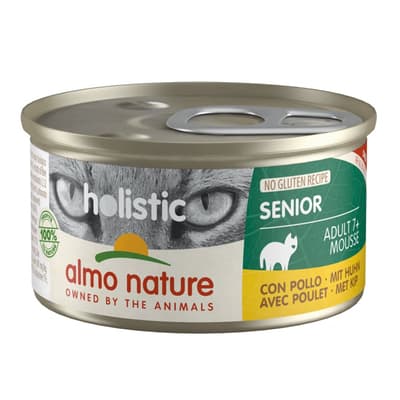
| Almo Nature Holistic Senior Care 85g | Wet food | 0.16% | Not stated (wet food typically about 78-80%) | About 0.76% | $11.3 | $133/kg |
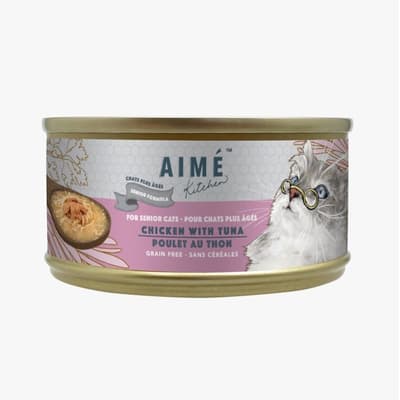
| AIME Senior Cat Can 75g | Wet food | 0.25% (maximum) | 85% | About 1.67% | $14 | $187/kg |
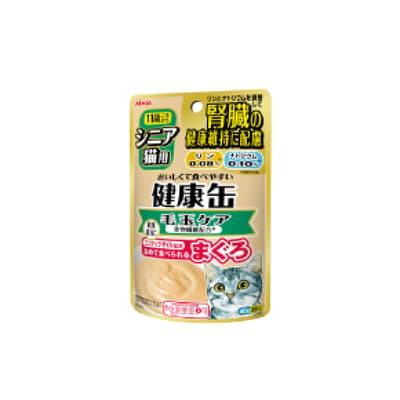
| AIXIA Low Magnesium Low Phosphorus Senior Cat Hairball Control 40g | Wet food | Labelled low magnesium low phosphorus formula | Wet food | — | $7.2 | $180/kg |
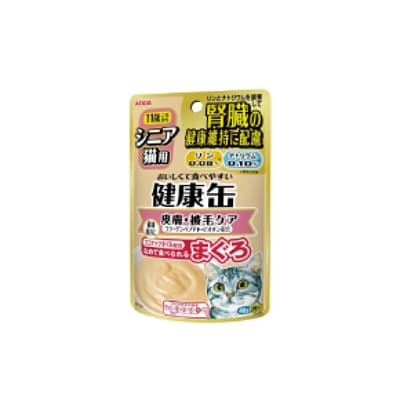
| AIXIA Low Magnesium Low Phosphorus Senior Cat Skin & Coat 40g | Wet food | Labelled low magnesium low phosphorus formula | Wet food | — | $7.3 | $183/kg |
| nutram Potato-Free Grain-Free All Life Stages Cat Food 5.4kg (discontinued) | Dry food | 0.8% | Dry food about 10% | About 0.89% | $397.6 | $74/kg |
| Leonardo Grain-Free Senior Cat Food 300g | Dry food | 0.9% | 10% | About 1.0% | $58 | $193/kg |
| HeroMama Probiotic Crystal Ball Center-Filled Food Wild Fresh Chicken 400g | Dry food | 0.9% | 8.7% | About 0.99% | $91 | $228/kg |
| HeroMama Probiotic Crystal Ball Center-Filled Food Deep Sea Cod 400g | Dry food | 1% | 9% | About 1.1% | $82 | $205/kg |
| ownat All Life Stages Cat Food Selected Free-Range Chicken and Turkey 400g | Dry food | 1.1% | 8% | About 1.2% | $70 | $175/kg |
| ownat All Life Stages Cat Food Neutered Weight Management 1kg (discontinued) | Dry food | 1% | 10% | About 1.11% | $140 | $140/kg |
| Instinct Freeze-Dried Kitten Food 9.5oz (discontinued) | Freeze-dried | 1% | 6% | About 1.06% | $86 | $320/kg |
| Animonda Diabetic Prescription Dry Food 1.2kg | Prescription dry food | Formula targets metabolism | 6% | — | $155 | $129/kg |
Interpretation: Maintenance foods for healthy adult cats generally have dry matter basis phosphorus of 0.8-1.5%, and the products above fall within the normal range. What needs attention is sick cats—the same food may be too high for CKD cats, so the value of prescription diets lies in clearly controlling phosphorus density.
Convert mg/100 kcal Yourself (3 Steps)
- Convert 'phosphorus %' to 'mg per 100 g': Phosphorus 0.25% = 250 mg per 100 g.
- Calculate how many grams correspond to 100 kcal from the labelled calories: For example, labelled 690 kcal/kg → 100 kcal = 1,000 ÷ 690 × 100 ≈ 145 g.
- Multiply back: 250 mg/100 g × 1.45 = about 363 mg/100 kcal.
Using the same method for the AIME Senior Cat Can in the table (labelled 690 kcal/kg, phosphorus 0.25%) gives about 363 mg/100 kcal. This figure is clearly higher than the IRIS recommendation for CKD cats (≤150 mg/100 kcal)—but remember: AIME Senior Cat Can is a maintenance food, not a renal prescription diet, and is fine for healthy cats; if your cat has been diagnosed with CKD, switch to a prescription diet specified by your veterinarian.
If the packaging does not state calories: You cannot accurately convert to mg/100 kcal; you can only compare 'dry matter basis phosphorus %' (column 2), or ask your veterinarian to decide based on blood test results and product information.
Prescription vs Non-Prescription Low-Phosphorus Options (Hong Kong Prices)
| Product | Positioning | Hong Kong price | Suitable for |
|---|---|---|---|
| Royal Canin Renal + Mobility Prescription Wet Food 85g | Prescription (RENAL+MOBILITY) | $20 | IRIS stages 2-4 (veterinary guidance) |
| Royal Canin Adult Renal + Mobility Prescription 2kg | Prescription dry food | $319 | IRIS stages 2-4 |
| Royal Canin Early Renal + Mobility Prescription 2kg | Prescription (Early Renal) | $319 | Early CKD (milder phosphorus restriction) |
| Hill's c/d Urinary Care Canned 2.9oz | Prescription (urinary) | $25 | History of urinary stones (not kidney disease) |
| ADVANCE Cat Wet Food Urinary Special 85g (discontinued) | Prescription (urinary) | $4.5 | Urinary prescription, requires veterinary instruction |
| AIXIA Low Magnesium Low Phosphorus Senior Cat Can 40g | Non-prescription (senior maintenance) | $7.2 | Daily for healthy senior cats, not for therapeutic use |
| Almo Nature Holistic Senior Care 85g | Non-prescription | $11.3 | Healthy senior cats; dry matter basis phosphorus about 0.76% (low) |
Important reminder: Urinary prescription diets (c/d, Urinary S/O) and renal prescription diets cannot be interchanged—the former targets stones (controlling magnesium, urine pH), the latter targets phosphorus and protein metabolism. Mixing them up can worsen the condition, so they must be specified by a veterinarian based on diagnosis.
Should Protein Be Restricted Too?
- Early stage (IRIS 1-2): Significant protein restriction is generally not recommended; the focus is on 'avoiding excess' while ensuring high-quality protein to prevent muscle loss. Literature commonly suggests about 5-5.4 g protein/kg body weight per day.
- Later stage (3-4): Protein is gradually reduced to alleviate uremic symptoms.
- Senior cats with CKD: They have a high risk of muscle loss, so protein quality (animal-based, highly digestible) is more important than quantity, and must be balanced by a veterinarian.
Daily Cost Comparison
| Option | Hong Kong price | Daily cost |
|---|---|---|
| Regular maintenance food (dry $74-90/kg) | From $397.6/5.4kg | About $10.5-16.8 (250 kcal estimate) |
| Prescription renal dry food 2kg | $319 | Depends on daily portion, follow veterinary instructions |
| Prescription renal wet food 85g | $20/can | Higher cost for all-canned feeding (reference general complete wet food: about $68-74/day) |
| Non-prescription low-phosphorus wet food | $7.2-11.3/can | Lower, but not suitable for diagnosed CKD |
Sources
- IRIS (International Renal Interest Society) CKD guidelines: serum phosphorus stage targets (stages 1-2 2.7-4.5 mg/dL, stage 3 <5.0, stage 4 <6.0); dietary phosphorus density recommendations (stages 1-2 ≤150 mg/100 kcal, stages 3-4 ≤120 mg/100 kcal); renal diet recommended for stages 2-4; add phosphate binders if dietary restriction fails after 4-6 weeks.
- Today's Veterinary Practice (2018), 'Feeding Cats With Chronic Kidney Disease': therapeutic renal prescription diets generally have phosphorus density of 80-135 mg/100 kcal; early stage suggests about 5-5.4 g protein/kg body weight per day.
- AAFCO cat food nutrient profiles: adult maintenance minimum phosphorus 0.5% dry matter basis, growth stage 0.8%.
- Product phosphorus content, moisture, calories, prices: PetChill product page packaging labels (checked 2026-10-02).
This article is general nutritional information and does not constitute veterinary diagnosis or prescription. The diet of a cat with kidney disease must be determined by a registered veterinarian based on blood test results.
Further Reading
- Which Hong Kong cat food is good? 2026 Top 10 Popular Cat Food Brands Guide →
- Senior Cat Food Guide: Protein, Phosphorus and Water After Age 7 →
- Canned vs Dry Cat Food: Moisture Content, Water Intake and Daily Cost →
- How to Tell Complete Wet Food from Complementary Wet Food? Label Identification →
- Carrageenan, Guar Gum and 6 Other Gums at a Glance →
- 12 Popular Cat Foods Recommended by Scenario (Hong Kong Prices) →
- Freeze-Dried vs Air-Dried: Process, Rehydration and Daily Cost →
⚠️ Some products mentioned in this article have been discontinued (marked 'discontinued' in the text); the prices are pre-discontinuation records. For other products, please refer to the current prices displayed on the online store.
 Royal Canin full guide →
 Almo Nature full guide →
 AIXIA full guide →