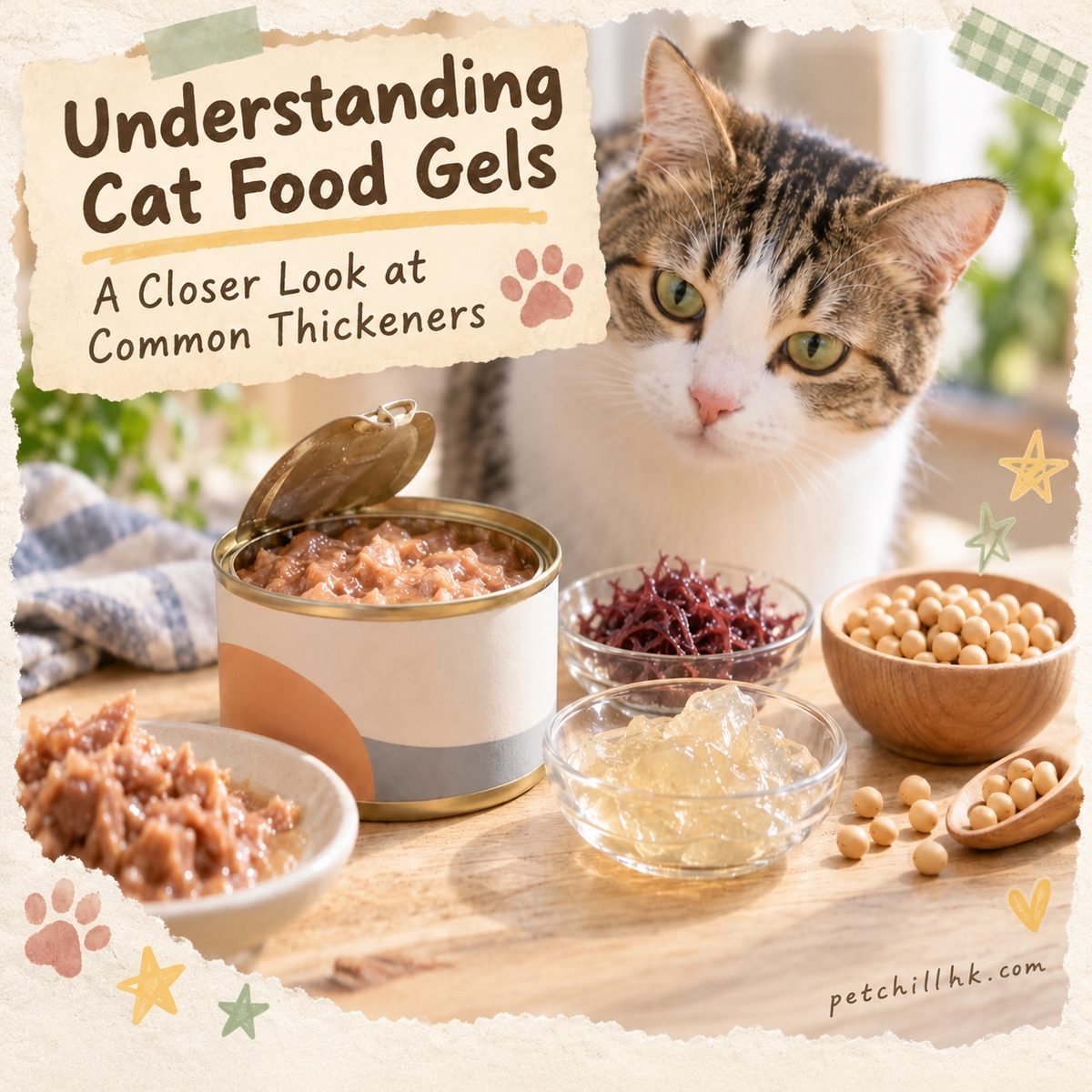
The gums (hydrocolloids) in canned food mainly serve to thicken, gel and prevent meat juice and water from separating, giving the food a consistent texture. Both the EU's EFSA and the international JECFA have assessed and approved the commonly used gums for safety; public discussion focuses on carrageenan (E407), but the real controversy is 'degraded carrageenan, poligeenan'—which is not a food additive and is not permitted in food. Cats with sensitive digestion can consider gum-free formulas, but there is no need to treat all gums as toxic.
3 key points
- Gums are not 'chemical toxins': most are natural polysaccharides (from seaweed, beans, tree gum, bacterial fermentation), and EFSA/JECFA have assessed and approved their use.
- Distinguish carrageenan from poligeenan: the former (E407) is approved for use and JECFA gave it 'ADI not specified'; the latter (degraded carrageenan, molecular weight 10-20 kDa) has never been approved as a food additive.
- Gum-free is an option, not a must: if your cat has chronic loose stools and food sensitivity is suspected, trying a gum-free formula is a reasonable elimination step, but it will not 'detox' your cat.
Comparison table of 6 common gums
| Gum | E number | Source | Function in canned food | Regulatory status (verifiable source) | Evidence/controversy focus |
|---|---|---|---|---|---|
| Carrageenan | E407 | Extracted from red algae (Eucheuma etc.) | Gelling, suspending, stabilising meat juice | EFSA 2018 re-evaluation: maintained temporary group ADI of 75 mg/kg body weight/day; subchronic toxicity study NOAEL 3,400-3,900 mg/kg body weight/day (highest tested dose), no carcinogenicity or genotoxicity concerns; JECFA gave 'ADI not specified' | In vitro (test tube) studies have suggested possible intestinal inflammation; clinical evidence in humans and cats has not established causation |
| Guar gum | E412 | Guar bean (legume) seeds | Thickening, water retention | EFSA 2017 re-evaluation and approval | A fermentable dietary fibre; large intake can cause loose stools |
| Xanthan gum | E415 | Fermentation by bacteria (Xanthomonas campestris) | Thickening, stabilising, heat-stable for sterilisation | EFSA 2017 re-evaluation: ADI 'not specified'; NOAEL 750 mg/kg body weight/day in newborn pigs | Partially fermented by gut microbiota into short-chain fatty acids; very high doses can cause loose stools |
| Locust bean gum | E410 | Carob tree seeds (galactomannan) | Gelling, preventing water separation | EFSA 2017 re-evaluation and approval | Synergistic thickening with xanthan gum, commonly used together |
| Cassia gum | E427 | Cassia (Senna obtusifolia/tora) seeds | Stable after high-temperature sterilisation, common thickener in canned food | Listed in the EU approved food additives list (must meet purity specifications) | Often used with xanthan gum; some products state the actual added amount (see below) |
| Agar | E406 | Red algae polysaccharide (agar-agar) | Gelling, mimicking meat jelly texture | EFSA re-evaluation and approval; ADI 'not specified' | An indigestible polysaccharide, mainly excreted in faeces |
How to read ADI? ADI (acceptable daily intake) is the level at which a regulatory body assesses that daily intake over a lifetime would not pose a risk. ADI 'not specified' usually means toxicity is very low and no limit is needed, not that it has not been assessed.
The carrageenan controversy: the source is poligeenan, not E407
Public concern about carrageenan mostly comes from animal experiments and in vitro studies in the 1970s-90s. It is important to distinguish two different substances:
| Item | Food-grade carrageenan (E407) | Degraded carrageenan (poligeenan) |
|---|---|---|
| Molecular weight | High (generally >100 kDa) | 10-20 kDa |
| Regulatory status | Approved for use in the EU, US and elsewhere | Never approved as a food additive, not used in food |
| EFSA 2018 conclusion | Subchronic study NOAEL 3,400-3,900 mg/kg body weight/day (highest tested dose); no carcinogenicity or genotoxicity concerns | Not within the scope of food additive risk assessment because it is not approved |
EFSA also noted that current specifications require analytical methods to verify the proportion of low molecular weight fraction (<50 kDa)—so the conclusion set the ADI as 'temporary' and requested additional data within 5 years. This reflects regulatory rigour, not a finding of harm.
Practical meaning for cats: there is currently no clinical study proving that cats eating commercial canned food containing carrageenan will develop gastrointestinal disease. For cats with chronic gastrointestinal problems, an elimination trial can include trying a gum-free formula, but it should be done with a veterinarian and other more common causes (food protein sensitivity, parasites, IBD) should also be considered.
Real label examples from Hong Kong products (checked 2026-10-02)
The following are ingredient labels actually seen on PetChill product pages, not speculation:
| Product | Gums shown (original label) | Hong Kong price | Price per kg |
|---|---|---|---|
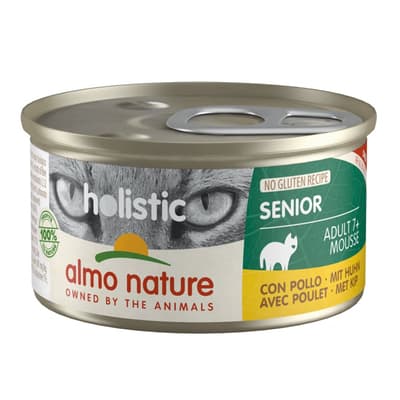
| Almo Nature Holistic Senior Care Chicken 85g | Additives: cassia gum 5,600 mg/kg (also labelled protein 10.7%, phosphorus 0.16%) | $11.3 | $133/kg |
| WeRuVa Complete Wet Food Chicken Breast with Pumpkin in Chicken Broth 156g (discontinued) | Ingredients contain guar gum, plus taurine, fish oil | $15.6 | $100/kg |
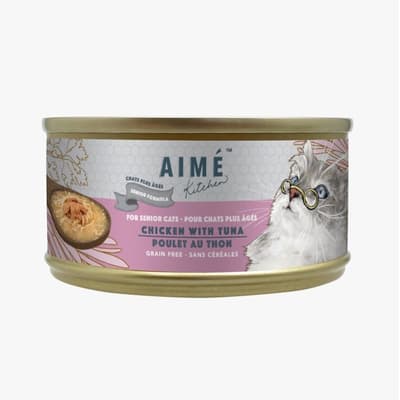
| AIME Senior Cat Can Chicken with Tuna 75g | Ingredients contain locust bean gum; labelled 690 kcal/kg, moisture 85%, phosphorus 0.25% | $14 | $187/kg |
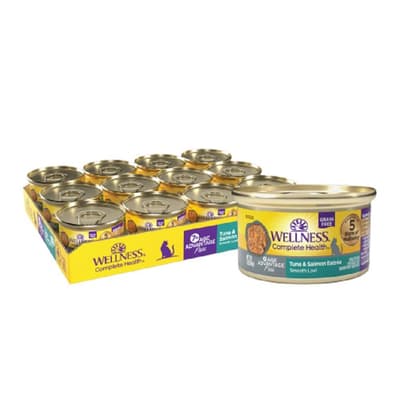
| WELLNESS Complete Health Senior Formula | Ingredients contain guar gum, cassia gum, xanthan gum (three used together) | $16.6 | $— |
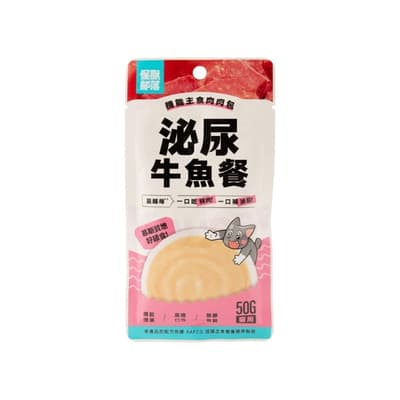
| Monster Tribe Functional Complete Meat Pack Urinary Beef & Fish 50g | Product labelled 'gum-free, grain-free, 100% fresh meat' | $15 | $300/kg |
| Cat Master Royal Gum-Free Fresh Soup Pack Tender Pure Chicken 55g | Product name labelled 'gum-free'; also contains taurine | $16 | $291/kg |
| Cat Master Royal Gum-Free Fresh Soup Pack Chicken + Grass-Fed Beef 55g | Product name labelled 'gum-free' | $16 | $291/kg |
Conversion example: Almo Nature labels cassia gum at 5,600 mg/kg, so an 85g can contains approximately 0.085 kg × 5,600 mg/kg ≈ 476 mg. This figure is a conversion from the label, not an indication of risk; it just lets you know how much you are feeding.
Gum-free/reduced-gum alternatives
| Approach | Method | Hong Kong examples |
|---|---|---|
| Choose gum-free formulas directly | Product labelled 'gum-free' or ingredient list has no gums | Monster Tribe Urinary Beef & Fish 50g $15, Cat Master Royal Gum-Free Fresh Soup Pack 55g $16 |
| Freeze-dried/air-dried complete food | Process does not require gum thickeners | Instinct Freeze-Dried Raw Kitten Food 9.5oz (discontinued) $86, ZiwiPeak Steam-Dried 800g $279 |
| Mixed feeding | Use complete wet food daily for hydration, replace 2-3 meals a week with gum-free or freeze-dried | Depends on choice, daily difference about $10-30 |
Daily cost comparison (actual prices)
| Product | Hong Kong price | Net weight | Price per kg | Daily cost (full canned feeding, 250 kcal estimate) |
|---|---|---|---|---|
| Almo Nature Senior Care 85g | $11.3 | 85g | $133/kg | Calories not labelled, cannot calculate |
| AIME Senior Cat Can 75g | $14 | 75g | $187/kg | Labelled 690 kcal/kg → about $68/day |
| Monster Tribe Urinary Beef & Fish 50g | $15 | 50g | $300/kg | Calories not labelled, cannot calculate |
| Cat Master Royal Gum-Free Fresh Soup Pack 55g | $16 | 55g | $291/kg | Soup pack is a topper type, calories not labelled |
Conclusion: products labelled 'gum-free' usually cost 1.5-2 times more per kilogram than regular canned food. If your cat has no gastrointestinal symptoms, you don't necessarily need to switch everything to gum-free; if your cat often has loose stools and other causes have been ruled out, trying a 4-6 week gum-free diet and recording symptom changes is a cost-controlled experiment.
30-second ingredient list check
- Ingredients are listed by weight, and gums usually appear in the middle to later part (after water and meat).
- Search for keywords: carrageenan, guar gum, xanthan gum, locust bean gum, cassia gum, agar.
- Check whether the added amount (mg/kg) is stated—if it is, it usually indicates higher transparency from the manufacturer.
- Look for water separation in the liquid and meat juice: without gums, natural meat collagen is relied upon, and the texture will be looser, which is normal.
Sources
- EFSA ANS Panel (2018), 'Re-evaluation of carrageenan (E 407) and processed Eucheuma seaweed (E 407a) as food additives', EFSA Journal, doi:10.2903/j.efsa.2018.5238—temporary group ADI 75 mg/kg body weight/day; NOAEL 3,400-3,900 mg/kg body weight/day; no carcinogenicity or genotoxicity concerns; poligeenan not approved as a food additive.
- EFSA ANS Panel (2017), 'Re-evaluation of xanthan gum (E 415) as a food additive', EFSA Journal, doi:10.2903/j.efsa.2017.4909—ADI 'not specified'; partial fermentation by gut microbiota; NOAEL 750 mg/kg body weight/day in newborn pigs.
- EFSA ANS Panel (2017), 'Re-evaluation of locust bean gum (E 410)' and 'Re-evaluation of guar gum (E 412) as a food additive', EFSA Journal.
- AAFCO cat food nutrient profiles—minimum taurine in canned food 0.20% on a dry matter basis (for comparing processing effects on nutrition).
- Product ingredient labels, prices, net weights: PetChill product pages (checked 2026-10-02).
This article is general ingredient information and does not constitute veterinary diagnosis or prescription. Cats with gastrointestinal symptoms should consult a registered veterinarian.
Further reading
- Which cat food is good in Hong Kong? 2026 top 10 popular cat food brands guide →
- How to tell complete wet food from complementary wet food? Label identification →
- Canned cat food vs dry food: moisture, water intake and daily cost →
- Cat probiotics: strains, CFU dosage and antibiotic spacing →
- Phosphorus and kidneys: mg/100kcal comparison and prescription diet choices →
- Freeze-dried vs air-dried: process, rehydration and daily cost →
- The truth about grain-free cat food: grain-free ≠ low-carb →
- 12 popular cat foods recommended by scenario (Hong Kong actual prices) →
⚠️ Some products mentioned in this article are discontinued (marked 'discontinued' in the text), and the prices are records from before discontinuation; for other products, please refer to the current prices shown on the online store.
 Almo Nature full guide →
 Royal Canin full guide →
 ZiwiPeak full guide →