Quick answers
- A domestic cat's thermoneutral zone is about 30 to 38°C, compared with 18 to 25°C for humans and 20 to 30°C for dogs: the air-conditioned room you find comfortable is actually on the cool side for a cat.
- Hong Kong Observatory 1991–2020 averages: July mean temperature 28.9°C, mean daily maximum 31.6°C; January mean temperature 16.5°C, mean daily minimum 14.6°C.
- Adult cats sleep 12 to 16 hours a day; kittens and cats over 10 can sleep 16 to 20 hours. 'Where to sleep' is one of the biggest decisions a cat makes each day.
- Three conditions for security: cover, more than 1 exit, and a clear view of the surroundings; each cat needs at least 2 separate resting spots, one warm and one cool.
- Moving from high spots to the floor isn't necessarily a problem, but if your cat hasn't been on the windowsill or cat tree for more than 3 days, along with hesitation before jumping or stiffness when getting up, treat it as a symptom.
The question 'Why does my cat prefer sleeping on the floor instead of a cat bed?' usually isn't answered by 'it doesn't like the bed' but by temperature and security. A domestic cat's thermoneutral zone (the range of environmental temperatures where it doesn't need to expend extra energy to keep warm or cool down) is roughly 30 to 38°C, much higher than a human's 18 to 25°C. So in a Hong Kong summer without air-conditioning, tiled floor may be the closest thing in the home to a cat's 'just right'; conversely, in winter or with air-conditioning running for long periods (typically set to 24 to 26°C), the same cat will seek out sunny spots or warm pads. The second factor is security: the environmental needs guidelines from the International Society of Feline Medicine (ISFM) and the American Association of Feline Practitioners (AAFP) state that cats need a private, safe 'safe point', usually located high up, and when a cat relaxes, that safe point becomes its sleeping spot. In small Hong Kong flats with few high surfaces, the floor is often the only flat surface that satisfies both 'cover' and 'multiple escape routes'.
The third situation is the easiest to overlook: sleeping on the floor can be a pain signal. The home modification guidelines from International Cat Care and ISFM both list 'sleeping in lower positions, sleeping in unusual locations' and 'reluctance or refusal to jump to high places' as major signs of musculoskeletal pain. So this article addresses three questions separately: how to calculate temperature, how to create security, and when to see a veterinarian. For an overall daily care routine, see also Pet Daily Care Hub.
Temperature first: a cat's comfort zone is higher than a human's, so an air-conditioned room feels 'cold' to a cat
According to 2006 data from the US National Research Council, a domestic cat's thermoneutral zone is about 30 to 38°C, a dog's is 20 to 30°C, and the comfortable living range for humans is about 18 to 25°C. This gap explains an apparent contradiction: in the same home, in summer a cat stretches out flat on the tiles, and in winter it curls up by the heater—both behaviours are the same thing, finding a surface where the body doesn't have to waste energy.
Cats cool down differently from dogs, mainly not by panting but through behaviour combined with a few physiological mechanisms:
- Conductive cooling: stretching out flat against a surface that conducts heat quickly (tiles, marble, metal, bathtub bottom), transferring body heat directly to the floor.
- Increasing surface area: lying on the side with limbs extended, exposing the belly and other areas with thinner fur.
- Grooming: saliva evaporating carries away heat.
- Reducing activity: moving less, lowering metabolic heat production.
- Panting: cats generally don't pant to cool down; if it occurs, treat it as a warning sign.
Conversely, when the environmental temperature is below the comfort zone, a cat's only option is to find a heat source, curl up, and retain body heat through soft cushions and fur. This is why 'the same soft cushion is a godsend in winter and an oven in summer'—the problem isn't the cushion's design but the match between the surface's thermal conductivity and the room temperature.
A practical approach is to measure it yourself: at the same time, use the same thermometer to measure the air one metre above the floor, the tiled floor, and the surface of the soft cushion. The three numbers are usually different, so you'll know which spot is most comfortable for your cat. Then use the seasonal table below to position beds—this will be more effective than blindly buying an expensive bed.
Security: the floor may be the only place in a Hong Kong flat that qualifies as a 'safe point'
The AAFP and ISFM 2013 environmental needs guidelines divide a healthy cat environment into five pillars. The first is 'provide safe points': for a cat, a safe point is a private, safe area, usually located high up, characterised by cover, isolation or concealment, and once a cat relaxes, the safe point becomes its sleeping spot. The second pillar requires 'multiple, separated key resources': food, water, litter tray, scratching post, play area and rest/sleep areas should each have multiple locations, and each cat should have at least two resting spots that are not placed together.
However, 'high up' is only a general description. In practice, cats choose sleeping spots based on three things:
- Cover: ideally blocked on three sides (cabinet edge, cardboard box, under the sofa); the cat doesn't need to be fully hidden, just 'unable to see potential threats' to relax.
- More than one exit: it must not be possible for another cat or a person to block the only exit.
- View: able to see entrances, exits and the family's movement paths.
In a 200 to 400 sq ft Hong Kong flat, high surfaces are already scarce, so 'floor + cabinet edge + cardboard box' is often the only combination that meets all three conditions. Conversely, many cat beds are placed 'in the middle of the living room, open on all sides, with only one exit'—to a cat, that's one of the least secure spots in the home. So when a cat doesn't use its bed, sometimes it's not the bed's fault but the placement.
Multi-cat households need extra consideration: if there's only one cat bed and it's in the main walkway, the more dominant cat will occupy it and the others will prefer the floor. The guidelines recommend that the number of safe points should be at least equal to the number of cats, placed apart, ideally with two entrances and exits.
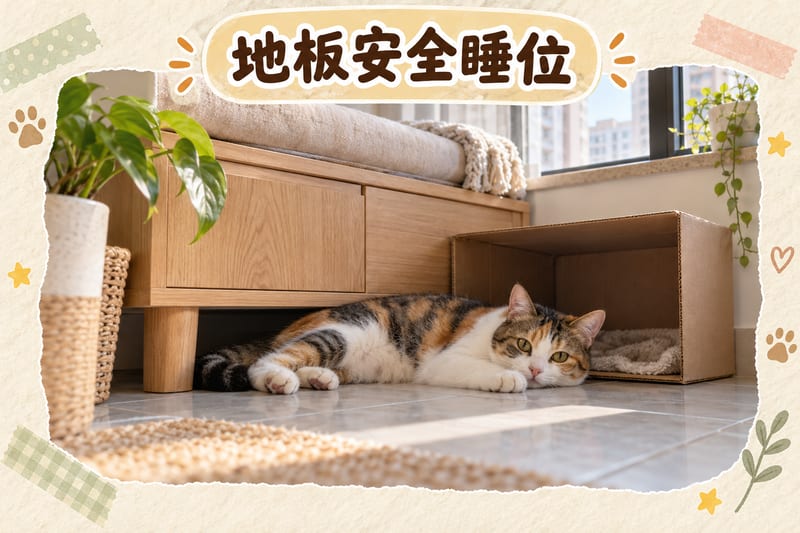
Floor vs soft cat bed: comparing heat conduction, height, hardness and cleaning
Now that we understand temperature differences and security, we can compare the two types of sleeping spot item by item. The last column of the table below gives the practical impact on the cat, making it easier to decide based on your own home.
| Comparison item | Hard floor (tiles/marble/wood) | Soft cat bed | Practical impact on the cat |
|---|---|---|---|
| Heat conduction speed | Fast; lying against it continuously draws away body heat | Slow; traps body heat | Floor is comfortable when the room is warm; soft bed is comfortable when it's cool |
| Surface hardness | Hard and flat; getting up doesn't require pushing | Soft and sinks; getting up requires effort | Cats with weak hind legs or joint pain usually choose hard surfaces |
| Height and view | Lowest, but open on all sides | Depends on placement; can be placed high | High spots offer a view, but landing must be safe |
| Cover and escape | Needs furniture bottoms or boxes for semi-enclosure | Has sides; can add a half-cover | Both can achieve it; placement is key |
| Warmth retention | Almost none | Yes | Soft beds clearly better in winter or air-conditioned rooms |
| Cleaning and odour | Wipes clean; neutral odour | Needs regular washing and thorough drying; retains own scent | Familiar scent is part of security, but dampness can cause mustiness |
After looking at the table, there are a few practical points. First, hardness is the most easily underestimated item: soft beds are comfortable for healthy young cats, but for cats whose hind leg muscles are starting to waste or whose joints are degenerating, a soft bed makes getting up require more effort and therefore more pain, so they choose hard floors. If you notice an older cat moving from the bed to the floor, don't immediately assume it 'doesn't like' the bed; consider whether getting up has become difficult.
Second, scent and cleaning. A soft bed retaining the cat's own scent is an advantage, but only if you don't wash it too often: washing every two days with a scented detergent may make the cat simply switch to a 'neutral-smelling' floor tile. Tiles wipe clean; soft beds don't need frequent washing if not dirty, and after washing they should be air-dried for at least 6 to 12 hours, completely dry before putting back, ideally with two sets to rotate.
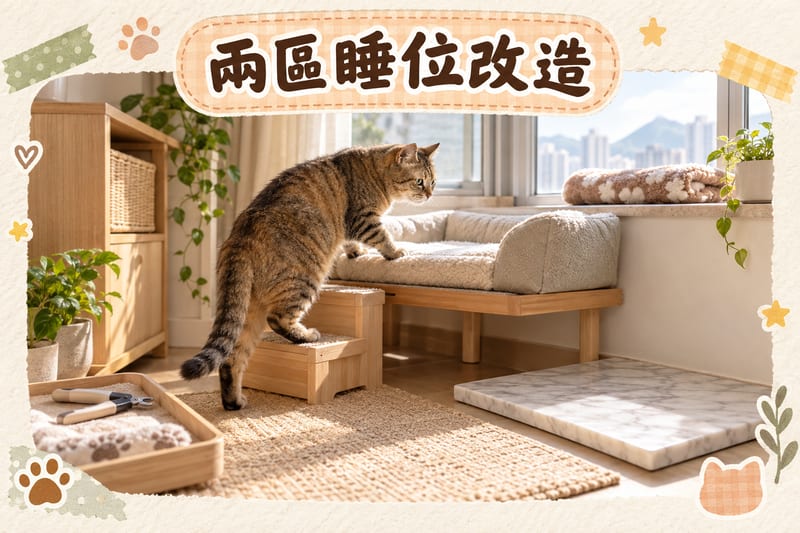
Third, it's not either-or. The guidelines require at least two resting spots per cat; the ideal combination is 'one hard, cool spot (summer) + one soft, warm spot (winter)', with the two at different heights so the cat can choose according to how it feels that day. Rather than buying one 'most expensive, best' bed, place two spots with 'different conditions'.
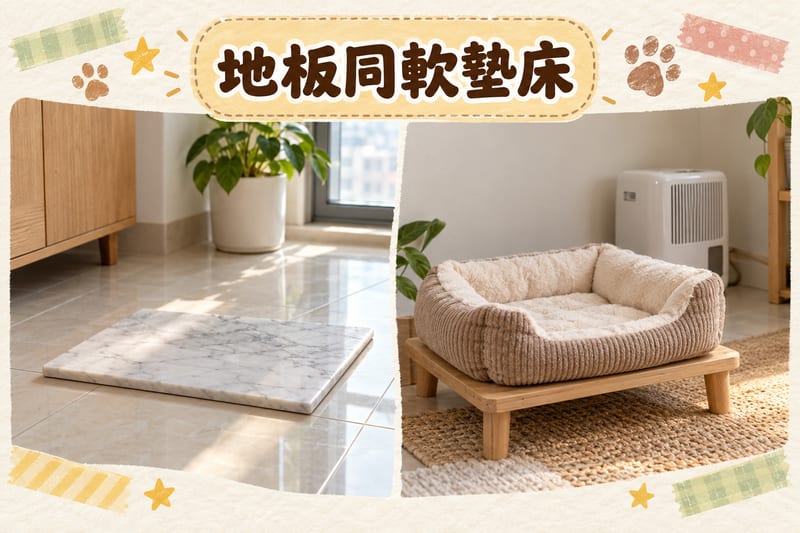
Where a cat sleeps and in what posture are driven by the same set of security signals; see also Cat Sleeping Positions Explained | What Your Cat's Sleeping Position and Location Mean.
Hong Kong's four seasons: when to lie on tiles, when to use a warm pad
The temperature swings in Hong Kong homes are larger than in many places: in summer, a flat without air-conditioning can be very stuffy, and in winter the cold floor can rob a cat of body heat. The table below uses the Hong Kong Observatory 1991–2020 monthly averages as background, combined with typical home situations, to list common scenarios and actions.
| Scenario | Environmental figures (HKO 1991–2020 averages) | Where the cat is most likely to choose | Suggested action |
|---|---|---|---|
| July, no air-conditioning | Mean temperature 28.9°C, mean daily maximum 31.6°C, sunshine 197.3 hours | Tiled floor, bathroom tiles, washbasin | Add a marble mat or cooling mat; place water in two locations |
| July, air-conditioning on for long periods | Air-conditioning typically set to 24 to 26°C, below the lower end of a cat's comfort zone at about 30°C | Warm spots away from vents, top of appliances, your lap | Keep one warm zone with a warming pad; don't let vents blow directly on the sleeping area |
| January | Mean temperature 16.5°C, mean daily minimum 14.6°C | Sunny spots, by the heater, your bed | Move the bed to a sunny spot; add a warming pad and raise it off the floor |
| Returning humidity and damp season | High relative humidity; soft beds hard to dry | Hard floor (dry) | Use washable beds, keep two sets to rotate, dry thoroughly |
This table has two practical conclusions. First, in the same July, your home may need both a cool zone and a warm zone. A living room with air-conditioning and a room without are two seasons to a cat; if you switch on and off frequently, the safest approach is to keep one cool and one warm spot fixed so the cat doesn't have to readjust each time.
Second, a cat's schedule is directly linked to temperature. Cats are crepuscular, and deep daytime sleep is mostly concentrated in the hottest hours, so in summer you'll see a cat lying on the tiles for long periods and only going up to the cat bed or windowsill when it cools down in the evening—this doesn't mean it has 'changed its ways', it's just following the temperature. To encourage your cat to use the bed more, make the bed's temperature conditions match the floor: in winter rely on sunlight and warming pads; in summer rely on ventilation or cooling mats.
Also, dehumidifiers make the air drier and evaporation cooling more effective, but they also remove moisture, so it's best to have water near the sleeping area. If a cat sleeps directly under an air-conditioning vent for long periods, besides being too cool, the airflow and dryness may increase irritation; adjust the direction or add a deflector.
When 'sleeping on the floor' is a symptom: distinguishing discomfort from refusal to go high
In most cases, a cat sleeping on the floor is a normal preference. What really deserves attention is behaviour change: moving from high to low, from soft bed to hard floor, and persisting. International Cat Care lists major signs of joint pain including 'reluctance, hesitation or refusal to jump up or down' and 'stiffness after resting'; the ISFM home modification guidelines, under 'decreased activity', directly state that 'sleeping in lower positions, sleeping in unusual locations' is an observed sign of musculoskeletal pain. The 2022 ISFM acute pain guidelines also remind us that cats are good at hiding pain, and that a smartphone video of jumping up and down is very helpful for a veterinarian's assessment.
The following table can be used as a guide: note that 'sleeping on the floor' itself isn't the problem; 'not going to high spots' plus other changes is the key.
| Observation | Is it a normal preference? | Suggested action |
|---|---|---|
| Sleeping on tiles during hot days, going up to the cat bed when it cools in the evening | Normal | Maintain one cool and one warm sleeping spot |
| Always sleeps on the floor but still jumps onto windowsill or cat tree | Normal preference | Improve bed placement and height; no special treatment needed |
| Hasn't been to a high spot for more than 3 days, won't even jump onto the cat tree | Possibly pain | Take a video, book a vet check for joints and hind legs |
| Hesitates or backs up before jumping, or uses climbing instead | Possibly pain | Add steps or a ramp, and book a vet appointment |
| Stiff when getting up, slow for the first few steps | Possibly joint pain | Book a vet; add non-slip mats on the floor |
| Arched back, hunched, head pressed to the floor, frequent position changes, crying at night | Possibly pain or discomfort | Book a vet as soon as possible |
| Lying on tiles with panting, drooling, hot ears and paw pads | Emergency | See a veterinarian immediately; possible heatstroke |
| Lying on tiles with decreased appetite, changes in drinking and urination, weight loss | Needs examination | Book a vet within a week |
It's important to distinguish two types of 'lying on the floor': lying on the floor in hot weather is cooling; lying on the floor in cold weather or an air-conditioned room may have other causes. If the weather isn't hot and the room temperature is normal, but the cat still lies for long periods on the coolest tiles or in the washbasin, along with changes in appetite, drinking, urination or weight, don't just assume 'it likes the cool'. Pain medication must be prescribed by a veterinarian; never use or stop medication on your own, as some human medications are severely toxic to cats.
Another ageing detail: overgrown claws. Cats with reduced activity have fewer chances to wear down their claws; the longer they grow, the more they curve, sometimes pressing into the paw pads, making every step painful and further reducing willingness to jump to high spots. Trimming can follow veterinary or pet groomer instructions; don't cut too close—stop when you see the pink blood vessel.
Getting your cat to use a cat bed: a 7-step practical checklist
The following seven steps start with 'conditions', not asking the cat to change its habits but changing the conditions of the sleeping spot. Observe for a week after doing them; most cats will redistribute their sleeping spots on their own.
- Measure temperature before placing: in summer, move the bed to a spot cooler than the floor, away from direct air-conditioning and single-aspect sunny windows; in winter, move it near sunlight or a heat source.
- Raise it to a certain height: aim for 40 to 60 cm off the ground, with a low stool or step so the cat can jump up easily. The key is 'can get up and land safely', not 'the higher the better'.
- Add cover: place one side of the bed against a cabinet edge or wall corner, or add a half-cover, so the cat feels 'blocked on three sides'.
- Retain scent: don't use a brand-new bed with scented detergent. Mix in a towel the cat has slept on, or use a shirt you've worn as a base.
- Two spots per cat, placed apart: at least two resting spots per cat, one cooler and one warmer, not in the same corner. In multi-cat households, the number should equal or exceed the number of cats.
- Floor support: in winter add a rug or non-slip mat on tiles; in summer place a marble mat or cooling mat as a 'cool zone' so the cat doesn't have to crowd into the bathroom to cool down.
- Address mobility issues: overgrown claws and slippery floors both reduce walking and jumping; regular claw trimming and non-slip surfaces will directly increase willingness to go to high spots.
After these seven steps, if your cat still hasn't been to a high spot for several consecutive days, along with the other signs mentioned earlier, book a vet appointment rather than continuing to change beds.
The following products are available in the PetChill online shop and relate to sleeping spots and daily care:
- Petio necoco Cat Nail Clipper with Safety Guard (91601544) — HK$132
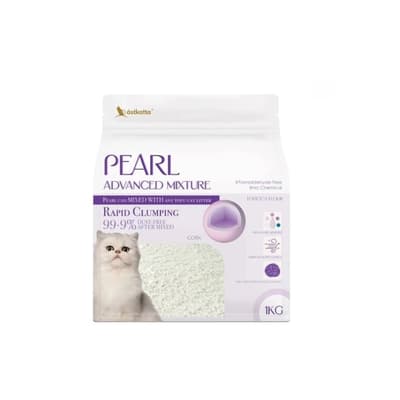
- Astkatta Cat Quick-Clump Dust-Free Mixed Pearl Cat Litter 1kg (P00179-1) — HK$28
- Ever Clean USA Mineral Cat Litter Blue Diamond Gold Label Coarse Low Dust Light Scent 4.2kg (LD4.2) (Bag) — HK$99 (available for pre-order)
Prices and stock are subject to the online shop's current listed price.
The three products relate directly to this article's topic. Claw clippers: cats with reduced activity have fewer chances to wear down claws, and overgrown claws affect walking and jumping; trimming method can follow veterinary instructions. Cat litter: cats that sleep on the floor are in close contact with dust, so coarse-particle or low-dust/dust-free formulas can reduce airborne dust; also remember that the litter tray must be far from the sleeping area—this is the AAFP/ISFM environmental guideline requirement for 'separated key resources'—a litter tray next to the cat bed will make the cat avoid both. For grooming frequency, see also Complete Cat Grooming Guide.
Further reading
- Pet Daily Care Hub | Grooming, Nails, Ears, Home Cleaning (2026)
- The Warm Secrets Behind Cat Kneading | 5 Behaviour Insights Every Hong Kong Cat Owner Should Know
- Cats Watching TV | Visual Science and Cat TV Safety Guide for Hong Kong Cat Owners
- Complete Cat Grooming Guide | Essential for Hong Kong Cat Owners: Daily Brushing to Protect Skin Health
In an emergency, contact a veterinarian immediately; this article is for reference only and cannot replace veterinary diagnosis.
Information checked as of 2026-10-12Source: PetChill Editorial Team
 Feline Natural full guide →
 Almo Nature full guide →
 Astkatta full guide →