Quick answers
- For cat trees in small Hong Kong flats, an upright model around 100 to 130cm tall with a narrow base fits the space best; for ceiling-height models, confirm the ceiling's load-bearing capacity and installation method first.
- Check the coating label before buying and choose products marked as water-based paint or non-toxic coating; if the paint and adhesive smell is sharp, air a new cat tree in a ventilated spot for a few days before letting your cat use it.
- Activated carbon itself is non-toxic to cats; the real risk is a charcoal pack being bitten open and the contents swallowed, so always place packs where the cat cannot reach.
- Pet microchips use the ISO 11784/11785 standard with 15 digits and must be read with a dedicated scanner at a veterinarian clinic or an Agriculture, Fisheries and Conservation Department recognised body; ordinary phone apps and phone browsers cannot read them because the frequency is different (134.2 kHz).
- Smart feeders and water fountains need regular dismantling and washing to prevent mould; trackers are only an aid and cannot replace a veterinarian's examination.
- Stainless steel, glass and some PP containers can go in the dishwasher; wooden, coated and electronic-part items cannot, and everything must be completely dry after washing.
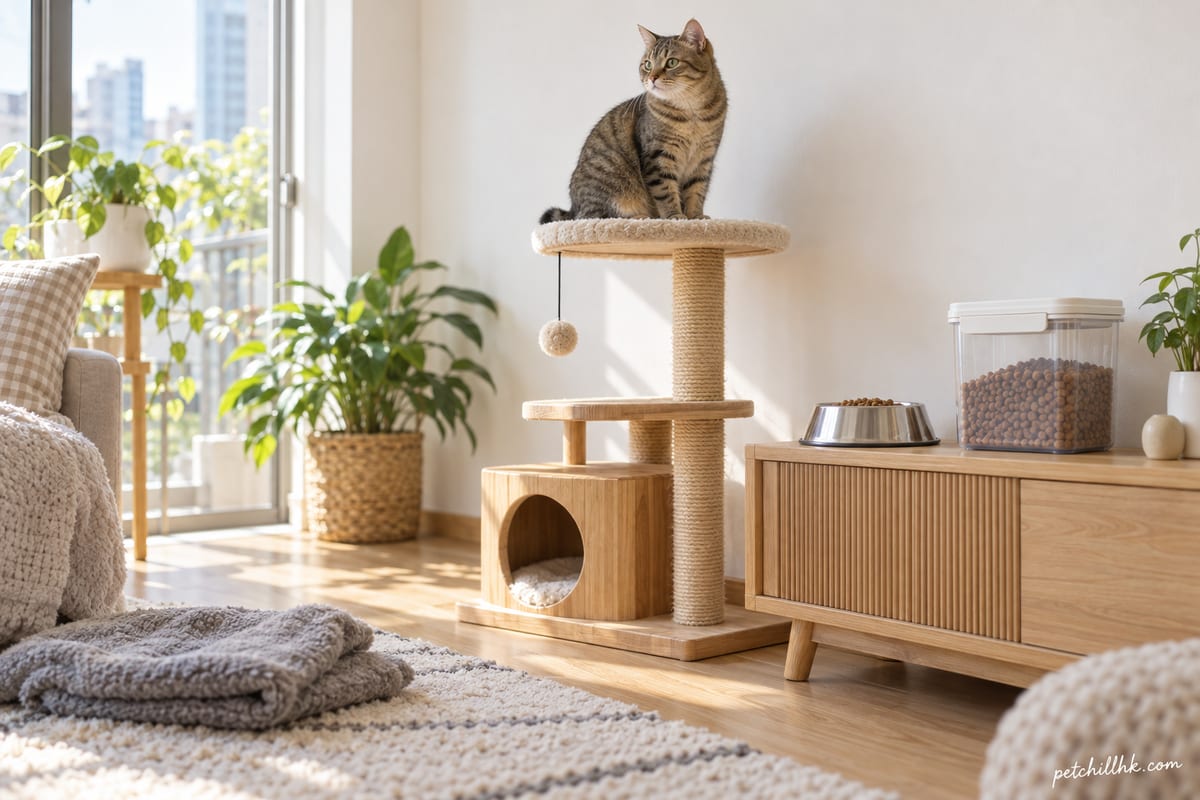
Hong Kong flats are generally small, and the cat tree, food bin, smart feeder and water fountain often all crowd into the same living room, sometimes even the same corner as the litter box. A small space does not mean you have to sacrifice safety: the cat tree's stability, its coatings and adhesives, where the deodorising charcoal packs go, and the cleaning cycles for smart devices all have objective ways to check them, so you do not need to guess by feel.
Below we break down each item: how to choose cat tree style and height for small Hong Kong flats, what labels to look for on solid wood coatings and adhesives, the 7-day safety check after delivery, the correct way to place activated carbon deodorising packs, the actual process for pet microchip checks, the cleaning cycles and safety limits for 3 types of smart device, and the material limits and drying requirements for washing cat food containers in a dishwasher. If you have not yet read the overall framework for daily care, start with the Pet Daily Care Guide and then come back to check each item.
How to choose a cat tree for a small Hong Kong flat: style, height and base size
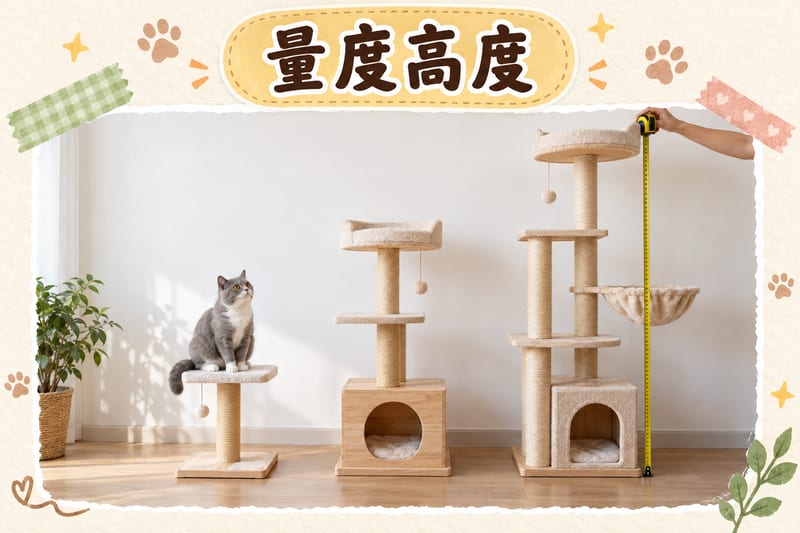
Choosing a cat tree is not a case of "the taller the better". The right order is: first measure the available space where it will go, then match your cat's age, weight and activity habits, and only then look at style and price. Common styles on the market fall roughly into 4 types:
| Style | Height characteristics | Base and footprint | Suitable for | Points to note |
|---|---|---|---|---|
| Low platform model | About 40 to 80cm | Small base, can go beside a windowsill or sofa | Kittens, senior cats, first-time cat tree users | Few platforms, limited scratching area |
| Standard upright model | About 100 to 130cm | Narrow base, placed against a wall | Single-cat or two-cat households in small Hong Kong flats | Must be against or fixed to a wall to avoid rocking back and forth |
| Tall multi-level model | About 140cm and above | Larger base, noticeably more floor space | Enough space, active adult cats | Takes up space, harder to move and clean |
| Ceiling-height model | From floor to ceiling | Load carried by the pole, not the base | Flats wanting to use vertical space fully | Must confirm ceiling load-bearing capacity and installation method |
The most common choice in small Hong Kong flats is the standard upright model around 100 to 130cm tall with a narrow base: tall enough for the cat to jump up and down and survey the room, while the base does not take up too much floor space. This height roughly corresponds to a person's waist to chest when standing, so a cat can hop up via the sofa or a low cabinet without needing one big leap. If the flat is really narrow, choose an upright model against the wall, or a low platform model paired with a windowsill or desk.
Ceiling-height models can "use the full height", but not every ceiling suits them. Before installing, always confirm the ceiling's load-bearing capacity and fixing method; if you rent, ask the landlord's permission first, because holes may need to be drilled in the wall or ceiling. If in doubt, do not force the installation; switch to an upright model against the wall with anti-tip fittings, which carries much less risk.
3 principles for height and placement:
- Start from the cat's route: cats like to observe from high up, but they need a step-by-step route up. The distance from the floor to the first platform should be shorter for kittens and senior cats.
- The base must be wide enough: the taller the unit, the wider the base needs to be relative to it. A narrow base with a tall body will rock back and forth the moment a cat charges up.
- Against or fixed to a wall: placing it against a wall uses the wall to reduce back-and-forth rocking; if needed, use anti-tip fittings to secure the pole to the wall.
Adjust by age: Kittens are not yet coordinated and are at greater risk of falling from height, so start with a low model and follow the environment setup principles in the Kitten Care Guide; cats over 7 years old start to have joint degeneration, so jumping heights should be lowered and intermediate steps between platforms will be more comfortable, as covered in the Senior Cat Care Guide. If your cat is indoor-only with low activity, besides adding a cat tree, you can also use scratching boards and toys to increase vertical and horizontal activity.
Paper scratching board products are affordable and good for testing your cat's acceptance first. For example, the Corrugated Cardboard Cat Scratching Board Cat Tree Kindergarten Bus — HK$118, is a low, lightweight entry-level option that works flexibly beside a windowsill or sofa. Prices and stock are subject to the live price shown on the online store.
Coatings and adhesives on solid wood cat trees: what labels to check before buying
Solid wood cat trees are popular because they are durable, look good and feel solid. But the wood itself has to be treated: the surface needs a coating (paint, wood oil or wax), joints need adhesive, and the rope ends on sisal poles need glue to fix them. Cats scratch and lick their paws every day, so paws and mouths come into contact with these materials, which makes coatings and adhesives the parts most worth spending time on.
When buying, check 4 things:
- Coating label: prioritise products marked "water-based paint" or "non-toxic coating". Water-based paint uses water as the solvent and usually smells less than solvent-based coatings. The more specific the label (which coating, which part it is used on), the more assurance it generally gives.
- Smell on opening: if the paint or glue smell is sharp and does not fade after a few days, do not let your cat use it yet; go back and ask the seller.
- Adhesive: check joints for glue overflow or sticky residue. If you find glue marks on a new delivery, wipe once with a damp cloth and dry it.
- Sisal rope and pole: the rope should be wrapped tightly and not come loose easily; if there are obvious glue marks at the rope ends, wipe them clean before letting your cat scratch.
Order of handling a new purchase: After unboxing, put it in a well-ventilated spot away from your cat's main activity area and let the smell fade for a few days before moving it into the living room. During the airing period you can do the full inspection at the same time, completing both jobs in one go rather than separately.
| Check item | Ideal situation | Points to watch |
|---|---|---|
| Coating label | Marked water-based paint or non-toxic coating | No coating information at all, only "solid wood" |
| Smell on opening | Faint wood smell, fades within a few days | Sharp, pungent, still strong after a few days |
| Adhesive | Joints clean, no overflow | Obvious glue marks, sticky to the touch |
| Sisal pole | Wrapped tightly, rope ends finished | Loose, rope coming off, lots of glue marks |
| Surface finish | Sanded smooth, no splinters | Exposed splinters, sharp edges |
Splinters and sharp edges deserve special mention. When a cat scratches a wooden pole, its front paws press against the surface, and exposed splinters can cut the paw pads, which may then become inflamed. On delivery, run the back of your hand over it once (do not press hard with your fingertips); if you feel splinters, sand them gently with fine sandpaper and wipe away the wood dust. This habit is the same as the daily skin checks mentioned in the Pet Skin Health Guide: "find it early, deal with it early", rather than waiting until the paw pads are already red and swollen.
The 7-day safety check after delivery: stability, screws and smell
With a new cat tree, it is not advisable to move it straight into your cat's main activity area after unboxing. Spend 7 days checking it in stages, then officially put it into use, and you will feel much more at ease:
Days 1 to 2: smell and appearance
- Put it in a ventilated spot to air out, as far as possible from the sleeping area and food bowls.
- Check that all components are present and that the boards have no cracks, chips or obvious colour differences.
- Run the back of your hand over the surface and edges once and deal with any splinters.
Days 3 to 4: assembly and screws
- Assemble in the order given in the instructions. Do not tighten the screws fully at first; put them all in, then tighten them one by one.
- Check for stripped screws and loose joints.
- Press each platform, step and hammock gently to see if anything is loose or squeaks.
Days 5 to 7: stability test and putting into use
- Vigorous shake test: hold the middle of the pole and rock it gently back and forth and side to side a few times, and see whether the base lifts off the floor or the whole unit shifts.
- A base that lifts off the floor means it is unstable: retighten the screws, or add anti-slip pads and weight the base.
- Once it is confirmed stable, place it where your cat will walk past and let it explore on its own; do not pick the cat up and put it straight on.
3 things to watch in daily use:
- Screws: check each one every 2 to 3 months. A cat's jumping and impact are constant, and screws will gradually loosen.
- Sisal rope: a loose spot will get bigger the more it is pulled, so deal with it early once it comes loose to stop the cat eating rope fragments.
- Base: in homes with multiple cats chasing each other or with children, the base may get knocked out of place, so put it back during each clean.
Also, if the cat tree is directly under an air-conditioning vent or sits in the sun by a window for long periods, the wood and sisal rope will age faster. These spots are not off-limits, but the joints need checking more often.
Deodorising charcoal packs and activated carbon: are they safe for cats? How to place them correctly
Many Hong Kong households put activated carbon deodorising packs beside the litter box, in the shoe cabinet or under cupboards. Activated carbon itself is non-toxic to cats; it works by using its porous structure to adsorb odour molecules and does not release toxic gases, so there is no need to worry that "putting it out will poison the cat".
The real risk is not the activated carbon but the packaging:
- Charcoal packs are mostly wrapped in non-woven fabric or paper bags, and if a cat bites the packaging open it may swallow the contents and packaging fragments.
- Cats are especially interested in bag-like objects and will bat them with their paws and bite them, especially small packs beside the litter box.
- Swallowing non-woven fabric or activated carbon granules may cause stomach upset and even a risk of blockage. If there is vomiting, reduced appetite or low energy, see a veterinarian immediately.
4 steps for safe use:
- Place it where the cat cannot reach: inside cupboards, drawers, behind the litter box cabinet, or in a fixed case.
- Do not use open mesh bags on the floor or beside the litter box. If you really must place something in the litter box area, choose a style with a hard outer case that a cat's paw cannot pry open.
- Check the packaging regularly for bite marks and holes, and replace it as soon as it is damaged rather than patching it up and carrying on.
- Remember that deodorising is only an aid: scooping the litter box daily, changing the litter in the whole box regularly and keeping the area ventilated are the mainstays of odour control.
A reminder: if your cat is avoiding the litter box because of odour, or is urinating in inappropriate places, rule out urinary and digestive problems first rather than just adding charcoal packs. For related situations, see Cat Constipation: Management and Daily Prevention and the Pet Digestive Health Guide, and arrange a veterinarian examination as needed.
Pet microchip checks: why phone apps cannot read them
A pet microchip is a tiny device implanted under the skin; the common standard in Hong Kong is ISO 11784/11785, carrying a 15-digit identification number. This number itself does not contain owner details; it must be matched against the registration database and issuing body's records to find the registered information.
Why can't an ordinary phone read it?
- Pet microchips operate at 134.2 kHz, which is a low frequency.
- A phone's built-in wireless sensing is on a different frequency band from pet microchips, so the phone itself cannot sense the chip.
- Some "chip scanning apps" on the market rely on a Bluetooth external reader; it is not the phone itself reading it. A phone browser or ordinary app alone cannot read the chip number.
The correct checking process:
- Take the cat to a veterinarian clinic and have the veterinarian read the chip number with a dedicated scanner. The process is quick and generally does not need anaesthesia.
- Or enquire at an Agriculture, Fisheries and Conservation Department recognised body or related service point.
- Once the 15-digit number is read, verify the owner's details through the registration database and issuing body's procedure.
- If no number can be scanned, the chip may have migrated, failed, or never have been implanted; have a veterinarian examine further.
Always update details when you move home or change phone number. The chip number does not change, but the registered details must be updated by the owner. If your phone number or address changes and you do not update them, even if someone scans the chip when the cat is lost, they will not be able to contact you. It is best to sort this out within a month of moving, and to ask the veterinarian to scan again during the annual check to confirm the chip is in the normal position.
| Checking method | Can read the chip number | Characteristics |
|---|---|---|
| Veterinarian clinic dedicated scanner | Yes | Most direct and reliable, and the chip position can be checked at the same time |
| Agriculture, Fisheries and Conservation Department recognised body | Yes | Handled through official procedures |
| Phone built-in wireless sensing | No | Different frequency band from pet microchips (134.2 kHz) |
| Phone app with external reader | Partly | Depends on whether there is external reading hardware; not a function of the phone itself |
Smart feeders, water fountains and trackers: cleaning cycles and safety limits
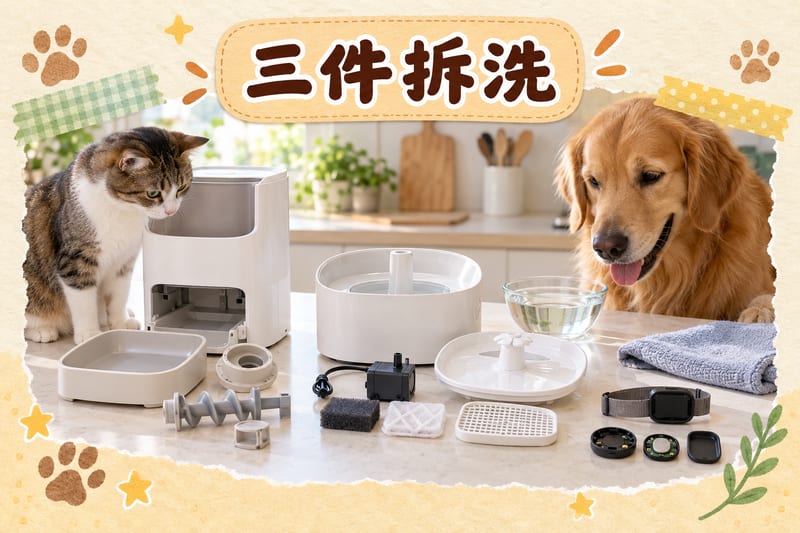
Smart devices are convenient, but food and water stay inside the machine for long periods, and if cleaning is insufficient they become a breeding ground for mould and bacteria. Here are the key points for 3 common types of device:
Smart feeders
- The food trough, dispensing outlet and auger are the most likely places for food powder and oil to build up; wipe them once each time you refill.
- Do not keep topping up the storage bin with old food; clear out old food left at the bottom of the bin to avoid mixing old and new food and damp.
- Dismantle and wash removable parts as instructed, and dry them completely before reassembling; never add food while parts are still wet.
Water fountains
- The pump, filter cotton and water tray should be dismantled and washed at the interval specified by the manufacturer; filter cotton is generally a consumable and should be replaced regularly.
- Rinse and change the water in the tray daily, and check the filter cotton and pump at least once a week.
- If the water tray feels slimy to the touch, a biofilm is starting to form; wash it thoroughly immediately and replace the filter.
Trackers
- Bluetooth or location trackers can help you know your cat's approximate position, but signals are affected by the environment and readings may be delayed or inaccurate.
- A tracker is only an aid and cannot replace a veterinarian's examination. For situations such as a cat not eating, low energy or abnormal breathing, go straight to a veterinarian even if the tracker shows normal activity.
- For trackers attached to a collar, check the buckle and weight regularly to avoid catching on furniture; collars with a safety buckle design are safer.
| Device | Parts to clean | Suggested frequency | Points to note |
|---|---|---|---|
| Smart feeder | Food trough, dispensing outlet, auger | Wipe at each refill, deep dismantle and wash as instructed | Avoid mixing old and new food in the storage bin |
| Water fountain | Water tray, pump, filter cotton, filter | Rinse tray daily, check filter cotton weekly | Wash thoroughly as soon as it feels slimy |
| Tracker | Casing, buckle, charging contacts | Wipe once a week | Only an aid, cannot replace a veterinarian's examination |
Power supplies and cables also need attention: use the original adapter, do not share the same extension board with high-power appliances, and keep cables tidy to stop cats biting them. Cats biting cables is a common home accident; use cable trunking or cable covers, and tie up excess cable so it does not dangle. If your cat is especially interested in cables, use scratching boards and toys to redirect its attention and reduce the chance of it playing with them.
Can cat food containers be washed in a dishwasher? Materials and points to note
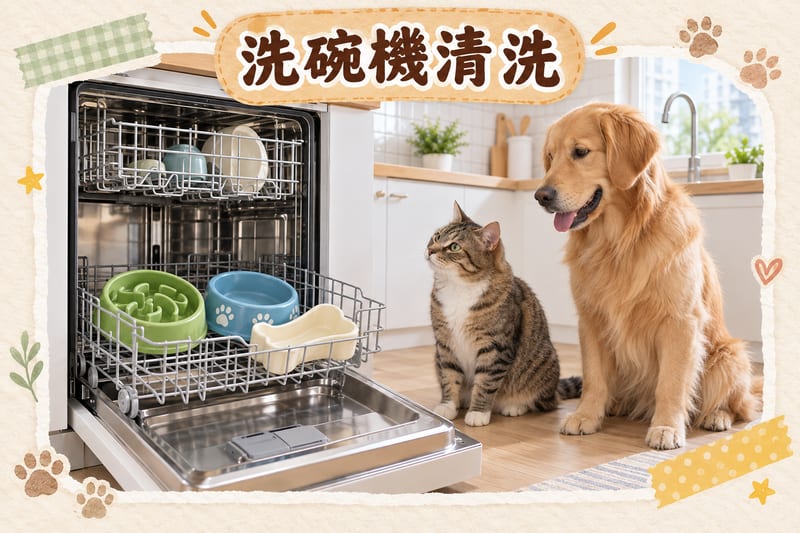
Whether cat food containers, water bowls and wet food dishes can go in the dishwasher depends on the material. The high temperatures and detergents in a dishwasher are unkind to some materials, and forcing them through can cause warping, coating loss or water ingress.
Dishwasher-safe:
- Stainless steel: heat-resistant and does not easily absorb odours, the most common safe choice.
- Glass: heat-resistant glass is fine, but place it securely and avoid knocks.
- Some PP (polypropylene) containers: check the product label, and only put in ones marked dishwasher-safe.
Not recommended for the dishwasher:
- Wooden containers and wooden bowls: high heat and soaking make wood crack and grow mould.
- Coated containers: the coating may be washed off and then come into direct contact with food.
- Parts with electronic components: the main unit, sensors and battery compartment of a smart feeder must not get wet.
- Silicone parts and seals: some can be removed and washed, but follow the label; if unsure, wash by hand.
The key step after washing: dry completely. If moisture remains on the inner walls of a container, the food will become damp and the mould risk rises. After washing, turn it upside down in a ventilated spot, or dry it with a clean cloth, and confirm it is completely dry before adding new food. Seals and lid edges trap water easily, so removing them to dry will speed things up.
| Material | Dishwasher-safe? | Points to note |
|---|---|---|
| Stainless steel | Yes | Avoid knocking against items that scratch easily |
| Glass | Yes | Place securely, avoid large temperature differences |
| PP containers | Partly | Check the product label, only put in ones marked safe |
| Wooden containers | No | Soaking makes them crack and grow mould |
| Coated containers | No | The coating may be washed off |
| Electronic parts | No | Main unit, sensors and battery compartment must not get wet |
If you transfer dry food into a bin after opening, remember to write down the opening date, and put the original bag inside the airtight bin too, sealed with a clip, to reduce damp and oxidation. Treats should also be stored as the packaging instructs; opened wet food must be refrigerated and eaten within the time stated on the packaging. Serving treats on a clean small dish goes well with small packs such as CIAO Cat Treats Japan INABA Churu Spoon Tuna 14g×3P — HK$15, opening one small pack at a time to reduce how long opened food is stored. Prices and stock are subject to the live price shown on the online store.
Incidentally, it is best to keep cleaning items for the food bin, water bowls and litter box separate, and not to share the same cloth. This principle matches the cleaning zoning approach mentioned in the Pet Supplies Buying and Maintenance Guide.
Whole-home safety checklist: daily, weekly, monthly
Remembering so many items is hard, so dividing the work by frequency makes it simple:
Daily
- Scoop the litter box, and check the activated carbon packs for bites at the same time.
- Change the water in the fountain and rinse the water tray.
- Check whether the cat tree base has shifted, and whether there is a risk of heavy objects on cabinets being pushed off by the cat.
Weekly
- Wipe the sensors and casing of smart devices.
- Check cables for bite marks, and the tracker's buckle and battery.
- Check the cat tree's sisal rope and platform joints.
Monthly
- Tighten each cat tree screw.
- Deep dismantle and wash the feeder and water fountain (as instructed).
- Check the food bin seal and replace the water fountain filter cotton.
Quarterly
- Redo the cat tree stability test.
- Check the power cables and plugs of all smart devices.
- Verify microchip registration details (if you have moved home or changed phone number).
Most home accidents do not happen "all at once"; they build up from a screw that has been loose for months, a charcoal pack that has been bitten through, or a cable that has dangled for a long time. Dividing the work by frequency means spending only a few minutes each time, and the risk drops a great deal.
Frequently asked questions
Q: Are the coatings or finishes on solid wood cat trees harmful to cats?
A: The label and the smell are what matter. Choose products marked as water-based paint or non-toxic coating, and avoid items that only say "solid wood" with no coating information; if the paint or glue smell is sharp on opening and does not fade after a few days, do not let your cat use it. Let a new cat tree air out in a ventilated spot for a few days first, and complete the stability and screw checks at the same time, then move it into your cat's main activity area once everything checks out.
Q: Which style of cat tree do Hong Kong owners usually choose?
A: In small Hong Kong flats, the most common choice is an upright model around 100 to 130cm tall with a narrow base, placed against or fixed to a wall, tall enough for the cat to jump up and down and survey the room without taking up too much floor space. For ceiling-height models, confirm the ceiling's load-bearing capacity and the installation method, and if you rent, ask the landlord first. For kittens and senior cats, choose models with lower platforms and intermediate steps.
Q: Is the activated carbon inside deodorising charcoal packs safe for cats?
A: Activated carbon itself is non-toxic to cats; the risk is the packaging. If a cat bites open a charcoal pack, it may swallow the contents and non-woven fabric fragments, causing stomach upset. Place packs where the cat cannot reach, such as inside cupboards, drawers or a fixed hard case, not on the floor or beside the litter box; check the packaging for bite marks during each clean and replace it immediately if damaged.
Q: Do I need a specific app or website to look up pet microchip data in a phone browser?
A: A phone browser cannot read microchip contents. Pet microchips use the ISO 11784/11785 standard with 15 digits and operate at 134.2 kHz, which is a different frequency band from a phone's wireless sensing, so ordinary phones cannot read them. The correct approach is to go to a veterinarian clinic or an Agriculture, Fisheries and Conservation Department recognised body, have the number read with a dedicated scanner, then verify the owner's details through the registration database procedure.
Q: Can cat food containers be washed in a dishwasher?
A: It depends on the material. Stainless steel, glass and some PP containers marked dishwasher-safe are fine; wooden, coated and electronic-part containers are not, because they can crack, grow mould, lose their coating or take in water. After washing, always dry completely; residual moisture on the inner walls makes the food damp and raises the mould risk, so confirm it is dry before adding new food.
Further reading
- Pet Daily Care Guide: cat litter, cleaning, grooming, nail care
- How to choose cat litter, body weight scales and smart products? Hong Kong pet supplies buying and maintenance guide
- Kitten Care Guide
- Senior Cat Care Guide
- Pet Skin Health Guide
- Cat Constipation: Management and Daily Prevention
Veterinary warning: In an emergency, contact a veterinarian immediately; this article is for reference only and cannot replace a veterinarian's diagnosis. Information checked as of 2026-10-13 · Source: compiled by the PetChill editorial team