
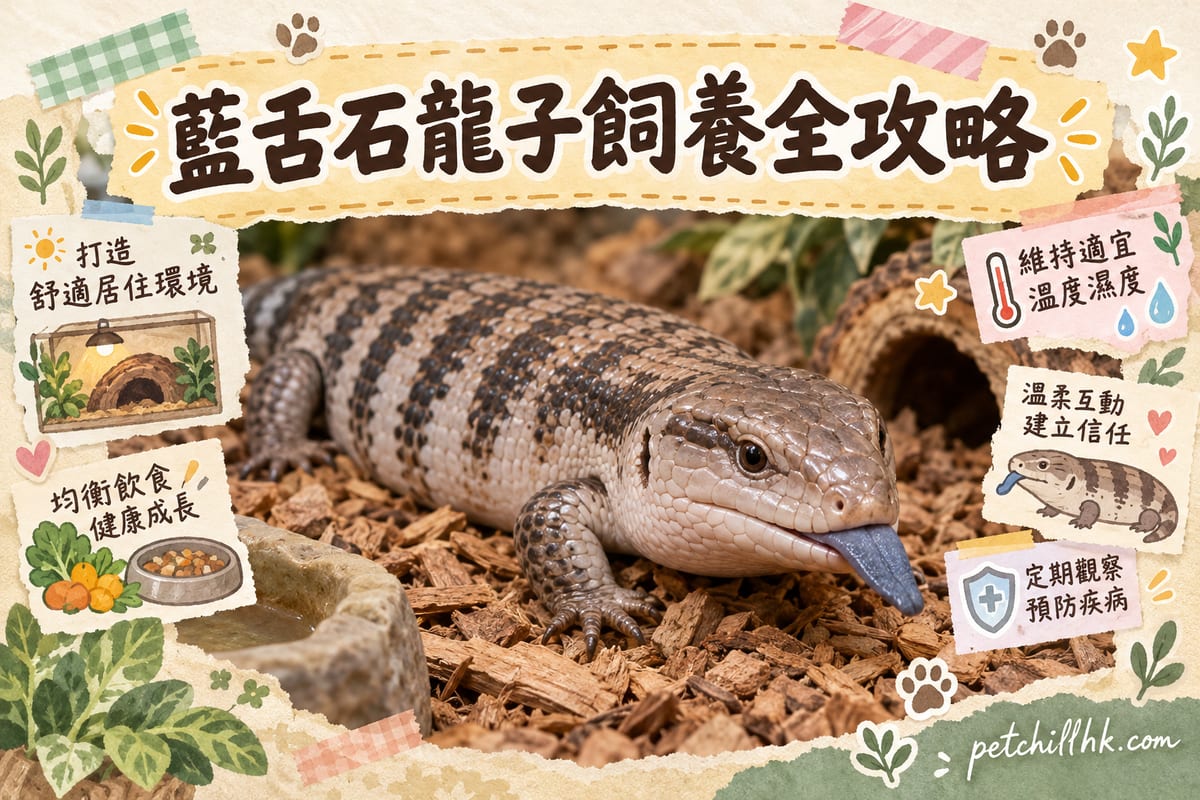
Quick answer: Blue-tongue skinks are ground-dwelling diurnal lizards. The key points are a sufficiently large floor area (adults generally need at least a 4-foot tank), a hot spot around 32 to 35°C with a cool end, UVB plus calcium powder with D3, and a diet mainly of insects paired with dark green leafy vegetables. When handling, support the abdomen and do not grab the tail. If in doubt, ask a veterinarian.
What kind of animal is a blue-tongue skink? Basic facts and temperament
The species commonly seen in the Hong Kong pet market is the Eastern blue-tongue skink, native to Australia, a ground-dwelling diurnal lizard: active during the day, does not climb high, and moves slowly. Adults generally range from about 40 cm to 60 cm, and most sources believe they can live for over ten to twenty years.
Its signature move is extending its blue tongue and hissing when startled; its temperament is generally docile, so it is often kept as a lizard that can be handled, but equipment requirements are not lowered just because it is good-natured. Ask clearly about the source before buying; Indonesian lines are generally believed to require higher humidity and a warmer environment, and their setup differs from Australian lines.
Living environment: floor area, substrate and temperature gradient
Blue-tongue skinks are ground-dwelling animals, so the floor area of the tank is more important than height. Adults generally need a floor area of at least about 4 feet by 2 feet, with space for a hiding house and a water dish.
The substrates to avoid most are fine sand and calcium sand: blue-tongues eat with large movements and can easily swallow substrate, causing intestinal blockage. Safer choices include reptile-specific soil, coconut coir, newspaper or tiles.
The temperature gradient is core: set a hot spot at one end, generally recommended at about 32 to 35°C, and keep the other end at about 22 to 26°C. The tank should have a hiding house and a water dish large enough for soaking, with humidity maintained at a moderate level.
Heating and UVB: lighting arrangements for a diurnal species
Blue-tongue skinks are active during the day, and UVB has a practical role in their calcium metabolism, so most care sources recommend providing UVB tubes, with output and distance calculated according to the lamp model and tank dimensions. Tubes should be replaced regularly as they age.
During the day, the hot spot is usually created with a basking lamp or ceramic heater, and must be paired with a thermostat. Lamps should have protective guards to prevent the animal from directly contacting hot surfaces; the tank should also have sufficient cool areas. A fixed lighting schedule is generally recommended.
At night, if Hong Kong winter room temperatures are low, use non-light-emitting heating equipment with a thermostat. Heat mats can be used, but must be paired with a thermostat.
Diet: omnivorous ratio of insects to vegetables and fruits
Blue-tongue skinks are omnivorous and need both animal protein and plant food. Juveniles grow quickly, and a higher proportion of animal protein is generally recommended, mainly appropriately sized insects; adults generally have about half vegetables and the rest animal feed. Recommendations vary, so adjust according to the individual's body condition.
Animal feed includes crickets, Dubia cockroaches, mealworms and earthworms; feed should not be larger than the width of the animal's head. Avoid feeding wild snails and wild insects due to high parasite and pesticide risks.
For vegetables and fruits, dark green leafy vegetables (kale, choy sum, dandelion leaves), pumpkin and green peas are common choices, and fruits such as blueberries and papaya can be given in small amounts. Food should be chopped finely and washed clean, and dusted with calcium powder containing D3 before feeding; adults are generally fed every two to three days, and leftovers should be removed the same day.
Tail autotomy and tail loss: correct handling and common misconceptions
Skinks are generally believed to be able to autotomize their tails, but opinions on blue-tongue skinks vary and I cannot be certain; the safest approach is to treat their tail as not to be pulled.
The correct way to hold them is to support the body and abdomen with one hand and the front half with the other, so that the weight is evenly distributed. Do not use the tail for leverage, do not grab the tail and lift, and do not let go from a height. Slow movement does not mean they cannot be injured; the risk of dropping is not low.
If the tail does break, keep the wound clean and observe for infection; if in doubt, ask a veterinarian. The general belief is that even if the tail regenerates, it will not look the same as the original, usually shorter, thicker and with a different pattern.
Daily care and cleaning
Daily tasks are removing feces, changing water and checking temperature readings. Feces are large and smelly; if not cleaned daily, humidity and bacterial levels in the tank will rise. The water dish should be changed daily.
Weekly tasks include cleaning the food bowl and water dish, and checking toes, tail tip and skin for retained shed or wounds. If retained shed is found, a shallow lukewarm soak can help; the water level should not be higher than the side of the body, and the animal must be supervised throughout; soaking is supportive care.
Choose reptile-safe cleaning products, rinse thoroughly and air dry before returning the animal to the tank. Soil-type substrates should be completely replaced regularly; Hong Kong is humid, so substrate should be changed as soon as it gets wet, otherwise mold grows easily.
Refusal to eat, respiratory infection and other health warning signs
Refusal to eat is the most common problem; the principle is to rule out environmental causes first: check temperature and humidity and substrate, confirm lamps are working, weigh and record body weight. Low winter temperatures, pre-shedding and full tank cleanings can all make them temporarily unwilling to eat. See a veterinarian as soon as possible if the following occur:
| Observation | Possible meaning | What to do |
|---|---|---|
| Open-mouth breathing, nasal discharge or bubbles | Respiratory infection | Review temperature and humidity, avoid direct air-conditioning, seek veterinary care promptly |
| Yellow-white discharge or swelling in the mouth | Stomatitis | Do not clean or apply medication yourself; leave to a veterinarian |
| Soft limbs, unsteady walking, soft lower jaw | Possibly metabolic bone disease | Review UVB and calcium powder, see a veterinarian promptly |
| Reduced or no bowel movements, hard distended abdomen | Possibly intestinal blockage | Stop feeding, record and seek veterinary care immediately |
Chronic weight loss, abnormal feces or visible worms next to feces all require veterinary examination. Medical decisions should be made by a veterinarian experienced with reptiles.
Hong Kong winter heating, humid weather and common beginner mistakes
Hong Kong winter room temperatures can drop below 15°C, which is already low for the diurnal blue-tongue skink: the daytime hot spot should be provided as usual, and at night thermostatically controlled heating equipment should be used, not below about 18 to 20°C. Typhoon season and power outages are real risks; prepare heat packs or hot water bottles placed against the outside wall of the tank (not in direct contact with the animal).
Regarding humidity, Hong Kong is humid year-round, and problems are usually wet substrate and mold in the tank. Countermeasures are improving ventilation, monitoring with a hygrometer, changing substrate as soon as it is wet, and avoiding direct air-conditioning on the tank.
The most common beginner mistakes: tank too small, feeding only insects long-term without vegetables, using cat or dog food as staple, using fine sand as substrate, no UVB, and grabbing the tail when handling. Before renting or moving, ask clearly about lease and building deed restrictions on keeping animals. There are few exotic pet veterinarians in Hong Kong, so it is advisable to call ahead to confirm.
Key summary
- ✅ Floor area first: adults generally need at least 4 feet by 2 feet.
- ✅ Hot spot around 32 to 35°C, cool end around 22 to 26°C, UVB and calcium powder during the day.
- ✅ Diet is omnivorous: insects with dark green leafy vegetables, avoid cat and dog food as staple and long-term lettuce-only feeding.
- ✅ Support the abdomen when handling, do not grab the tail; after tail loss keep the wound clean and ask a veterinarian.
- ✅ In Hong Kong winter, maintain the nighttime minimum temperature and have a heating plan for power outages.
- ✅ For refusal to eat, first check temperature, substrate and lighting; seek veterinary care promptly for respiratory infection.
Related reading
- Six major pet care essentials: cats, dogs, small animals, aquatics, reptiles, birds
- Gecko care: temperature gradient plus calcium powder with D3
- Horned frog care: ground-dwelling amphibian environment setup
- For tanks, lighting and calcium powder, see PetChill pet supplies.
This article is for reference only and cannot replace veterinary diagnosis; in emergencies, contact a veterinarian immediately. There are few exotic pet veterinarians in Hong Kong, so it is advisable to call ahead to confirm.