
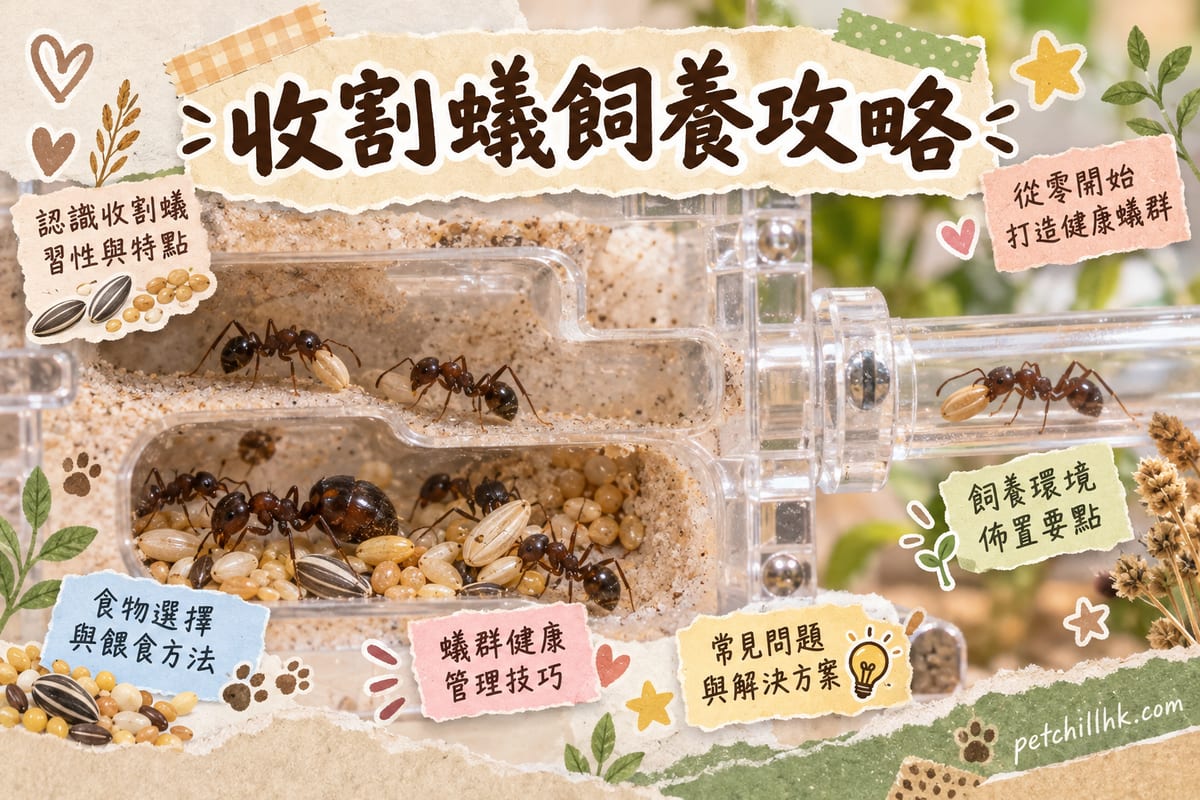
Quick answer: Harvester ants are communal insects and must have a mated queen. The nest needs both a wet zone and a dry zone, and the outworld must have escape prevention. Feed small seeds as the staple plus protein, and remove any mouldy seeds. Do not change nests casually — in Hong Kong, the biggest summer risk is moisture build-up inside the nest.
What makes harvester ants special is their 'food storage': you'll see workers carrying seeds one by one into storage chambers, then handing them to major workers with unusually large heads to crush.
What are harvester ants? Do you need a queen?
The harvester ants sold in the pet trade are mostly Messor species, most commonly Messor barbarus. They are native to the Mediterranean climate of southern Europe and North Africa, where they are important seed dispersers. Colonies are monogynous: one queen per colony. A worker-only group will never produce new workers and will eventually die out.
Body size varies greatly: minor workers are only a few millimetres and handle carrying and brood care; major workers have very large heads, up to 14 mm, and specialise in crushing hard seeds; queens are typically 14–16 mm. Some sources say queens can live over 10 years, but actual lifespan depends on keeping conditions and there is no consistent figure.
Their popularity comes from being clean to keep: seeds don't crawl away or rot immediately, portions are easy to control, and the carrying and storing behaviour is highly watchable.
Nest and outworld setup: dry/wet zoning and escape prevention
The setup has two parts: the nest and the outworld (foraging area), connected by clear tubing. The nest provides a dark, stable living space; the outworld holds food and gives workers room to move.
The core design is dry/wet zoning: a moist zone for the brood chamber, holding eggs, larvae and pupae; a dry zone for storage chambers holding seeds. If the whole nest is wet, seeds sprout and go mouldy; if the whole nest is dry, the brood and queen suffer. So nests usually have a water port or reservoir that moistens only one side.
Nest materials include acrylic, aerated concrete, wood and 3D-printed designs. The key points are tunnel diameter matched to colony size and the ability to block light. Colonies prefer darkness and little vibration; constant light or frequent moving will stop the queen laying. The outworld must have escape prevention, such as an anti-escape coating, talcum powder or an escape ring. Coatings degrade with time and dust and need recoating regularly.
Temperature, humidity and diapause
Outworld room temperature is generally recommended at 22–28°C, with the nest kept similar or slightly higher. In summer you can provide a local hot spot in the outworld so workers can move brood to a warmer spot, but the whole nest should not stay above 30°C long-term. Brood chamber humidity is generally 50–70%, storage chambers 30–50%. Hong Kong homes tend to be humid, so extra humidification is usually unnecessary — instead watch ventilation and standing water.
Diapause (winter rest) is the most debated point: most European keepers recommend an annual rest period at 10–15°C from around October to March, while some keepers rear at room temperature year-round and still build large colonies. Both approaches have succeeded, so there is no consensus. If you want to try it, skip it in the first year and reduce feeding during the period.
| Item | General recommendation | Hong Kong considerations |
|---|---|---|
| Outworld temperature | About 22–28°C | Avoid prolonged periods above 30°C in summer |
| Nest humidity | Brood zone 50–70%, storage zone 30–50% | Homes are humid; ensure ventilation |
| Diapause | 10–15°C | No consensus; can skip in the first year |
Feeding: seeds as staple, protein as supplement
The staple is small seeds, commonly millet, poppy seeds, dandelion seeds, flaxseed and sesame. Workers carry seeds into storage chambers and, when needed, major workers crush them into a paste — what keepers call 'ant bread'. Portions need not be large: some keepers suggest about one seed per worker per month. Offer in small batches rather than dumping a large pile at once, because leftover seeds absorb moisture and sprout or go mouldy.
Besides seeds, offer protein regularly, as larval development requires it. Supply small amounts of pre-killed feeder insects (such as mealworms) once a week to once every two weeks, and remove leftovers the next day. Sugar water or honey water can be offered separately but is not the staple.
Must avoid: salty or processed foods, bread and biscuit crumbs, and seeds with pesticide residue or seasoning. In humid Hong Kong, store seeds sealed and check for clumping from damp before feeding.
Routine colony care and cleaning
Routine care is mainly three things: observation, cleaning and topping up water. Daily, check temperature and humidity, colony activity and any unusual deaths. Weekly, check storage chambers for sprouting, mouldy or clumped seeds and remove them.
Clean the outworld once a week, removing leftover food, waste and dust, and check the escape barrier at the same time. Watering depends on nest design: you can use a test-tube water source or add water via the reservoir. Don't add too much at once — standing water in the brood zone directly harms the brood.
Vibration and light control are often overlooked: don't place the nest near frequently opened cupboard doors, speakers or washing machines, and don't open the lid daily. For observation, choose a nest with a light-blocking cover.
Health warning signs and colony abnormalities
Colony problems are often a reflection of the setup, not 'disease'. If you see the following, check temperature, humidity and food first — don't rush to move the nest.
| Sign | Possible cause | Immediate action |
|---|---|---|
| Queen death | Old age, stress, unsuitable environment | The colony will gradually decline |
| Mass worker deaths | Overheating, standing water or mould in the nest | Check temperature/humidity, clean nest and outworld |
| White mould patches in nest | Long-term excess moisture, damp seeds | Reduce watering, remove mouldy seeds |
| Seeds pile up uncrushed | Lack of major workers or colony too small | Normal stage; add protein and wait for growth |
| Colony stays inside | Temperature too low, stress or colony too small | Keep quiet, check temperature |
| Ants crossing the escape barrier | Barrier has failed | Clean the surface and reapply |
Hong Kong climate, air-conditioned rooms and humidity risks
The biggest enemy of harvester ant keeping in Hong Kong is humidity: summer indoor humidity is high, nest ventilation is limited, and seeds and nest material mould easily. At this time, don't add more water — instead check whether the brood zone is too wet and place the nest where there is slight air movement.
In winter, indoor temperatures in the teens slow the colony naturally, so feeding can be reduced. If you plan diapause, Hong Kong winter room temperatures are actually close to the required 10–15°C, but don't let them stay below 10°C long-term — prolonged low temperatures can stall the colony or even kill it. Power cuts affect both heating and insulation equipment. In summer, high temperatures plus a sealed nest won't cause problems for a short time, but don't feed large amounts of protein during hot spells.
Ant escape is a real risk: workers that get out will nest in corners of the home, causing trouble for residents and neighbours alike. Check the escape barrier daily. Messor species are not native here and must not be released into the wild. There are few veterinarians in Hong Kong who treat ants, so environmental management is the only line of defence.
Common beginner mistakes
- Buying a worker group without a queen — it will only slowly die out.
- Dumping a large amount of seeds into the storage chamber at once; they absorb moisture and all sprout or mould.
- No dry/wet zoning in the nest, so both brood chamber and storage chamber are wet.
- Frequent nest changes, relocations or daily lid-opening, causing the queen to stop laying.
- Feeding only seeds with no protein long-term, leading to poor larval development.
- No escape prevention in the outworld, or a worn-out barrier, letting workers out to nest in the home.
- Mistaking them for a native species, or releasing them when keeping fails.
- No plan for power cuts or summer heatwaves.
- On seeing mould, tipping out the whole nest to change it, which stresses the queen into stopping laying.
Key points
- ✅ A mated queen is essential; the Messor genus is monogynous, and a colony without a queen will never produce new workers.
- ✅ The nest must have dry/wet zoning: brood chamber on the moist side, storage chambers on the dry side, otherwise seeds sprout and mould.
- ✅ The staple is small seeds plus protein; err on the side of less, and remove any mouldy seeds.
- ✅ Check and recoat the outworld escape barrier regularly — escape is the most practical risk in Hong Kong homes.
- ✅ Don't change nests casually or open the lid daily; there is no consensus on diapause, and you can skip it in the first year.
Related reading
- Pet Care Guide: Key Points for Six Types of Pets
- Corn Snake Care Guide
- Orchid Mantis Care Guide
- For nests, outworlds, escape coatings and seed food, see PetChill pet supplies.
This article is for reference only; there are few veterinarians in Hong Kong who can treat insects, so daily environmental management and early detection are most important.