
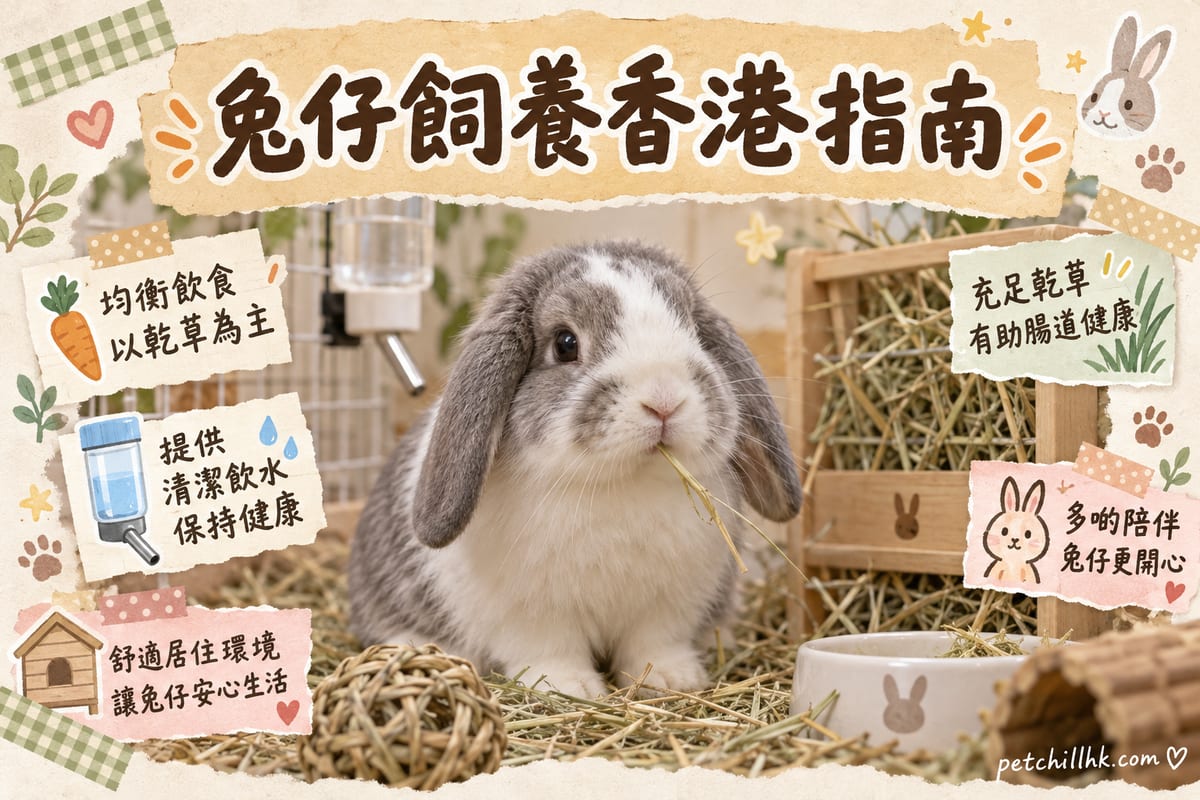
Quick answer: The three core points of rabbit care: hay must be unlimited, the environment must be cool and well-ventilated, and a stopped gut is an emergency. Rabbits are heat-sensitive and tolerate cold better, a pen is better than a cage, and vegetables and pellets are only supporting actors; once a rabbit refuses food, droppings become smaller and fewer, or it hunches in a corner, contact a veterinarian immediately.
Rabbit basics: breeds, lifespan and body structure
Domestic rabbits are burrowing herbivores and prey animals, particularly sensitive to sudden sounds and hands coming from above. Common pet rabbits include the Netherland Dwarf, Holland Lop, Lionhead and New Zealand White.
For the full version on hay proportions, GI stasis warning signs and summer heat protection, see the rabbit breed guide.
Three points to understand first: rabbits are hindgut fermenters, with a digestive tract designed to process large amounts of fibre; rabbits cannot vomit, so when there is gas or a blockage in the gut there is no vomiting as an outlet; rabbit teeth grow continuously and must be worn down by chewing fibre.
| Item | General reference |
|---|---|
| Average lifespan | About 8 to 12 years, depending on breed and care |
| Adult weight | Dwarf rabbits about 1 to 1.5 kg, medium breeds about 2 to 2.5 kg |
| Daily staple | Unlimited hay or grass |
| Suitable room temperature | Most sources suggest about 15 to 22°C; intensify cooling above 25°C |
Living environment: pen or cage? Space, substrate and temperature/humidity
A pen is generally better than a cage. Rabbits are horizontal movers and need length for continuous hopping, not levels. The UK rabbit welfare organisation (RWAF) recommends an activity area of about 3 metres by 2 metres; this may not be possible in small Hong Kong flats, but at least do not confine the rabbit long-term in a cage only big enough to turn around, and provide daily free-roaming time.
The most important thing about substrate is slip resistance. Long-term standing on wire mesh floors puts pressure on the soles, causing fur loss and even ulcers; solid non-slip surfaces with paper litter or unscented wood shavings are recommended; fragrant softwood shavings are also not ideal.
Regarding temperature and humidity, rabbits are heat-sensitive and tolerate cold better: low temperature with dryness is usually tolerable, while high temperature with high humidity is very dangerous. Avoid air-conditioning draughts blowing directly; the pen should have a hiding house, preferably with two entrances.
Diet: how much hay? Vegetables, pellets and rules for changing food
Hay is the rabbit's staple, no exception. It is generally recommended that hay makes up most of the daily food volume; adult rabbits mainly eat grass hay such as timothy, while young rabbits can have alfalfa (higher in calcium, not suitable in large amounts long-term).
Vegetables are a small daily amount of dark green leafy vegetables, portion adjusted by body weight; beans, corn and potatoes are not suitable. New vegetables should be tried one at a time in small amounts. Pellets are only a supplement, about one to two tablespoons per day is enough;
Changing food must be slow. A sudden change disrupts gut flora, causing soft droppings, bloating and even GI stasis. The usual approach is to mix gradually over seven to ten days; if soft droppings appear during the transition, pause and consult a veterinarian. Rabbits eating their own caecotrophs is normal physiological behaviour.
Dental wear: problems arise if hay is not provided
Rabbit teeth grow continuously and are naturally worn down by chewing fibre. Long-term feeding of only soft food, pellets and fruit leads to overgrown teeth, uneven occlusal surfaces, and even injury to the mouth and tooth roots.
Watch for drooling, wet fur on the chin and neck, slow eating, preference for soft food, weight loss and increased eye discharge. In rabbits with long-term fibre deficiency, tooth roots may also press on the tear ducts, causing eye discharge. Dental problems must be handled by a veterinarian, and may require grinding under anaesthesia; cutting teeth yourself is extremely risky. Daily prevention relies on hay, untreated wood chews and regular check-ups.
GI stasis: the most common emergency in rabbits
A rabbit's gut relies on fibre and water to maintain motility; once it slows due to stress, dehydration or sudden dietary change, gas accumulates.
| Observation | Possible meaning | What to do |
|---|---|---|
| Refusing food, big drop in appetite | Gut starting to slow | Contact a veterinarian the same day, do not wait until the next day |
| Droppings smaller, fewer, or stopped | Motility clearly slowed, an emergency | Seek veterinary care immediately, record the time of last droppings |
| Hard distended abdomen, will not let you touch | Gut gas | Keep warm, do not press the abdomen, seek veterinary care immediately |
| Hunching in a corner, teeth grinding | Obvious pain | Seek veterinary care immediately |
What you can do during an emergency: keep the environment warm and quiet, ensure hay and fresh water are available, do not force-feed or administer medication, and leave the rest to the veterinarian. During moulting season, fur intake increases; daily brushing reduces the risk.
Daily care and cleaning
- Daily: change water, top up hay, remove wet bedding and leftover vegetables.
- Litter training: most rabbits urinate in a fixed corner; place a square litter box with paper or wood pellet litter.
- Brushing: short-haired rabbits two to three times a week, daily during moulting; long-haired rabbits need layered brushing down to the skin to avoid matting underneath.
- Nails: check every four to six weeks; overgrown nails affect stance; if unsure, leave it to a veterinarian or pet groomer.
- Do not bathe frequently: rabbits clean themselves; full-body washing easily causes chilling and stress; use a slightly damp cloth for local cleaning.
- Cleaning agents: use pet-safe formulas, rinse thoroughly and air dry.
Hong Kong-specific notes: summer heat protection, muggy season and public housing tenancy
Summer is the highest-risk period of the year. Rabbits dissipate heat through their ears and have no sweat glands; room temperatures above 28°C are already quite dangerous. Practical measures include: maintaining a stable air-conditioning temperature, placing ceramic tiles or frozen water bottles for the rabbit to lie on, using fans only for air circulation, and closing curtains against the western sun. Never leave a rabbit in a room without air-conditioning or on a balcony. Power outages are a real risk in Hong Kong summer.
The muggy season and rainy season make hay and food prone to dampness; mycotoxins cannot be dealt with by 'scooping away the surface'; storage should be sealed with desiccants.
In small flats, rabbits are active at night, and the sound of hopping and cage biting can travel to the floor below; thick mats can reduce complaints. Public housing tenancy agreements generally restrict keeping animals; for private buildings, check the building's deed of mutual covenant. There are not many veterinarians in Hong Kong who see rabbits; it is advisable to find one after moving and to understand the out-of-hours emergency arrangements.
The five most common beginner mistakes
- Feeding only pellets and vegetables, no hay. This is the common source of GI stasis and dental problems.
- Keeping the rabbit in a small cage long-term. Rabbits need floor space to move, not a tiered cage.
- Changing food suddenly or feeding a large amount of fruit at once. Gut flora need time to adapt; rushing a change only causes problems.
- Ignoring weight changes. Rabbits are good at hiding pain; weekly weighing can detect problems early.
- Incorrect handling. Grabbing from above or by the ears frightens and injures the rabbit; the correct way is one hand supporting the chest and the other supporting the hindquarters, held close to the body.
Key summary
- ✅ Hay is the rabbit's staple and must be unlimited; pellets and fruit are only supporting actors.
- ✅ Rabbits are heat-sensitive and tolerate cold better; keep them cool in summer and intensify cooling above 25°C.
- ✅ A pen is more suitable than a cage; substrate must be non-slip, as long-term wire mesh floors damage the soles.
- ✅ Change food gradually over seven to ten days; a sudden change causes soft droppings and even GI stasis.
- ✅ Refusing food, droppings becoming smaller and fewer, and a hard distended abdomen are emergencies; seek veterinary care immediately, do not wait.
- ✅ There are not many veterinarians in Hong Kong who see rabbits; it is advisable to find a clinic early and understand out-of-hours arrangements.