
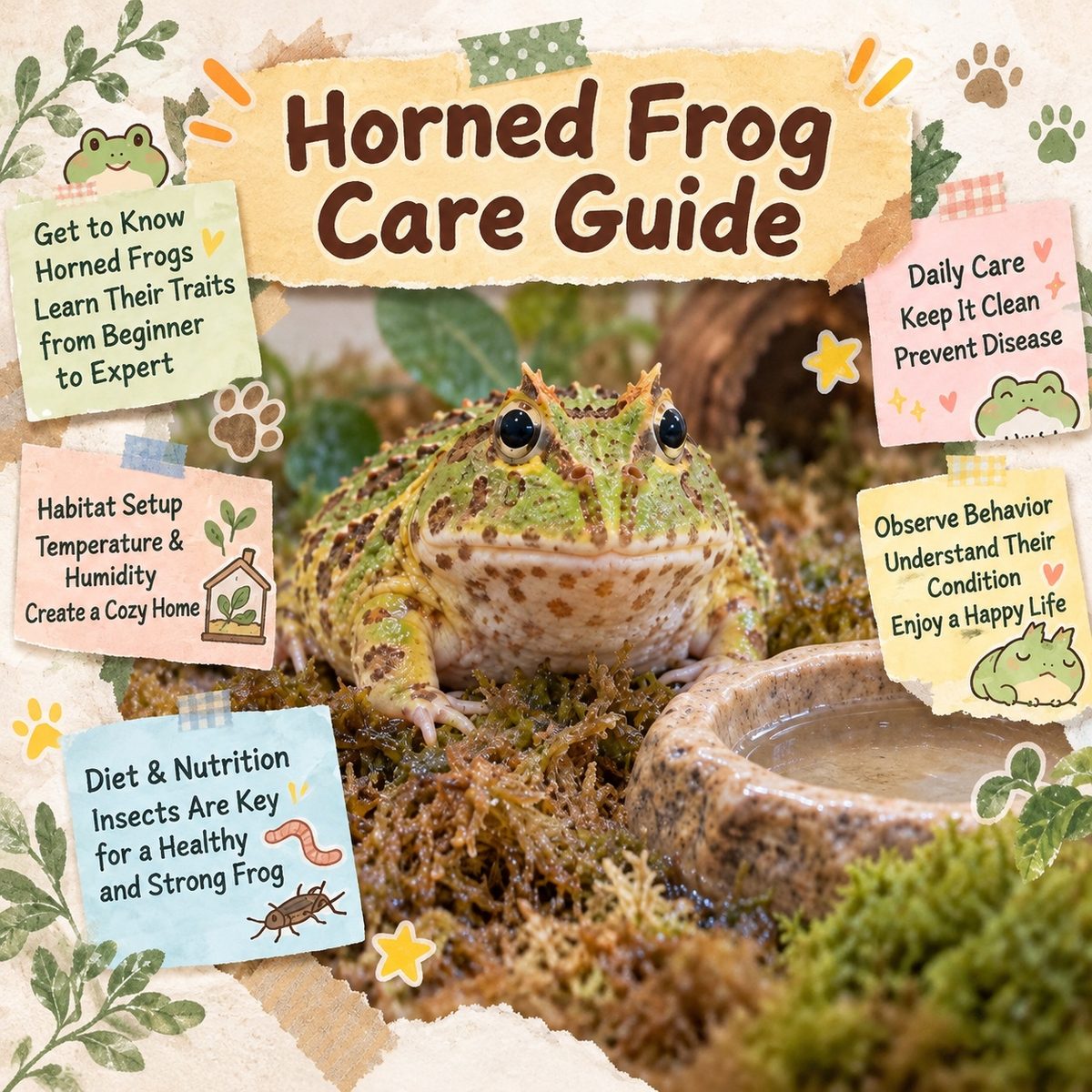
Quick answer: Pacman frogs are terrestrial amphibians that don't swim. The tank needs slightly damp substrate plus a shallow water dish (water level below the mouth), humidity generally recommended at 60–80%, and temperature around 24–28°C. UVB is generally not needed; use D3 calcium powder instead. They shouldn't be handled often. Ask a veterinarian if you have questions.
What kind of animal is a Pacman frog? Naming such as green Pacman frog and basic facts
Most Pacman frogs in the Hong Kong pet market belong to the genus Ceratophrys, native to South America, and are terrestrial ambush predators: they usually sit among leaf litter or soil with only their eyes and head showing. Names like green Pacman frog, pumpkin Pacman frog and Brazilian Pacman frog are not very consistent on the market, so ask clearly about the source and care parameters before buying.
Adults generally range from about 10 cm to 20 cm; most sources consider they can live over 10 years. Pacman frogs are not interactive pets, they have teeth and a strong bite, and moving hands during feeding can trigger a predatory response, so use tongs or forceps to offer food.
Housing: terrestrial, doesn't swim, moisture-retaining substrate and shallow water dish
Pacman frogs are terrestrial amphibians that cannot swim, and deep water can drown them, so they cannot be kept like fish. The tank should prioritise floor area; for adults, a minimum of about 45 cm by 30 cm is generally recommended, with hiding spots.
Use coconut coir, sterile soil or sphagnum moss as substrate, kept slightly damp. Avoid gravel, sand and calcium sand, as Pacman frogs lunge when eating and can easily swallow substrate, causing intestinal blockage. Hiding spots can be half a flower pot or cork bark.
For water, only provide a shallow dish with the water level below its mouth, and a sloped edge so it can climb in and out. Humidity is maintained mainly by slightly damp substrate and daily misting, not by flooding.
Temperature and humidity: how to supplement calcium for a species that doesn't need UVB
Temperature is generally recommended at 24–28°C, not exceeding 30°C. When winter room temperature drops below about 22°C, use a heat mat with a thermostat, placed under part of the tank or on the side, and don't seal and wrap the whole tank.
Humidity is generally recommended at 60–80%, monitored with a hygrometer. Substrate should be slightly damp but not waterlogged, as standing water causes bacterial and fungal problems. Mist daily or every other day with dechlorinated water.
Regarding UVB, most care sources consider Pacman frogs nocturnal and crepuscular and not needing UVB, with D3 calcium powder being sufficient. Calcium powder is generally dusted on prey; juveniles can be dusted more frequently, adults less often, and ask a veterinarian for actual dosage.
Diet: carnivorous prey and feeding frequency
Pacman frogs are carnivorous, mainly eating appropriately sized insects: crickets, Dubia cockroaches and mealworms are common, but mealworms are higher in fat and shouldn't be the only prey. Prey should not be much larger than its mouth.
Do not feed wild-caught insects, as pesticide and parasite risks are high. Most care sources consider vertebrate prey with fur or bones unsuitable as regular food. Dust with D3 calcium powder before feeding.
Feeding frequency by age: juveniles can be fed every 1–2 days, while adults generally need about once a week. Pacman frogs easily overeat, so a single meal shouldn't be too large.
Daily care and cleaning
Daily tasks are removing faeces, changing the water dish, and checking temperature and humidity readings. Without daily cleaning, bacterial levels in the tank rise. Use dechlorinated water.
Weekly, check the skin for redness, ulcers or cotton-like patches, and turn the substrate. Substrate is generally recommended to be fully changed every 2–4 weeks, and immediately if there's a mouldy smell. Choose cleaning products suitable for amphibians, rinse thoroughly and air-dry before returning the animal.
For equipment, if keeping several frogs, use separate equipment to avoid cross-infection of fungi and bacteria. Hong Kong's high humidity makes substrate prone to mould, so maintain ventilation, but don't use a large fan blowing directly at the tank.
Refusal to eat and swelling warning signs
Refusal to eat is a common problem for Pacman frog owners, most often caused by too low temperature or too dry an environment, followed by a new environment, winter, shedding, over-handling and intestinal impaction. The principle is to first check temperature and humidity, record weight, reduce disturbance, and don't force-feed.
If refusal lasts more than 1–2 weeks, see a veterinarian promptly:
| Observation | May indicate | What to do |
|---|---|---|
| Markedly distended abdomen, body swelling | Possibly oedema or organ problems | Don't treat yourself, see a veterinarian promptly |
| Skin redness, ulcers or cotton-like patches | Possibly bacterial or fungal infection | Isolate, improve ventilation and hygiene, seek veterinary help promptly |
| Limb weakness, twitching, skeletal deformity | Possibly calcium metabolism problems | Review calcium powder and prey, ask a veterinarian |
Any medication or treatment must be decided by a veterinarian experienced with amphibians; don't buy medication yourself.
Why you shouldn't handle them often
Amphibian skin is highly permeable, so salts, body heat, hand cream and cleaning product residue on human hands can be absorbed through the skin, and being picked up is also stressful. Therefore Pacman frogs shouldn't be handled often, only for necessary checks or tank moves.
If you really must handle, first wash hands and rinse off soap, keep hands slightly damp, support the lower body with your hand, and don't squeeze or let go from a height. Pacman frogs have teeth and may bite by mistake when hands move inside the tank, so it's best to feed with tongs or forceps.
Also, after handling one, wash hands before touching another tank, and keep equipment separate. Fungi and bacteria can spread via hands and equipment.
Hong Kong summer heat, air-conditioning and beginner mistakes
Hong Kong summer room temperatures can exceed 30°C, which is too high for Pacman frogs and is the most common fatal risk. The countermeasure is to move the tank away from west-facing windows and use air-conditioning or a fan to improve room temperature (without blowing directly at the tank).
When winter room temperature drops below about 22°C, use heating equipment with a thermostat. Place the tank in a spot free from draughts. Have a plan for typhoon-season power outages: in summer, place ice packs outside the tank (never in direct contact with the animal); in winter, wrap towels around the tank sides for insulation.
Common beginner mistakes: keeping them like fish (with deep water), using gravel as substrate, frequent handling, overfeeding or feeding too-large prey, sharing equipment among several frogs, no shallow water dish or insufficient humidity, and no summer cooling. Before renting or moving, also check the tenancy agreement and building deed of mutual covenant regarding pet keeping; there are few veterinarians in Hong Kong seeing exotic pets, so call ahead to confirm.
Key summary
- ✅ Pacman frogs are terrestrial amphibians that don't swim; deep water can drown them, so only provide a shallow water dish.
- ✅ Substrate should be slightly damp but not waterlogged; humidity generally recommended at 60–80%, maintained by misting with dechlorinated water.
- ✅ Temperature around 24–28°C, not exceeding 30°C; when winter drops below 22°C, use a heat mat with a thermostat.
- ✅ UVB is generally not needed; use D3 calcium powder; adults generally fed about once a week.
- ✅ Shouldn't be handled often.
- ✅ If refusing food, first check temperature and humidity; abdominal swelling or skin redness needs prompt veterinary attention.
Related reading
- Six major pet care essentials: cats, dogs, small animals, aquatics, reptiles and birds
- Gecko care: temperature gradient plus D3 calcium powder feeding
- Blue-tongue skink care: UVB and omnivorous diet arrangement
- For tanks, substrate and calcium powder, see PetChill pet supplies.
This article is for reference only and cannot replace veterinary diagnosis; in emergencies contact a veterinarian immediately. There are few veterinarians in Hong Kong seeing exotic pets, so call ahead to confirm.