
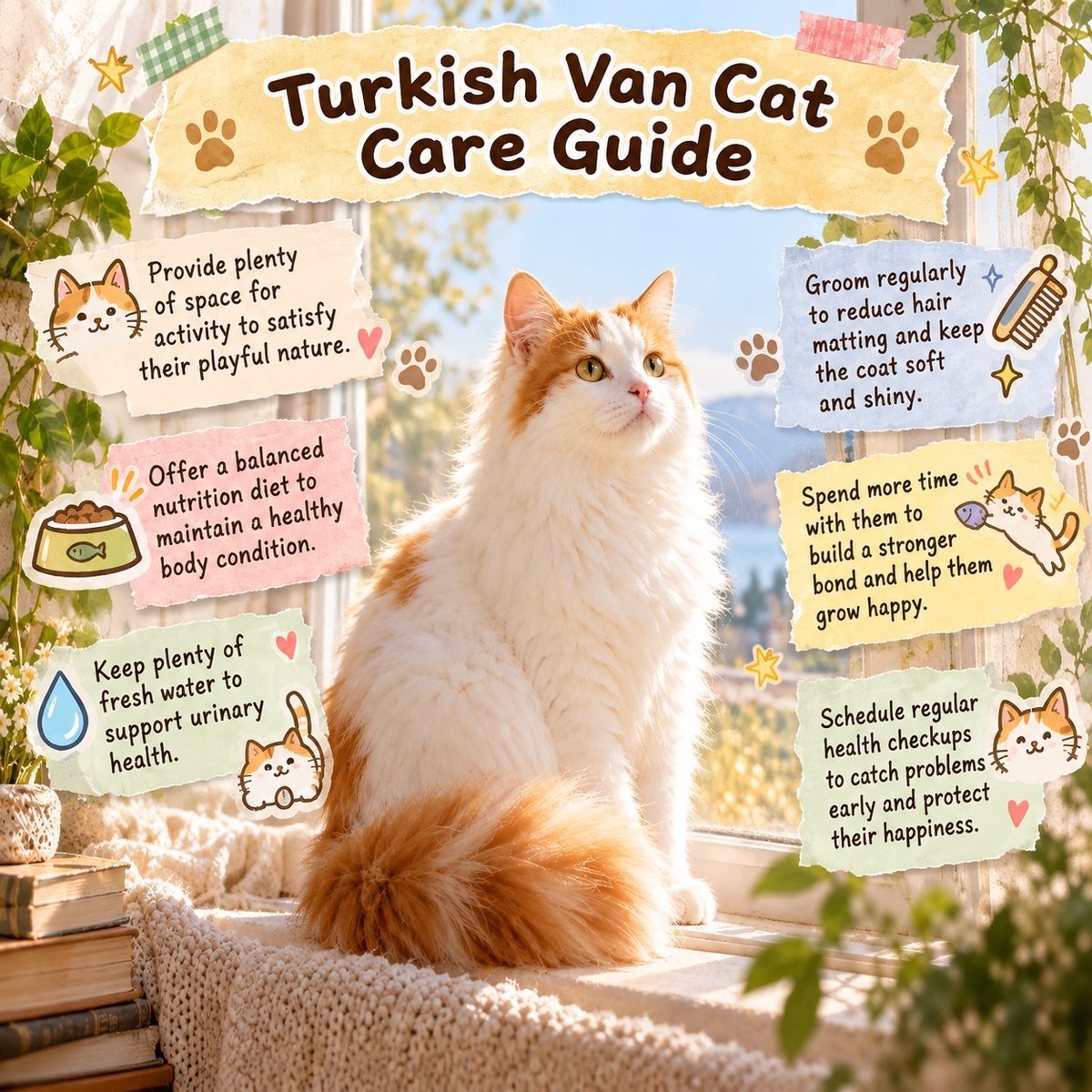
Quick answer: To keep a Turkish Van well, the key is both space and health. For space, you need tall cat trees, shelves and daily playtime, and window screens are a must; for grooming, brush weekly and more often during shedding, and dehumidify in humid Hong Kong. For health, watch for HCM heart disease, the risk of congenital deafness in white cats with blue eyes, and tail vertebrae abnormalities, and arrange early veterinary checks.
What kind of cat is the Turkish Van? Appearance and basic facts
The Turkish Van originates from the Lake Van area of eastern Turkey, and general sources mention it was first brought to Britain around 1955. The breed characteristic is a white body with colour only on the head and tail; the body should have no colour patches. The coat is semi-longhair, silky, with a water-resistant feel, and single-layered. Eyes can be blue, amber, or one blue and one amber.
The body is medium to large, with a sturdy frame and muscles, and matures slowly; some sources say it takes three to five years to fully mature. For weight, general sources state males are about 4 to 7 kg and females lighter; these figures are only approximate. Lifespan is mostly given as 12 to 17 years. To compare another breed also known for its white long coat, see Turkish Angora.
Personality and activity needs: active, curious, can open doors
The Van's activity level is high among domestic cats: it loves climbing, jumping high and inspecting every high point in the home, and many individuals can use door handles or play with taps, hence the description 'a cat like a dog'—they can learn simple commands and play fetch. They are sociable and curious, and like to join in everything the family does, but they also have boundaries; some do not like being picked up and will resist. They are also sensitive to sudden loud noises.
Practical implications: set fixed daily play sessions and puzzle toys (treat balls, puzzle boards). A bored Van will invent its own entertainment, usually including pushing things off surfaces, opening cupboards and night-time running. To learn about caring for another large semi-longhair cat, see Norwegian Forest Cat Care Guide.
Living environment: arranging vertical space in small Hong Kong flats
Vans do not need a big garden, but they need space to 'develop upwards': the cat tree should be tall (ideally near the ceiling), with wall shelves and routes across the tops of bookcases, so it can jump and look down from above. In flats with limited floor space, vertical routes are key; otherwise insufficient activity turns into destructiveness and excessive vocalisation. Window screens and anti-fall measures are essential, because they jump powerfully and are curious, and in high-rise flats you cannot rely on 'it won't jump'.
Also, because Vans love water, separate the 'drinking area' from the 'playing area': water bowls should ideally be heavy ceramic or have anti-tip designs, otherwise you will be mopping up daily. If you have a fish tank or aquarium, cover it and secure it. For a full care framework, see Pet Care Guide.
Coat care and Hong Kong's humid weather
The Van has a semi-longhair single coat with no thick undercoat, so it is not the hardest longhair breed to manage, but seasonal shedding is quite noticeable: the coat is thicker in winter and thinner in summer, and shedding periods produce a lot of loose hair. Brush at least once a week, increasing to two or three times during shedding, focusing on the armpits, inner hind legs and tail base, where tangles are most likely.
Hong Kong's humidity is high all year, which can affect coat and skin; use a dehumidifier indoors to keep humidity relatively dry while maintaining ventilation; dry the coat if it gets wet rather than letting it air-dry for long periods. Frequent bathing is not recommended, as cats groom themselves. Breed sources also commonly mention dental issues in Vans, so brush the teeth several times a week and check the ear canals weekly.
Health: heart and genetic risks to watch
General breed sources describe the Van as quite healthy with a low risk of genetic disease, but there are several points to keep in mind. First, the heart. Hypertrophic cardiomyopathy (HCM) is the most common heart disease in cats, and Van breed information generally lists HCM as a concern; early on there may be no signs at all, and diagnosis relies on veterinary auscultation, blood tests and echocardiography. At home, you can record the breathing rate during deep sleep, and seek veterinary help if it suddenly increases.
Second, hearing. Cats with all-white coats and blue eyes are generally considered to have a higher rate of congenital deafness, which can be confirmed with a BAER test. Third, tail vertebrae abnormalities. Some breed sources mention that Van kittens may have tail vertebrae abnormalities affecting bowel and bladder control, which X-rays can detect early. Breeding also needs attention to the risk of neonatal isoerythrolysis due to different blood types.
Diet and weight management
Vans are carnivorous, with animal protein as the mainstay, and wet food can help with hydration. Because they are large and active, they eat more than the average domestic cat, but that does not mean unlimited free-feeding—excess weight increases the burden on joints and the heart, and heart problems are exactly the concern for this breed. The approach is timed, measured meals, monitored with a scale and body condition score, not just 'looks not fat'.
For drinking, Vans love water and may tip bowls or not drink enough; use heavy bowls, a water fountain, and place water in several locations. Supplements cannot replace veterinary prescriptions; cats diagnosed with heart disease must follow veterinary medication.
Household health warning signs
Vans need particular attention to the following:
| Condition | What you may observe at home | What to do |
|---|---|---|
| Heart disease (HCM) | Fast breathing during deep sleep, easily tired, reluctant to move, abdominal swelling | Arrange a veterinary check as soon as possible; echocardiography may be needed |
| Thrombus (blockage of the artery to the hind legs) | Sudden inability to use the hind legs, cold limbs, crying out | This is an emergency; go immediately to a veterinarian with emergency services |
| Congenital deafness | No response to sound, unusually loud vocalisation | Confirm with a BAER test and adjust home safety |
| Tail vertebrae abnormality | Incontinence, difficulty defecating, hopping gait | Veterinary examination plus X-ray assessment |
| Ear canal problems | Scratching ears, head shaking, discharge or odour from ears | Do not buy ear drops yourself; see a veterinarian first |
| Skin and coat | Localised hair loss, redness, itching, heavy dandruff | Check whether it is fungus or parasites |
| Dental problems | Bad breath, tartar, red swollen gums, reduced appetite | Book a dental scaling assessment |
Hong Kong-specific notes and beginner mistakes
Hong Kong's living environment poses several practical challenges for Vans. First, high humidity plus constant air-conditioning means temperature and humidity changes affect skin and coat, so dehumidifying and ventilation must be thorough. Second, flats are small, and without vertical space planning, insufficient activity will quickly become apparent. Third, not installing window screens is high-risk, especially in high-rise flats. Fourth, toilet water, fish tanks and standing water must be secured, because they love water. Fifth, during summer power cuts without air-conditioning, watch the indoor temperature.
Common beginner mistakes include: buying a cat tree that is not tall enough, using water bowls as toys, not scheduling daily playtime, feeding only dry food without considering water intake, forcing to pick up a cat that resists, and not doing early heart checks.
Key summary
- ✅ The Van is a semi-longhair single-coated cat, white with colour patches on the head and tail, medium to large in size
- ✅ Highly active, can open doors and climb; vertical space and daily play are essential
- ✅ Window screens are a must; because they love water, separate the drinking area from the playing area
- ✅ During shedding, brush two to three times a week; in humid Hong Kong, dehumidify and dry the coat
- ✅ HCM and congenital deafness risks require early checks, especially in white cats with blue eyes
- ✅ Weight management directly affects joint and heart burden; free-feeding is not allowed
Related reading
- Pet Care Guide
- Norwegian Forest Cat Care Guide
- Turkish Angora Breed Introduction
- Cat trees, dehumidifiers and heavy water bowls are available at PetChill pet supplies.
This article is for reference only and cannot replace veterinary diagnosis; sudden heart, breathing or hind-leg abnormalities are emergencies—contact a veterinarian immediately.