
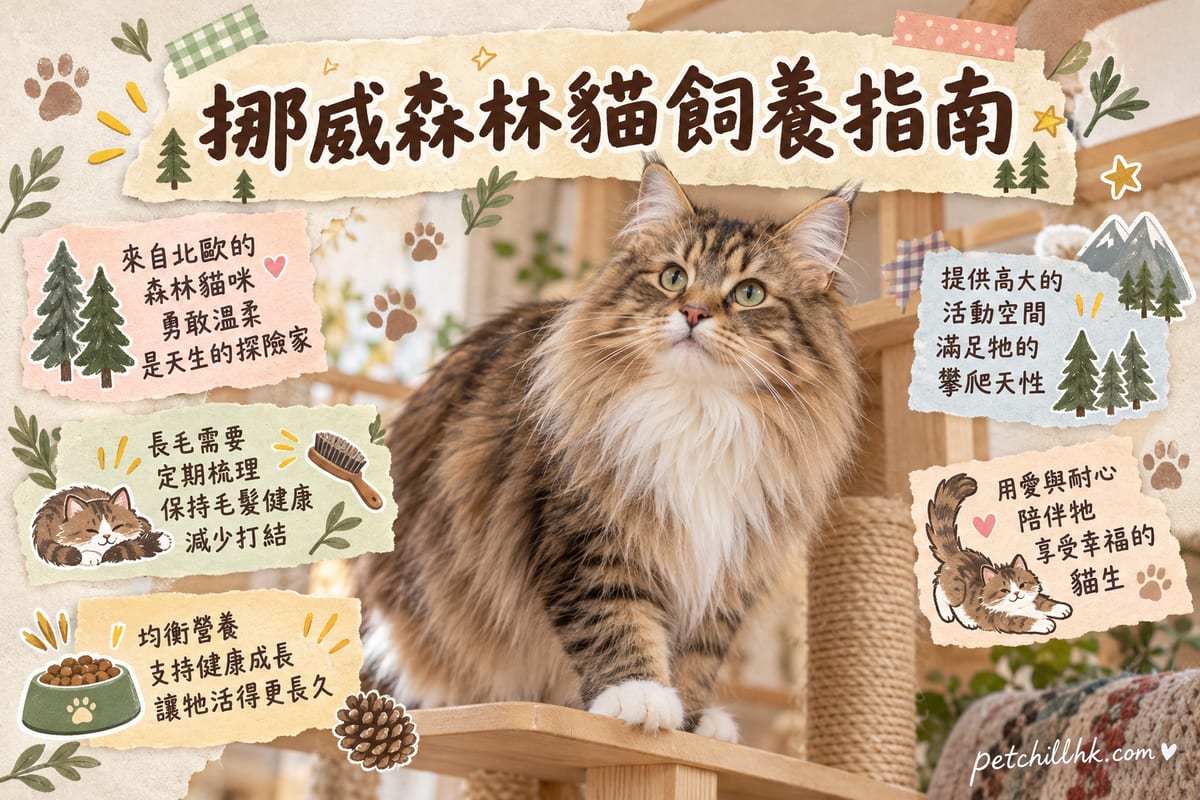
Quick answer: The Norwegian Forest Cat is a natural large semi-longhaired breed from Northern Europe: independent, fond of climbing, and not a lap cat. Keeping one means preparing three things: sturdy high spaces, intensive seasonal grooming of the double coat, and air-conditioning to cope with Hong Kong's humid summers. Health-wise, watch for heart conditions such as HCM and arrange regular checks.
What kind of breed is the Norwegian Forest Cat? (Origins, size and slow maturity)
The Norwegian Forest Cat is called skogkatt in Norwegian. Unlike many modern breeds, it is a natural breed: over centuries it adapted to harsh cold on Northern European farms and in forests, not through deliberate crossbreeding.
Its size is its biggest selling point: large, heavy-boned, with hind legs taller than the front. The industry generally cites about 5 to 9 kg for males and about 4 to 5.5 kg for females. It is also a slow-maturing breed, generally taking 4 to 5 years to fully grow, so don't judge final size by age in months. Lifespan is about 12 to 16 years. Appearance features include a semi-long double coat, a ruff around the neck and chest, breeches on the hind legs, tufts between the toes, and ear tufts; coat colours are many, but do not include pointed patterns.
Double coat and seasonal grooming
The Norwegian Forest Cat's coat evolved to withstand wind and snow: the outer coat is long and water-repellent, the undercoat soft and dense. The side effect of this structure is that seasonal shedding can be dramatic—day-to-day shedding is actually light, but when the season changes (mostly when it warms up in spring in Hong Kong) the whole home ends up covered in fur.
For grooming, once or twice a week is enough day to day; increase to every other day or even daily in seasonal change, using a steel comb or slicker brush to reach deep into the undercoat. Focus on the neck and chest ruff, armpits, inner hind legs and tail—these tangle most easily. Don't rip at tangles; separate them with your fingers first, and leave large matted areas to a groomer. Bathing is optional; the outer coat is water-repellent, so it gets wet slowly and dries even more slowly. After a bath you must dry the undercoat thoroughly, otherwise Hong Kong's humidity can easily cause skin problems.
Climbing and high places: how to arrange vertical space
The Norwegian Forest Cat is an expert climber, likes to occupy the highest point in the home, and descends head-first with its hind legs first. This habit isn't naughtiness but breed instinct: height means security and a vantage point. If the home doesn't provide legitimate high places, it will create its own—bookshelf tops, fridge tops and curtain rails are common targets.
Stability is the key: this breed is heavy, and a flimsy cat tree wobbles as soon as it climbs on, so it simply won't use it. The base must be heavy and the platforms large enough. Install sturdy window screens by windows, especially in high-rise flats. You can also arrange a stepped route to reduce direct jumps from height onto hard floors; scratching posts need enough height and thickness, as it stretches longer than an ordinary domestic cat when scratching.
Personality: independent, slow to warm up, not a cuddler
The Norwegian Forest Cat is known for a gentle nature, a quiet voice and not being particularly clingy. It will follow you around and sit near you, but usually dislikes being held for long or having its paws trapped; with strangers it observes first and warms up later. This temperament is generally friendly to households with children or other pets, provided its space is respected.
In practice, adjust expectations: don't use a "the more you hold it, the closer it gets" approach—that actually makes it avoid you. Build bonds through play and treats, such as wand toys and puzzle feeders; this works better than forced cuddles. Provide high places and hiding spots where it can be alone. It also likes water, and some will even scoop at fish tanks, so cover any aquarium at home.
If what you want is a cat that sits on your lap all day, the Ragdoll may fit your expectations better; to compare another large breed, see the Maine Coon, and the Norwegian Forest Cat personality analysis.
Diet, weight and urinary health
A large cat's calorie needs are higher than an ordinary domestic cat's, but you must also prevent obesity. Slow-maturing breeds have a longer growth period, so formula and portion arrangements should follow your veterinarian's or the packaging guidelines—don't simply increase amounts based on size.
Choose a complete and balanced cat food with animal protein as the core; dry and wet food can be mixed, and wet food helps with hydration. Adjust portions by weight, body condition score and activity level, split into two to three meals a day—large cats that eat too much at once are prone to vomiting. Longhaired cats swallow more hair in seasonal change, so hairball gel or high-fibre formulas can help, but they should not replace brushing. Cats generally drink little; a flowing water fountain helps, and urinary problems are linked to water intake and body weight.
Health warning signs and genetic conditions: HCM, GSD IV and others
Hypertrophic cardiomyopathy (HCM) is the one to watch most: the heart muscle thickens abnormally, affecting pumping, and in severe cases can lead to heart failure or blood clots. The problem is there is no breed-specific DNA test; it relies on regular heart ultrasound screening. Early on there may be no symptoms at all, and by the time panting, lethargy or sudden hind-leg weakness appear it is already relatively advanced. Regular health checks are recommended, and ask the breeder about the parents' heart screening records.
Glycogen storage disease type IV (GSD IV) is a recessive inherited condition with a DNA test; affected kittens mostly show weakness and muscle wasting within a few months. Carrier cats can be completely normal, so testing and breeding management are essential. Others include polycystic kidney disease (PKD), PK deficiency, hip dysplasia and urinary system problems.
| Common health problem | Possible signs | Suggested action |
|---|---|---|
| HCM (thickened heart muscle) | Panting, lethargy, sudden hind-leg weakness | Regular heart ultrasound, veterinary assessment |
| GSD IV | Weakness, muscle wasting, delayed development in kittens | Ask the breeder for DNA test results |
| Polycystic kidney disease (PKD) | Increased drinking and urination, weight loss | Ultrasound or genetic testing, regular blood tests |
| Skin/hairball problems | Matted fur, frequent vomiting of hair, skin rashes | Increase brushing, dehumidify, consult a veterinarian |
These are common risks and don't mean every cat will develop them. Always ask your veterinarian about any health concern.
Hong Kong specifics: air-conditioning, humidity and small flats
The Norwegian Forest Cat's equipment is built for Nordic winters, so in Hong Kong you actually need to help it cool down. In summer, keep the air-conditioning on indoors or maintain good ventilation, and keep water topped up; don't leave it in a sealed room or on a balcony without air-conditioning. Note that the air-con shouldn't blow directly on its resting spot—it needs a warm sleeping nest.
On humidity, Hong Kong's humidity is high year-round, and the double coat dries slowly, raising the risk of skin problems and fungal infections. A dehumidifier, regular skin checks and drying the undercoat after washing are the three basics. In small flats, vertical space is the biggest variable: without a cat tree, it will choose high places itself, and the result may be ornaments on cabinet tops being pushed to the floor. Before renting or buying, also confirm whether the building's deed of mutual covenant allows cats.
Mistakes new owners make most often
- Buying a flimsy little cat tree that wobbles as soon as the cat climbs on, so it never gets used.
- Thinking a semi-longhair needs daily washing—actually brushing is the key, and washing too often damages the skin barrier.
- Not increasing brushing in seasonal change, waiting until tangles form solid mats and the cat is in pain.
- Forcing cuddles and concluding the cat "isn't affectionate"—actually the approach is wrong.
- Neglecting regular heart checks and only discovering a heart problem when panting appears.
- Not turning on the air-conditioning in summer, treating a Nordic cat as heat-tolerant and ignoring the risk of heatstroke.
Further reading: Norwegian Forest Cat disadvantages in full and Norwegian Forest Cat size and weight.
Key takeaways
- ✅ The Norwegian Forest Cat is a natural large semi-longhaired breed from Northern Europe, generally taking 4 to 5 years to fully grow.
- ✅ Brush once or twice a week day to day; increase to every other day or even daily in seasonal change.
- ✅ The cat tree must be sturdy: heavy base, large platforms—stability matters more than height.
- ✅ Independent and not a cuddler; building bonds through play and treats works best.
- ✅ HCM has no breed-specific DNA test and relies on regular heart ultrasound screening.
- ✅ Hong Kong summers call for air-conditioning, dehumidifying and tangle prevention; shaving short is not recommended.
Related reading
- Pet care guides (series overview)
- Norwegian Forest Cat personality analysis
- Norwegian Forest Cat care notes for Hong Kong
- Norwegian Forest Cat disadvantages in full
- PetChill pet supplies: sturdy cat trees, steel combs, dehumidifying products and water fountains—everything for cat ownership in Hong Kong in one place
This article is for reference only and cannot replace veterinary diagnosis; in an emergency, contact your veterinarian immediately.