
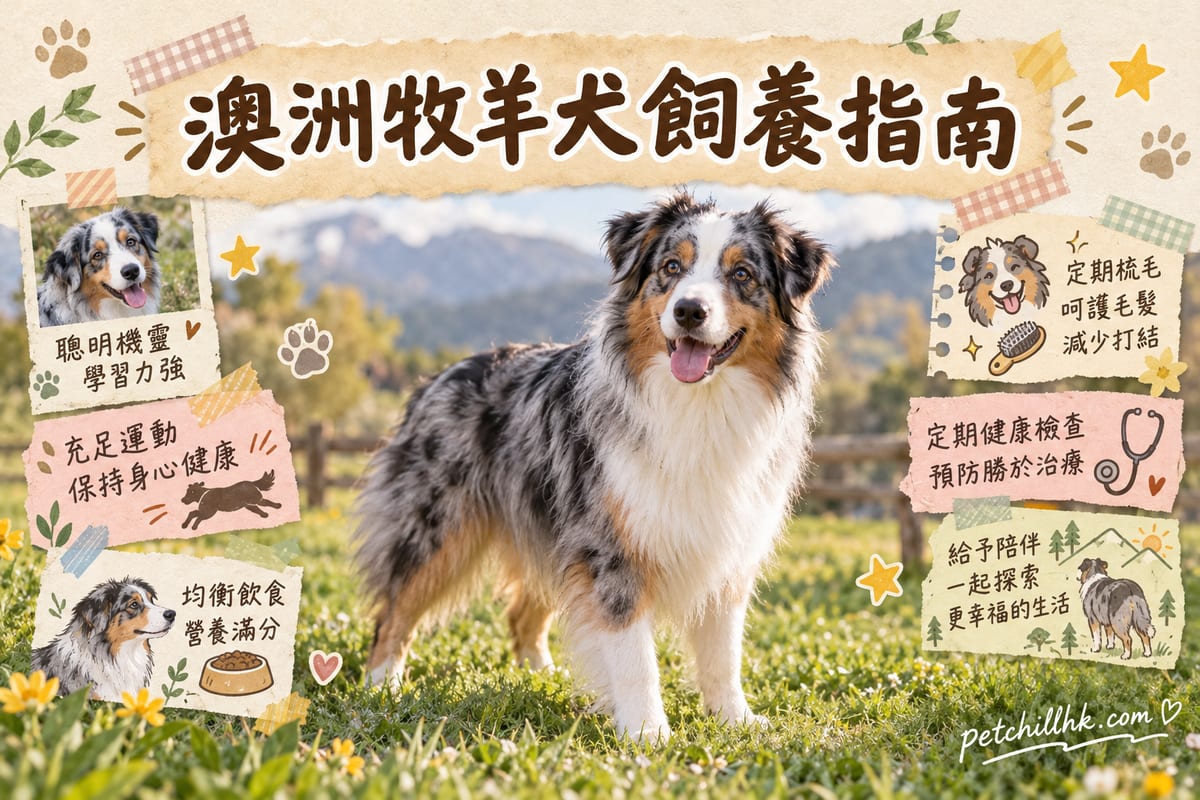
Quick answer: The Australian Shepherd is a medium-sized working dog developed in the US: extremely energetic, intelligent and loyal. The key to keeping one well is exercise and mental outlets: 1–2 hours of activity plus training every day, or barking, destructive behaviour and other problems are likely. Hong Kong summers require heat precautions, the double coat should not be shaved, and before buying you should understand the MDR1 gene and joint and eye hereditary risks.
What kind of breed is the Australian Shepherd? (Origin, size and colours)
The Australian Shepherd is called "Aussie" in Hong Kong. The most common misunderstanding is the name: the breed is not from Australia but was developed in the western US in the 19th century — Merino sheep shipped from Australia to the US worked alongside a group of European herding dogs, and ranchers lumped them together as "dogs from Australia". Genetic analysis generally places it in the British herding dog group.
It is medium-sized and muscular: males stand about 51–58 cm at the shoulder, females about 46–53 cm, weight is generally 16–32 kg, and average lifespan is about 12–15 years. Colours include blue merle, red merle, solid black and solid red, with a medium-long double coat.
Exercise and "having a job": the hardest part to meet in Hong Kong
The core need of this breed is not running a lot but having something to do. Herding dogs were bred for work: tracking, moving sheep, following commands, solving problems. When the outlet is removed, they invent their own work — most commonly chasing bicycles, chasing children, nipping heels, barking at the window and digging at the sofa.
In practice, break it into three layers: 1–2 hours of outdoor activity daily, split into morning and evening sessions; 10 minutes of sniffing games or training, which is often more effective than half an hour of aimless running; and a fixed schedule for meals, walks and training, which greatly affects the stability of a high-energy dog. Even with enough running, behavioural problems will still appear if the dog is left alone at home for long periods with no interaction. To compare similarly high-energy breeds, see the Border Collie care guide and the Belgian Malinois care guide.
Living environment: space, temperature and home safety
Hong Kong flats are small, and the Australian Shepherd is not easy to accommodate; the key is whether there is alternative space. Indoors you need: an undisturbed rest spot — high-energy dogs need to learn to settle; non-slip flooring to reduce joint stress during sudden stops and turns; and lockable window screens.
Hong Kong summers are the biggest challenge for thick-coated dogs: keep air-conditioning or fans on indoors for ventilation, provide enough water, and never leave the dog in a sealed room without air-conditioning, on a balcony or in a car. Management also needs checking in advance: this breed barks loudly, public housing generally does not allow dogs (except working dogs), and for private buildings you need to check the deed of mutual covenant and management office rules.
Diet and weight management
The Australian Shepherd is a medium-to-large, high-activity breed, but high activity does not mean unlimited feeding. A common opposite situation in Hong Kong is owners compensating for lack of exercise with treats, and the dog gradually becomes overweight.
Choose a complete and balanced formula for medium-to-large dogs, appropriate to life stage; adjust the portion according to weight, body condition score (ribs palpable, waist visible) and actual exercise level, split into two meals a day; keep treats within 10% of daily total calories. Introduce new food gradually over 7–10 days, and consult a veterinarian if soft stools or vomiting persist. Do not feed a large meal immediately after exercise — large dogs are at risk of gastric torsion; every extra kilogram is extra load on the hip and knee joints.
Coat and daily grooming: double coat, seasonal shedding and the shaving debate
The Australian Shepherd has a double coat: a coarser, water-resistant outer coat and a soft, dense undercoat. This structure both insulates and retains heat, so "shaving in summer keeps them cooler" generally does not hold — shaving removes insulation and sun protection, increasing the risk of sunburn and skin problems.
Brush 2–3 times a week normally, and every other day during shedding season, using an undercoat rake plus a pin brush section by section; do not pull hard at mats. Bathing every 4–8 weeks is enough, but always dry the undercoat thoroughly afterwards — in humid Hong Kong, a dry topcoat with a wet undercoat is a common cause of fungal and skin infections. Also trim nails every 2–4 weeks, clean ears and brush teeth regularly.
Socialisation and common behavioural problems
The Australian Shepherd is loyal to family but not naturally friendly to everyone. Individuals lacking socialisation easily bark at strangers and are over-alert to other dogs. The golden socialisation period is generally from 3 to 16 weeks of age.
| Behaviour problem | What to do |
|---|---|
| Chasing bicycles, chasing children | Manage on a lead, teach "stop" and eye contact; provide alternative outlets such as sniffing or frisbee |
| Heel nipping | Stop the game, do not run away, teach an alternative behaviour |
| Barking and destruction when alone | Top up exercise and mental activity, practise being alone gradually; consult a veterinarian in severe cases |
| Barking at the window | Apply frosted window film or remove window perches to reduce visual stimulation |
Positive reinforcement works best in training; this breed is sensitive to harsh punishment, and loud scolding easily turns into fear responses. The whole family must be consistent in what they ask for.
Health warnings and hereditary disease: MDR1, joints and eyes
The MDR1 (ABCB1) gene mutation is the one you most need to know about: dogs with the mutation can have severe neurological reactions to certain dewormers (e.g. high-dose ivermectin), some antidiarrhoeals and anaesthetics, and industry data generally indicates the proportion of this breed carrying the mutation is quite high. Because it cannot be seen from appearance, genetic testing is generally recommended, and you should tell the veterinarian before every medication or surgery.
Regarding merle colouring: when two merle dogs are mated, each puppy has about a one-in-four chance of inheriting two copies (double merle), and such individuals have a higher chance of being born deaf or with vision defects; responsible breeders will not deliberately make this mating. Other reported issues include hip and elbow dysplasia, hereditary cataracts, collie eye anomaly (CEA), progressive retinal atrophy (PRA) and epilepsy.
| Common health problem | Possible signs | Suggested action |
|---|---|---|
| MDR1 drug sensitivity | Low energy, seizures, unsteady walking after medication | Tell the veterinarian before medication, do genetic testing |
| Hip/elbow dysplasia | Slow to rise, cannot jump up, limping after running | Control weight, veterinary assessment, X-ray |
| Cataracts/PRA | Bumping into things at night, cloudy pupils | Eye examination, record changes early |
| Epilepsy | Seizures, staring blankly, drooling | Video-record seizures, give to veterinarian for assessment |
The above are common risks and do not mean every dog will develop them. Always ask a veterinarian about any health concern.
Hong Kong summer heat safety and the mistakes new owners make most
Hong Kong summers are hot and humid, and thick-coated working dogs are high-risk. Walk in the early morning and at night, and feel the ground with the back of your hand before going out — if it is hot to the touch, do not walk; keep air-conditioning or fans and ventilation indoors, provide water and a cool resting spot; never leave the dog in a car, on a balcony or in a sealed space without air-conditioning.
If you see heavy panting, increased drooling, red gums, unsteady walking or vomiting, move the dog to shade immediately, wipe it down with room-temperature water, offer water slowly, and seek veterinary help as soon as possible. New owners most often make four mistakes: assuming enough running means no barking; cramming in exercise all at once without teaching calm and rest; skipping puppy socialisation; and not checking the parents' health screening records before buying.
Key points
- ✅ The Australian Shepherd is a medium-sized working dog developed in the US, not from Australia.
- ✅ 1–2 hours of exercise daily plus mental activity such as sniffing, food puzzles and training — both are essential.
- ✅ The double coat should not be shaved; prevent heat stress by brushing out the undercoat, air-conditioning and avoiding peak heat.
- ✅ The MDR1 gene mutation affects reactions to several drugs; test first and tell your veterinarian.
- ✅ For risks such as hip and elbow joints, cataracts and epilepsy, checking the parents' screening records before buying is the most practical step.
Related reading
- Pet care guides (series overview)
- Border Collie care guide
- Belgian Malinois care guide
- PetChill pet supplies: non-slip mats, slow-feed bowls, interactive sniffing toys and portable water bowls — everything for Hong Kong dog ownership in one place
This article is for reference only and cannot replace veterinary diagnosis; in an emergency, contact a veterinarian immediately.