
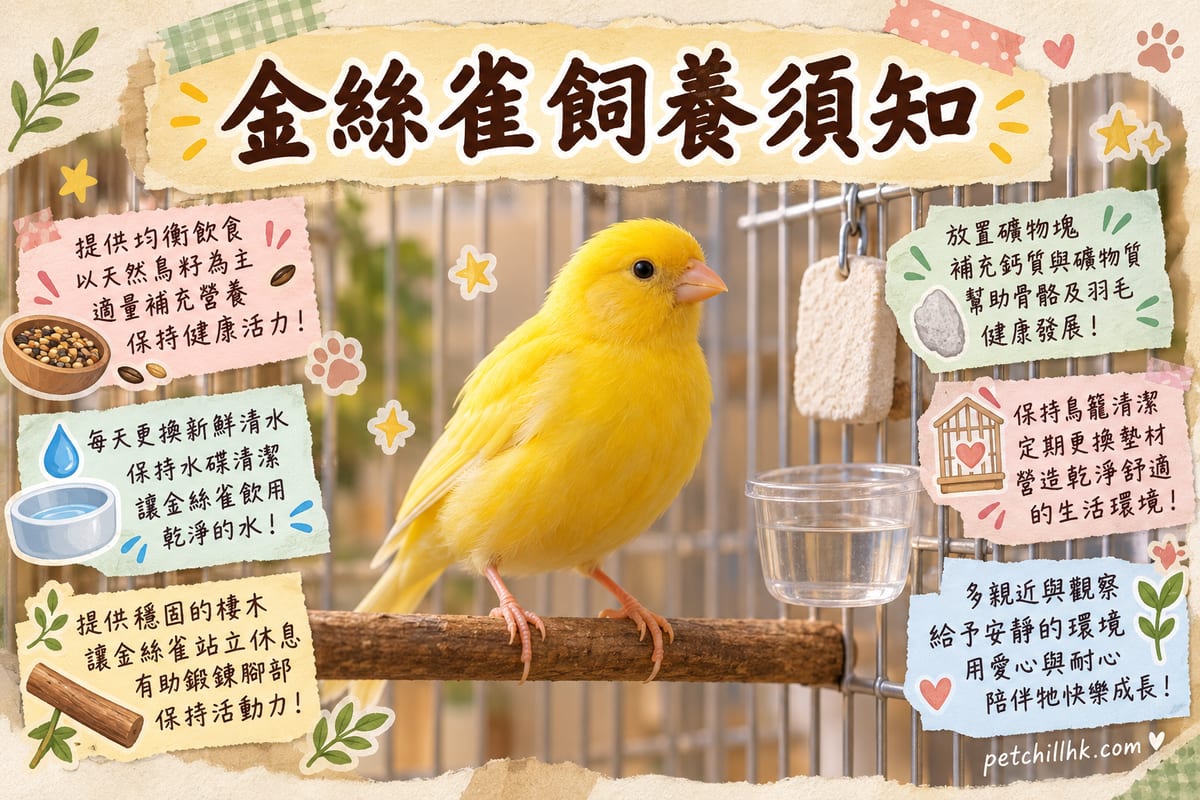
Quick answer: Success with canaries comes down to four things: a wide cage for horizontal flight, natural branch perches, a mixed diet with daily vegetables and cuttlebone, and extra nutrition during the moult. Males are prized for their song; females mostly make short calls. Check leg rings and toenails regularly; air sac mites and egg binding are common warning signs. Hong Kong is humid, so keep food sealed against mould.
What is a canary? Colour, type and song varieties
The canary (Serinus canaria) is a small finch originally from the Canary Islands area of the Atlantic, and centuries of captive breeding mean today's colours, body types and songs vary widely. The pet market generally divides them into three groups: colour canaries (red, yellow, white, cinnamon and others), type canaries (Border, Norwich, Yorkshire and others) and song canaries (German Roller, Belgian Waterslager, Spanish Timbrado and others).
Song is the core of the breed: a male's song carries a territorial message, while females mostly make short calls. Before choosing a bird, remember: canaries are sexually monomorphic, so DNA testing is needed to confirm sex; lifespan is often quoted as 7 to 12 years, for reference only. To compare another common cage bird, see Budgie Care Essentials.
Song, single or paired? The trade-offs new keepers ask about most
Keeping a single bird is the most common approach in Hong Kong: a male will still sing, with no rival to compete against, so his song is often more focused; the cost is less social stimulation, so daily out-of-cage time and interaction are needed. If you want two birds, be clear about why. For companionship, same-sex birds may peck at each other during the breeding season, especially two males; for breeding, you will need nest cups, nesting material and breeding-season nutrition, and you must think carefully about where the offspring will go—canaries cannot be released into the wild, where their chances of survival are extremely low.
Breeding takes a toll on the female, and calcium deficiency and egg binding are real risks. Practical advice: start with a single bird and get familiar with the song rhythm and cleaning routine; when adding a bird, always quarantine and observe for several weeks first.
Cage and living environment: space, perches, light, temperature and humidity
Canaries are flying birds. The cage must be large enough for them to stretch both wings in all directions, ideally with room to actually fly a short distance; horizontal width matters more than height. Cage fittings must be non-toxic and zinc-free—clips, old paint and metal fittings are all sources of zinc poisoning. Position the cage away from direct sunlight and air-conditioning draughts, and away from kitchen fumes, non-stick coating gases and scented sprays—these gases can be fatal to a bird's respiratory system.
Use washed natural branches for perches; sandpaper covers only wear down the soles of the feet. Birds generally need UV light to support calcium metabolism. Clean the cage at least once a week and dry it thoroughly; stability of temperature comes first, with around 18 to 24 degrees generally recommended, watching for overnight drops in winter and stuffiness in summer.
Diet: the three pillars of mixed food, vegetables and minerals
Canaries eat seeds, but "eats seeds" does not mean "feed only seeds". Plain seed mixes generally lack vitamin A, calcium, some amino acids and trace elements, affecting feathers, immunity and breeding performance in the long run. The approach is to base the diet on a canary-specific mixed seed (canary seed, millet, panicum, oats, rapeseed and others) or a complete formulated food, and add fresh vegetables daily—bok choy, Chinese cabbage, carrot, broccoli and others, washed, chopped small and fed at room temperature.
Never feed avocado, chocolate, caffeine, alcohol, onion or garlic, or high-salt and fried foods. Keep cuttlebone or a mineral calcium block in the cage at all times, both for calcium and to help wear the beak; change fresh water daily, and provide a shallow dish for bathing—a dish that is too deep is dangerous. Advice on mineral grit varies between sources, so ask your veterinarian; when changing foods, mix gradually over 1 to 2 weeks.
Moulting management: the big change once a year
Canaries usually moult once a year; with air-conditioning and fixed lighting indoors in Hong Kong, the timing may not follow the seasons exactly, and some individuals moult in fits and starts. The most obvious change is reduced or even stopped singing, along with more feather loss and a quieter demeanour, which is normal. Nutritional needs rise during the moult, and egg food or complete formulated food is generally recommended before and after.
Reduce stress in the environment: do not move the cage or change its position, avoid frequent handling, and do not let temperature rise or fall sharply. With Red Factor canaries, note that their red colour depends on carotenoid-containing colour food during the moult. Moulting abnormalities that need a veterinarian include: feathers not growing back for a long time, patchy baldness, swollen feather shafts (feather cysts) and failure to moult for a long period.
Toenails, leg rings and routine care
Without natural branches to wear them down, toenails grow longer and longer, eventually snagging on the cage or twisting the toes. Only the very tip should be trimmed, because the nail contains a blood vessel and cutting too deep causes bleeding; if you are inexperienced, do not cut them yourself—leave it to a veterinarian.
- Leg rings: used to identify individuals and record bloodlines and breeding data. Check once a week for dirt, redness, discolouration or entanglement with thread, hair or nesting fibres under the ring. A ring that is too tight restricts circulation and can cause toe necrosis in severe cases.
- Soles of the feet: watch for thick skin, cracking or redness; leg mite problems need microscopic examination by a veterinarian to distinguish.
- Cleaning: change food and water daily, wash food and water dishes daily, and give the cage a thorough clean once a week.
Common illnesses and health warnings
Canaries are light and fast-metabolising, so they deteriorate faster than cats and dogs. Here are common conditions and their signs:
| Common condition | Possible signs | Action at home |
|---|---|---|
| Air sac mites | Noisy breathing, open-mouth breathing, tail bobbing with each breath | Do not self-medicate; see a veterinarian as soon as possible |
| Leg mites, thick skin on legs | Abnormally thick scales or nodules on legs and feet | Veterinary microscopic examination |
| Respiratory infection | Discharge from nose or eyes, rapid breathing | Treat as an emergency; arrange a veterinarian |
| Egg binding (females) | Swollen abdomen, straining, sitting on the cage floor | Critical; see a veterinarian immediately |
| Feather cysts, abnormal feather loss | Patchy baldness, swollen feather shafts | Book a veterinary check |
| Toes entangled in fibres | Swollen, discoloured toes, unwilling to perch | Check nesting material; see a veterinarian immediately |
| Obesity and fatty tumours | Fat accumulation on the abdomen, reduced activity | Cut back on seed, increase flying |
Many early signs of illness in birds are "going quiet, not singing"; never buy medication to use yourself. Few veterinarians in Hong Kong see exotic pets, so call ahead to confirm the clinic accepts birds.
Hong Kong-specific notes and beginner mistakes
Hong Kong's humidity is high all year, and food and environmental mould are the most affected. After opening mixed food, egg food and seeds, seal them, add desiccant and store in a cool, dry place; do not pour too much into the dish at once; if it becomes damp or infested, throw it all away. Change cage paper daily and avoid bedding that moulds easily. Hot, humid weather also increases mosquitoes, which transmit avian pox viruses, so fit window screens, clear standing water and avoid spray mosquito products near birds.
In small flats, consider noise: canaries are usually active from early morning, and their song is loud, especially in males, so check neighbour relations and the building's deed of mutual covenant in advance. During power cuts, move the cage to a cool place in summer and prepare a way to keep it warm in winter. Common beginner mistakes: feeding only seed, a cage that is too small, sandpaper perches, placing the cage in the kitchen or in direct sun by a window, using household cleaning products, air-conditioning blowing directly on the cage, and not providing cuttlebone.
Key points
- ✅ Song is the core of the breed: males have a full repertoire, females mostly short calls
- ✅ The cage must be wide, with natural branch perches—no sandpaper covers
- ✅ Mixed food plus daily vegetables, with cuttlebone for calcium and beak wear
- ✅ During the moult, add protein and reduce stress; stopping singing is normal
- ✅ Check leg rings and toenails weekly; do not cut a tight or stuck ring yourself
- ✅ Illness often shows as "going quiet, not singing"; confirm in advance that a veterinarian accepts birds
Related reading
- Pet Care Overview
- Small Pet Care and Feeding in Hong Kong
- Budgie Care Essentials
- Bird cages, perches and mixed food are available at PetChill pet supplies.