
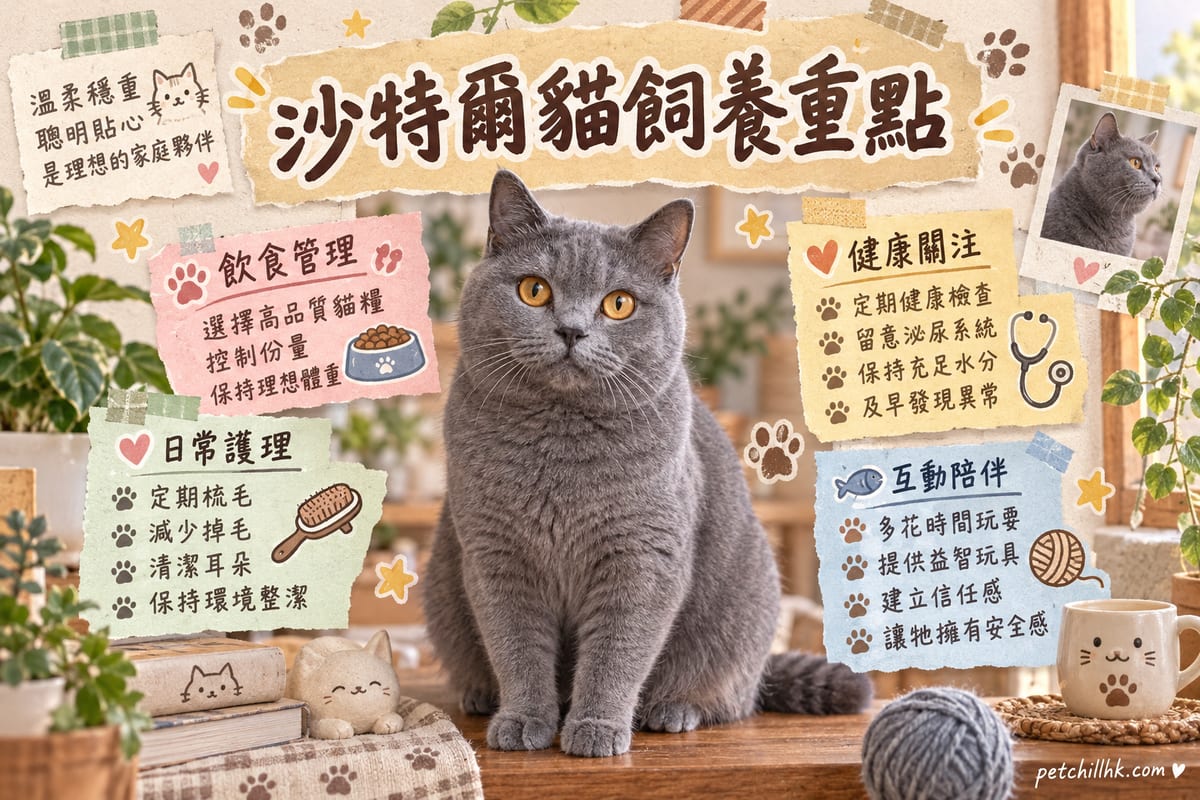
Quick answer: The Chartreux (also called the French Blue Cat) is a medium-to-large cat with a blue-grey double coat and copper eyes. It is quiet but still active. Before getting one, prepare: sturdy high spaces, portion-controlled feeding and regular weighing (it is prone to obesity), and a medical budget for joint, heart and kidney checks. Hong Kong is humid, so the double coat needs regular grooming.
What breed is the Chartreux (French Blue Cat)?
The English name of the Chartreux is Chartreux, and in Chinese it is also written as French Blue Cat or Chartreux cat. They all refer to the same breed: a medium-to-large cat with a blue-grey double coat, copper to orange-gold eyes and a sturdy build. The coat is somewhat woolly and thicker than that of a typical shorthair; the face is relatively narrow, and the line of the mouth gives it a slight smile, often called "the Chartreux smile".
As for origins, it is generally considered a natural French breed with ties to French monasteries, and was systematically preserved and bred in France in the early 20th century; specific dates vary among sources, so this article will not commit to a fixed year.
Be aware of the most common confusion in Hong Kong: there is more than one blue shorthaired cat. The Chartreux has a longer body and a thick, woolly coat; the British Shorthair has a rounder body and a short, dense coat. Their health risks differ, so ask for the English breed name before buying. For blue-grey breeds, see the Russian Blue, and for more breeds see the breed directory.
| Item | Chartreux |
|---|---|
| Chinese aliases | French Blue Cat, Chartreux cat |
| Coat colour and texture | Blue-grey, woolly double coat |
| Eyes | Copper to orange-gold |
| Adult weight | Generally about 4 to 7 kg, males tend to be heavier |
| Average lifespan | Generally about 12 to 15 years |
Chartreux personality and exercise needs
It is generally described as a "quiet cat": it vocalises little and softly, often using short chirps instead of loud meows, which is an advantage for apartment living. But quiet does not mean inactive—it still has hunting instincts and loves chasing toys and jumping to high places; without an outlet, stress can turn into night-time zoomies or over-grooming.
Socially, it is affectionate with family but not clingy, tends to be slow to warm to strangers, and generally tolerates children but dislikes being held too tightly. Aim for two to three interactive play sessions per day. For a comprehensive cat care guide, see the pet care overview.
Living environment: arranging a small Hong Kong flat
Cats do not need walks outside, but they need three-dimensional space. In a small flat, the most practical approach is to maximise vertical space: wall-mounted cat shelves, the top of a bookcase, a soft cushion on the windowsill, plus a place where the cat can hide completely. The Chartreux is a medium-to-large cat, so cat trees and shelves must be sturdy.
Window screens are a necessity, not an option. When opening windows for ventilation in high-rise flats, cases of cats leaping after birds or falling are not rare. Also, do not let air-conditioning vents blow directly onto the cat bed or litter box.
For the litter box, a large box suits a medium-to-large cat, and the general recommendation is "number of cats plus one". Before renting or applying for public housing, confirm whether the building's deed of mutual covenant and regulations allow pets.
Diet and weight management: dealing with a tendency to gain weight
The Chartreux has a good appetite and a large frame, and mostly lives indoors, so weight tends to creep up. Being overweight puts extra strain on both joints and heart, so portion control is the first priority.
- Staple food: a nutritionally balanced adult cat formula with animal protein as the core; wet food can help with hydration.
- Portions: adjust according to weight and body condition score, feeding two to three meals a day; being able to feel the ribs and see a waistline is a useful reference.
- Treats: keep within 10% of daily total calories, avoid feeding human food; if the cat eats too fast, use a slow-feeder bowl.
- Monitoring: weigh every two to four weeks, and reduce portions if weight rises.
When changing food, mix it in gradually over seven to ten days. If soft stools, vomiting or a sudden change in appetite persist, have a veterinarian assess it.
Coat and daily grooming
The Chartreux's double coat is thicker than that of a typical shorthair, and shedding is noticeable during seasonal changes. Brush two to three times a week, increasing to daily during shedding season, focusing on removing loose undercoat; while grooming, check the skin for red spots, dandruff or flea dirt.
- Nails: trim every two to four weeks, cutting only the clear front part.
- Ears: check weekly, clean the outer ear with an ear cleaner commonly used by vets, and do not insert cotton buds into the ear canal.
- Teeth: brush two to three times a week; red gums and bad breath are early signs of periodontal problems.
- Litter box: remove clumps daily, and change the litter and wash the box every two to four weeks.
Health warning signs and common risks
The Chartreux is generally healthy, but there are several risks to be aware of. Patellar luxation (the kneecap slipping out of its normal position) is an orthopaedic problem commonly mentioned in the breed, and may show as limping after jumping or reluctance to put weight on a hind leg. For the heart, hypertrophic cardiomyopathy is not rare in cats, and some sources mention related cases in this breed; for the kidneys, polycystic kidney disease is also mentioned, which is a genetic problem that requires ultrasound follow-up.
| Common risk | Possible signs | Suggested action |
|---|---|---|
| Patellar luxation | Limping after jumping, reluctance to put weight on a hind leg | Have a veterinarian assess; do not push or massage it yourself |
| Hypertrophic cardiomyopathy | Rapid breathing, reduced activity | Cardiac ultrasound examination |
| Polycystic kidney disease | Increased drinking and urination, weight loss | Regular ultrasound follow-up |
| Periodontal problems | Bad breath, drooling, reduced appetite | Dental scaling must be done under anaesthesia by a veterinarian |
| Overweight | Cannot feel ribs, waistline disappears | Adjust portions, increase interactive play |
The above are common risks and do not mean every Chartreux will develop them. Before buying, ask the breeder for the parents' joint, heart and kidney screening records; after adulthood, have at least one physical examination per year. The exact percentages of genetic diseases and individual case numbers mentioned in this article cannot be confirmed, so they are not stated from memory; any medical decision should be discussed with a veterinarian.
Special considerations for Hong Kong's climate and living environment
Hong Kong is humid all year round, and the undercoat of a double-coated cat can trap moisture, making skin problems and fungal infections more likely. The countermeasures are dehumidification, ventilation, regular washing of cat beds, and checking for dandruff or lumps while grooming.
In summer, ensure ventilation and do not leave the cat in an enclosed room or car without air-conditioning; in winter, watch out for temperature differences in air-conditioned rooms. If the cat is constantly curled up and reluctant to move, consider that it may be unwell rather than just cold.
Humidity also affects food: keep dry food sealed after opening and away from kitchen moisture; refrigerate or discard wet food not eaten promptly. If the litter box is placed in a damp corner, change the litter more frequently.
Common beginner mistakes
- Buying a cat based on coat colour alone: treating any blue shorthair as a Chartreux, and getting both health risks and personality completely wrong.
- Ignoring weight: thinking "rounder is cuter" until joint and heart problems appear before reducing food.
- Not installing window screens: assuming a high-rise means the cat won't jump; accidents usually happen in an instant.
- Brushing only the surface and ignoring bad breath: loose undercoat that mats can only be cut out; early periodontal problems show only as bad breath and red gums, and by the time the cat doesn't want to eat, it is usually not mild.
Key takeaways
- ✅ Chartreux = French Blue Cat = Chartreux; do not confuse with the British Shorthair
- ✅ Quiet personality with soft vocalisations, suitable for small flats, but still needs daily interactive play and high spaces
- ✅ Good appetite and prone to obesity; portion control and regular weighing are the most practical measures
- ✅ Commonly mentioned risks include patellar luxation, hypertrophic cardiomyopathy, polycystic kidney disease and periodontal problems
- ✅ Brush the double coat two to three times a week, more often during shedding season; check the skin while grooming
- ✅ Hong Kong humidity plus air-conditioning temperature differences: dehumidification, ventilation and window screens are basic
Related reading
- Pet care overview (six major pet categories)
- British Shorthair breed introduction
- Turkish Van care guide
- To buy cat trees, litter boxes, ear cleaners or toothbrushes for your cat, see PetChill pet supplies.
This article is for reference only and cannot replace veterinary diagnosis; in emergencies, contact a veterinarian immediately.